The Annual Ritual of Review: A Recurring Challenge
The annual job description review is a critical yet often dreaded undertaking for human resources departments. The cycle typically kicks off at the turn of the year, with HR teams tasked with updating hundreds, sometimes thousands, of JDs. This task is not merely about textual amendments; it’s about ensuring alignment with evolving business needs, market changes, and legal requirements. However, the manual methods commonly employed—relying on disparate document management systems like shared drives or individual desktops—introduce significant friction. Studies suggest that HR professionals can spend upwards of 20-30% of their time on administrative tasks, a significant portion of which is dedicated to document management, approvals, and chasing information. This overhead costs organizations not only in direct labor hours but also in missed strategic opportunities. The lack of a centralized, dynamic system means that the "review" often begins with a costly and time-consuming search for the right documents, often followed by confusion over version control and an opaque approval workflow.
The Strategic Imperative of Accurate Job Descriptions
While often perceived as static documents, good job descriptions are the foundational pillars supporting numerous critical organizational functions beyond just hiring. They provide essential clarity for:
- Talent Acquisition: Attracting the right candidates with clear expectations.
- Pay Equity and Compensation: Ensuring fair and competitive remuneration aligned with responsibilities and market rates.
- Performance Management: Establishing clear benchmarks for employee evaluation and goal setting.
- Training and Development: Identifying skill gaps and informing learning initiatives.
- Onboarding: Providing new hires with a precise understanding of their role.
- Legal Compliance: Adhering to labor laws, anti-discrimination regulations (e.g., ADA, EEO), and pay transparency mandates.
When JDs are not regularly reviewed and updated, they quickly become obsolete. This obsolescence creates a ripple effect of inefficiencies and risks across the organization. For instance, employees may be evaluated against responsibilities they no longer perform, compensation structures can drift out of sync with market realities, and the organization faces escalating compliance risks due to outdated language or missing legal requirements. The annual review process is designed to mitigate these problematic areas, yet its effectiveness is severely hampered by prevalent process issues, such as scattered documentation and inefficient approval workflows, which collectively slow down the entire HR cycle.
Transforming the Review Cycle: The Role of Job Description Software
The advent of specialized job description software offers a powerful antidote to these traditional challenges, providing a robust system to streamline and simplify the JD review process. These platforms transition the annual review from a reactive, administrative chore to a proactive, strategic exercise.
1. Centralized Repository and Enhanced Accessibility
One of the most profound benefits of JD software is the establishment of a centralized, cloud-based library for all job descriptions. The common scenario of team members struggling to locate the definitive JD for a specific role—receiving conflicting advice about whether it resides in SharePoint, a Shared Drive, or Google Docs—is eliminated. A dedicated JD tool, such as Ongig, provides a single source of truth. This means that the annual review process no longer commences with an exhaustive search across disparate files and folders, but rather from one live, accessible cloud library. This foundational shift alone saves countless hours, ensuring that HR professionals and managers can immediately access, verify, and begin working on the correct documents. The ability to quickly find and trust the authenticity of a JD transforms the review from a logistical nightmare into an efficient workflow.
2. Streamlined Workflow and Approval Mechanisms
The manual approval process for job descriptions is notoriously cumbersome. It often involves endless email threads, uncertainty about who needs to approve what, and significant delays as documents languish in inboxes. This disorganization can extend a process that should take days into weeks. JD software addresses this by introducing structured, automated approval workflows. Key features include:
- Defined Approval Paths: Clearly outlining the sequence of approvals (e.g., manager, department head, HR, legal).
- Automated Notifications: Alerting reviewers when a JD requires their attention.
- Digital Signatures: Expediting formal approvals.
- Audit Trails: Documenting every change and approval, providing a clear history.
This automation ensures accountability and transparency, significantly accelerating the review cycle. The January review is thus transformed from a scramble for approvals into a streamlined, trackable process, free from the bottlenecks of manual communication.
3. Real-time Content Optimization and Quality Assurance
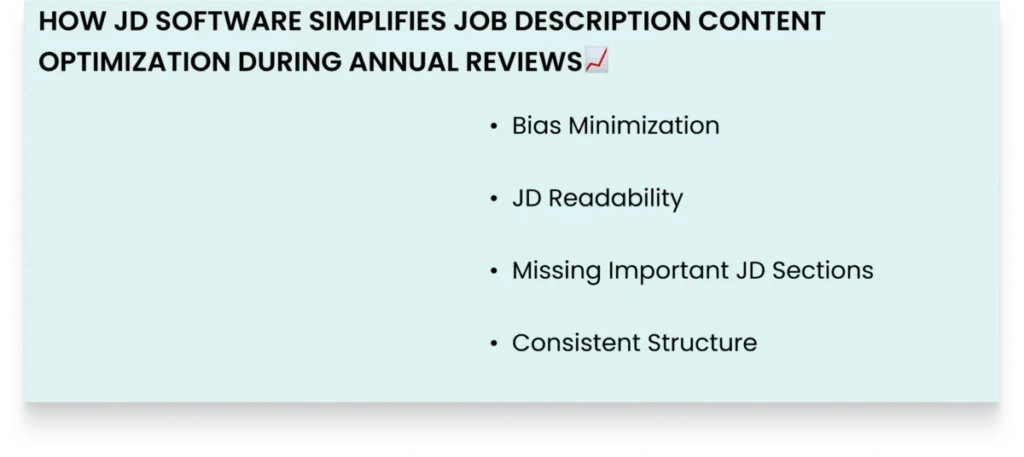
Optimizing job description content is a multifaceted task involving checks for readability, bias, compliance, and consistency. In a manual process, this often means documents are passed sequentially between different reviewers, leading to delays and the potential for conflicting edits or overlooked errors. JD software integrates real-time content optimization capabilities, offering immediate assistance during the editing process. This includes:
- Readability Scores: Guiding users to write clear, concise language, often targeting an 8th-grade reading level for broader appeal.
- Bias Detection: Identifying and suggesting alternatives for gender-coded, ageist, or exclusionary language, promoting inclusive hiring practices.
- Skill and Keyword Optimization: Ensuring JDs contain relevant terms for applicant tracking systems (ATS) and search engines.
- Compliance Prompts: Flagging potential legal issues or missing required disclosures.
By providing instant feedback, these tools empower reviewers to make improvements concurrently, eliminating the need for multiple manual passes and significantly reducing the risk of errors. This turns content optimization into a guided, efficient process rather than a tiresome manual audit.
4. Robust Version Control and Audit Trails
Poor version control is a major headache in manual JD management, leading to confusion over which document is current and making it difficult to trace the evolution of a role. Questions like, "Why did the senior data analyst role suddenly require a master’s degree?" or "Which team approved this last year?" become unanswerable. JD software inherently solves these issues by maintaining a comprehensive history of every change. Benefits include:
- Automatic Versioning: Saving each iteration of a JD, allowing users to revert to previous versions if needed.
- Change Tracking: Highlighting modifications made by different users, providing transparency.
- Accountability: Identifying who made specific changes and when.
- Historical Context: Offering a complete narrative behind JD evolution, crucial for annual reviews and compliance audits.
This level of detail transforms the annual review from a memory test into an evidence-based process, providing a clear understanding of why and how roles have changed over time.
5. Accelerating Standardization and Consistency
Inconsistencies across job descriptions—such as unfair salary ranges, confusing titles, or missing compliance requirements—are rampant in organizations lacking a standardized approach. Addressing these manually during an annual review is labor-intensive, requiring reviewers to:
- Cross-reference similar roles across departments.
- Manually enforce formatting and language guidelines.
- Update individual JDs to reflect new company standards or market data.
JD software significantly expedites standardization through:
- Templating: Providing pre-approved templates for different job families or levels, ensuring a consistent structure and core content.
- Standardized Language Libraries: Offering approved phrases and competencies that can be easily inserted.
- Automated Checks: Flagging deviations from established standards.
- Role Mapping: Helping identify similar roles that should share common elements.
This guidance ensures that JDs maintain uniformity across the organization, simplifying the review process and supporting broader initiatives like pay equity and career pathing.
6. Proactive Compliance Management
Employment laws and regulations are constantly evolving, making JD compliance a moving target. What was compliant eight months ago might not be today, particularly with new mandates around pay transparency (e.g., in Colorado, California, and Connecticut) or diversity reporting. Manually reviewing hundreds of JDs for these nuanced changes is incredibly challenging and prone to error, potentially leaving organizations exposed to legal risks. JD software provides proactive compliance support by:
- Integrating Legal Updates: Incorporating the latest employment laws and regulations.
- Flagging Non-Compliant Language: Automatically identifying terms or omissions that violate current laws.
- Requiring Specific Disclosures: Prompting users to include mandatory information like salary ranges or benefit details.
- Accessibility Checks: Ensuring JDs are accessible to individuals with disabilities.
This automated vigilance significantly reduces the burden on HR and legal teams, allowing them to focus on fact-checking flagged items rather than conducting exhaustive manual audits. It minimizes the risk of misclassifying workers or publishing non-compliant salary ranges.
7. Seamless ATS and HRIS Integration
The final hurdle in a manual JD review process is often the tedious and error-prone task of manually copying and pasting updated job descriptions into an Applicant Tracking System (ATS) or Human Resources Information System (HRIS). This not only wastes time but can also lead to formatting issues, missing content, and inconsistencies between the source document and the recruiting platform. JD software provides efficient, often API-driven, integration with these critical HR systems, offering benefits such as:
- Automated Synchronization: JDs are automatically updated in the ATS/HRIS once approved in the software.
- Preserved Formatting: Ensuring that the visual integrity of the JD is maintained across platforms.
- Reduced Data Entry Errors: Eliminating manual transcription mistakes.
- Faster Time-to-Post: Accelerating the publication of new or updated roles.
This seamless data flow ensures that the effort invested in the annual review translates directly into updated, accurate, and readily usable job postings, enhancing the candidate experience and operational efficiency.
Broader Organizational Impact and Strategic Advantages
The adoption of job description software represents a significant strategic shift for organizations. Beyond the immediate benefits of streamlining the annual review, it empowers HR to move from a reactive, administrative function to a proactive, strategic partner. By ensuring JDs are consistently accurate, compliant, and optimized, companies can:
- Improve Talent Acquisition: Attract higher-quality candidates with clear, inclusive job postings, reducing time-to-hire and cost-per-hire.
- Strengthen Employee Engagement and Retention: Provide employees with transparent role expectations, fostering clearer career paths and reducing ambiguity.
- Mitigate Legal and Financial Risks: Ensure ongoing compliance with labor laws, avoiding costly penalties and litigation related to misclassification, discrimination, or pay inequity.
- Enhance Operational Efficiency: Free up HR and management time from administrative tasks, allowing them to focus on strategic initiatives like talent development, workforce planning, and organizational design.
- Drive Organizational Agility: Facilitate quicker adaptation to market changes and internal restructuring by making JD updates faster and more manageable.
According to a recent HR technology report, organizations leveraging integrated HR platforms experience a 15-20% improvement in HR process efficiency and a significant reduction in compliance-related incidents. This underscores the tangible return on investment that JD software provides.
Expert Perspectives and Industry Trends
Industry experts widely acknowledge the transformative potential of specialized JD management tools. "The era of managing critical HR documents in generic file folders is rapidly drawing to a close," notes Dr. Eleanor Vance, a prominent HR technology analyst. "Companies are realizing that their job descriptions are too important to be left to manual processes. The shift towards integrated, intelligent platforms is not just about efficiency; it’s about competitive advantage in attracting and retaining talent, and crucially, about mitigating increasingly complex legal risks."
The trend towards greater transparency, particularly in pay, is also driving the adoption of such tools. "With new pay transparency laws emerging annually across states and even cities, manual compliance checks are simply unsustainable for multi-state employers," states David Chen, a labor law attorney. "JD software with built-in compliance checks becomes an indispensable tool for staying ahead of legislative changes and ensuring consistency."
Conclusion
The annual job description review, traditionally a laborious administrative burden, is undergoing a profound transformation thanks to specialized software solutions. By providing centralized libraries, streamlined workflows, real-time optimization, robust version control, standardization tools, proactive compliance, and seamless ATS integration, these platforms empower organizations to manage their JDs with unprecedented efficiency and accuracy. This shift not only saves countless hours and reduces administrative overhead but also elevates job descriptions to strategic assets that drive talent acquisition, performance management, and legal compliance. For HR teams still grappling with scattered files and manual processes, embracing dedicated JD software is no longer a luxury but a strategic imperative for navigating the complexities of the modern workforce and transforming January’s dreaded review into a swift, strategic success.