Private companies frequently employ ownership incentives, such as stock options and equity grants, as a cornerstone strategy for attracting and retaining their most valuable senior executives. The underlying principle is to foster a deep-seated commitment to the company’s long-term prosperity and encourage decision-making that drives sustainable value creation. However, new research from Chief Executive Group highlights a critical, yet often overlooked, deficiency in many of these compensation programs: the failure to ensure these incentives are truly meaningful by making their value transparent and readily understandable to the executives themselves.
This oversight can significantly diminish the motivational power of these awards, potentially leading to a disconnect between executive performance and their perceived financial rewards. While the intention is to align executive interests with those of the company’s owners, a lack of clarity regarding the actual worth of their equity stake can render these potent tools less effective than intended.
The research underscores a significant gap in how private companies manage and communicate the value of executive equity. Unlike their counterparts in publicly traded corporations, where daily stock price fluctuations provide an immediate and quantifiable measure of ownership value, executives in private firms often operate with considerably less visibility. This opacity can create a scenario where a substantial portion of an executive’s compensation package, intended to be a powerful motivator, remains an abstract concept rather than a tangible asset driving strategic decisions.
The Elusive Value of Private Company Equity
The core issue identified by Chief Executive Group’s latest findings is that many private companies, despite offering equity or phantom equity incentives to their senior leadership, fail to consistently measure and communicate the gains realized from these awards. This inaction can dilute the motivational impact of these incentives, turning a potentially powerful driver of long-term value into a less potent tool.
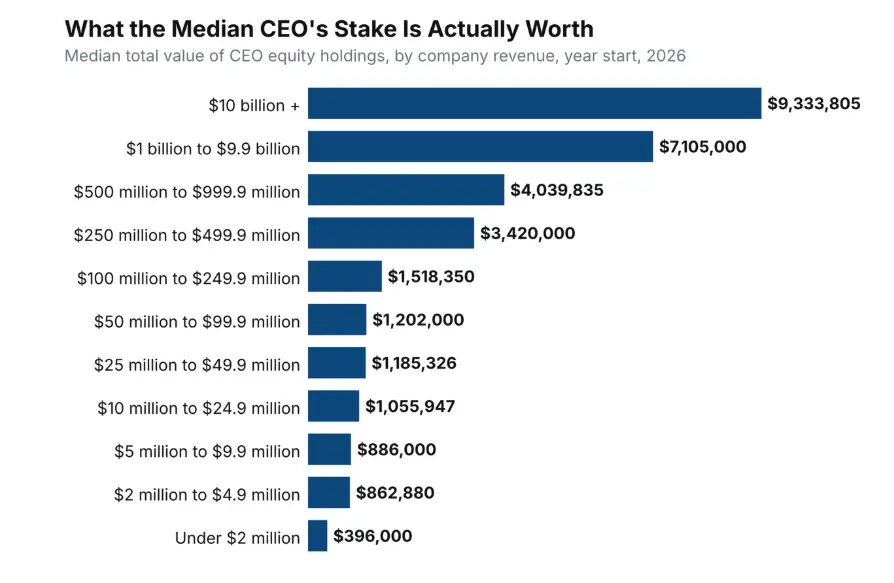
The value of an executive’s equity stake in a private company can vary dramatically, influenced heavily by the size and revenue of the organization. For instance, the median equity stake for CEOs at companies with annual revenues under $2 million is valued at approximately $396,000. This figure escalates significantly with company scale, reaching a median of $7.1 million for CEOs at companies generating between $1 billion and $9.9 billion in annual revenue. These substantial figures represent a considerable investment in executive loyalty and performance, yet their impact is blunted if their worth is not clearly understood.
A significant hurdle for private companies is the inherent difficulty in establishing a clear valuation for equity awards. Without a public market to benchmark against, determining the precise worth of stock options or equity grants can be a complex undertaking. This lack of readily available valuation data means that executives may struggle to grasp the tangible benefits of their long-term commitment and the direct impact of their strategic decisions on their personal wealth.
The Disconnect: Valuation and Communication Gaps
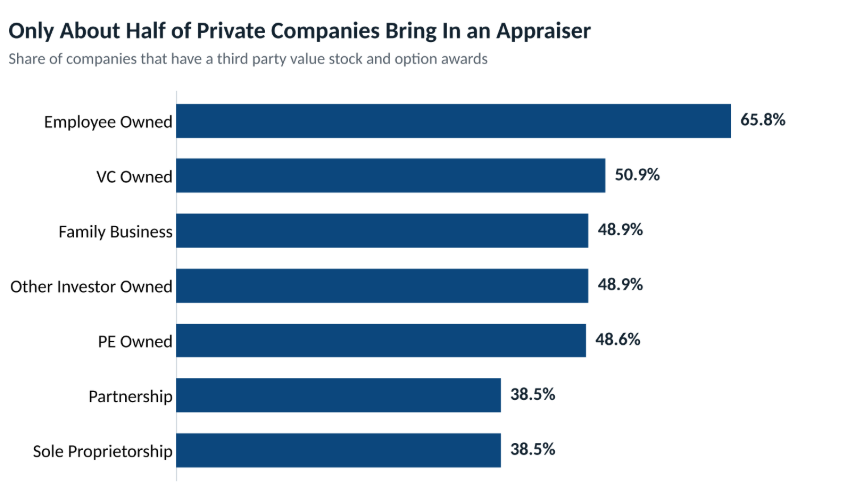
The Chief Executive Group report reveals a concerning trend: only about half of private companies engage external experts to conduct valuations of stock and option awards. Employee-owned companies demonstrate a higher propensity for such valuations, with 66 percent utilizing external services. Conversely, sole proprietorships and partnerships lag behind, with only 39 percent engaging in regular independent valuations. The remaining companies often rely on internal assessments from their Chief Financial Officer or other internal staff, or utilize formulas tied to specific financial metrics like profits or sales, which may not always capture the full, nuanced value of the equity.
Private equity and venture capital-backed companies generally exhibit a more robust approach to regularly valuing and communicating equity gains compared to other privately held businesses. However, even within this group, the engagement of independent appraisers falls somewhere in the middle of the spectrum. This suggests that while these firms may have more sophisticated internal processes, there is still room for improvement in ensuring objective, third-party validation of equity values.
The implications of this valuation deficit are profound. The true value of an equity incentive extends beyond the eventual payout upon a liquidity event. It encompasses the executive’s understanding of the financial stake they are actively building over time. When regular valuations and clear communication of these valuations are absent, executives may find it challenging to connect their daily decisions and the company’s overall performance to their potential future rewards. This disconnect can lead to a situation where compensation programs designed to foster long-term commitment and strategic thinking fail to deliver their intended motivational impact.
Case Studies: Illuminating Best Practices in Valuation
Examining the practices of companies that are actively addressing this valuation challenge offers valuable insights. Pete Ensch, CEO of Sani-Matic, a private equity-backed manufacturing firm, describes a structured approach where their sponsor tracks value quarterly, and a formal valuation is commissioned annually. This year, Sani-Matic took a significant step forward by initiating personalized statements for each equity holder, detailing the current worth of their stake based on the latest valuation and even providing a projected range of outcomes should the business be sold.
Ensch candidly admits that the process of valuation can be a double-edged sword. In a prior, more challenging business environment, valuations brought disappointment rather than enthusiasm. "It comes down to the numbers," he stated, emphasizing that transparency, while crucial, requires a willingness to confront the financial realities, whether positive or negative. This highlights the importance of not only conducting valuations but also preparing for the communication and potential emotional responses associated with them.
Another example is Parr Instrument Company, a 127-year-old independent manufacturer based in Moline, Illinois. This company has maintained its independence and operates under a unique ownership structure. Jim Nelson, President and CEO, explains that an independent appraiser values the business annually. Subsequently, the company offers key employees the opportunity to purchase shares at a discount of approximately 40% below the appraised fair market value. This discount is strategically important, as the difference between the purchase price and the fair market value is considered taxable income to the employee in the year of acquisition, necessitating accurate annual valuations.
Both Sani-Matic and Parr Instrument Company share another commonality: their executives are required to invest their own capital to acquire equity incentives. This practice, while not widespread—only 22% of companies reportedly require employees to invest personal funds—is supported by research suggesting it aligns executive interests more closely with the company’s financial performance by exposing them to both the potential upside and downside risks.
The Growing Significance of Equity Incentives in Private Companies
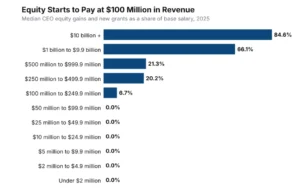
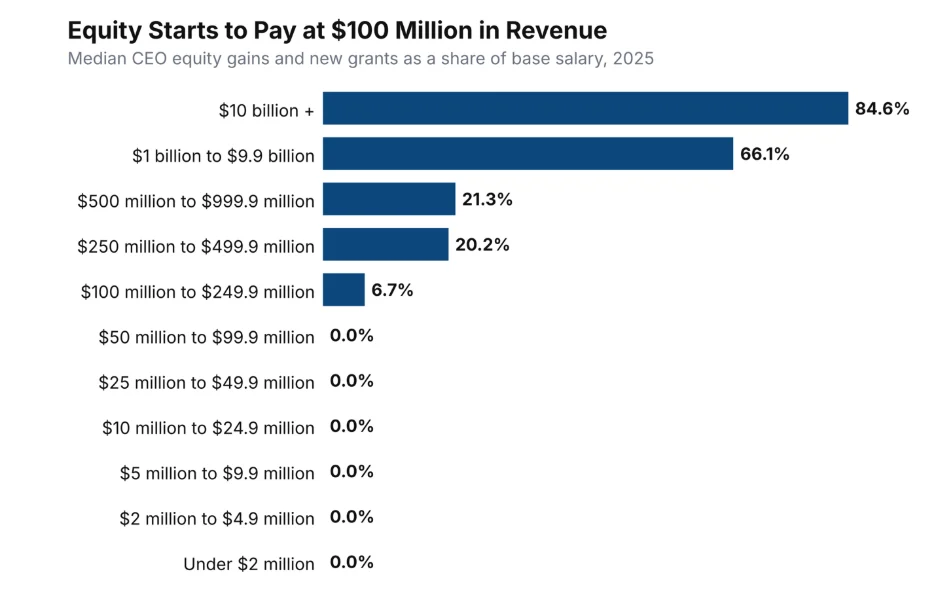
As private companies mature and scale, the importance of equity incentives continues to grow. The Chief Executive Group report provides compelling data illustrating this trend. For CEOs at companies with annual revenues between $100 million and $249.9 million, equity gains and new grants in 2025 represented approximately 7% of their base salary. This figure escalates significantly for larger enterprises: at companies generating $250 million to $499.9 million in revenue, equity incentives accounted for roughly 20% of base salary, and for those in the $1 billion to $9.9 billion revenue bracket, this figure surged to an impressive 66%.
Conversely, for companies with revenues below $100 million, the median CEO reported no equity gains or new grants at all. This disparity underscores a potential missed opportunity for smaller, growing businesses to leverage equity as a powerful retention and motivation tool during critical growth phases.
The structure of equity vesting also presents a point of divergence among private companies. Time-based vesting, which is contingent solely on the passage of time, is favored by nearly half of companies. Performance-based vesting, which requires specific metrics to be met, is employed by 19% of companies, while a combination of both time and performance is used by 34%. This indicates a preference for simpler, more predictable vesting schedules, potentially at the expense of directly tying executive rewards to measurable business achievements.
The consequence of these practices is that an equity stake can remain on a company’s books for years without a clearly defined monetary value. This occurs even though the median CEO’s equity holding is valued at least twice their base salary across all company sizes surveyed. The fundamental question for private company owners, therefore, is not merely whether an award incentivizes the right behaviors, but rather whether anyone within the organization can definitively state its current worth.
Actionable Strategies for Maximizing Incentive Impact
As private company CEOs look ahead to fiscal year 2027 and beyond, the research from Chief Executive Group offers several practical recommendations for optimizing their executive compensation programs. These strategies aim to ensure that existing incentives are not only understood but also strategically aligned with the company’s overarching long-term objectives.
-
Establish Regular, Independent Equity Valuations: The most critical step is to move beyond internal estimates or simplistic formulas. Engaging reputable third-party valuation experts provides an objective and credible assessment of equity value. This process should be conducted on a consistent schedule, at least annually, and ideally more frequently for rapidly growing companies or those experiencing significant market fluctuations. The cost of such valuations should be viewed as an investment in maximizing the effectiveness of the compensation program, rather than an unnecessary expense.
-
Develop Clear Communication Protocols: Valuations are only effective if they are clearly communicated to the executives who hold the equity. This involves creating personalized statements that detail the current value of their awards, explain the methodology behind the valuation, and potentially outline future scenarios or potential payouts. This transparency helps executives understand how their efforts contribute to increasing the value of their stake and reinforces the link between performance and reward. Educational sessions or workshops can further enhance understanding of equity structures and valuation principles.
-
Consider Executive Investment: Encouraging or requiring executives to invest their own capital in equity incentives can significantly enhance their commitment and alignment with the company’s financial well-being. This "skin in the game" approach ensures that executives share in both the potential upside and the downside, fostering a more prudent and long-term oriented decision-making process. When executives are financially invested, they are more likely to engage deeply with the valuation process and understand its implications for their personal financial future.
The ultimate objective of these recommendations is not necessarily to increase overall compensation costs or grant more equity. Instead, the focus is on ensuring that the equity incentives already in place are fully understood, demonstrably valuable, and strategically aligned with the company’s ambitious long-term goals. For private company owners, this distinction is paramount. A potentially lucrative reward that executives cannot readily evaluate is likely to be far less effective than one whose value, and its direct connection to performance, is made crystal clear. By addressing the hidden cost of unseen value, private companies can unlock the full potential of their executive compensation strategies, fostering greater engagement, driving superior performance, and ultimately building more sustainable long-term value.
Chief Executive Group’s 2026-2027 CEO & Senior Executive Compensation Report provides comprehensive benchmarks for CEO and senior executive compensation, including detailed insights into equity incentives, pay practices, and variations across company size, industry, and ownership structure.