For years, the American workforce has grappled with evolving workplace dynamics, leading to a proliferation of terms describing various forms of disengagement or strategic adjustments to corporate life. These trends, ranging from "quiet quitting" and "bare minimum Mondays" to the more recent "date them till you hate them" phenomenon, highlight a persistent desire among employees to redefine their relationship with work. Now, a new, more pragmatic strategy has emerged: "PTO-maxxing." This approach focuses on strategically leveraging paid time off (PTO) to maximize time away from work, transforming a standard allotment of vacation days into significantly longer periods of rest and rejuvenation.
New data from the mobile-first employee experience platform, Blink, shared exclusively with Fortune, indicates that a well-planned calendar strategy can effectively stretch a modest 15 vacation days into an impressive 49 days off annually. This innovative method is gaining traction as employees seek proactive solutions to combat burnout and enhance their overall well-being, especially in a professional landscape where taking adequate time off has historically been a challenge for many Americans.

The Genesis of PTO-Maxxing: A Response to Workplace Realities
The rise of PTO-maxxing is not an isolated event but rather a calculated response to several converging factors within the American work culture. For decades, there has been a noticeable disparity between the amount of PTO offered and the amount actually taken by U.S. workers. Research from the Pew Research Center consistently shows that nearly half of U.S. workers who receive paid time off utilize less than they are entitled to. The primary reasons cited for this underutilization are often rooted in workplace anxieties: a fear of falling behind on projects, concerns about burdening colleagues, and a general apprehension about appearing less committed than peers.
This trend is amplified when compared to global standards. A 2024 Expedia Vacation Deprivation Report revealed that Americans receive an average of just 12 vacation days per year, the lowest among surveyed countries. Furthermore, over 50% of these employees reported not planning to use all their allotted days. This stark contrast, with countries like Japan encouraging monthly breaks and France valuing extended vacations, underscores a significant cultural gap in prioritizing rest and recovery. Melanie Fish, head of public relations for Expedia Group brands, has noted the potential for the U.S. to learn from these global practices, suggesting that "spreading your PTO throughout the year or prioritizing rest on your next vacation" could offer substantial benefits.
Compounding this issue is the persistent difficulty many employees face in truly disconnecting during their time off. Data cited by SHRM, based on a 2024 Harris Poll, indicates that a staggering 86% of employees check emails from their bosses while on vacation, and 56% engage in work-related calls. This inability to fully unplug further diminishes the restorative benefits of even the limited time off taken, creating a cycle of fatigue and reduced productivity.

Strategic Planning: The Mechanics of PTO-Maxxing
PTO-maxxing operates on a simple yet effective principle: strategically aligning PTO with existing public holidays to create extended breaks. The core idea, as explained by Lauren Burns, Chief Operating Officer at Blink, is to "strategically spread vacation days around federal holidays [to] create more breaks to prevent burnout before it starts." This proactive approach aims to build in periods of rest before employees reach a breaking point, rather than waiting for exhaustion to set in.
The strategy is particularly effective when applied to U.S. federal holidays, which often fall on Mondays or Fridays, creating natural long weekends. By strategically requesting just one or two additional PTO days, employees can transform these three-day weekends into four- or five-day respites. For instance, pairing a Friday off with a Monday federal holiday can extend a weekend into a four-day break. Similarly, taking a Wednesday and Thursday off around a Christmas holiday that falls on a Friday can create a five-day period of rest.
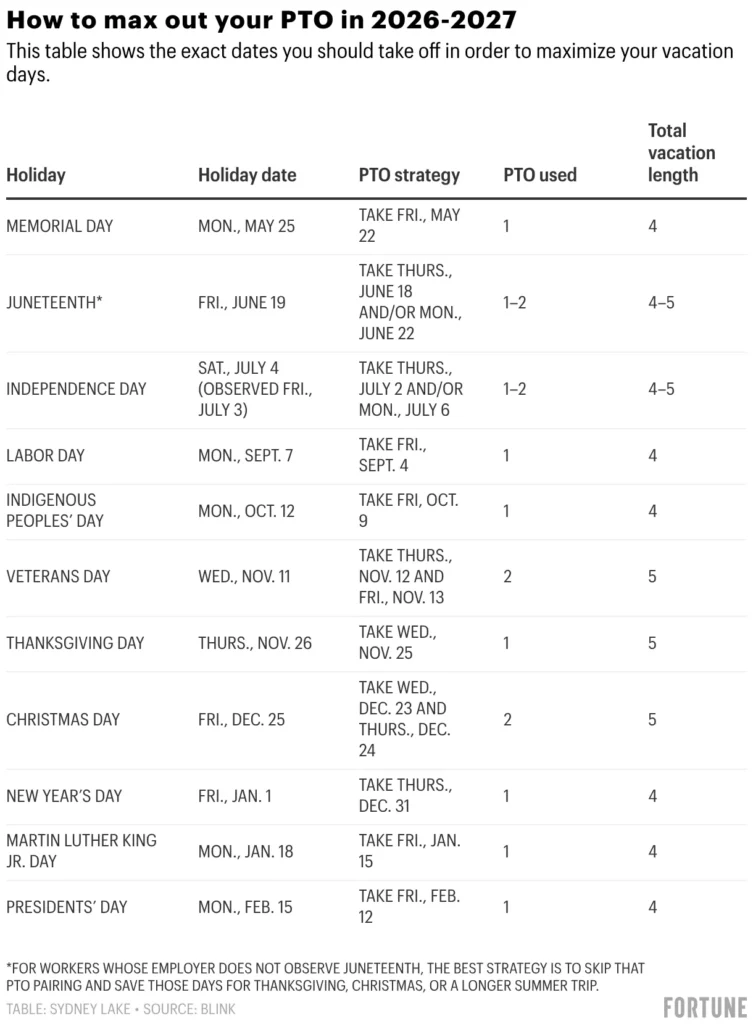
The data compiled by Blink provides a clear roadmap for this optimization. By analyzing the U.S. federal holiday calendar, the platform identified specific days where employees can request time off to maximize their breaks without disproportionately depleting their PTO balance. The methodology is straightforward:

- Monday Holidays (e.g., Memorial Day, Labor Day, Martin Luther King Jr. Day): Requesting the preceding Friday off. This turns a standard three-day weekend into a four-day break.
- Holidays falling mid-week (e.g., Fourth of July, Thanksgiving): Strategically requesting the days immediately before or after the holiday. For a holiday on a Wednesday, taking off the Thursday and Friday can create a five-day break. If the holiday is on a Friday, taking off the preceding Monday and Tuesday can achieve a similar outcome.
- Year-End Holidays (e.g., Christmas, New Year’s Day): These often provide the most significant opportunities. Taking off days surrounding Christmas and New Year’s can create extended breaks of a week or more, depending on the specific day of the week the holidays fall.
The analysis by Blink suggests that a diligent application of these tactics across the year can yield substantial time off. For an employee with 15 PTO days, this strategic approach could theoretically translate into 49 days off, a nearly threefold increase in effective vacation time. This not only provides more opportunities for rest but also allows for longer, more substantial trips without consuming an entire year’s worth of PTO in one go. Burns further elaborated on this flexibility, stating, "Alternatively, employees can save some days for a longer trip, where using just five PTO days can turn into a 10-day break while still allowing smaller resets throughout the year."
A Timeline for Maximizing PTO
The strategic application of PTO-maxxing is an ongoing process that can be planned throughout the year. While some holidays like Memorial Day have already passed, there remain numerous opportunities to implement this strategy for the remainder of 2026 and into the early part of 2027.
Key Federal Holidays and Strategic PTO Integration for 2026-2027:

- Labor Day (Monday, September 7, 2026): Requesting Friday, September 4th off. This extends the weekend to a four-day break.
- Columbus Day (Monday, October 12, 2026): Requesting Friday, October 9th off. This creates a four-day weekend.
- Veterans Day (Wednesday, November 11, 2026): Requesting Thursday, November 12th and Friday, November 13th off. This results in a five-day break.
- Thanksgiving Day (Thursday, November 26, 2026): Requesting Friday, November 27th off. This creates a four-day weekend.
- Christmas Day (Friday, December 25, 2026): Requesting Monday, December 21st, Tuesday, December 22nd, and Wednesday, December 23rd off. This, combined with the weekend and Christmas Day, can create a substantial break of up to seven days.
- New Year’s Day (Friday, January 1, 2027): Requesting Monday, December 28th, Tuesday, December 29th, Wednesday, December 30th, and Thursday, December 31st off. This can lead to an extended break of up to ten days, bridging the year-end holidays.
- Martin Luther King Jr. Day (Monday, January 18, 2027): Requesting Friday, January 15th off. This extends the weekend to a four-day break.
This structured approach ensures that employees can plan their time off well in advance, communicate effectively with their employers, and maximize the value of their PTO without appearing to be taking excessive time away from work. The visual representation provided by Blink, outlining these strategic pairings, serves as a practical tool for employees to visualize and implement their PTO-maxxing plans.
Broader Implications: Addressing Burnout and Parental Leave Gaps
The emergence of PTO-maxxing is more than just a clever hack; it speaks to deeper systemic issues within the American workplace, particularly concerning employee well-being and the challenges faced by working parents. The data consistently shows a significant gap in how Americans approach vacation time compared to global counterparts, highlighting a cultural imperative to prioritize rest.
Furthermore, PTO-maxxing offers a potential, albeit informal, solution to the persistent problem of childcare coverage during school breaks. Content creator Paige Connell has highlighted the dilemma faced by parents who struggle to bridge the gaps when schools are closed. "Parents are doing the math right now and they’re saying ‘how do I make this work? Do I take PTO? Do I take sick days?’" she noted in a widely shared TikTok video. The reality is that many parents lack sufficient PTO or sick leave to cover extended school holidays, forcing them into difficult choices. By strategically maximizing PTO, parents can better align their time off with school schedules, providing essential care without jeopardizing their employment or financial stability. While not a substitute for comprehensive paid parental leave policies, PTO-maxxing offers a tactical advantage for parents navigating these challenges.
The trend also indirectly challenges the deeply ingrained notion that constant availability and minimal time off equate to dedication. As employees become more adept at strategically using their PTO, employers may be compelled to re-evaluate their own policies and cultural expectations around vacation time. A workforce that is well-rested and experiences less burnout is likely to be more engaged, productive, and innovative in the long run.
Looking Ahead: A Shift Towards Proactive Well-being
PTO-maxxing represents a significant evolution in how American workers approach their time off. It moves beyond passive acceptance of limited vacation days and embraces a proactive, strategic mindset focused on maximizing personal well-being. As more employees adopt these tactics, it could contribute to a broader cultural shift where taking time off is not just permissible but actively encouraged and strategically planned.
The insights from Blink and the experiences shared by employees and experts suggest that the future of work may involve a more nuanced understanding of productivity, one that recognizes the essential role of rest and recovery. By empowering employees to effectively utilize their PTO, companies can foster a healthier, more sustainable work environment, ultimately benefiting both individuals and the organizations they serve. The "PTO-maxxing" trend, therefore, is not merely about taking more days off; it’s about reclaiming a fundamental aspect of human well-being in an increasingly demanding professional world.