
The modern talent acquisition landscape presents an intricate challenge for organizations worldwide: the increasing prevalence of candidate reneging. This phenomenon, where an accepted offer is subsequently declined by the candidate before their start date, has evolved from an intermittent nuisance into a significant operational and financial drain for businesses across sectors. Traditionally, many recruitment programs have lacked a structured process to address this, often discovering a renege only after it has already occurred, leaving teams scrambling to backfill critical roles. By the time a candidate falls silent, their decision to withdraw has frequently solidified, rendering reactive interventions largely ineffective. The strategic imperative, therefore, lies in transforming engagement signals into actionable leading indicators, a paradigm shift exemplified by the implementation of sophisticated tools such as the Engagement Health Scorecard.
The Hidden Costs of a Reactive Recruitment Strategy
The repercussions of candidate reneging extend far beyond the immediate disappointment of a lost hire. Industry data consistently highlights the substantial financial and operational burdens associated with these withdrawals. Estimates from various HR and recruitment consultancies suggest that the cost of replacing a reneging candidate can range from 1.5 to 3 times their annual salary, factoring in direct expenses such as recruitment fees, advertising, and background checks, as well as indirect costs like lost productivity, administrative overhead, and the impact on team morale. For specialized or senior roles, these figures can escalate dramatically.
Beyond the monetary implications, the operational impact is equally profound. A renege can delay critical projects, strain existing teams forced to absorb additional workloads, and disrupt carefully planned timelines. In highly competitive sectors like technology, healthcare, and finance, where talent shortages are acute, a single renege can set back a hiring initiative by weeks or even months, potentially costing a company market advantage or delaying product launches. Furthermore, a high renege rate can subtly erode an organization’s employer brand, signaling potential issues within the recruitment process or pre-start experience, which can deter future high-quality candidates. The traditional reactive approach—waiting for a withdrawal email before initiating damage control—is increasingly recognized as an unsustainable model in today’s dynamic labor market.
The Engagement Health Scorecard: A Proactive Paradigm Shift
To mitigate these risks, leading organizations are adopting proactive, data-driven strategies centered on continuous candidate engagement during the crucial pre-start period. The Engagement Health Scorecard stands as a robust framework for categorizing candidates based on their observable behaviors, thereby enabling targeted and timely interventions. This approach transforms the passive waiting game into an active management process, where potential issues are identified and addressed before they escalate into full-blown reneges.
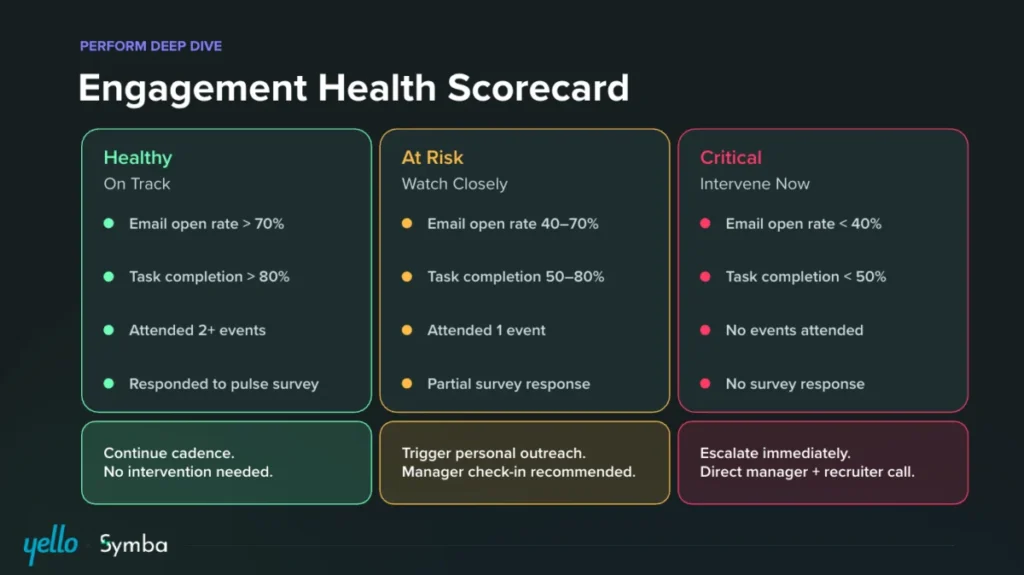
The scorecard typically classifies candidates into three distinct groups: Healthy, At-Risk, and Critical, each defined by specific engagement metrics and requiring tailored strategic responses. This systematic approach ensures that resources are allocated efficiently, focusing intensive efforts where they are most needed, while maintaining consistent positive engagement with all candidates.
Healthy Candidates: Sustaining Momentum and Reinforcing Commitment
Healthy candidates represent the ideal scenario, exhibiting consistent and strong engagement during the pre-start phase. Their behavior typically includes opening emails at a rate exceeding 70%, diligently completing required tasks such as paperwork or onboarding forms, actively participating in multiple pre-start events (e.g., virtual meet-and-greets, informational webinars), and promptly responding to surveys designed to gauge their sentiment and readiness.
For this group, the recommended action is to "continue the cadence and stay the course." This involves maintaining the established communication schedule, providing relevant updates, and reinforcing the positive aspects of joining the organization. The goal is not just to retain them, but to transform them into enthusiastic advocates even before their first day. This can include sending personalized welcome messages from future team members, sharing company news and achievements, inviting them to internal social platforms, and providing resources that help them prepare for their role and integrate into the company culture. The underlying principle is to sustain their excitement and commitment, ensuring they feel valued, informed, and eagerly anticipated. This continuous positive reinforcement minimizes the chances of external factors swaying their decision and strengthens their psychological contract with the company.
At-Risk Candidates: Prompt Intervention and Personalized Outreach
The "At-Risk" category signals a concerning but often reversible decline in engagement. These candidates typically demonstrate email open rates ranging between 40% and 70%, show limited attendance at pre-start events, and provide incomplete or delayed responses to surveys. These behaviors are critical warning signs that a candidate’s enthusiasm may be waning, or that they might be experiencing doubts or external pressures.
The imperative for At-Risk candidates is immediate and personal outreach within 48 hours of identifying the disengagement. This short timeframe is crucial, as prolonged silence can allow uncertainty to fester or competing offers to gain traction. Generic, mass-distributed communications are ineffective at this stage. Instead, interventions must be highly personalized. A direct message or call from the program manager, specifically addressing their observed disengagement in a supportive and non-accusatory tone, can be highly effective. This might involve acknowledging their limited event attendance and offering a personalized invitation to a different event or a one-on-one virtual coffee chat tailored to their interests.
Crucially, a check-in from the hiring manager can often be the most impactful intervention. This direct communication from their future leader demonstrates genuine interest and commitment, allowing the manager to address any potential concerns directly and reiterate the value the candidate brings to the team. Such personalized efforts can quickly re-engage the candidate, reassure them of their fit, and often turn their trajectory around, preventing a potential renege. These conversations should focus on understanding any hesitations, offering support, and reaffirming the company’s excitement about their impending arrival.
Critical Candidates: Immediate Escalation and Empathetic Dialogue
The "Critical" category represents the most severe level of disengagement, indicating a high probability of reneging without immediate, high-level intervention. Candidates in this group exhibit almost no engagement: email open rates consistently below 40%, no attendance at any pre-start events, no survey responses, and a prolonged period of inactivity—typically three or more weeks. At this stage, generic communications are entirely futile, and the situation demands urgent, direct, and empathetic escalation.
The primary action for critical candidates is an immediate, direct call from the hiring manager. This signifies the utmost importance the organization places on their candidacy and provides an opportunity for a frank and open conversation. This should be followed by a personal touchpoint from the recruiter, offering support and a space for the candidate to voice any concerns. The objective is to initiate a real conversation about "what’s going on."
Experience shows that the root causes for critical disengagement are often identifiable and, if caught in time, addressable. Common factors include receiving a competing offer (often with a higher salary or different benefits package), personal circumstances (such as family issues, relocation challenges, or health concerns), or simple uncertainty and "cold feet" about a significant career change. By creating an environment of trust and empathy, the hiring manager and recruiter can uncover these underlying issues. For instance, if it’s a competing offer, the company might have a window to re-evaluate their compensation package or highlight non-monetary benefits. If it’s a personal circumstance, flexibility or support might be offered. If it’s uncertainty, a deeper dive into the role, team, or company culture could provide the necessary reassurance. The key is active listening and a genuine desire to understand and resolve the candidate’s concerns, rather than simply trying to persuade them. This immediate, high-touch approach significantly increases the chances of salvaging the candidate relationship and preventing a costly renege.
The Strategic Imperative: Data-Driven Talent Retention
The fundamental difference between organizations that consistently retain their top candidates and those that frequently scramble to backfill roles lies in their approach to data. The former group continuously monitors and analyzes engagement data, using it as a predictive tool, not merely a post-mortem diagnostic. This continuous data vigilance allows for proactive problem-solving, rather than reactive damage control.
The shift towards data-driven talent retention aligns with broader trends in HR analytics, where metrics are increasingly used to optimize every stage of the employee lifecycle. By leveraging tools like the Engagement Health Scorecard, companies gain actionable insights into candidate sentiment and behavior, enabling them to refine their pre-start programs, improve communication strategies, and ultimately enhance the overall candidate experience. This not only reduces renege rates but also contributes to a stronger employer brand and a more efficient talent acquisition function. The ROI of such systems can be substantial, often manifesting as reduced recruitment costs, faster time-to-hire, and improved quality of hires.
Chronology of Engagement: From Offer to Onboarding
The pre-start period is a critical, often underestimated, phase in the candidate journey. It typically spans from the moment an offer is formally accepted until the candidate’s official first day of employment. This window, which can range from a few weeks to several months, is ripe for either solidifying commitment or allowing disengagement to set in.
- Offer Acceptance (Week 0): Initial excitement is high. Communications should focus on congratulations, practical next steps (background checks, paperwork), and setting expectations for future engagement.
- Initial Paperwork & Background Checks (Weeks 1-2): This administrative phase can be tedious. Automated systems with clear instructions, coupled with periodic check-ins, are crucial to prevent frustration. Engagement signals here include timely submission of documents.
- Pre-Onboarding Communications & Community Building (Weeks 3-N): This is where proactive engagement truly shines. Regular, relevant content (company news, team introductions, preparation tips), invitations to virtual events, and access to internal resources help maintain momentum. Monitoring event attendance and email open rates is vital.
- Final Countdown & First Day Preparation (Final Week): Intensive personalized communication, confirming logistics, and sharing details about the first day. This is a final opportunity to address any lingering anxieties. Engagement signals here are often direct questions or confirmations from the candidate.
Throughout this chronology, the Engagement Health Scorecard acts as a dynamic monitoring system, flagging deviations from expected engagement patterns at each stage. This allows recruiters and hiring managers to intervene precisely when and where it’s most effective, ensuring a smooth transition from candidate to committed employee.
Voices from the Field: Perspectives on Proactive Retention
While specific quotes may not be provided, the implications for various stakeholders are clear and widely acknowledged within the industry:
- HR Leaders: "Reducing renege rates is not just about saving money; it’s about strategic talent management. A robust pre-start engagement strategy directly impacts our ability to meet business objectives and maintain a competitive edge in the talent market. It’s an investment in our future workforce."
- Recruiters: "There’s nothing more disheartening than a last-minute renege after weeks of effort. Having a system like the Engagement Health Scorecard empowers us. We’re no longer just ‘order takers’; we’re proactive talent strategists, able to save a candidate relationship before it’s too late. It transforms our role from reactive damage control to proactive relationship management."
- Hiring Managers: "When a candidate reneges, it doesn’t just impact HR; it directly impacts my team’s capacity and project timelines. Being able to connect with a candidate directly, understand their concerns, and address them before their first day is invaluable. It shows them we truly care and sets a positive tone for their eventual integration into the team."
- Candidates (Inferred): "It’s easy to feel like just another number during the hiring process. When a company reaches out personally, especially if I’m having second thoughts or facing another offer, it makes a huge difference. It shows they value me as an individual, not just a filled headcount."
These inferred statements highlight the multi-faceted benefits of a proactive engagement strategy, resonating with the experiences and priorities of key players in the hiring ecosystem.
Broader Implications: Elevating the Candidate Experience and Employer Brand
Beyond the immediate goal of preventing reneges, a sophisticated pre-start engagement strategy has broader, long-term implications for an organization. It fundamentally elevates the candidate experience, transforming what can often be a stressful and uncertain period into a supportive and positive journey. Candidates who feel valued, informed, and connected are more likely to have a positive perception of their new employer, even if they ultimately don’t join. This positive experience translates into stronger employer branding. In an era where Glassdoor reviews and social media narratives significantly influence talent attraction, a reputation for excellent candidate care is a distinct competitive advantage.
Furthermore, a well-executed engagement strategy fosters a sense of belonging even before day one. This pre-integration can accelerate onboarding, boost initial productivity, and improve long-term retention. Candidates who arrive feeling prepared and connected are more likely to thrive in their new roles and become brand ambassadors themselves. This holistic approach moves beyond mere transactional hiring to cultivate genuine relationships, securing not just a new employee, but a committed, engaged team member.
Implementing an Engagement Playbook: Best Practices and Future Outlook
To operationalize such a sophisticated approach, organizations often turn to comprehensive resources. "The KEEP Playbook," for instance, exemplifies the type of guide that includes a full engagement health scorecard with predefined thresholds and recommended actions for each tier. It also typically provides a step-by-step intervention playbook and a post-cycle review template, enabling continuous improvement with every recruitment program. These tools are crucial for standardizing best practices, ensuring consistency across different hiring teams, and providing the necessary training for recruiters and hiring managers.
Looking ahead, the evolution of candidate engagement will likely incorporate more advanced technologies, such as artificial intelligence and machine learning. Predictive analytics could refine the identification of At-Risk and Critical candidates even earlier, based on more complex behavioral patterns and sentiment analysis. AI-powered chatbots could provide instant answers to common candidate queries, freeing up human recruiters for more personalized, high-touch interventions. Virtual reality and augmented reality could offer immersive pre-start experiences, further enhancing engagement and cultural integration.
In conclusion, the era of reactive recruitment is drawing to a close. The competitive nature of the global talent market demands a proactive, data-driven approach to candidate engagement. By leveraging tools like the Engagement Health Scorecard and implementing tailored interventions, organizations can significantly reduce renege rates, optimize their talent acquisition processes, strengthen their employer brand, and ultimately secure the human capital essential for their sustained success. The investment in robust pre-start engagement is no longer a luxury but a strategic necessity for any forward-thinking enterprise.






