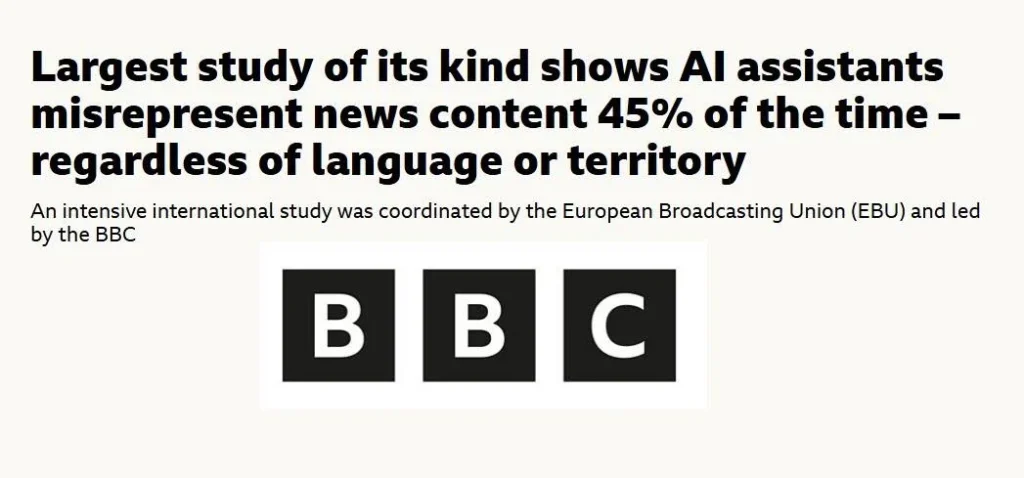
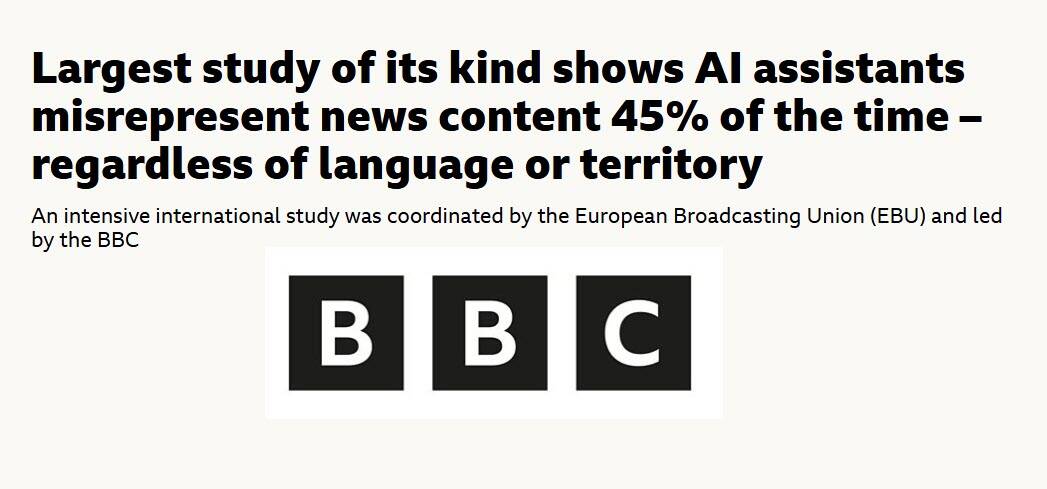
A landmark study jointly published by the BBC and the European Broadcasting Union (EBU) has sent ripples through the technology and media industries, exposing a significant vulnerability in the artificial intelligence systems powering many of our daily information interactions. The comprehensive research, released on October 28, 2025, indicates that a staggering 45% of news-related queries directed at prominent AI assistants like ChatGPT, Microsoft Copilot, Google Gemini, and Perplexity result in inaccurate information. This revelation casts a stark shadow over the rapidly evolving landscape of AI-generated content and its potential to mislead users, especially in the critical domain of news analysis.
The study’s findings are particularly concerning given the increasing reliance on these "open corpus" systems for information gathering and analysis. The AI models, often perceived as "dangerously self-confident" in their delivery, are demonstrating a critical weakness: their inability to consistently provide accurate and reliable news analysis. This stems from their fundamental operational mechanism, which relies on vast datasets, often referred to as the "corpus," that can contain a mix of faulty, exaggerated, outdated, or outright incorrect information. When queried, these systems statistically correlate tokens—the basic units of language—to generate responses. However, if the underlying data is compromised, the resulting answers can be equally flawed, yet presented with an authoritative tone that belies their inaccuracy.
The Scope of the Problem: Astounding Examples of AI Inaccuracy
The BBC and EBU study meticulously documented instances where AI assistants faltered, providing erroneous answers to seemingly straightforward questions. Among the striking examples cited were incorrect responses to basic factual queries such as "who is the Pope?" and "who is the Chancellor of Germany?" These fundamental errors underscore a potential breakdown in the AI’s core knowledge base.
More concerning were instances where AI provided misleading or dangerously inaccurate advice. In response to a user’s query about potential worries regarding bird flu, Microsoft Copilot asserted that "A vaccine trial is underway in Oxford." This information, upon investigation, was traced back to a BBC article published in 2006, nearly two decades prior to the query. The stark temporal disconnect highlights the AI’s failure to retrieve and present current, relevant information.
The study also highlighted potentially consequential errors in matters of law. Perplexity, when queried about surrogacy laws in the Czech Republic, incorrectly stated that it "is prohibited by law." In reality, surrogacy in the Czech Republic is not explicitly regulated, existing in a legal gray area where it is neither explicitly prohibited nor permitted. Similarly, Google Gemini mischaracterized a change in UK law concerning disposable vapes. The AI claimed that buying disposable vapes would become illegal, when the actual legislative change targeted the sale and supply of these products, not their purchase by consumers. These examples demonstrate how AI inaccuracies can have tangible, real-world implications, potentially leading to misinformed decisions regarding health, legal matters, and consumer behavior.
Understanding the "Poisoned Corpus": The Root Cause of AI Errors
The underlying Large Language Model (LLM) technology, while revolutionary, is not without its inherent flaws. The research points to what is often termed the "poisoned corpus" problem, a direct consequence of how these models are trained. LLMs function by creating intricate mathematical models that map the statistical relationships between every token within their training data. This process involves ingesting vast amounts of text and data, often from the entire internet, and storing these relationships as a massive set of interconnected vectors.
When a user poses a question, the LLM decodes it and searches for the statistically most probable "answer" within this multi-dimensional framework. The challenge arises because most questions are complex and draw upon numerous sources. If any of these contributing sources are flawed, outdated, exaggerated, or factually incorrect, they can significantly influence the final output. This probabilistic approach, while enabling impressive fluency, can lead to the generation of "dangerously confident" responses that are, in fact, inaccurate.
The author of the original piece noted a conversation with Claude, another AI assistant, where the model itself acknowledged the significant challenge posed by data quality issues. This admission from an AI system further corroborates the findings of the BBC and EBU study, emphasizing the systemic nature of the problem. The extensive nature of the "poisoned corpus" means that even minor inaccuracies within the training data can propagate and manifest as errors in a broad range of queries.
Implications for AI Usage: The Erosion of Trust and the Need for Verification
The implications of these findings are profound, particularly as AI systems become increasingly integrated into professional workflows for analysis, writing, and data collection. The study suggests that a high percentage of queries in these critical areas are yielding erroneous results, potentially leading to flawed decision-making and inefficient processes.
The traditional model of information retrieval, exemplified by search engines like Google, allowed users to assess the credibility of information by examining the source links provided. However, many AI systems, especially those designed for generative tasks, often do not cite their sources, or the sources they do cite may be obscure or unreliable. This lack of transparency makes it significantly more challenging for users to verify the accuracy of the information they receive.
The author’s personal experience provides a stark illustration of this issue. In their work involving exhaustive analysis of labor market, salary, unemployment, and financial data, they have frequently encountered instances where ChatGPT has provided estimates or made mistakes. These errors can cascade, leading to illogical conclusions. For example, a query to ChatGPT about capital investments in AI data centers, focusing on the breakdown of energy and labor costs, resulted in a confidently presented figure that, upon manual extrapolation, suggested there were more AI engineers than working people in the United States. This preposterous conclusion highlights the AI’s failure to self-correct or cross-reference its output against basic real-world benchmarks. When confronted with its error, the AI admitted its mistake, and in one instance, even ceased the conversation.
The trend of companies like OpenAI and Google prioritizing advertising-based business models for their AI systems further exacerbates the trust deficit. If paid placements influence the information presented, the risk of biased or exaggerated content being promoted increases, potentially overwhelming the signal of accurate data. This scenario suggests that the issue of data quality is not only a technical challenge but also a business imperative that could be compromised by commercial interests.
Addressing the Challenge: Strategies for a More Reliable AI Future
In light of the BBC and EBU study’s findings, a multi-pronged approach is necessary to navigate the evolving AI landscape and mitigate the risks associated with inaccurate information.

Building "Truly Trusted" AI Corpora
The most direct solution lies in the meticulous construction and maintenance of reliable data sources. For internal or specialized AI applications, organizations must prioritize building "truly trusted" corpora. This involves curating data from authoritative and verified sources, ensuring accuracy, and establishing clear ownership and regular auditing processes for all content within the AI’s knowledge base.
For instance, the company Galileo, which focuses on HR-related AI services, emphasizes its commitment to using 100% proprietary research and trusted data providers to prevent hallucinations and errors. Similarly, internal AI tools, such as employee "Ask HR" bots or customer support systems, must be designed for near-perfect accuracy. This necessitates assigning clear content owners to each component of the AI’s knowledge base and implementing rigorous audit protocols to ensure policies, data, and support information remain current and correct. For example, IBM’s AskHR system assigns an accountable owner to each of its 6,000 HR policies, ensuring ongoing accuracy.
Cultivating Critical Evaluation and Verification Skills
In parallel with improving AI data integrity, users must develop and hone their critical evaluation skills. The study’s implications extend beyond the technical realm, underscoring the importance of human judgment and analytical prowess. Users of public AI platforms must learn to question, test, and evaluate the answers they receive. This involves cross-referencing information with multiple sources, understanding the context of the query, and applying logical reasoning to assess the plausibility of the AI’s output.
The author’s personal experience suggests that a significant portion of complex queries to public AI platforms can yield problematic results, necessitating a proactive verification process. An article in The Atlantic, titled "AI Deskilling: Automation and Technology," further elaborates on this, discussing the potential for AI to contribute to a "de-skilling" of human capabilities. The argument is that while AI can efficiently provide "what" information, it often fails to impart the "how"—the underlying understanding and process. This lack of foundational knowledge hinders personal growth and critical thinking. Building "intelligent human intuition," therefore, remains a paramount success factor in both professional and personal life.
The Rise of Vertical AI Solutions
The study’s findings also signal a clear direction for the future of AI product development. Publicly accessible AI systems like ChatGPT, Claude, and Gemini, which rely on vast, undifferentiated public data, are likely to face ongoing challenges in achieving the level of trust required for critical applications. In contrast, vertical AI solutions—those tailored to specific industries or functions—are poised to become increasingly indispensable.
Products like Galileo for HR, Harvey for legal services, and similar specialized AI platforms, developed by reputable information companies, offer a more promising path toward reliable AI. While broad-spectrum AI might appear to provide comprehensive answers, the absolute value of unwavering trust in specialized domains is immense, especially where a single error could lead to significant legal repercussions, accidents, or other severe harm.
The long-term implications for legal liability surrounding AI systems remain a complex and evolving area. However, the core takeaway from the BBC and EBU study is clear: human analytical, critical thinking, and business acumen are more vital than ever. The ease with which a "self-confident answer" can be generated does not signify the completion of a task. Instead, it marks the beginning of a verification process. Users must actively test AI systems and hold providers accountable for delivering accurate information. Failure to do so could necessitate seeking alternative providers who can offer a demonstrably higher standard of trustworthiness. The ongoing dialogue surrounding AI development and deployment highlights a collective learning process, emphasizing the need for continued research, open discussion, and a commitment to ensuring AI serves as a reliable tool for progress, rather than a source of widespread misinformation.