When electric vehicle (EV) startup Fisker filed for bankruptcy in October 2024, it was not for a lack of foresight regarding the burgeoning EV market; rather, it was a profound illustration of the dangers of preparing for only a singular, optimistic version of the future. The company, like many in the tech-driven automotive sector, operated under assumptions of continuously accelerating EV adoption, abundant capital, and an eager consumer base ready to embrace new entrants. This optimistic outlook collided head-on with a rapidly evolving reality shaped by higher interest rates, decelerating demand, intensifying competition, and a significant tightening of funding — a potent cocktail of challenges that Fisker, and indeed many other enterprises, proved ill-equipped to navigate.
The cautionary tale of Fisker extends far beyond the confines of the automotive industry, serving as a critical lesson for organizations across all sectors in an era defined by unprecedented uncertainty. True resilience and sustained success, it reveals, do not stem from an uncanny ability to predict the future accurately. Instead, they are forged in the capacity to adapt, regardless of which complex future scenario ultimately unfolds.
The Rise and Fall of Fisker: A Case Study in Unpreparedness
Fisker Inc. was founded in 2016 by renowned automotive designer Henrik Fisker, known for his work on iconic luxury cars and his previous, ultimately unsuccessful, venture, Fisker Automotive. With Fisker Inc., the vision was to create a "digital car company" leveraging an outsourced manufacturing model and focusing on sustainable, technologically advanced electric vehicles for the mass market. The company went public in October 2020 through a SPAC merger, raising over $1 billion and riding the wave of investor enthusiasm for EV startups. Its flagship model, the Fisker Ocean SUV, promised innovative design, sustainable materials, and competitive pricing, garnering significant pre-orders.
A Chronology of Optimism and Obstacles:
- 2016: Fisker Inc. is founded by Henrik Fisker, aiming to develop premium electric vehicles.
- 2020 (October): The company goes public via a reverse merger with a special purpose acquisition company (SPAC), valuing it at $2.9 billion and injecting substantial capital. Initial investor sentiment is highly positive, driven by the broader EV boom.
- 2021-2022: Fisker announces plans for multiple models, including the Ocean SUV, the compact Pear, and the Alaska pickup truck. It signs manufacturing agreements with Magna Steyr in Austria, adopting an asset-light production strategy. Pre-orders for the Ocean begin to accumulate, fueling expectations.
- 2022 (November): The Fisker Ocean begins production at Magna Steyr’s facility, albeit with initial delays. The company sets ambitious production targets for 2023.
- 2023 (Mid-year): Reports begin to surface regarding production bottlenecks, software glitches in early vehicles, and slower-than-anticipated deliveries. Customer complaints about vehicle performance and service support start to erode brand confidence.
- 2023 (Late-year): The macroeconomic environment shifts dramatically. Global interest rates rise significantly, making capital more expensive and investment in speculative ventures less attractive. Consumer demand for EVs, while still growing, begins to decelerate from its previously torrid pace, especially for new, unproven brands. Intense competition from established automakers like Tesla, Ford, GM, and a host of Chinese manufacturers further squeezes market share and pricing.
- 2024 (Early-year): Fisker faces severe financial distress. Production guidance is repeatedly lowered, cash reserves dwindle, and the company struggles to secure additional funding. Negotiations for a strategic partnership or investment, reportedly with a major automaker like Nissan, fail to materialize.
- 2024 (March): Fisker receives a delisting warning from the New York Stock Exchange due to its stock price falling below minimum requirements and its inability to file its annual report on time. The company announces a significant workforce reduction.
- 2024 (October): After exhausting all options, Fisker Inc. files for Chapter 11 bankruptcy protection. The filing outlines a plan for asset liquidation and potential restructuring, with thousands of customers facing uncertainty regarding their vehicles and deposits.
The Broader Economic Context and Industry Reactions
Fisker’s collapse did not occur in isolation. It coincided with a noticeable "cooling" in the broader EV market, a stark contrast to the fervent growth seen just a few years prior. Analysts, including those from S&P Global Mobility and Cox Automotive, had begun reporting a slowdown in EV sales growth rates in late 2023 and early 2024. Factors contributing to this included:
- Inflation and High Interest Rates: These made new car purchases, particularly for premium EVs, less affordable for many consumers. Financing costs surged, impacting monthly payments.
- Charging Infrastructure Concerns: While improving, the perceived lack of widespread and reliable public charging infrastructure remained a deterrent for some potential buyers.
- Range Anxiety: Persistent concerns about vehicle range, especially in varying climates, continued to influence purchasing decisions.
- Intensifying Competition: Established automakers poured billions into EV development, flooding the market with new models and leveraging their vast manufacturing, distribution, and service networks. This made it increasingly difficult for startups like Fisker to differentiate and scale.
- Capital Market Contraction: The era of "easy money" for startups ended. Venture capital and private equity firms became more cautious, prioritizing profitability and proven business models over ambitious growth projections.
Industry observers noted that Fisker’s failure highlighted the immense capital requirements and operational complexities of automotive manufacturing, even with an outsourced model. "Building a car company from scratch is incredibly difficult and expensive," commented one automotive analyst for Reuters, emphasizing that "Fisker made some good-looking cars, but they struggled with execution, software integration, and scaling customer support in a very challenging market." The company’s reliance on a single, optimistic forecast for market conditions left it without sufficient contingencies when those conditions rapidly deteriorated.
Beyond Automotive: The Universal Imperative of Adaptability
The lessons from Fisker resonate far beyond the auto industry, extending to every organization grappling with an era defined by radical uncertainty. Today, the velocity of change is unprecedented. Artificial intelligence (AI) is compressing timelines between opportunity and execution, demanding instant strategic responses. Simultaneously, a confluence of other factors – geopolitical clashes, rapid regulatory shifts, fragile global supply chains, and persistent talent constraints – further exacerbates this volatility. As the Fisker example starkly illustrates, what constituted a competitive advantage yesterday can quickly transform into an insurmountable burden today if not continuously re-evaluated and adapted.
Andrew Grove, the legendary former president and CEO of Intel, famously observed, "Success breeds complacency. Complacency breeds failure." This adage has never been more pertinent. High-performance organizations intuitively grasp this truth. They proactively challenge ingrained assumptions, rigorously pressure-test their existing business models against various future scenarios, and deliberately engineer their workforces to be resilient and versatile across multiple possible outcomes. They understand that a static plan, however meticulously crafted, is a liability in a dynamic world.
In essence, these leading organizations prepare for the future not by attempting to predict it with pinpoint accuracy, but by fostering a profound capacity for agility. This agility is not merely a tactical adjustment; it is a core, cultural trait—a deep-seated organizational muscle memory that, regrettably, far too few companies possess in our current AI-disrupted landscape.
Cultivating Resilience: The Pillars of Organizational Agility
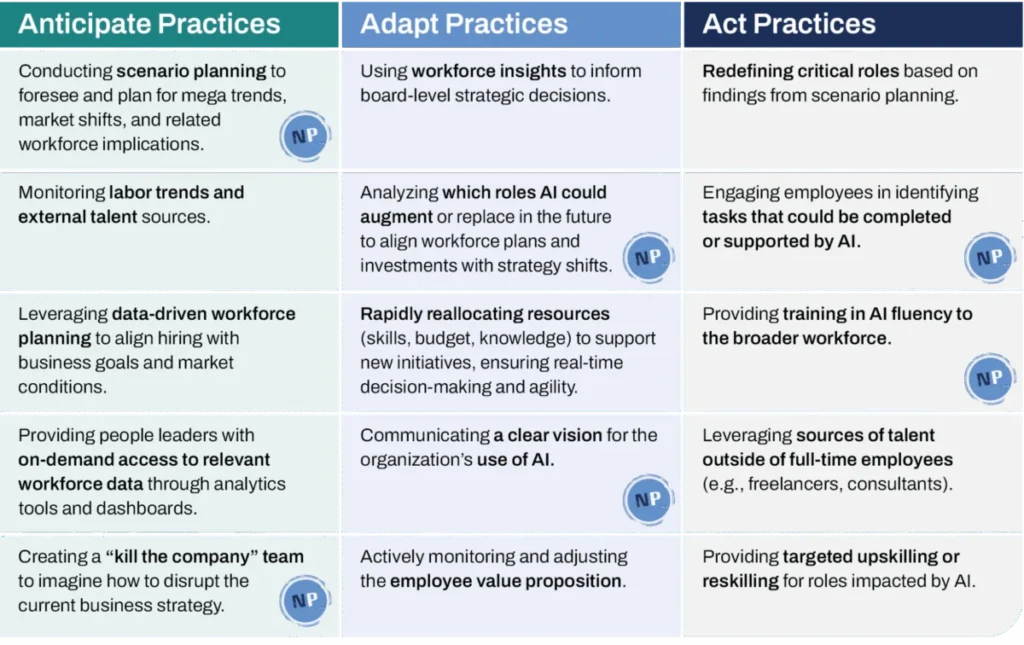
A truly disruption-ready organization is not one that consistently guesses the future correctly. Instead, it is characterized by its ability to anticipate change, adapt its strategy swiftly, and act decisively before competitors can. This "Three As" formula for agility forms the bedrock of high-performance in an uncertain world.

1. Anticipate: This pillar involves developing sophisticated sensory capabilities to detect weak signals of change in the external environment. It’s about looking beyond immediate trends to identify emerging shifts that could fundamentally alter market dynamics, competitive landscapes, or customer expectations.
- Practices: This includes robust market intelligence, continuous horizon scanning, scenario planning (developing strategies for multiple plausible futures), predictive analytics, and fostering an organizational culture where employees at all levels are encouraged to share observations and insights from their interactions with customers, partners, and the broader industry. Companies might establish dedicated "future-sensing" teams or integrate foresight exercises into regular strategic planning cycles. For Fisker, anticipating a potential slowdown in EV adoption or a tightening of capital markets would have involved stress-testing their growth projections against less favorable economic forecasts and identifying trigger points for strategic pivots.
2. Adapt: Once changes are anticipated, the organization must possess the structural and operational flexibility to pivot its strategy and resource allocation rapidly. This moves beyond merely reacting; it involves proactively reconfiguring the organization to align with new realities.
- Practices: This includes adopting modular organizational structures that allow for easy re-teaming and project-based work, fostering a culture of rapid experimentation and iterative development, and building robust feedback loops. It also involves flexible resource allocation models, where capital, talent, and technology can be quickly redirected to new priorities. Adaptive organizations empower frontline teams with decision-making authority, reducing bureaucratic bottlenecks. For Fisker, this might have meant having contingency plans for slower production ramp-ups, alternative funding strategies, or even a more flexible product roadmap that could be adjusted based on real-time market demand rather than a fixed launch schedule.
3. Act: Anticipation and adaptation are fruitless without the capacity for swift and decisive execution. Agile organizations can translate strategic shifts into concrete actions quickly, capitalizing on opportunities or mitigating threats before competitors gain an advantage.
- Practices: This requires clear leadership, streamlined decision-making processes, and a culture that encourages calculated risk-taking and learning from failure. It involves establishing agile project management methodologies, fostering cross-functional collaboration, and ensuring that employees have the necessary skills and tools to implement new strategies. The emphasis is on speed and efficacy in implementation, avoiding analysis paralysis. For Fisker, more decisive action on software issues, supply chain disruptions, or customer service complaints might have mitigated some of the brand damage and operational inefficiencies that ultimately plagued the company.
Empirical Evidence for Agility’s Value
Research consistently validates the profound benefits of organizational agility. Studies show that the most agile organizations report significantly higher productivity—often 3 to 6 times more than their least agile counterparts. These organizations also typically experience higher employee engagement, as individuals feel more empowered and connected to a dynamic, forward-moving mission. Crucially, they report the lowest levels of change fatigue (around 12%), demonstrating that continuous adaptation, when managed effectively within an agile framework, does not overwhelm the workforce but rather energizes it.
Furthermore, agile organizations are often pioneers in technology adoption and optimization. Our research indicates that these companies operationalize AI at a rate 2 to 5 times higher than other organizations. This isn’t merely about having the latest tech; it’s about having the cultural and structural readiness to integrate new technologies seamlessly into workflows, extract maximum value, and rapidly adapt to new AI-driven capabilities. The "Three As of Agility" provide a simple yet powerful framework for organizations to enhance their adaptive capacity and prepare for the future. However, their true effectiveness hinges on the consistent execution of these practices, which, when regularly applied, create a self-sensing system capable of detecting change, adjusting strategy, and implementing actions that yield distinct performance advantages.
HR’s Pivotal Role in Forging an Agile Workforce
The Human Resources function holds immense influence in cultivating an agile workforce and workflows, and—most critically—a culture that genuinely embraces change. From the initial stages of hiring and onboarding to ongoing performance management, reward systems, and leadership development, HR’s strategic involvement is indispensable.
HR is uniquely positioned to design talent strategies that prioritize adaptability, resilience, and a growth mindset. This includes:
- Hiring for Agility: Shifting focus from purely technical skills to assessing candidates for cognitive flexibility, learning agility, problem-solving capabilities in ambiguous situations, and a proactive attitude toward change. Behavioral interviewing techniques, simulations, and diverse assessment tools can identify these traits.
- Onboarding for Dynamic Environments: Integrating organizational agility principles into onboarding programs, clearly communicating the company’s expectation of continuous learning and adaptation, and providing early exposure to cross-functional projects.
- Performance Management for Growth: Moving away from static annual reviews to continuous feedback loops, peer reviews, and forward-looking goal setting that encourages experimentation and learning from failure. Performance metrics should reward adaptability and collaboration, not just adherence to a rigid plan.
- Rewards and Recognition: Designing compensation and recognition programs that incentivize teamwork, cross-functional collaboration, skill development, and successful adaptation to new challenges. This can include project-based bonuses or recognition for innovative problem-solving.
- Leadership Development: Training leaders to be coaches, facilitators, and navigators of change rather than solely command-and-control figures. This involves fostering psychological safety, empowering teams, and modeling adaptive behaviors.
The benefits of this proactive approach are long-lasting. A change-ready culture not only absorbs disruption seamlessly but also strategically exploits the opportunities that change invariably presents. This prevents every market shift from devolving into internal chaos, employee exhaustion, or missed strategic advantages. To effectively build such a culture, organizations must concentrate on three fundamental components:
1. Fostering Psychological Safety: This is the bedrock of an agile culture. Employees must feel safe to speak up, challenge assumptions, propose new ideas, experiment, and even fail without fear of retribution or humiliation. When psychological safety is present, information flows freely, diverse perspectives are valued, and innovation thrives. HR can cultivate this through leadership training on empathetic communication, establishing clear norms around constructive feedback, and promoting a "learn from failure" mindset rather than a "punish failure" approach.
2. Empowering Autonomy and Distributed Decision-Making: Agile organizations push decision-making authority closer to the front lines, where information is most granular and reactions can be swiftest. This involves decentralizing structures, creating empowered, cross-functional teams with clear mandates, and trusting employees to make informed choices. HR’s role here includes designing flatter organizational hierarchies, clarifying roles and responsibilities within agile teams, and providing training on self-organization and accountability.
3. Cultivating Continuous Learning and Skill Development: In a rapidly changing world, static skill sets are a liability. An agile culture champions continuous learning, reskilling, and upskilling as fundamental aspects of professional development. This goes beyond formal training programs to embed learning into daily work, encourage peer-to-peer knowledge sharing, and foster a growth mindset across the organization. HR can facilitate this through robust learning platforms, mentorship programs, internal mobility initiatives, and by integrating learning objectives into performance development plans.
The Fisker story is a powerful, albeit painful, reminder that disruption, whether from economic shifts, technological advancements, or geopolitical instability, ruthlessly exposes organizations that were fundamentally built for constancy rather than adaptability. The companies best positioned to thrive in the complex, AI-driven era will not necessarily be those with the most accurate long-term forecasts or the largest technology investments. Instead, enduring success will belong to those that have meticulously built cultures capable of anticipating change, adapting their strategies with agility, and acting decisively to navigate and capitalize on an ever-shifting landscape.
The pertinent question for every executive and leader today is not whether disruption is coming, but rather, whether your organization is truly designed to embrace it.