The global business landscape is in a constant state of flux, driven by rapid technological advancements and evolving workforce demands. Among the most pressing concerns for organizations today is the imperative to reskill, upskill, and accelerate the adoption of Artificial Intelligence (AI). This sentiment was palpable during a recent gathering of over 200 Chief Human Resource Officers (CHROs) in India and Singapore, where the paramount topic of discussion was "AI readiness" – specifically, how to rapidly cultivate AI fluency and capability across all organizational functions.
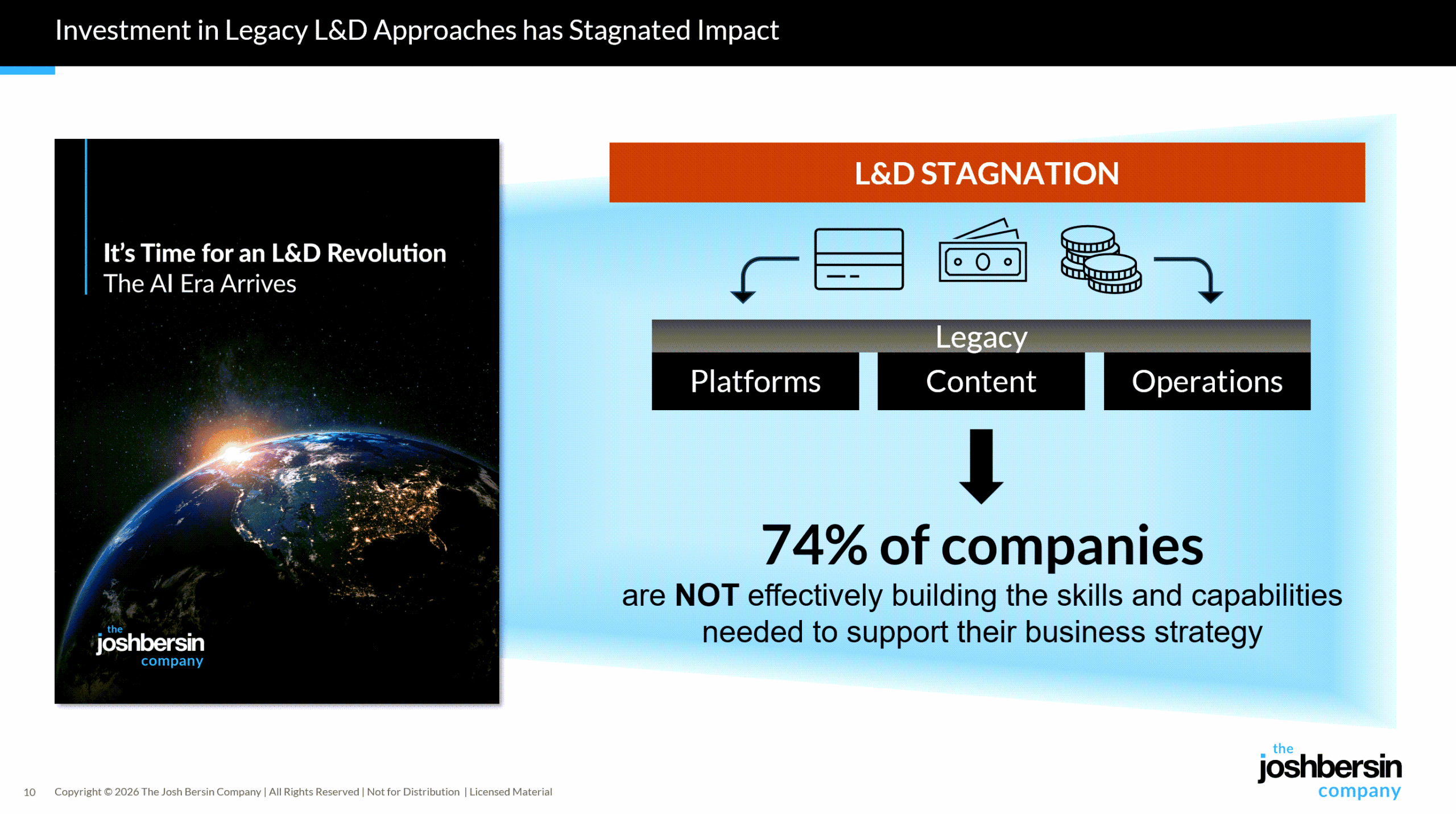
This widespread concern underscores a critical finding from years of research into corporate training methodologies: the current approaches, philosophies, technological stacks, and operating models for learning are, by and large, outdated. A significant new study, the fifth major investigation into corporate Learning and Development (L&D) by industry analyst Josh Bersin, reveals a stark reality: a staggering 74% of companies report that they are not keeping pace with their organization’s demand for new skills. This statistic is particularly alarming given the estimated $400 billion spent annually by businesses on training, content libraries, L&D technology, trainers, and consultants. The implication is that billions of dollars are being expended with insufficient returns, failing to meet the burgeoning needs of the modern workforce.
The research points to a fundamental redefinition of the problem. The challenge facing businesses is not merely about "learning" or "training" in the traditional sense. Instead, it is about dynamically sharing information, fostering an environment where individuals can explore, question, and apply new ideas. The conventional pedagogical paradigm of "training" is identified as a significant bottleneck hindering progress.

The AI Revolution in Corporate Learning
The findings of Bersin’s latest study, detailed in his forthcoming publication "Learning 2026," suggest that AI is poised to fundamentally reinvent how organizations approach learning and development. The core hypothesis, explored in his previous work "The Revolution of Corporate Learning," has now been strongly validated. AI-native systems, capable of dynamically generating and sharing content, are emerging as the key to transforming how employees are trained, upskilled, supported, and ultimately, "enabled." This new paradigm, exemplified by platforms like Galileo, is set to redefine L&D, HR, and all facets of organizational change management.
What is AI-Native Learning?
AI-native learning leverages the inherent capabilities of generative AI to create content dynamically. Unlike traditional methods that involve manual design, building, and publishing of static courseware, AI platforms can generate content on demand, tailored to specific needs and presented in desired formats. This drastically reduces the time and resources required for content creation. For instance, platforms like Galileo, built on the Sana framework, can develop new courses in days rather than months, ensuring that the entire organizational learning ecosystem is continuously updated with the latest information.
This dynamic approach empowers employees in several key ways:

- Personalized Learning Journeys: Content is automatically categorized by skills, allowing employees to access information relevant to their current roles and career aspirations.
- Continuous Skill Assessment: As employees engage with the system, their skill levels are inferred from their activity, providing real-time insights into their development.
- Seamless Information Access: Every piece of content is interconnected, enabling employees to find answers to questions without needing to navigate extensive course catalogs. The entire knowledge base functions as a unified "intelligence system" for the organization.
The success of consumer-facing AI tools like ChatGPT, with an estimated 60% of its 900 million weekly users engaging in learning activities, serves as a powerful indicator of this paradigm’s effectiveness. This level of engagement far surpasses that of traditional course catalogs. Furthermore, organizations are increasingly incorporating expert interviews and recordings into these AI-native systems, ensuring that the knowledge base remains current and enriched with real-world insights, tips, and discoveries. This represents a "miraculous application of AI," with the potential to unlock trillions of dollars in business improvement.
The Learning Maturity Model: A Framework for Transformation
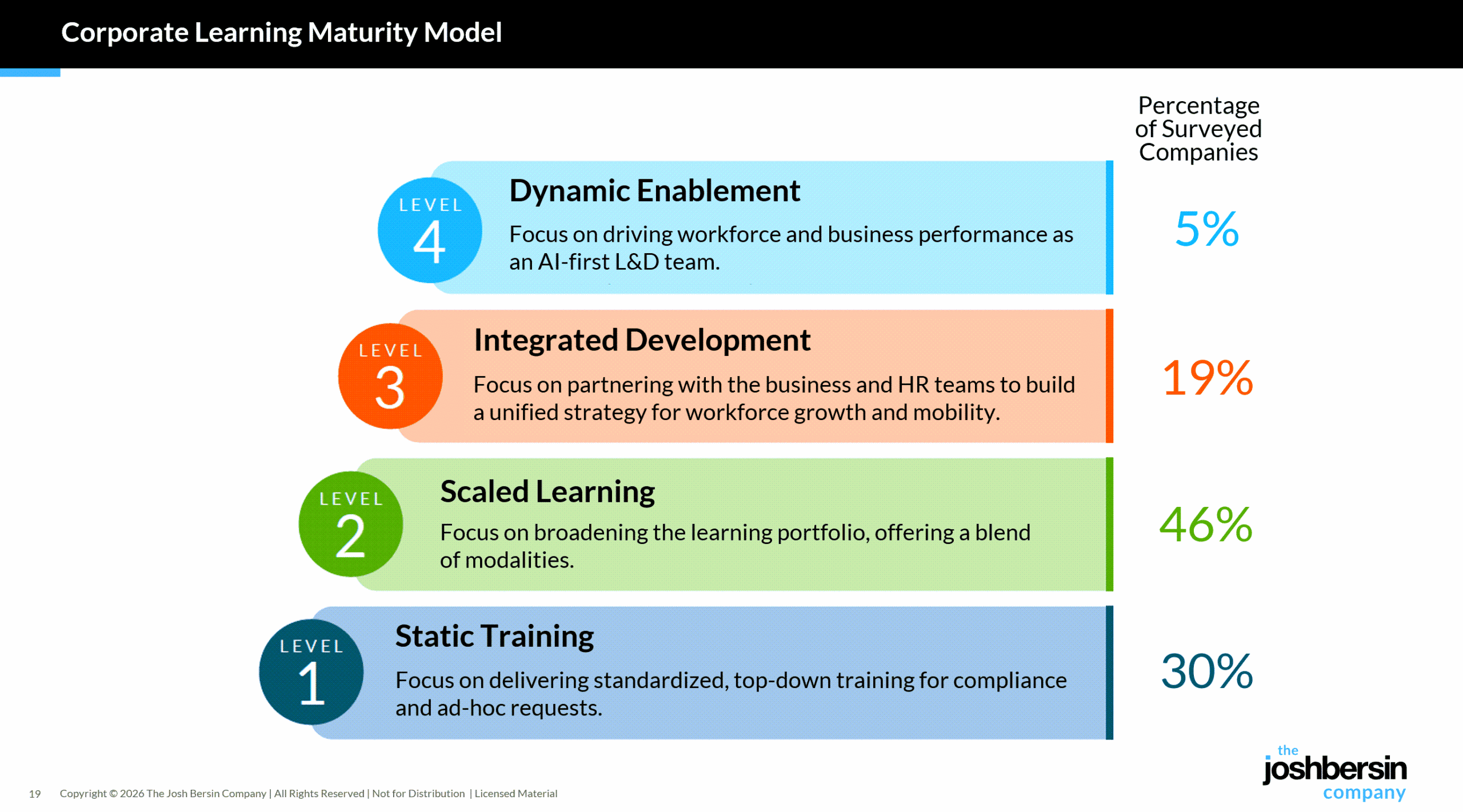
To navigate this evolving landscape, Bersin’s research introduces a comprehensive "Learning Maturity Model," outlining four distinct levels of organizational readiness:
Level 1: Static Training Programs
At the foundational level, companies engage in "Static Training" programs. These typically involve building or purchasing pre-designed courses for compliance-based or mandatory top-down learning. This segment accounts for nearly a third of the market, with a focus on compliance, new product launches, or other episodic learning needs. While these programs are often cost-effective to acquire or develop and help employees stay current on new information, they offer limited scope for skills-based development.
Level 2: Scaled Learning
Building upon static training, approximately 46% of companies advance to "Scaled Learning." This stage involves expanding the learning portfolio to include a variety of formats such as videos, audio content, and job aids. Content vendors play a significant role here, providing a broader range of resources. Popular platforms like LinkedIn Learning, Coursera, Skillsoft, and Pluralsight primarily operate within this category. While offering more extensive options, the onus remains on the individual learner to identify and consume the most relevant content.
Level 3: Integrated Development
The next tier, "Integrated Development," involves tailoring learning programs around specific job roles, skills, and career paths. Companies at this level move beyond individual training modules to construct comprehensive "development programs." This approach introduces significant complexity, requiring the management of multi-dimensional skill taxonomies, professional competencies, job roles, and hierarchical levels.
However, the rapid pace of change in the modern economy poses a challenge to this model. LinkedIn data indicates that approximately 70% of job-related skills become obsolete annually, making it exceptionally difficult to maintain dynamic and relevant career paths. Despite this, "Integrated Development" remains effective for specific applications like channel training, technical education (e.g., certifications), and onboarding new employees.
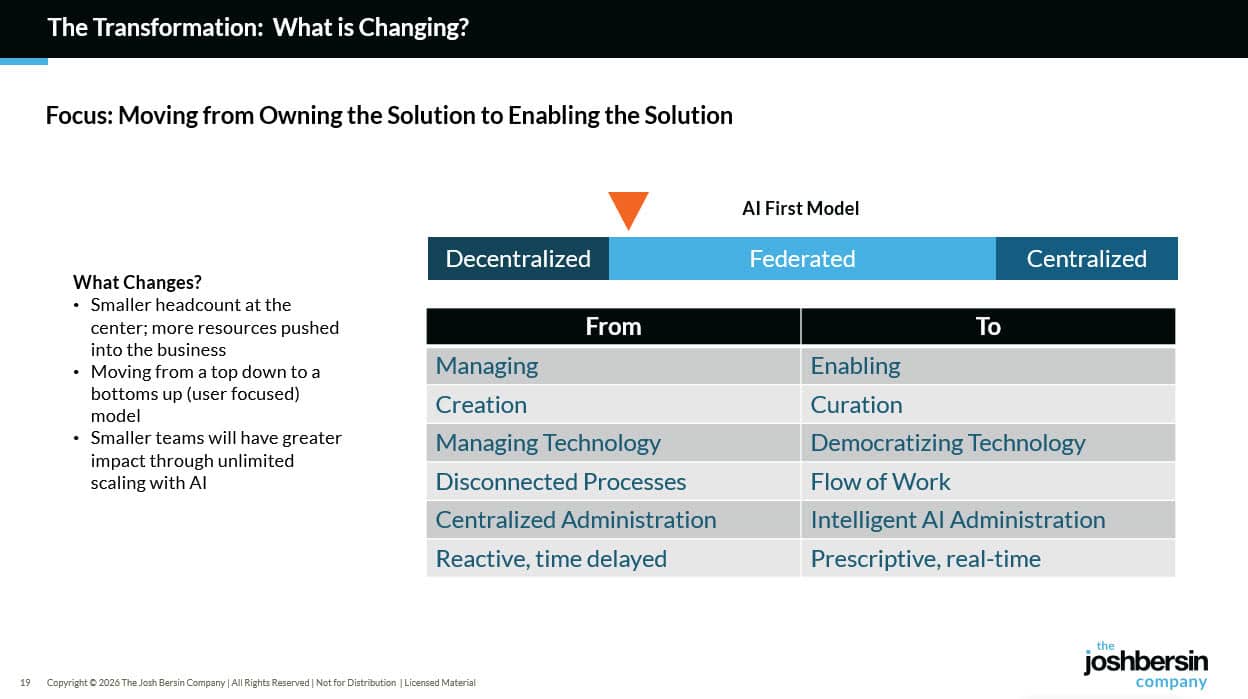
As organizations climb to Level 3, the size and cost of L&D operations typically increase substantially. Maintaining and refreshing dozens of programs, curricula, skills models, and content objects can become an overwhelming task. The question of operational ownership and maintenance becomes critical, especially given the decentralized nature of corporate learning. While L&D professionals manage strategic programs, an estimated 70% of training is localized within specific business units like sales, manufacturing, and customer service. This necessitates locally updated content and specialized infrastructure, often diverting resources from frontline training needs. Consequently, many Level 3 companies adopt a "federated" model, delegating line-of-business training to others to enhance scalability, albeit with increased complexity.
Level 4: AI Transformation – Dynamic Enablement
The apex of the maturity model is "AI Transformation," characterized by "Dynamic Enablement." This level envisions a platform that consolidates all organizational knowledge – including courses, documents, policies, and expert interviews – transcending the traditional definition of a "learning platform."
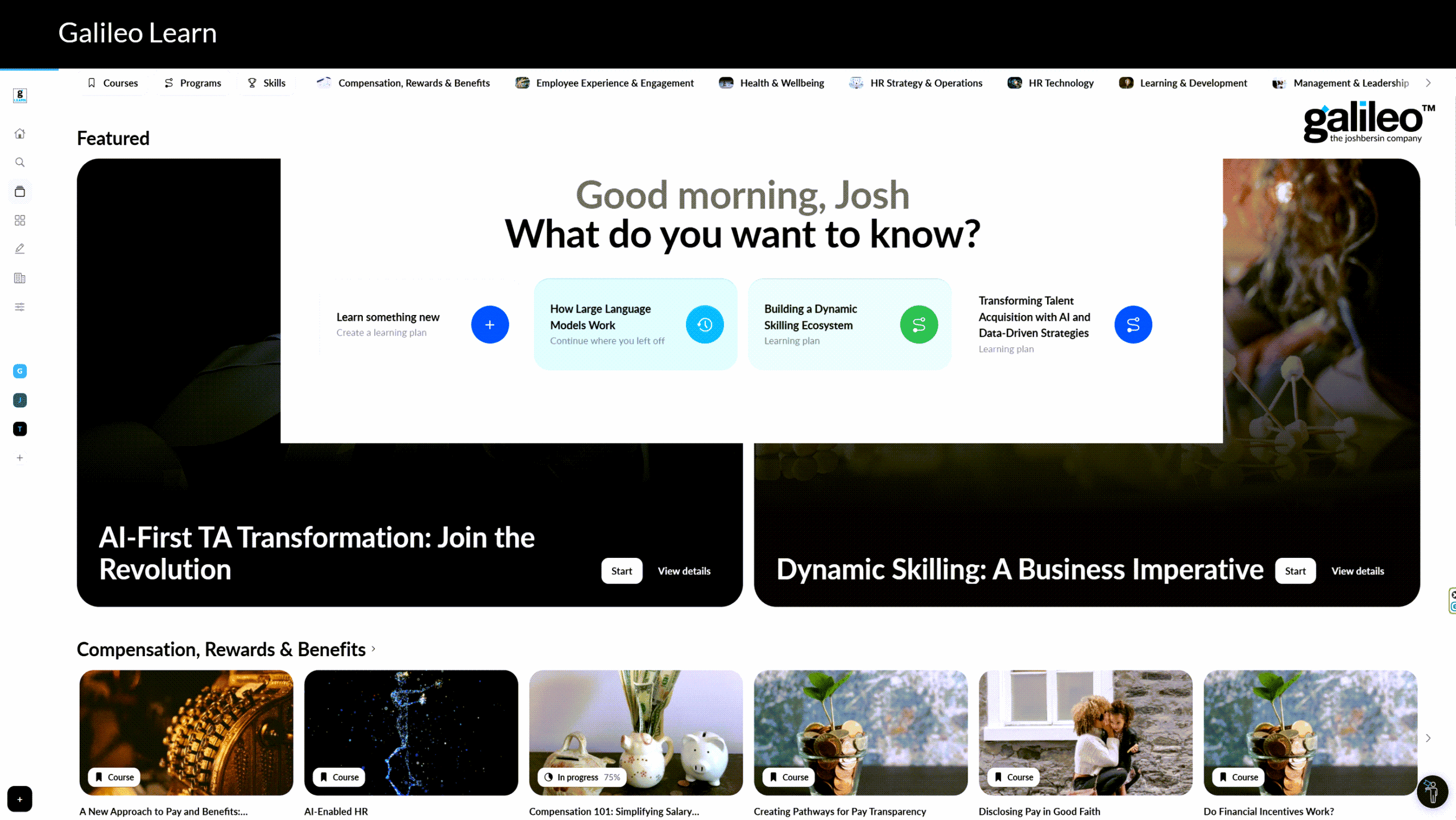
AI-native learning platforms are central to this transformation. They enable the rapid publication of information, often within days rather than months, and empower employees to learn in ways that best suit their individual needs. Many organizations retain their legacy Learning Management Systems (LMS) for compliance programs while adopting new AI platforms that replace Learning Experience Platforms (LXPs), learning portals, and most content development tools. Early adopters of these AI-native solutions are already reporting significant reductions in L&D internal spending, with some experiencing savings of 40-50%.
The Implications of Dynamic Enablement
The shift towards "Dynamic Enablement" offers profound benefits, including substantial savings in time and resources for delivering learning solutions, coupled with an enhanced employee experience. This new approach facilitates the embedding of learning into every corporate chatbot or agent. For instance, an employee filling out benefits forms could ask a chatbot for a comparison of different plans. Similarly, an individual entering a new sales opportunity into Salesforce could request coaching on selling into that specific industry. A nurse or manufacturing worker logging into their workstation could inquire about recent process changes or departmental updates.
One notable example involves a large travel reservation company that utilizes call recordings from top customer service agents within its learning system. This allows other agents to learn best practices and navigate challenging customer interactions more effectively. The potential for training in customer service, engineering, sales, and various support functions is immense.
Within organizations like Josh Bersin’s own, new materials, including client interviews, are published into platforms like Galileo. This ensures that any employee can gain insights into clients, understand industries, or better comprehend client needs. This new domain, "Dynamic Enablement," signifies a crucial transition from mere "learning" to practical "enablement." Employees learn not for the sake of learning, but to enhance their capabilities, drive performance, and foster growth.
Proven Returns and Strategic Next Steps
The research unequivocally demonstrates the tangible returns of adopting Level 4 practices. Organizations operating at this maturity level are significantly more likely to be innovation leaders (10 times more likely), exceed financial targets (6 times more likely), and adapt effectively to change (16 times more likely). As these AI-driven learning platforms mature, the associated benefits are expected to expand further.
What Should Companies Do?
Achieving "AI-Native Learning" or "Dynamic Enablement" extends beyond merely using AI to expedite course creation. It necessitates a fundamental shift away from traditional SCORM-based LMS platforms towards dynamic content systems. Several emerging vendors, including Sana, Arist, Disperz, Uplimit, and Colossyan, are at the forefront of this evolution.
The roadmap to enablement is clear:
- Content Rationalization: Organizations must meticulously review and rationalize their existing content, identifying which materials to retain. Legacy SCORM courses can be transformed into AI-native formats using platforms like Galileo.
- New Governance Models: Establishing a new governance framework for L&D is crucial. Early adopters in insurance, healthcare, pharmaceuticals, and airlines have found that once the system is established, line-of-business training can be effectively delegated to local staff.
- Hybrid/Distributed Operating Model: This approach fosters agility. Corporate HR can then focus on global strategic priorities such as leadership development, compliance, culture, and business strategy. Individual business units can establish dedicated "Enablement Academies" for specific functions like sales and manufacturing.
The ultimate bottom line is that AI-native learning has the power to fundamentally transform businesses. By embracing this new paradigm, organizations can unlock unprecedented levels of innovation, efficiency, and employee empowerment, ensuring they remain competitive in the rapidly evolving global marketplace.
For those seeking to delve deeper, comprehensive research, case studies, benchmark data, and maturity model diagnostics are available through platforms like Galileo. Additionally, a new learning program, "The Journey to Dynamic Enablement," is offered, providing users with the opportunity to author courses, upload content, and experience AI-native learning firsthand. The journey towards dynamic enablement represents the future of how businesses will learn, adapt, and thrive.