The relentless acceleration of artificial intelligence is fundamentally reshaping the global business landscape, creating a significant chasm between leadership’s ambitious transformation agendas and employees’ capacity to adapt to the daily implications of these changes. This disparity is not merely an operational challenge; it is deeply human. The Achievers Workforce Institute’s (AWI) 2026 State of Recognition Report underscores this growing disconnect, revealing that while strategic initiatives are advancing rapidly, employee confidence, clarity, and connection are failing to keep pace. This report, drawing on extensive global data, highlights a critical leadership blind spot: the underestimation of change readiness and the fundamental misunderstanding of the role of recognition in navigating this complex transition.
The report’s findings paint a stark picture for 2026: strategies are evolving at an unprecedented speed, but the underlying belief and buy-in from the workforce are lagging. This belief, crucial for successful transformation, is not solely a product of communication; it is cultivated through consistent reinforcement. Employees need to experience tangible signals about what is valued, what is succeeding, and what their next steps should be. This is precisely where effective recognition emerges as a pivotal, yet often misunderstood, driver of organizational success.
Rethinking Recognition: Five Assumptions Leaders Must Unlearn
To foster an environment where employees can effectively navigate rapid change, leaders must critically re-evaluate their long-held assumptions about employee recognition. The AWI report identifies five key areas where traditional thinking needs to be unlearned:
-
Recognition is about Reward: The most impactful recognition is specific, timely, and intrinsically motivating, rather than being solely tied to monetary or material rewards. While rewards have their place, genuine recognition focuses on acknowledging effort, skill, and contribution, fostering a sense of value beyond transactional benefits. This specific, non-reward-based acknowledgment is more potent in reinforcing desired behaviors and building intrinsic motivation.
-
Recognition Scales Through Automation: While AI can streamline processes, it cannot replicate the trust and genuine connection fostered by human interaction. Employees overwhelmingly value recognition from their peers and managers over automated, AI-generated messages. The AWI report indicates that reliance on automation for recognition can erode trust, a critical component for employee engagement and a willingness to embrace change. True recognition requires empathy and understanding, qualities that are inherently human.
-
Recognition is Solely a Managerial Responsibility: When recognition efforts are confined to managers, they inevitably create bottlenecks. An effective recognition strategy empowers all employees to acknowledge and appreciate their colleagues, fostering a more distributed and pervasive culture of appreciation. This peer-to-peer recognition not only lightens the load on managers but also strengthens team bonds and creates a more inclusive environment where contributions are consistently visible.
-
Recognition is the Outcome of Good Work: Instead of being a retrospective acknowledgment, recognition should be viewed as a proactive driver of good work. Frequent and timely recognition reinforces positive behaviors, increases employee connection, fosters clarity on expectations, builds trust, and ultimately boosts performance. By recognizing desired actions as they occur, organizations can actively shape and enhance the quality of work produced.
-
Recognition is a Culture Initiative: While recognition certainly contributes to culture, it is more than just a standalone initiative. It is an integral part of the daily workflow, operating within the flow of work to reinforce priorities, guide execution, and provide real-time feedback. By embedding recognition into everyday processes, organizations can ensure that strategic objectives are consistently understood and acted upon.
The Unseen Risk: The Criticality of Change Readiness
In 2026, leaders must shift their focus from traditional engagement metrics to a more forward-looking indicator: change readiness. The AWI report reveals a pervasive pattern across global organizations: employees are being asked to adapt at a pace that outstrips their perceived preparedness. This phenomenon, while sometimes misinterpreted as resistance, is more accurately characterized as hesitation. Employees are not inherently opposed to change; they are struggling to interpret its meaning and implications in real-time.
This gap between the pace of change and employee readiness has tangible consequences:
- Decreased Confidence: When employees feel ill-equipped to handle new demands, their confidence in their abilities diminishes, leading to increased anxiety and a reluctance to take initiative.
- Erosion of Clarity: Rapid shifts in processes, tools, or strategic direction can create confusion about roles, responsibilities, and objectives, leading to a loss of focus.
- Weakened Connection: A lack of understanding about how their work fits into the larger organizational picture, especially during periods of flux, can lead to feelings of isolation and a disconnect from their colleagues and the company’s mission.
- Stalled Performance: When confidence wavers, clarity is lost, and connection weakens, performance inevitably suffers. Employees may revert to familiar, less efficient methods or become hesitant to experiment with new approaches.
The critical insight here is that employees do not require more communication about change; they need clearer signals about what is working, what is truly important, and where they fit into the evolving landscape. Currently, these signals are weak in many organizations. Those that are successfully navigating this period of transformation are not necessarily communicating more, but rather reinforcing more effectively through consistent and meaningful recognition.
The Misunderstood Mechanism: Recognition as a System, Not an Event
Many organizations believe they have a robust recognition strategy, often evidenced by various programs, platforms, and campaigns. However, the global data presented in the AWI report suggests a different reality: recognition exists, but it often lacks the potency to shape behavior when it matters most. A striking statistic from the report reveals that only 17% of employees receive recognition on a weekly basis, with the majority experiencing it sporadically or only a few times a year.
This infrequency creates a fundamental problem: recognition arrives too late to effectively guide action. When recognition is delayed, generic, or disconnected from the actual work performed, it ceases to be a powerful reinforcement tool and devolves into mere background noise. This is the critical disconnect many leaders are overlooking. Recognition is not failing because employees do not value it; it is failing because it is being treated as an isolated event rather than an integrated system.
The Global Recognition Gap: A Symptom of Deeper Issues
The most significant takeaway from the AWI State of Recognition Report is not any single data point, but the overarching pattern it reveals. Across metrics such as belonging, trust, clarity, and performance, a consistent signal emerges: when reinforcement is weak, confidence collapses.

For instance, the report highlights that employees who feel consistently recognized are significantly more likely to:
- Feel a strong sense of belonging.
- Express high levels of trust in their leaders and the organization.
- Possess clear understanding of their roles and contributions.
- Exhibit higher levels of performance and productivity.
Conversely, a lack of consistent recognition correlates with:
- Feelings of isolation and exclusion.
- Skepticism towards leadership and organizational decisions.
- Ambiguity regarding expectations and priorities.
- Diminished motivation and a decline in work quality.
These are not isolated engagement issues but rather indicators of a more profound leadership challenge: a failure in consistent and meaningful reinforcement. When the signals employees receive about their contributions are inconsistent, they do not push back against strategy; they disengage from it. The recognition gap, therefore, represents not a failure of intent, but a failure of effective reinforcement.
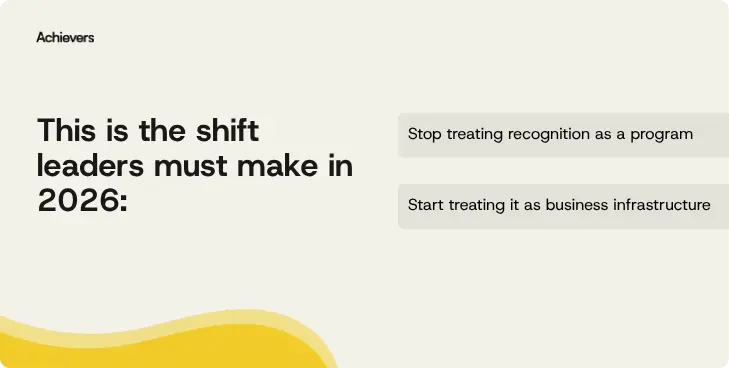
Recognition as Infrastructure, Not a Perk
The traditional framing of recognition as a cultural "add-on" or a morale-boosting activity needs a complete overhaul. While it certainly contributes to a positive work environment, the data indicates its role is far more foundational. Recognition is not merely a perk; it is an essential piece of organizational infrastructure that underpins critical business functions.
Recognition acts as a real-time feedback mechanism, transforming abstract priorities into concrete actions and stabilizing performance amidst constant change. It provides the crucial reinforcement that communication, training, and strategy alone cannot deliver. Specifically, recognition:
- Reinforces desired behaviors: By acknowledging actions that align with organizational goals, recognition encourages their repetition.
- Drives alignment: It clearly communicates what is valued, ensuring that individual efforts are directed towards strategic priorities.
- Builds trust: Consistent and genuine recognition fosters a sense of being seen and valued, strengthening the trust bond between employees and leadership.
- Enhances clarity: It clarifies expectations by highlighting what constitutes success and impactful contributions.
- Boosts performance: By motivating employees and reinforcing positive actions, recognition directly contributes to improved productivity and outcomes.
The report explicitly demonstrates that recognition functions as the dynamic system that translates strategic intent into practical execution, providing the stability needed to navigate periods of upheaval.
The Missing Link in AI Transformation: Bridging the Behavior Gap
Perhaps the most critical insight emerging from the AWI report is that the ongoing AI transformation is less a technological challenge and more a behavioral one. Organizations are expecting employees to embrace new AI-powered tools, adapt to evolving workflows, and develop new skills. However, employees often feel unsupported in consistently practicing these new behaviors.
This lack of support is a primary reason why AI adoption stalls. It is not that the tools are unavailable or ineffective, but rather that the necessary reinforcement mechanisms are absent. Recognition plays a pivotal role in bridging this behavioral gap by:
- Making progress visible: Recognizing employees for their efforts in learning and applying new AI tools highlights their achievements and encourages further adoption.
- Reinforcing new behaviors: Acknowledging instances where employees effectively leverage AI for problem-solving or efficiency reinforces these desirable actions.
- Building confidence: By celebrating successful integration of AI, recognition helps employees feel more competent and comfortable with the technology.
In essence, as the report articulates, "recognition is what turns intent into action and strategy into practice." Without it, transformation initiatives, including those driven by AI, remain purely theoretical, failing to translate into tangible organizational gains.
High-Performing Organizations: Redesigning Recognition for Impact
Organizations that are successfully closing the change readiness gap are not simply increasing the number of recognition moments. Instead, they are fundamentally redesigning recognition as an integrated component of how work operates. These leading organizations:
- Embed recognition into workflows: They ensure that opportunities for recognition are built into daily tasks and project cycles, making it a natural and continuous process.
- Empower peer-to-peer recognition: They cultivate a culture where employees are encouraged and equipped to recognize each other, fostering a distributed and pervasive system of appreciation.
- Align recognition with strategic priorities: They ensure that recognition efforts are directly tied to the behaviors and outcomes that support the company’s overarching goals.
- Provide clear guidance and tools: They offer employees and managers clear guidelines and accessible platforms to facilitate meaningful and timely recognition.
Crucially, these organizations understand a fundamental truth: employees do not need more communication; they need more proof. Recognition provides that tangible proof that their contributions are valued and that their efforts are making a difference.
The Takeaway for Leaders: Recognition as the Engine of Transformation
For leaders seeking a concise understanding from the 2026 State of Recognition Report, the central message is clear: recognition is not merely the reward at the end of a transformation journey; it is the very mechanism that determines whether that transformation will endure.
When recognition is:
- Frequent: Behavior accelerates, as positive actions are consistently reinforced.
- Meaningful: Trust strengthens, as employees feel genuinely seen and valued.
- Visible: Alignment scales, as understanding of what matters becomes widespread.
Conversely, when recognition is absent or ineffective, even the most meticulously crafted strategies can stall. The opportunity for leaders in the current climate is not to refine existing recognition programs, but to reposition recognition as a core operating system for culture, performance, and successful change management.
At Achievers, we are committed to equipping organizations and their leaders with the data-driven insights and practical tools necessary to leverage recognition as a catalyst for positive and sustainable change. By understanding and implementing these principles, businesses can navigate the complexities of rapid technological advancement and evolving workforce expectations, ensuring that transformation leads to genuine progress and enduring success.