The effectiveness of an organization’s entire recruitment strategy hinges significantly on the quality and precision of its job descriptions (JDs). Yet, a persistent paradox exists: while JDs are the foundational touchpoint for attracting talent, many organizations continue to grapple with inefficient, disorganized, and often archaic processes for their creation and management. This widespread inefficiency not only impedes the hiring process but also carries substantial hidden costs, impacting everything from candidate quality and diversity to legal compliance and employer brand. Against this backdrop, Ongig emerges as a pivotal solution, offering a comprehensive software platform designed to streamline, automate, and optimize every facet of the job description lifecycle, thereby ushering in a new era of talent acquisition.
For decades, the standard operating procedure for crafting job descriptions has involved manual drafting in generic tools like Microsoft Word or Google Docs. These documents then circulate through labyrinthine email threads, are stored in scattered shared drives, and reside in outdated folders, creating a chaotic landscape devoid of a central library or standardized workflow. This fragmentation breeds a host of operational challenges: approval processes become protracted and opaque, collaboration devolves into a painful exchange of conflicting edits, and gathering consolidated feedback becomes an arduous task. The cumulative effect is a recruitment bottleneck, where the very first step—defining the role—is riddled with inefficiencies that ripple throughout the entire hiring funnel.
The Pervasive Problems of Disorganized JD Processes
The traditional approach to job description management is fraught with specific, identifiable challenges that significantly undermine recruitment efforts:
- Manual Inefficiency and Time Drain: Without dedicated tools, HR and hiring managers spend countless hours manually writing, editing, and formatting JDs. This time could be better spent on strategic talent initiatives. Industry reports frequently highlight that HR professionals can spend upwards of 30% of their week on administrative tasks, a significant portion of which is often dedicated to JD-related activities.
- Lack of Content Guidance and Quality Control: Generic word processors offer basic grammar checks but provide no intelligent content guidance specific to recruitment. This means JDs often contain discriminatory language, vague jargon ("rockstar," "ninja"), or terms that inadvertently deter diverse candidates. The result is JDs that fail to attract qualified individuals, instead drawing a pool of unsuitable applicants.
- Fragmented Information and Version Chaos: The absence of a central repository means JDs are scattered, making it nearly impossible to locate the latest version, track historical changes, or ensure consistency across similar roles. This leads to redundant efforts, outdated information, and internal confusion about role requirements.
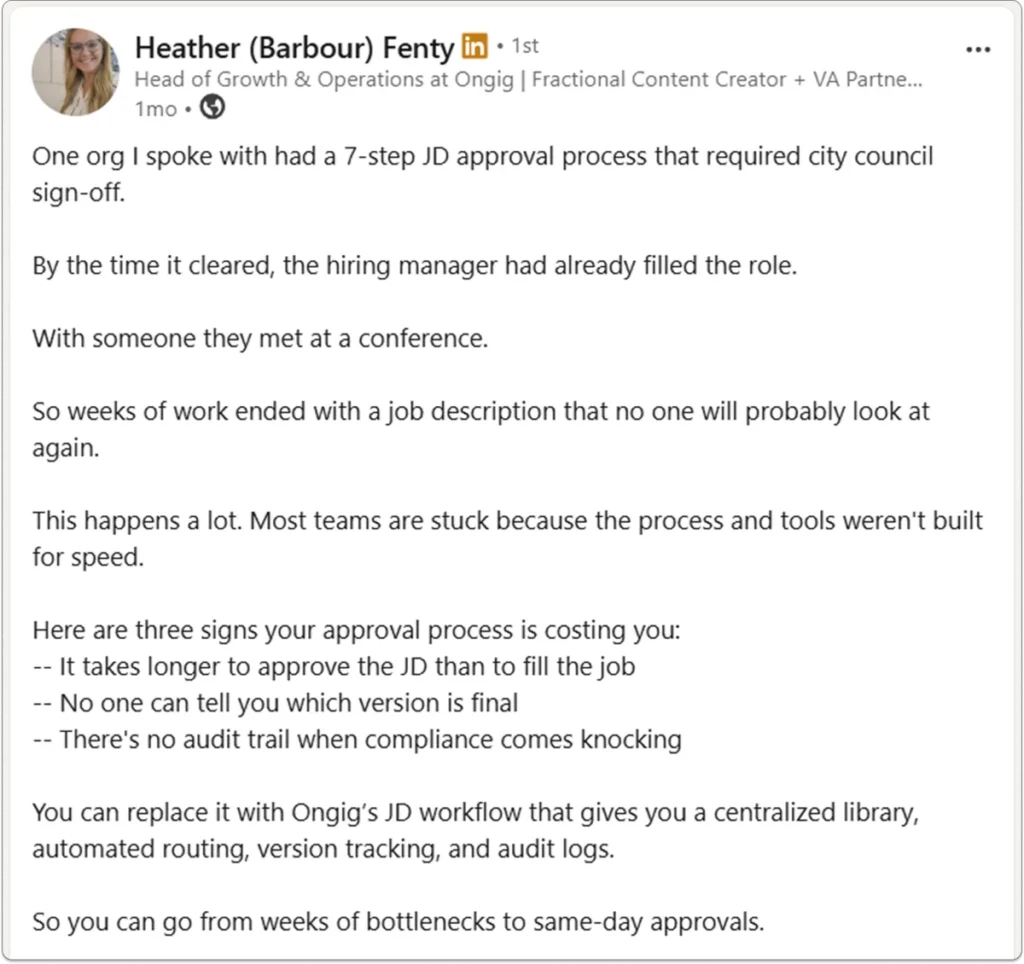
- Bottlenecked Approval Workflows: Job descriptions typically require input and approval from multiple stakeholders: recruiters, hiring managers, DEI teams, legal/compliance officers, and department leads. Without a structured workflow, tracking approvals, consolidating feedback, and determining who has final sign-off becomes a significant administrative burden, causing delays in job posting and extending time-to-hire.
- Compliance Risks and Brand Damage: Non-compliant JDs—those containing biased language, unclear requirements, or lacking essential legal disclaimers—expose organizations to potential discrimination lawsuits, regulatory penalties, and reputational damage. Furthermore, unclear or poorly written JDs reflect negatively on the employer brand, deterring top talent.
Ongig’s Transformative Approach: A Holistic JD Management Platform
Ongig addresses these systemic inefficiencies by centralizing and automating the entire job description process, leveraging advanced technology to ensure precision, compliance, and strategic advantage. The platform offers a suite of integrated tools that empower organizations to create, manage, and optimize JDs with unprecedented efficiency and effectiveness.
1. Automated JD Creation with AI-Powered Text Analysis:
At the core of Ongig’s solution is its AI-driven Job Description Creator, a feature that dramatically accelerates the drafting process. Instead of starting from a blank page, users can leverage AI to generate an initial draft based on role requirements. This foundational draft then undergoes sophisticated optimization using Ongig’s Text Analyzer. This tool goes beyond basic grammar, offering intelligent recommendations to:
- Minimize Bias: It identifies and suggests alternatives for language that may be biased based on gender, race, age, or other protected characteristics. This proactive approach supports diversity, equity, and inclusion (DEI) initiatives by ensuring JDs appeal to the widest possible talent pool.
- Enhance Readability: The Text Analyzer provides suggestions to shorten complex sentences, replace hard-to-read words, and ensure the JD is accessible to candidates of varying educational backgrounds. This improves the candidate experience and reduces application abandonment rates.
- Optimize Job Titles: It recommends industry-standard and commonly searched job titles, improving visibility on job boards and ensuring candidates can easily find relevant openings.
- Boost JD Score: As optimizations are applied, the tool provides a real-time "JD score," giving immediate feedback on the document’s overall quality and effectiveness.
This automated creation process, as demonstrated in Ongig’s tutorial videos, can reduce initial drafting time from hours to minutes, allowing recruiters to focus on candidate engagement rather than administrative writing.
2. Maintaining Effective Job Description Language for Broader Appeal:
Beyond initial creation, Ongig continuously helps organizations maintain high standards for JD language. Vague phrases like "rockstar software engineer" or "hits the ground running" often confuse candidates and narrow the applicant pool. Ongig’s platform addresses this by:
- Ensuring Clarity and Specificity: It guides users to employ clear, concise, and meaningful language, ensuring every word contributes to a precise understanding of the role and requirements. This eliminates guesswork for candidates, making it easier for them to determine if they are a good fit.
- Promoting Inclusivity: By actively flagging and suggesting alternatives for exclusionary terms, Ongig helps organizations craft JDs that resonate with a diverse array of candidates, fostering a more inclusive hiring environment.
- Optimizing for Searchability: The platform provides insights into keyword usage, helping ensure JDs are discoverable by relevant candidates searching on job boards and through Applicant Tracking Systems (ATS).
Recruitment specialists consistently emphasize that clear, unbiased language in JDs significantly increases application rates from qualified and diverse candidates, leading to better hiring outcomes.
3. Establishing a Controlled JD Approval Process:
The multi-stakeholder nature of JD approval often leads to significant delays and confusion. Ongig introduces a structured, transparent approval workflow that transforms this chaotic process into a streamlined operation:
- Defined Approval Paths: The platform allows organizations to configure custom approval chains, ensuring JDs move systematically through recruiters, hiring managers, DEI teams, and legal counsel.
- Enhanced Visibility: Stakeholders gain real-time insight into the status of each JD, clearly seeing who has reviewed, approved, or requested changes. This eliminates the "who’s holding up the process?" dilemma.
- Centralized Feedback and Edits: All comments, suggestions, and edits are consolidated within the platform, preventing conflicting versions and lost feedback that plague email-based workflows.
HR leaders frequently cite approval delays as a primary cause of extended time-to-hire. Ongig’s controlled process significantly reduces these cycles, ensuring JDs are published promptly.
4. A Searchable, Centralized JD Library: The Single Source of Truth:
The scattering of JDs across various platforms (Word, Google Docs, spreadsheets) is a major contributor to inefficiency. Ongig’s cloud-based, searchable JD library serves as a central intelligence hub:
- Single Source of Truth: All JDs, templates, and associated data reside in one secure, accessible location, eliminating duplication and ensuring everyone works from the most current information.
- Efficient Search and Retrieval: Powerful search functionalities allow users to quickly find specific JDs based on keywords, roles, departments, or other criteria, saving countless hours previously spent sifting through disparate files.
- Historical Data and Analytics: The library stores historical versions and data, providing valuable insights for auditing, compliance, and future JD optimization. This historical context is invaluable for understanding past hiring trends and refining future strategies.
- Template Management: Organizations can store and manage standardized JD templates, ensuring consistency across all roles and departments.
This centralization is critical for large organizations, enabling them to maintain consistency across global teams and diverse business units.
5. Organized JD Collaboration: Fostering Teamwork and Clarity:
Job description creation is inherently a collaborative effort. Ongig eliminates the pain points of disorganized collaboration by providing in-platform tools:
- Real-time Comments and Annotations: Team members can leave comments and suggest edits directly within the JD document, ensuring all feedback is contextualized and easily tracked.
- Version Tracking and Attribution: Every change, suggestion, and approval is logged with attribution, providing a clear audit trail and fostering accountability.
- Reduced Communication Overhead: By centralizing collaboration, Ongig significantly reduces the need for endless email exchanges and external communication, streamlining the feedback loop.
This integrated approach to collaboration ensures that all stakeholders contribute effectively, leading to higher-quality JDs crafted in less time.
6. Enhanced Version Control: Integrity and Accountability:
Maintaining clear version control is crucial for compliance, auditing, and preventing costly errors. Ongig’s robust version control features offer:
- Automatic Version History: Every saved change creates a new version, allowing users to track modifications over time.
- Audit Trails: Detailed records show who made which changes and when, providing complete transparency and accountability.
- Rollback Capabilities: In case of errors or a need to revert to an earlier state, the platform allows for easy restoration of previous versions, safeguarding against unintended alterations.
- Approval-Based Versioning: Only approved versions can be published, ensuring that only finalized, compliant JDs are released.
This level of control is indispensable for organizations operating in regulated industries or those requiring meticulous record-keeping.
7. Boosting Job Description Standardization: Consistency as a Competitive Edge:
Consistency in job descriptions is paramount for brand integrity, legal compliance, and a positive candidate experience. Ongig enforces standardization through:
- Mandatory Templates: Organizations can create and enforce the use of approved templates, ensuring a consistent structure, tone, and critical information across all JDs.
- Style Guides and Lexicons: The platform can integrate organizational style guides and approved terminology, preventing linguistic inconsistencies and promoting a unified brand voice.
- Automated Checks: Ongig’s tools automatically flag deviations from established standards, prompting users to make necessary adjustments.
A standardized approach not only enhances clarity for candidates but also simplifies internal processes and reduces the likelihood of compliance issues arising from disparate JD formats.
8. Enhancing Creation of Compliant Job Descriptions: Mitigating Risk:
Non-compliant JDs pose significant legal and reputational risks. Ongig proactively addresses these concerns by embedding compliance checks throughout the creation process:
- Bias Detection: As noted, the platform identifies and suggests remediation for biased language, helping organizations adhere to Equal Employment Opportunity (EEO) guidelines.
- Legal Keyword Checks: It flags terms that might be legally problematic or imply discriminatory intent.
- Accessibility Guidance: Ongig helps ensure JDs meet accessibility standards, making them readable and understandable for all candidates, including those with disabilities.
- Regulatory Alignment: The tool can be configured to align with specific local, national, and international employment laws, offering real-time guidance to prevent inadvertent non-compliance.
Industry analysis shows a significant rise in discrimination claims tied to recruitment language and practices. By using Ongig, organizations can substantially reduce their exposure to such risks, avoid potential fines, and protect their employer brand. Moreover, job boards are increasingly scrutinizing and sometimes removing non-compliant postings, making Ongig an essential tool for ensuring job visibility.
Hidden Benefits and Broader Implications for Talent Acquisition
Beyond the direct improvements, an efficient job description process powered by Ongig yields several strategic advantages:
- Enhanced Candidate Experience: Clear, inclusive, and well-structured JDs create a positive first impression, making candidates feel valued and informed. This contributes to a stronger employer brand and higher application completion rates.
- Improved Diversity, Equity, and Inclusion (DEI) Outcomes: By systematically eliminating bias from JDs, organizations naturally broaden their candidate pools, attracting a more diverse talent base and fostering a truly inclusive culture.
- Strategic Resource Allocation: By automating and streamlining administrative tasks, HR and recruitment teams are freed up to focus on strategic initiatives, such as talent pipelining, candidate engagement, and workforce planning.
- Reduced Time-to-Hire and Cost-per-Hire: Faster creation, approval, and publication of JDs, combined with attracting better-matched candidates, leads to a more efficient recruitment cycle, ultimately reducing both time and financial investment per hire.
Ongig centralizes and optimizes the entire job description journey, from drafting to publishing. By eliminating confusion, streamlining workflows, and embedding intelligence at every step, it empowers organizations to create high-quality, compliant, and engaging JDs that truly reflect their values and attract the best talent. This can translate into saving 3-5 hours per recruiter per week and reducing JD creation timeframes from months or weeks to just a few days. Organizations seeking to modernize their talent acquisition strategies and gain a competitive edge in the war for talent would do well to explore the transformative capabilities of Ongig.