
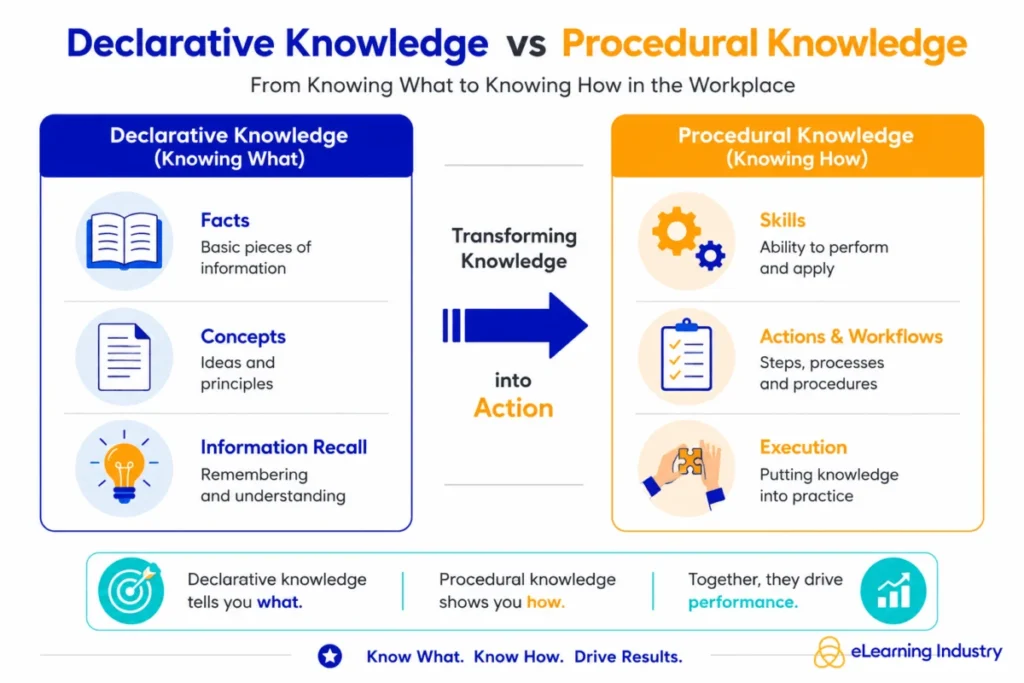
In the rapidly evolving landscape of global workforce development, the distinction between what an employee knows and what an employee can actually do has become a critical focal point for organizational success. Procedural knowledge, often defined as the "knowledge of how" to perform specific tasks, stands as the cornerstone of operational efficiency, separating theoretical understanding from practical mastery. Unlike declarative knowledge, which encompasses the memorization of facts, figures, and concepts, procedural knowledge is rooted in action, repetition, and the eventual transition of complex tasks into automatic behaviors. As industries move toward skill-based hiring and performance-driven metrics, understanding the mechanics of procedural learning has transitioned from a niche topic in cognitive science to a strategic imperative for business leaders and instructional designers worldwide.
The Cognitive Foundations of Procedural Knowledge
To understand the impact of procedural knowledge on the modern economy, one must first examine its roots in cognitive science. Procedural knowledge is primarily stored in the brain’s implicit memory system, specifically within the basal ganglia and the cerebellum. This is fundamentally different from declarative knowledge, which relies on explicit memory and the hippocampus. The practical implication of this neurological distinction is profound: while declarative facts can often be forgotten if not frequently recalled, procedural skills—once deeply encoded through practice—tend to be more durable and resistant to the passage of time.
The process of acquiring procedural knowledge typically follows a three-stage progression first identified by psychologists Paul Fitts and Michael Posner in 1967. The first stage is the cognitive phase, where the learner must consciously think about every step of a process, often relying on written instructions or verbal guidance. The second is the associative phase, where errors are reduced and connections between different parts of the task are strengthened. The final stage is the autonomous phase, where the skill becomes so ingrained that it can be performed with minimal conscious thought. In a workplace setting, reaching this autonomous stage is what defines an "expert" or a "high-performer," allowing employees to execute complex workflows while freeing up cognitive resources for higher-level problem-solving.
Distinguishing Declarative and Procedural Systems
The "Knowing-Doing Gap" is a well-documented phenomenon in corporate management where organizations possess vast amounts of information but fail to translate that information into productive action. This gap is essentially the divide between declarative and procedural knowledge.
Declarative knowledge is "knowing what." It includes an employee’s ability to state the company’s mission statement, list the features of a new product, or recite safety regulations. This type of knowledge is easily articulated, documented in manuals, and tested through traditional multiple-choice examinations. However, knowing the safety regulations (declarative) does not guarantee that an employee will correctly operate heavy machinery under pressure (procedural).
Procedural knowledge is "knowing how." It is the ability to navigate a complex software interface, manage a difficult client negotiation, or troubleshoot a mechanical failure on a production line. The primary difference lies in the application: declarative knowledge is static, whereas procedural knowledge is dynamic. For instructional designers, the challenge lies in the fact that procedural knowledge is often difficult to explain in words. A master craftsman may perform a task perfectly but struggle to write down the exact "feel" of the tools, a phenomenon known as tacit knowledge.
The Economic Impact of Skill Gaps and Training Inefficiency
The urgency of prioritizing procedural knowledge is underscored by current economic data. According to a 2023 report by the World Economic Forum, more than 50% of all employees worldwide will need reskilling by 2025 due to the adoption of new technologies. Traditional training methods that focus heavily on declarative content—such as long-form video lectures and static reading materials—often result in low "transfer of learning" to the actual job.
Research into the "Forgetting Curve," pioneered by Hermann Ebbinghaus, suggests that humans forget approximately 70% of new information within 24 hours if it is not applied. By shifting the focus to procedural learning—which emphasizes hands-on practice and immediate application—organizations can significantly increase the ROI of their training budgets. When employees move beyond "knowing about" a task to "mastering" the procedure, the results are reflected in reduced error rates, faster onboarding times, and increased output quality.
Procedural Knowledge in the Age of Artificial Intelligence
The rise of Artificial Intelligence (AI) has added a new layer of complexity to the discussion of knowledge types. Modern Large Language Models (LLMs) are essentially massive repositories of declarative knowledge; they can synthesize information and answer questions with remarkable speed. However, the next frontier in AI development is "Agentic AI," which focuses on procedural capabilities—the ability of an AI to execute a sequence of tasks, use software tools, and follow complex workflows to achieve a goal.

For organizations, this creates a dual challenge. On one hand, AI can automate many routine procedural tasks, such as data entry or basic scheduling. On the other hand, it elevates the importance of high-level human procedural knowledge, such as strategic decision-making, emotional intelligence in leadership, and complex technical troubleshooting. As AI takes over the "what," the human "how" becomes the primary source of competitive advantage. Christopher Pappas, CEO of eLearning Industry, notes that in the modern workplace, "Knowledge only becomes valuable when it is transformed into consistent action. Procedural knowledge is what turns understanding into performance, and performance into business impact."
Case Studies: Procedural Knowledge in Practice
The application of procedural knowledge is visible across diverse business sectors, from high-stakes medical environments to everyday retail operations.
-
Healthcare and Emergency Services: In a surgical setting, a medical student may have the declarative knowledge of human anatomy (knowing where the heart is), but the procedural knowledge (the ability to perform a steady incision under stress) is what saves the patient. Hospitals use high-fidelity simulations to build this procedural "muscle memory" before residents ever touch a live patient.
-
Sales and CRM Management: A sales representative might know the technical specifications of a software product (declarative). However, the procedural knowledge involves the specific steps of entering lead data into a CRM like Salesforce, navigating the internal approval workflow for discounts, and conducting a persuasive demo. Organizations that provide "sandbox" environments for sales teams to practice these steps see significantly higher CRM compliance and data accuracy.
-
Customer Onboarding: Successful SaaS (Software as a Service) companies rely heavily on procedural workflows. A customer success manager must follow a specific sequence: scheduling a kickoff, configuring account permissions, conducting user training, and setting up automated reporting. If any step of the procedure is missed, the "knowledge" of the product’s value is lost, leading to customer churn.
Strategies for Instructional Designers and L&D Leaders
To effectively foster procedural knowledge, Instructional Designers must move away from "information dumping" and toward "experience building." This requires a fundamental shift in how training is structured.
- Scaffolding and Modeling: Learning should begin with a demonstration by an expert, followed by guided practice. This "scaffolding" allows the learner to attempt the procedure with a safety net, gradually removing support as they gain competence.
- Simulations and Branching Scenarios: Digital learning platforms now allow for immersive simulations where employees can practice using software or interacting with customers in a risk-free environment. Branching scenarios, where a learner’s choice leads to different outcomes, are particularly effective for teaching procedural decision-making.
- Feedback Loops: Procedural learning cannot happen in a vacuum. Immediate, constructive feedback is essential for correcting errors before they become "hard-wired" habits. In a procedural context, feedback should be specific to the action taken rather than the fact remembered.
- Spacing and Repetition: Because procedural knowledge relies on long-term memory encoding, practice must be spaced out over time. Short, frequent "micro-learning" bursts that require the learner to perform a task are more effective than a single eight-hour training seminar.
Measuring Success: Beyond the Quiz
One of the greatest hurdles in implementing procedural-focused training is measurement. Most Learning Management Systems (LMS) are designed to track quiz scores (declarative) rather than performance (procedural). To truly assess procedural knowledge, organizations must implement performance-based assessments. This might include:
- Observation Checklists: Managers or peers observing an employee perform a task in real-time and checking off specific procedural steps.
- Simulated Tasks: Requiring the employee to complete a "mock" project or workflow within a software environment.
- Key Performance Indicators (KPIs): Tracking real-world outcomes, such as the time it takes to resolve a support ticket or the accuracy rate of a manufacturing process, as a proxy for procedural mastery.
Conclusion: The Future of Skill-Based Organizations
As the global economy becomes increasingly automated and data-driven, the value of pure information is declining. Facts are now available at the touch of a button or through a prompt to an AI assistant. Consequently, the true differentiator for the future workforce will be the ability to execute complex, high-value procedures that require human judgment, dexterity, and social intelligence.
Organizations that prioritize procedural knowledge will benefit from a more resilient and adaptable workforce. By moving beyond the "what" and mastering the "how," companies can ensure that their employees are not just knowledgeable, but truly capable. The transition from a declarative-heavy training model to a procedural-focused one is not merely an educational preference; it is a necessary evolution for any business aiming to thrive in the 21st century. The end goal of any learning initiative should be the transformation of information into habit, and habit into excellence. Through the deliberate cultivation of procedural skills, organizations can bridge the gap between potential and performance, ensuring that their greatest asset—their people—is prepared for the challenges of an ever-changing world.






