
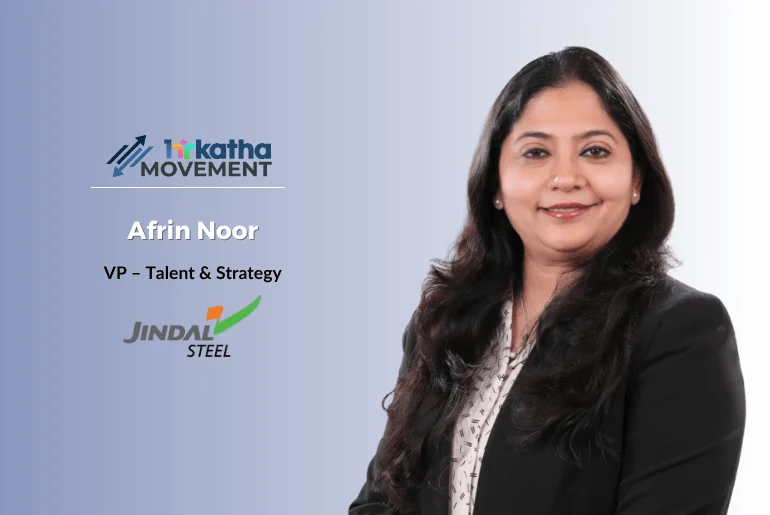
Jindal Steel, a prominent player in the Indian steel manufacturing landscape, has announced the strategic appointment of Afrin Noor as its new Vice President – Talent & Strategy. This pivotal move signals the company’s heightened focus on human capital development and strategic workforce planning, essential for navigating the complexities of modern industrial growth and global competitiveness. Ms. Noor, a seasoned HR professional with over two decades of experience, will assume a critical role in shaping the organization’s future talent landscape and aligning its people strategy with overarching business objectives.
In her new capacity at Jindal Steel, Afrin Noor is tasked with a comprehensive mandate aimed at fortifying the company’s human resource framework. Her key responsibilities will include leading initiatives to strengthen the leadership pipeline, a crucial undertaking for any large-scale industrial conglomerate seeking sustainable growth and effective succession planning. Furthermore, she will be instrumental in sharpening workforce capabilities, addressing the evolving skill requirements driven by technological advancements, market shifts, and the broader Industry 4.0 paradigm. A significant part of her strategic vision will also involve fostering a culture deeply anchored in innovation and operational excellence – principles that are increasingly vital for maintaining a competitive edge in the global steel market. At the core of her role is the imperative to align the people strategy seamlessly with business outcomes, drive strategic organizational change, and meticulously build robust frameworks designed for long-term, sustainable growth. This encompasses everything from talent acquisition and development to performance management, employee engagement, and organizational design, all viewed through a lens of strategic business partnership.
A Career Spanning Diverse Industrial Giants: A Chronology of Professional Ascent
Afrin Noor’s impressive professional journey is marked by significant tenures at two industrial behemoths: Honeywell and Tata Steel, providing her with a unique blend of experience across diverse manufacturing and technology-driven environments. This rich background equips her with a multifaceted understanding of human resource challenges and opportunities in both traditional heavy industries and advanced technology sectors.
Honeywell: A Sixteen-Year Trajectory of Leadership in Global HR
Prior to joining Jindal Steel, Ms. Noor dedicated a substantial sixteen years to Honeywell, a global diversified technology and manufacturing leader. Her tenure at Honeywell, spanning from June 2010 to April 2026 (the latter date likely indicating the end of her previous contract or a future reference point), saw her ascend through multiple challenging roles, culminating in her position as HR Director for Building Automation across India, ASEAN, and East Asia.
Her journey at Honeywell began in 2010 as an HR Manager, a foundational role that allowed her to immerse herself in the company’s HR operations and culture. Demonstrating consistent excellence and strategic acumen, she progressively moved into more senior leadership positions. One of her early significant roles involved serving as HR Leader for Security and Fire in Asia Pacific, a critical sector requiring precise talent management strategies given the specialized nature of the business and the diverse regulatory environments across the region. This experience honed her skills in managing complex, multi-country HR operations.
Subsequently, she took on the role of HR Leader for Buildings & Safety and Productivity Solutions, expanding her purview to encompass broader technological solutions and employee safety protocols. This role underscored her capability to manage HR for diverse business units with distinct operational requirements. Her career trajectory then led her to become HR Director for Building Technologies India, where she was responsible for the full spectrum of HR functions within a key growth market for Honeywell.
Her ultimate role at Honeywell as HR Director for Building Automation across India, ASEAN, and East Asia was particularly impactful. In this capacity, she oversaw the human resources function for a substantial portfolio valued at $600 million, spanning nine distinct countries and supporting a workforce of over 3,000 employees. This role demanded exceptional strategic thinking, cultural sensitivity, and an ability to navigate complex labor laws and market dynamics across a vast geographical expanse. Managing HR for such a diverse and large-scale operation at Honeywell provided her with unparalleled expertise in global talent management, organizational effectiveness, and driving HR initiatives that directly supported significant revenue streams and market expansion strategies. Her experience here is particularly relevant for Jindal Steel, a company with growing international aspirations and a diverse workforce.
Tata Steel: Foundational Expertise in Heavy Industry HR and Industrial Relations
Afrin Noor commenced her professional career at Tata Steel, one of India’s oldest and most respected industrial conglomerates, serving for more than seven years until April 2010. Her time at Tata Steel, based in Jamshedpur, provided her with invaluable foundational experience in the unique landscape of heavy industry human resources, including complex industrial relations.
As the Senior Manager Business HR at Tata Steel, she was responsible for managing the full HR lifecycle for a broad array of corporate services. This included critical support functions such as legal, medical services, security, aviation, and Corporate Social Responsibility (CSR). Beyond these, she also directly managed HR for functions reporting directly to senior leadership, including vigilance, corporate audit, and mergers & acquisitions (M&A). This comprehensive exposure to diverse corporate functions from an HR perspective equipped her with a holistic understanding of how human capital impacts every facet of a large organization.
Furthermore, a significant aspect of her role at Tata Steel involved handling industrial relations (IR), manpower planning, and incentive design for specific production units, notably Sinter Plant 3 and Sinter Plant 4. Industrial relations in India’s heavy industries are historically intricate and require a nuanced approach, deep understanding of labor laws, and strong negotiation skills. Her direct involvement in these areas at Tata Steel provided her with hands-on experience in managing workforce dynamics, union negotiations, and designing reward systems that motivate productivity while maintaining industrial harmony. This early career experience in a legacy industrial environment like Tata Steel is a strong asset for her role at Jindal Steel, another major player in India’s core manufacturing sector, where managing a large, often unionized, workforce is paramount.
Academic Foundations: Nurturing a Strategic HR Mindset
Afrin Noor’s robust professional journey is underpinned by a strong academic background. She is an alumna of the Xavier Institute of Social Service (XISS), Ranchi, one of India’s premier institutions for human resource management. She holds a Master’s in Personnel Management & Industrial Relations (P.M. & I.R.) from XISS, a qualification that provided her with a deep theoretical and practical understanding of HR principles, labor laws, and industrial relations, which she has consistently applied throughout her career. Before her postgraduate studies, she completed her Bachelor of Arts with English Honours from Patna Women’s College, laying a solid foundation in critical thinking, communication, and analytical skills. Her educational pedigree further reinforces her qualifications for a strategic role that demands both analytical rigor and effective communication.
Jindal Steel’s Strategic Imperative: Investing in Human Capital for Growth
The appointment of Afrin Noor at such a senior level underscores Jindal Steel’s continued and intensified investment in talent excellence and leadership frameworks. In an increasingly competitive global market, where access to raw materials and technological advancements can often be matched, human capital emerges as a key differentiator. Jindal Steel, as part of the larger Jindal Steel & Power (JSP) Group, is a major integrated steel producer with a significant presence in India and growing international operations. The company has ambitious growth plans, including capacity expansions, diversification into value-added products, and a stronger focus on sustainability and digital transformation within its operations.
To realize these strategic objectives, a robust talent strategy is not merely an administrative function but a core business enabler. The Indian steel industry, like many manufacturing sectors globally, faces challenges related to skill gaps, attracting and retaining top talent, and fostering a culture of continuous improvement and innovation. Companies like Jindal Steel are recognizing that a dynamic and future-ready workforce is essential for driving operational efficiency, technological adoption, and market leadership.
Broader Impact and Implications: A New Era for Jindal Steel’s People Strategy
Afrin Noor’s appointment is expected to usher in a new era for Jindal Steel’s human capital strategy. Her extensive experience in talent management, organizational design, and HR business partnering across multinational corporations will be invaluable in modernizing and globalizing Jindal Steel’s HR practices.
- Strengthening Leadership Bench: One of the immediate implications will likely be a renewed focus on identifying, developing, and retaining high-potential leaders within the organization. This could involve enhanced leadership development programs, robust succession planning frameworks, and mentorship initiatives to prepare the next generation of leaders.
- Workforce Capability Enhancement: With her background at Honeywell, a company known for its technological edge, Ms. Noor is well-positioned to drive initiatives that upskill and reskill Jindal Steel’s workforce, particularly in areas like automation, data analytics, digital manufacturing, and sustainable practices, which are crucial for the steel industry’s future.
- Cultural Transformation: Her mandate to foster a culture of innovation and operational excellence suggests a push towards more agile, performance-driven, and employee-centric practices. This could involve refining performance management systems, promoting cross-functional collaboration, and enhancing employee engagement strategies to build a more dynamic and adaptive workforce.
- Strategic Alignment: By aligning people strategy with business outcomes, Ms. Noor will likely ensure that HR initiatives directly contribute to Jindal Steel’s financial performance, market share growth, and overall strategic goals, moving HR from a support function to a central strategic partner.
- Diversity and Inclusion: While not explicitly mentioned in her immediate mandate, senior HR leaders often champion diversity, equity, and inclusion (DEI) initiatives. Given her experience in multinational environments, it is plausible that she will also bring a global perspective to fostering a more inclusive workplace at Jindal Steel.
Industry Context and the Evolving Role of HR
The role of a Vice President – Talent & Strategy, as taken on by Ms. Noor, exemplifies the evolving nature of human resources in the 21st century. HR is no longer merely an administrative or compliance-focused department. Instead, it has transformed into a strategic function that plays a direct role in business strategy, competitive advantage, and organizational transformation. In an era characterized by rapid technological change, demographic shifts, and intense competition for skilled labor, an organization’s ability to attract, develop, and retain talent is paramount.
Industry analysts suggest that this appointment underscores Jindal Steel’s commitment to nurturing a robust talent ecosystem that can support its ambitious growth trajectory. Sources close to the company indicate that Ms. Noor’s proven track record in complex, multinational environments makes her an ideal fit to lead this critical function, especially as Jindal Steel navigates global economic uncertainties and aims for enhanced operational efficiency and innovation. Her expertise in managing industrial relations from her Tata Steel days, combined with her advanced talent management skills from Honeywell, provides a powerful blend of traditional and modern HR leadership.
In conclusion, Afrin Noor’s appointment as Vice President – Talent & Strategy at Jindal Steel represents a significant strategic move for the company. Her extensive experience, coupled with a clear mandate for talent development, cultural transformation, and strategic alignment, positions her to play a crucial role in enhancing Jindal Steel’s human capital capabilities and ensuring its long-term success in a dynamic and competitive global industrial landscape. The industry will keenly observe the impact of her leadership on Jindal Steel’s organizational effectiveness and talent growth initiatives in the years to come.







