
The search for optimal job description software in 2026 has become a critical endeavor for talent acquisition professionals, particularly as recruitment demands intensify and regulatory landscapes become more intricate. Gone are the days when job descriptions were merely administrative formalities; today, they serve as strategic instruments for attracting diverse talent, ensuring compliance, and reinforcing employer branding. For small talent teams juggling multiple HR responsibilities or large enterprises managing hundreds of roles, the right software is no longer a luxury but an operational necessity. This article explores the leading platforms shaping the job description ecosystem in 2026, offering an in-depth comparison to guide HR and recruitment teams in their strategic technology investments.
The Evolution of Job Description Management
The journey of job descriptions from static internal documents to dynamic, externally facing marketing tools has been propelled by significant shifts in the labor market and technological advancements. Historically, job descriptions were often drafted manually, relying on generic templates and subject to individual biases or inconsistencies. This manual approach frequently led to prolonged hiring cycles, a limited talent pool, and increased risks of legal challenges related to discrimination or non-compliance.
The early 2010s saw the widespread adoption of Applicant Tracking Systems (ATS), which streamlined the storage and basic management of job postings. However, these systems often lacked sophisticated capabilities for content creation or optimization. The mid-2010s marked a pivotal moment with the emergence of Artificial Intelligence (AI) and Natural Language Processing (NLP) technologies. These innovations introduced the ability to analyze job descriptions for biased language, optimize for keywords, and enhance readability.
The period following the global pandemic, from the early 2020s into 2026, has witnessed an acceleration in the demand for advanced job description software. The rapid shift to remote and hybrid work models necessitated clearer, more engaging job descriptions that could resonate with a geographically dispersed talent pool. Simultaneously, a heightened focus on Diversity, Equity, and Inclusion (DEI) initiatives, coupled with the proliferation of pay transparency laws across various jurisdictions, transformed job description creation into a complex compliance and strategic communication challenge. In this environment, specialized JD software became indispensable, evolving from simple text editors to comprehensive platforms that integrate compliance, branding, and analytical capabilities.
Defining Modern Job Description Software
At its core, job description software assists recruiters and HR teams in crafting, updating, and managing job postings at scale. However, the functionality in 2026 extends far beyond basic text editing. These sophisticated platforms typically incorporate:
- Bias Detection: Utilizing advanced NLP and machine learning, they scan content for subtle biases related to gender, age, race, or cultural background, flagging problematic language and suggesting inclusive alternatives.
- Tone and Readability Enhancement: Tools provide guidance on maintaining a friendly, engaging, and professional tone, while also structuring content into easily scannable formats to improve candidate experience.
- Compliance Automation: A crucial feature, this ensures that essential sections such as salary ranges, Equal Employment Opportunity (EEO) statements, and other regulatory disclosures are included and accurate before a posting goes live. This is particularly vital given the patchwork of state and local pay transparency laws.
- Templating and Standardization: Facilitates the creation of consistent, on-brand job descriptions across an organization, ensuring a unified voice and professional appearance.
- Bulk Editing and Management: For large organizations, the ability to update hundreds of postings simultaneously is a significant time-saver, especially during organizational restructures or policy changes.
- Approval Workflows: Streamlines the review and approval process, ensuring all stakeholders (hiring managers, legal, HR) sign off on job descriptions before publication.
- ATS and HRIS Integrations: Seamlessly connects with existing talent acquisition and human resource information systems, maintaining data integrity and reducing manual entry.
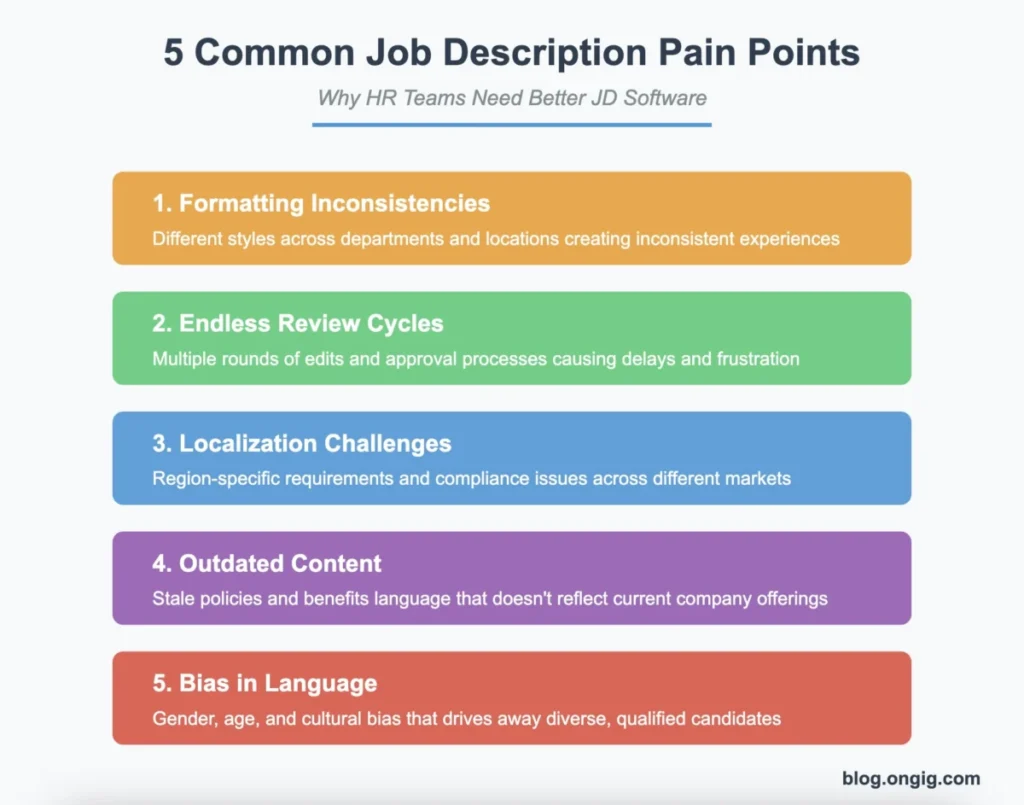
Key Challenges Addressed by Advanced JD Software
The adoption of specialized job description software is driven by a need to overcome several persistent challenges in modern recruitment:
- Ensuring Diversity, Equity, and Inclusion (DEI): Research from organizations like Gartner consistently indicates that diverse teams outperform homogeneous ones. However, unconsciously biased language in job descriptions can deter qualified candidates from underrepresented groups. Modern JD software actively identifies and mitigates such biases, broadening the applicant pool and fostering a more inclusive hiring process. For example, terms like "ninja" or "rockstar" can subtly lean masculine, while "strong communication skills" can sometimes mask a preference for extroversion.
- Navigating Regulatory Compliance: The landscape of employment law is in constant flux. Pay transparency laws, such as those in New York, California, and Colorado, mandate the disclosure of salary ranges in job postings. Beyond this, EEO statements, disability accommodation notices, and other legal disclaimers must be accurately included. Manual adherence to these regulations is prone to error and can lead to costly fines or litigation. Software automates these checks, providing a critical layer of protection.
- Boosting Recruitment Efficiency and Scalability: In large organizations, the volume of job descriptions can be overwhelming. Creating, reviewing, and publishing each one manually consumes significant recruiter time. Software with bulk editing, intelligent templating, and automated workflows drastically reduces administrative overhead, allowing recruiters to focus on candidate engagement and strategic initiatives rather than busywork.
- Enhancing Candidate Experience and Employer Branding: A poorly written, jargon-filled, or inconsistent job description can deter top talent. Conversely, clear, engaging, and brand-aligned job postings attract higher-quality applicants. Software helps maintain consistency in tone and messaging, reflecting positively on the employer brand and ensuring candidates have a positive first impression. Data from LinkedIn suggests that clear job descriptions can increase application rates by up to 15-20%.
- Achieving Internal Consistency and Governance: For compensation teams, HR business partners, and legal departments, maintaining a consistent job architecture and ensuring that job descriptions align with internal leveling and pay structures is paramount. Tools like JobArchitect and JDXpert are designed to support this, providing a single source of truth for all job-related data and facilitating internal auditing processes.
Leading Job Description Software Solutions in 2026
The market for job description software is robust, with platforms catering to a range of organizational needs and sizes. Here’s a detailed look at some of the prominent players:
1. Ongig’s Text Analyzer
- Best for: Talent acquisition teams seeking scalable, inclusive, and on-brand job descriptions.
- Key Features: Comprehensive bias detection (gender, age, race, disability), pay transparency compliance flagging, inclusive language suggestions, brand voice consistency, bulk editing, ATS integration, and an extensive library of optimized job description templates.
- Analysis: Ongig stands out for its deep integration of bias detection with pay transparency features, offering a holistic solution for modern recruitment challenges. Its focus on scalability makes it suitable for enterprises managing a high volume of diverse roles. Industry feedback often highlights its user-friendly interface despite its advanced capabilities.
- Pricing: Starts at $13,900/year, with discounts for nonprofits and smaller organizations.
- Free Trial: Yes (7-day trial and custom demo).
- Website: https://www.ongig.com
2. Textio
- Best for: Teams prioritizing inclusive and brand-aligned job postings, particularly those with a strong emphasis on data-driven language optimization.
- Key Features: Predictive text scoring for inclusivity and performance, real-time guidance on tone and phrasing, bias highlights, company-specific language insights, and integrations with major ATS platforms.
- Analysis: Textio pioneered the application of augmented writing in HR, focusing on predictive analytics to improve job post performance. Its strength lies in its ability to provide data-backed insights into how language impacts candidate attraction and diversity. While powerful, its enterprise-focused pricing reflects its sophisticated analytics.
- Pricing: Custom enterprise pricing.
- Free Trial: No free trial, but demos are available.
- Website: https://textio.com
3. Datapeople
- Best for: Companies with distributed teams looking for JD consistency, performance insights, and collaborative features.
- Key Features: Bias detection, readability scores, role-specific content suggestions, version control, analytics dashboard to track JD performance, and robust collaboration tools for team consistency.
- Analysis: Datapeople distinguishes itself with its strong focus on team collaboration and analytics, helping organizations maintain a consistent voice across diverse hiring teams. Its dashboard provides valuable insights into what language resonates with candidates, enabling continuous optimization.
- Pricing: Custom quote based on company size.
- Free Trial: No free trial, but demos are available.
- Website: https://datapeople.io
4. JobArchitect (by Salary.com)
- Best for: Compensation and HR teams aligning job content with pay structure, internal leveling, and market benchmarking.
- Key Features: Extensive job library, robust compensation data integration, job family and career pathing tools, workflow management for job approval, and analytics for pay equity.
- Analysis: JobArchitect is an invaluable tool for organizations where compensation and internal equity are primary concerns. Its direct integration with Salary.com’s vast compensation data allows for precise benchmarking and ensures that job descriptions accurately reflect internal value and market rates. This platform is particularly beneficial for establishing and maintaining a clear job architecture.
- Pricing: Starts around $5,000/year (based on company size/features).
- Free Trial: No free trial, but demos are available.
- Website: https://www.salary.com/solutions/jobarchitect
5. ChatGPT + JD Prompts
- Best for: Small teams or solo recruiters seeking quick drafts, editing assistance, or creative ideas for job descriptions on a limited budget.
- Key Features: AI-powered content generation, rephrasing, summarization, and idea generation based on prompts. Can be guided to include specific elements or adopt certain tones.
- Analysis: While not a dedicated JD software, general-purpose AI models like ChatGPT have become a powerful, accessible tool for initial drafting. Its utility is largely dependent on the quality of the prompts, and it lacks specialized features like automated compliance checks or advanced bias detection without explicit instructions. It serves as an excellent starting point for content creation, but requires human oversight for accuracy and legal adherence.
- Pricing: $20/month for GPT-4 (free GPT-3.5 version available).
- Free Trial: Yes (free tier available).
- Website: https://chat.openai.com/
6. JDXpert
- Best for: HR teams in highly regulated industries needing robust approval workflows, auditing capabilities, and detailed version history for job descriptions.
- Key Features: Centralized job description repository, customizable approval workflows, robust audit trails, version control, compliance tracking, and integration with HRIS and ATS.
- Analysis: JDXpert excels in governance and control, making it ideal for organizations with complex internal processes and strict regulatory requirements. Its focus on structured data and comprehensive audit trails ensures accountability and historical accuracy, which is paramount in sectors like finance, healthcare, or government.
- Pricing: Starts at ~$10,000/year (based on seats and number of JDs).
- Free Trial: No free trial, but demos are available.
- Website: https://www.jdxpert.com
7. Applied
- Best for: Organizations prioritizing unbiased hiring throughout the entire recruitment funnel, extending beyond just the job description.
- Key Features: Bias detection in job descriptions, anonymized application review, structured interview questions, skills-based assessments, and analytics on diversity outcomes.
- Analysis: Applied offers a broader platform for bias reduction, beginning with the job description and extending through the candidate assessment process. Its emphasis on anonymized review and skills-based evaluation helps organizations make more objective hiring decisions, addressing systemic biases that can occur at multiple stages of recruitment.
- Pricing: Starts at £3,500/year (~$4,300 USD); nonprofit pricing available.
- Free Trial: Yes (7-day free trial).
- Website: https://www.beapplied.com
8. RoleMapper
- Best for: Large enterprises and public sector organizations requiring governed, audit-ready job descriptions within a broader job architecture framework.
- Key Features: Job role design and architecture tools, skills taxonomy, workflow management, detailed reporting, and integration with workforce planning systems.
- Analysis: RoleMapper focuses on creating a comprehensive job architecture that supports strategic workforce planning. It helps organizations define roles, skills, and career paths, ensuring that job descriptions are not isolated documents but integral parts of a larger talent strategy. Its governance features make it suitable for complex organizational structures.
- Pricing: Custom quote based on company size.
- Free Trial: No free trial, but demos are available.
- Website: https://www.rolemapper.tech/
9. MoshJD
- Best for: Compensation and HR teams needing a centralized job description inventory with built-in templates, pay benchmarking, and robust governance features.
- Key Features: Centralized JD library, customizable templates, compensation benchmarking data, version control, and compliance checks.
- Analysis: MoshJD positions itself as a modern alternative to legacy systems, emphasizing accuracy and governance across all job records. Its focus on a centralized, reliable inventory of job descriptions, coupled with pay benchmarking capabilities, makes it attractive for organizations keen on maintaining strict control over their compensation structures and internal equity.
- Pricing: Custom quote.
- Free Trial: 30-day money-back guarantee.
- Website: https://www.moshjd.com/
10. Workable
- Best for: Growing teams that desire combined JD writing assistance and comprehensive ATS capabilities within a single platform.
- Key Features: AI-powered job description generator, a vast library of templates, candidate sourcing tools, interview scheduling, applicant tracking, and basic bias detection.
- Analysis: Workable offers an integrated solution, making it appealing for smaller to mid-sized organizations that prefer an all-in-one recruitment platform. While its JD writing features are solid, its primary strength lies in its full ATS functionality, providing a seamless experience from job creation to hire.
- Pricing: Starts at $299/month.
- Free Trial: Yes.
- Website: https://www.workable.com/
Strategic Implications and Future Outlook
The continued evolution of job description software underscores a broader trend in HR technology: the shift from purely administrative tools to strategic enablers. For organizations, investing in the right JD software offers multifaceted benefits:
- Reduced Legal Risk: Automated compliance checks significantly lower the probability of costly legal disputes arising from non-compliant or discriminatory job postings.
- Enhanced Talent Attraction: Well-crafted, inclusive job descriptions expand the talent pool, attracting more diverse and qualified candidates. This directly impacts an organization’s ability to innovate and compete.
- Operational Efficiency: Automating mundane tasks frees up HR and TA professionals to focus on higher-value activities, such as candidate engagement, strategic planning, and fostering a positive employee experience.
- Improved Employer Brand: Consistent, professional, and transparent job postings reinforce a positive employer brand, positioning the organization as an employer of choice.
- Data-Driven Decision Making: Analytics provided by these platforms offer insights into what language performs best, enabling continuous optimization of recruitment strategies.
Looking ahead, industry analysts predict further integration of generative AI to create more personalized job descriptions tailored to specific candidate segments. Predictive analytics will likely advance, offering insights into which language changes will yield the most diverse and qualified applicant pools. The focus will continue to be on creating job descriptions that are not only compliant and efficient but also deeply human-centric, engaging candidates on a personal level.
Choosing the right job description software in 2026 requires a thorough assessment of an organization’s specific needs, existing tech stack, and strategic priorities. Whether the primary concern is bias detection, compliance, compensation alignment, or overall recruitment efficiency, a tailored solution exists. These platforms empower HR and talent acquisition teams to move beyond mere job posting, transforming job descriptions into powerful tools that drive strategic talent outcomes.






