

The digital marketing landscape is undergoing a fundamental transformation as traditional metrics like individual keyword rankings lose their status as the sole indicators of search success. For years, businesses measured SEO performance by their ability to secure the "number one spot" for high-volume terms. However, as the buyer journey becomes increasingly fragmented across multiple platforms, search engines, and artificial intelligence interfaces, a more comprehensive metric has emerged: SEO Share of Voice (SoV). This metric represents a strategic shift from tracking isolated data points to measuring a brand’s total organic visibility within a specific market or topic area.
The Shift from Rankings to Market Dominance
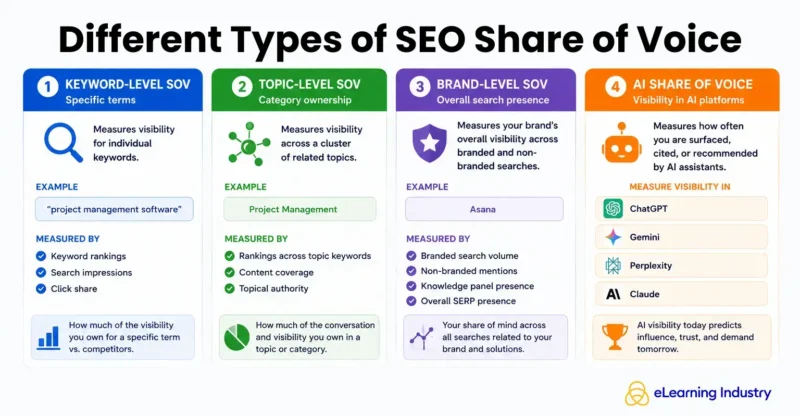
In the modern search environment, ranking for a handful of keywords no longer guarantees market attention. The contemporary buyer journey is non-linear; prospects rarely conduct a single Google search and proceed directly to a purchase. Instead, they engage in extensive research, navigating through industry publications, comparison directories, expert articles, and AI-driven recommendation tools. Consequently, a company may dominate a specific high-volume keyword but remain invisible during the critical research and comparison phases of the customer journey.
SEO Share of Voice addresses this gap by measuring the percentage of the total search landscape a brand occupies relative to its competitors. It evaluates presence across a broad spectrum of keywords, topics, and categories. For marketing leaders in competitive sectors such as Software as a Service (SaaS), Learning Management Systems (LMS), and Human Resources (HR) technology, SoV provides a macro-level view of brand authority. It answers the fundamental question: "How much of the total market conversation does our brand actually own?"

The Chronology of Search Metrics: From Clicks to Authority
The evolution of search measurement can be traced through three distinct eras. In the early 2000s, the focus was almost entirely on keyword density and high-volume rankings. By the mid-2010s, search engines became more sophisticated, shifting the focus toward user intent and click-through rates (CTR). Today, we have entered the era of "Topical Authority," where search engines and AI models prioritize brands that demonstrate comprehensive knowledge across entire subject areas.
This transition has been accelerated by Google’s integration of the Helpful Content Update and the introduction of Generative Experience (SGE). These updates have diminished the value of "thin" content designed only to rank for specific terms. Instead, they reward an ecosystem of interconnected content. As a result, the industry has seen a move toward Share of Voice as the primary KPI for brand awareness and demand generation.
Calculating the Value of Visibility
The mathematical foundation of SEO Share of Voice is straightforward, yet the insights it provides are complex. The standard formula is:
SEO Share of Voice = (Your Brand’s Estimated Visibility / Total Market Visibility) × 100
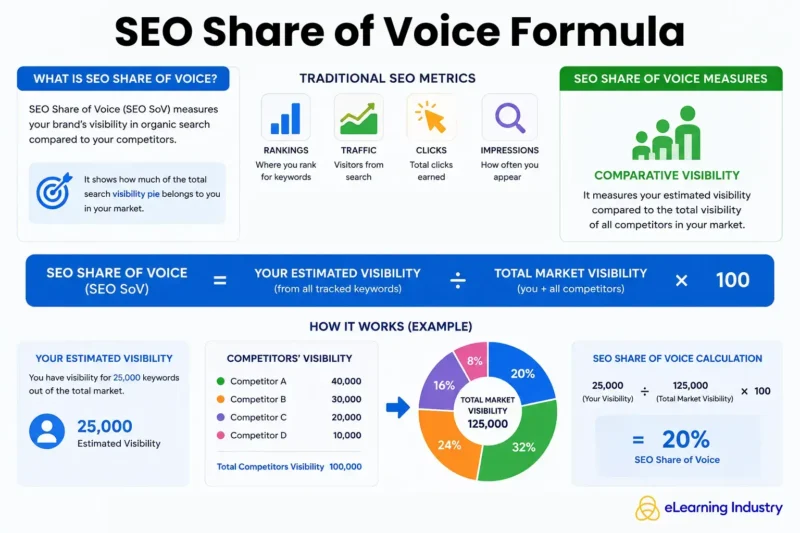
Visibility is typically calculated by weighing ranking positions against search volume and estimated click-through rates. For example, a top-three ranking on a high-volume keyword carries significantly more "visibility points" than a bottom-page ranking on a low-volume term. When these points are aggregated across thousands of relevant keywords within a category—such as "enterprise training software"—a brand can determine its true market share.
Data from major SEO platforms indicates that a high Share of Voice often correlates with higher "Excess Share of Voice" (eSOV), a phenomenon where a brand’s share of advertising or visibility is greater than its current market share. Historically, brands that maintain a positive eSOV tend to see a subsequent increase in actual market share and revenue over the following 12 to 18 months.
The Four Pillars of Modern Share of Voice
To accurately measure and improve SoV, organizations must look beyond a single percentage and analyze visibility at four distinct levels:
1. Keyword-Level Visibility: This involves tracking performance for high-priority, high-intent terms. While it is the most granular level, it remains essential for understanding commercial performance.
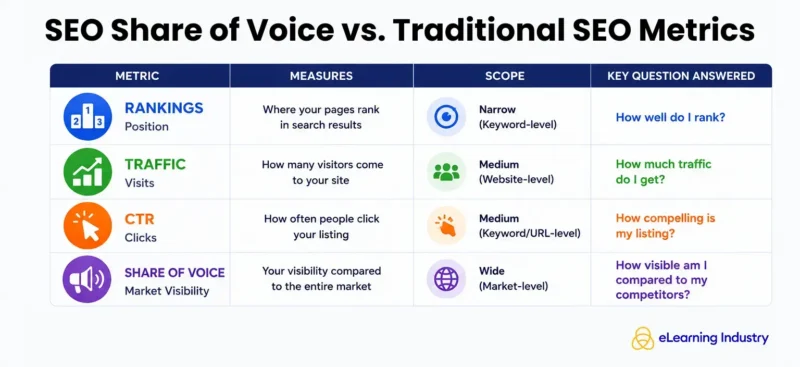
2. Topic-Level Ownership: This measures visibility across an entire subject matter. For an LMS provider, this would mean owning the conversation not just for "LMS," but for "employee onboarding," "compliance training," and "upskilling strategies."
3. Brand-Level Presence: This provides an executive-level view of how the brand compares to its primary competitors across the entire digital ecosystem.
4. AI Share of Voice (The New Frontier): As users shift toward AI assistants like ChatGPT, Perplexity, and Google Gemini, visibility is being redefined by "mentions" and "citations." AI Share of Voice measures how often an AI model recommends a brand or references its content when answering user queries.
The Rise of Generative Engine Optimization (GEO)
The emergence of AI-driven search has introduced Generative Engine Optimization (GEO). Unlike traditional SEO, which focuses on satisfying an algorithm that ranks links, GEO focuses on influencing the Large Language Models (LLMs) that generate direct answers.
Industry analysts suggest that tomorrow’s search leaders will be measured not by where they rank on a page, but by the frequency and sentiment of their citations within AI responses. To win in this environment, brands must secure third-party validation. Mentions in reputable industry directories, guest posts on high-authority sites, and citations in analyst reports serve as "trust signals" that AI models use to determine which companies to recommend. For B2B organizations, appearing in "Top 10" lists and expert roundups is no longer just a PR tactic; it is a core component of AI visibility.
Strategic Implementation: The OWN Framework
To improve SEO Share of Voice, high-performing brands are increasingly adopting structured frameworks to move from data collection to action. One such approach is the "OWN Framework," which categorizes efforts into three strategic pillars:
- Observe Competitors: Brands must look beyond their direct business rivals to identify "search competitors"—entities like review sites, publishers, and forums that capture search real estate. By analyzing where these competitors are gaining ground, brands can identify content gaps and emerging trends.
- Win Topic Clusters: Instead of creating disconnected blog posts, organizations must build "content ecosystems." This involves creating a central "pillar" page for a major topic and surrounding it with "cluster" content that addresses every related sub-topic. This structure signals to search engines that the brand is a definitive authority on the subject.
- Nurture Authority: Authority is built through original research, proprietary data, and digital PR. When a brand publishes a benchmark report that is cited by dozens of industry news sites, it creates a powerful network of backlinks and mentions that elevates its Share of Voice across all related keywords.
Implications for Demand Generation and Revenue
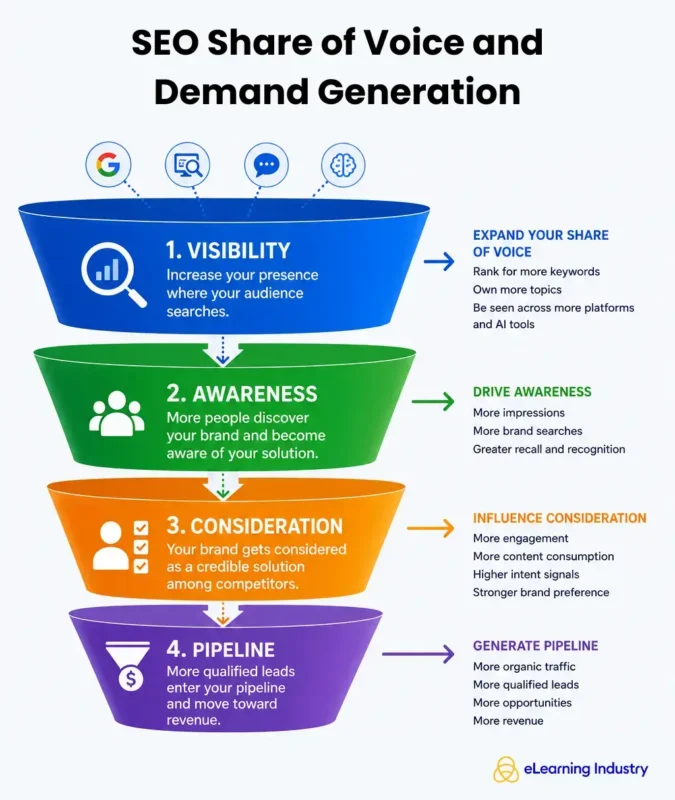
The relationship between visibility and revenue is becoming increasingly apparent in complex B2B sales cycles. Research into the "Buyer’s Journey" suggests that the average B2B buyer engages with approximately 10 to 15 pieces of content before ever contacting a sales representative.
A high Share of Voice ensures that a brand is present during these early-stage interactions. This consistent exposure builds "brand salience"—the degree to which a brand is thought of or noticed when a customer is in a buying situation. In essence, the brands that own the search conversation are the ones that buyers instinctively trust when they are ready to make a purchase.
Future Outlook: The Expanding Definition of Visibility
As we look toward the future of search, the definition of visibility will continue to broaden. We are moving toward an era where "Share of Voice" will encompass search engines, AI interfaces, social media discovery, and professional communities. The dominance of the "blue link" is fading, replaced by a complex web of recommendations, citations, and references.
For businesses, the mandate is clear: success in the digital age requires a shift in perspective. Those who continue to focus solely on individual rankings will likely find themselves sidelined by competitors who understand the power of topical ownership and AI discoverability. The future of search belongs to the brands that are consistently discovered, cited, and recommended wherever their audience seeks answers. SEO Share of Voice is the compass that will guide marketing leaders through this new, fragmented, and highly competitive reality.






