
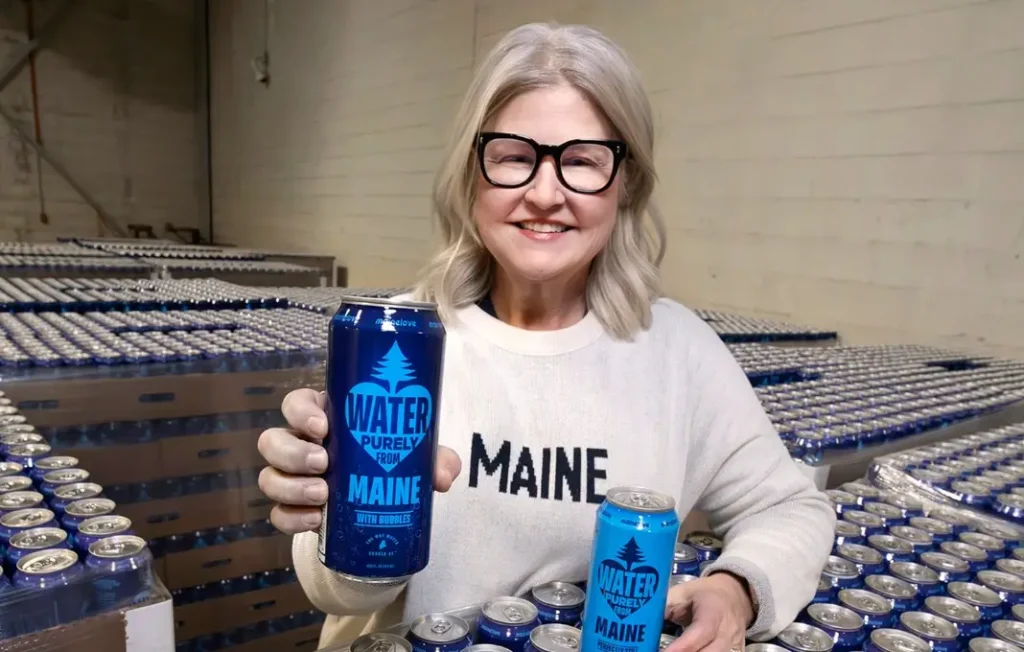
The craft beer industry in Maine, renowned for its innovation and quality, has been grappling with a significant challenge: a downturn in alcohol consumption. This shift has left many local breweries with idle production lines and underutilized capacity, creating a pressing need for diversified revenue streams. In response to this evolving landscape, Jen Millard, a 12th-generation Mainer, has launched mainelove, a canned water company that ingeniously leverages the existing infrastructure of these breweries, transforming a potential crisis into a burgeoning opportunity for both the brewers and the state’s economy.
Millard’s innovative approach centers on an "asset-light" business model, a strategy that minimizes capital expenditure by utilizing shared resources. By partnering with local breweries during their non-brewing hours, mainelove taps into the pristine waters of Sebago Lake, a vital resource for many Maine brewers, and cans it into a range of products, including still and sparkling water, and flavored seltzers. This symbiotic relationship not only provides a new income source for breweries but also ensures that the economic benefits derived from Maine’s natural water resources remain within the state.
The Genesis of mainelove: A Solution Born from Observation
The idea for mainelove began to crystallize in early 2024 during a visit Millard made to her cousin, Frank Grondin, owner of Brickyard Hollow brewery. Observing the brewery’s idle equipment during a weekday, Millard inquired about the downtime. Grondin explained that their weekly beer production was complete, a sentiment echoed by numerous other breweries across Maine. This observation coincided with Millard’s awareness of declining alcohol consumption trends, a factor contributing to underutilized brewing capacity nationwide. The U.S. alcohol market, while robust, has seen shifts in consumer preferences, with a notable increase in non-alcoholic beverage options and a plateauing or decline in traditional beer sales in certain segments. According to industry reports, while craft beer sales have shown resilience, overall beer consumption has seen a gradual decline over the past decade, prompting brewers to seek alternative ventures.
"I had always dreamed of starting a business in my home state, but never found the right opportunity," Millard shared in a recent interview. "That changed in early 2024 when I was back in Maine visiting my cousin, Frank Grondin, at his brewery, Brickyard Hollow. During that visit, I noticed the brewing facilities were sitting idle. Frank explained they had already produced all of their beer for the week, and I later found the same was true at many breweries across Maine. With alcohol consumption declining, a lot of brewing capacity was going unused for days at a time. As part of my research, I walked through more than 40 breweries in Maine and heard the same story everywhere."
This widespread underutilization of brewing infrastructure, coupled with the high quality of Maine’s water, particularly from sources like Sebago Lake, sparked Millard’s "aha moment." "At the same time, I knew that one of the reasons Maine beer is so great is its access to Sebago Lake water," she explained. "That led to the aha moment: Why don’t we can Maine’s great water to help breweries diversify their revenue?"
An Asset-Light Model: Efficiency and Economic Retention
Millard’s business model is fundamentally an asset-light approach, a strategy that has gained traction across various industries for its capital efficiency and scalability. In this model, mainelove retains ownership of its intellectual property, including drink formulas, and manages the procurement of raw materials like aluminum cans. The crucial manufacturing process – the canning of water – is outsourced to partner breweries. This arrangement allows mainelove to bypass the substantial capital investments typically required for establishing a bottling or canning facility, which can run into millions of dollars.
"Our model is designed differently," Millard elaborated. "We provide the drink formulas, purchase the aluminum cans and ship them to our three brewery partners. They produce and can the water, then deliver the finished product to our warehouse. All of our production partners meet GMP standards required for food-grade manufacturing. Since water is classified as a food product by the FDA, those standards are essential."
This operational structure allows for rapid scaling. Instead of investing in building and maintaining its own manufacturing plants, mainelove can onboard new brewery partners as demand grows. This flexibility is particularly advantageous in the fast-paced beverage industry, where market trends can shift quickly.
Mutual Benefits: A Win for Brewers and the State
The partnership model offers significant advantages to the breweries involved. By utilizing their existing equipment and labor during off-peak hours, they generate additional revenue without the need for major capital outlays or the complexities of developing and marketing a new product line independently. This provides a crucial buffer against the volatility of the beer market and helps maintain employment within the brewing sector.
"This model benefits our brewery partners by bringing them into the water economy and creating an additional revenue stream," Millard stated. "More importantly, it helps keep more of the economic value of Maine water in Maine."
The economic impact on the state of Maine is a cornerstone of Millard’s vision. Historically, Maine has been a source of water exports, but the value generated has not always been retained locally. mainelove aims to change this by creating a localized value chain. By processing and canning water within the state and distributing it through local channels, the company fosters job creation and economic activity that directly benefits Maine communities.
"Throughout this process, I kept asking myself: How do I build something meaningful in Maine? That question led me to this brewer model," Millard reflected. "We have 65 brewers pulling from Sebago Lake, and even more if you include the broader watershed. The water quality is incredible, thanks to Sebago Lake and the forests that surround it, which act as natural filters."
The cooperative spirit of the model is further exemplified by its resemblance to established cooperative models within Maine’s maritime industries, such as lobster and oyster harvesting. "In many ways, we are helping brewers evolve into co-packers," Millard explained. "We pay them a co-pack-style rate, similar in spirit to Maine’s cooperative models in industries like lobster and oysters. They complete production, send the product for testing and we sell it under one master brand."
Environmental Stewardship and Community Focus
Beyond economic considerations, mainelove places a strong emphasis on environmental stewardship. The company’s reliance on Sebago Lake water necessitates a commitment to protecting the watershed. This commitment is reflected in mainelove’s practice of giving back to local land trusts, recognizing that the long-term health of the lake is intrinsically linked to the preservation of the surrounding forests.
"We also strongly believe in giving back to land trusts because if we do not protect the forests, we will not protect the lake," Millard emphasized. "Taken together, it is a beautiful model: community-driven, job-creating, environmentally aware—and asset-light."
This integrated approach underscores a holistic vision for business, where profitability is intertwined with community well-being and ecological responsibility. The efficient nature of water canning, which uses less water than beer production due to the absence of boiling processes, further enhances the model’s sustainability.
Investor Appeal: The Power of an Asset-Light Structure
From an investor’s perspective, mainelove’s asset-light model presents a compelling proposition. By avoiding the significant capital expenditure associated with owning and operating manufacturing facilities, the company can reallocate financial resources towards growth initiatives such as marketing, sales, and distribution. This lean operational structure reduces financial risk and enhances the potential for higher returns on investment.
"I own almost no equipment besides a forklift. We rent warehouse space in Westbrook, Maine," Millard noted. "That asset-light structure is highly attractive to investors because the capital that would normally be tied up in a manufacturing facility can instead be used to drive growth. Rather than sinking money into heavy operating costs, we can direct more cash flow into promotions, sales and marketing, which is critical in the beverage business."
This financial agility allows mainelove to be more responsive to market opportunities and to scale its operations more rapidly than companies burdened by high fixed costs.
Rapid Expansion: From Maine to National Markets
The scalability of mainelove’s model has already yielded impressive results. In its first year of operation, the company focused on establishing a strong presence within Maine, securing placement in over 600 retail locations. Building on this success, mainelove has rapidly expanded its distribution footprint to four additional states: New Hampshire, Massachusetts, Vermont, and Connecticut.
The next phase of expansion is particularly ambitious, with a significant launch planned for Florida in the fall. This strategic move into a large and diverse market is driven by several factors. Maine’s established reputation for quality and natural resources resonates well with consumers in Florida, particularly among the "snowbirds" who frequently travel between the two regions. Furthermore, many areas in Florida face water quality challenges, making Maine-sourced water a particularly attractive and premium offering.
"Scalability is fast and furious!" Millard exclaimed. "Year one was focused on building distribution in Maine, where we are now available in more than 600 stores. We are currently distributing in five states: Maine, New Hampshire, Massachusetts, Vermont and Connecticut, to be followed by a major expansion into Florida this fall."
The licensing process in Florida proved to be remarkably swift, a testament to the product’s compliance and market readiness. "Florida is a particularly attractive opportunity," Millard explained. "Maine has a strong reputation there, especially among snowbirds who travel back and forth seasonally. Florida also faces significant water quality challenges across many areas, making Maine-sourced water an especially compelling proposition. We were licensed in Florida in just one day, and we are excited about what that market could mean for the brand."
Broader Implications for the Beverage Industry
The success of mainelove offers a blueprint for other industries facing similar challenges. The model demonstrates how underutilized assets and existing infrastructure can be repurposed to create new economic opportunities. For the beverage industry, it highlights the potential for collaboration and shared resources to foster innovation and resilience.
As consumer preferences continue to evolve, and the demand for healthier and more sustainable options grows, companies like mainelove are poised to thrive. By focusing on local sourcing, environmental responsibility, and community engagement, mainelove is not just selling canned water; it is selling a story, a commitment to Maine, and a vision for a more sustainable and interconnected future for its local economy and beyond. The company’s trajectory suggests a promising future, not only for its own growth but also for the broader revitalization of Maine’s artisanal and manufacturing sectors.








