
As the July 31 filing deadline approaches, small business owners and plan sponsors operating self-insured health arrangements are shifting their focus toward the Patient-Centered Outcomes Research Institute (PCORI) fee. Established under the Affordable Care Act (ACA), this federal mandate requires specific health plan providers and self-insured employers to contribute to a national fund dedicated to clinical effectiveness research. While often handled by insurance carriers for fully insured plans, the responsibility for reporting and paying these fees falls squarely on the shoulders of employers who utilize self-insured models, including various types of Health Reimbursement Arrangements (HRAs).
The PCORI fee represents a critical, albeit sometimes overlooked, compliance requirement for the small business community. Initially designed as a temporary measure to sunset in 2019, the fee was granted a ten-year extension by Congress through the Further Consolidated Appropriations Act of 2020. This extension ensures that the fee will remain a fixture of the corporate tax and benefits landscape until at least September 30, 2029. For organizations navigating the complexities of modern employee benefits, understanding the nuances of PCORI—from calculation methodologies to IRS Form 720 filing procedures—is essential to avoiding costly penalties and maintaining regulatory standing.
The Genesis and Purpose of PCORI
The Patient-Centered Outcomes Research Institute was established as an independent, nonprofit organization by the ACA in 2010. Its primary mission is to fund and disseminate research that helps patients, caregivers, and clinicians make better-informed healthcare decisions. Unlike traditional medical research that may focus on the molecular level of disease, PCORI focuses on "comparative clinical effectiveness research." This involves studying which medical treatments, diagnostic tests, and delivery methods work best for specific populations under real-world conditions.
By pooling resources through a national fee, the federal government aims to shift the healthcare paradigm toward consumerism and value-based care. The research funded by these fees is intended to reduce the "information gap" in the medical industry, providing empirical data on which interventions provide the highest quality of life and the most efficient outcomes. Since its inception, PCORI has awarded billions of dollars in grants to research projects across the United States, influencing everything from mental health protocols to chronic disease management.

Defining Liability: Who Must Pay the PCORI Fee?
Determining liability for the PCORI fee depends largely on the structure of the health benefit offered. For "fully insured" plans—where the employer pays a premium to an insurance company—the insurer is responsible for the fee. In these cases, the cost is typically baked into the premium rates, requiring no direct action from the employer.
However, the landscape changes for "self-insured" plans. Under these arrangements, the employer assumes the financial risk for providing healthcare benefits. This category includes:
- Traditional Self-Insured Group Health Plans: Large or mid-sized companies that pay claims directly rather than through an insurance carrier.
- Qualified Small Employer HRAs (QSEHRA): Designed for businesses with fewer than 50 full-time employees that do not offer a group health plan.
- Individual Coverage HRAs (ICHRA): A flexible model allowing employees to purchase their own individual insurance with tax-free employer contributions.
- Group Coverage HRAs (GCHRA): Also known as "integrated HRAs," these are offered alongside a group medical plan.
A notable distinction exists for integrated HRAs. If an employer offers a GCHRA alongside a self-insured medical plan from the same plan sponsor, the two are treated as a single plan, and only one fee is paid per covered life. Conversely, if a GCHRA is offered alongside a fully insured medical plan, the employer must pay the PCORI fee for the HRA, while the insurer pays the fee for the medical plan.
Exemptions do exist to alleviate the administrative burden on certain benefit types. Health Savings Accounts (HSAs) and Archer Medical Savings Accounts (MSAs) are exempt. Furthermore, "excepted benefits," such as standalone dental or vision plans that are not integrated into the primary medical coverage, do not trigger PCORI fee requirements.
A Chronology of PCORI Fee Adjustments
The financial impact of the PCORI fee has evolved steadily since its implementation. The fee is calculated based on the "average number of lives covered" under the plan during the plan year. Because the fee is adjusted annually for inflation—specifically tied to the percentage increase in the projected per capita amount of National Health Expenditures—the cost per covered life has seen a consistent upward trajectory.

The timeline of recent fee adjustments illustrates this trend:
- 2022-2023 Plan Years: The fee was set at $3.00 per covered life for plan years ending after October 1, 2022.
- 2023-2024 Plan Years: The rate rose to $3.22 per covered life.
- 2024-2025 Plan Years: The rate increased to $3.47 per covered life.
- 2025-2026 Plan Years: For plans ending on or after October 1, 2025, and before October 1, 2026, the fee has been set at $3.84 per covered life.
This data suggests a compound annual growth rate that employers must account for in their long-term benefits budgeting. For a company with a calendar year plan (ending December 31, 2025), the payment due in July 2026 will be calculated at the $3.84 rate.
Methodologies for Calculating "Covered Lives"
One of the most complex aspects of PCORI compliance is accurately determining the "number of lives" covered by a plan. The IRS provides three primary methods for self-insured plan sponsors to calculate this figure:
- The Actual Count Method: The sponsor adds the total number of lives covered for each day of the plan year and divides that sum by the number of days in the plan year.
- The Snapshot Method: The sponsor adds the total number of lives covered on specific dates (at least one date per quarter) and divides by the number of dates used. The dates must be consistent across quarters (e.g., the first day of each quarter).
- The Form 5500 Method: This method uses the participant counts reported on the organization’s Form 5500 (Annual Return/Report of Employee Benefit Plan). This is often the simplest method for larger organizations that are already required to file Form 5500.
For HRAs, the calculation is slightly more favorable. Plan sponsors are generally allowed to treat each HRA as covering only one life per participant, meaning spouses and dependents are often excluded from the HRA-specific PCORI count, provided the HRA is the only self-insured plan the employer offers. However, if the HRA is integrated with a self-insured medical plan, the standard "covered lives" rules (including dependents) apply to the combined plan.
The Filing Process: IRS Form 720
The PCORI fee is reported and paid annually using IRS Form 720, the Quarterly Federal Excise Tax Return. While Form 720 is generally a quarterly filing for other types of excise taxes (such as fuel or communications taxes), the PCORI fee is unique in that it is only reported once per year, specifically in the second quarter.
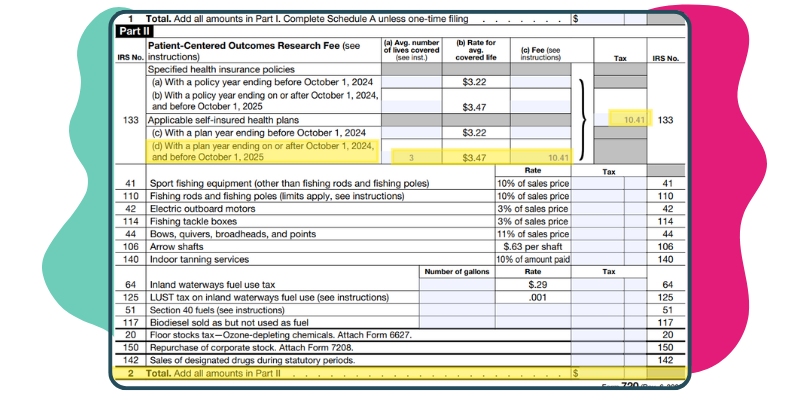
The deadline is strictly set for July 31. If July 31 falls on a Saturday, Sunday, or legal holiday, the return is considered timely if filed by the next business day. For the 2026 filing season, the form must be sent to the IRS office in Ogden, Utah.
Employers must navigate Part II of the form, specifically focusing on IRS No. 133. The form distinguishes between plans with years ending before October 1 and those ending on or after October 1 of the preceding year. Accurate completion of the "Payment Voucher" (Form 720-V) is also required to ensure the United States Treasury correctly attributes the payment to the organization’s EIN.
Compliance Risks and Expert Perspectives
The consequences of failing to meet PCORI obligations can be significant. Under Internal Revenue Code § 6651, the IRS imposes penalties for failure to file and failure to pay. The penalty for late filing is typically 5% of the unpaid tax for each month or part of a month the return is late, capped at 25%.
David Blain, CEO of BlueSky Wealth Advisors, emphasizes that the administrative burden of rectifying a missed filing often outweighs the cost of the fee itself. "Forgetting or choosing not to pay this fee can lead to penalties and interest charges, which can be significant and add unnecessary costs," Blain noted. He observed that miscalculations of covered lives frequently trigger complications during annual audits. "Acting swiftly to correct the oversight and promptly communicating with the IRS has helped in minimizing the penalties for our clients."
Industry analysts point out that while the dollar amount of the PCORI fee might seem negligible for a small business with only a few employees, the "compliance tail" is long. A failure to file Form 720 can be flagged during Department of Labor (DOL) audits or during the due diligence phase of a business merger or acquisition, potentially signaling a broader lack of ERISA or ACA compliance.

Broader Implications for the Small Business Ecosystem
The continued existence of the PCORI fee reflects a broader regulatory commitment to evidence-based medicine. For small business owners, the fee is more than just a tax; it is a contribution to a body of research that may eventually lower healthcare costs by identifying and eliminating ineffective treatments.
However, the rise of "alternative" funding models like ICHRAs and QSEHRAs means more small businesses are becoming "plan sponsors" for the first time. In the past, a business with 20 employees would simply buy a Blue Cross or Aetna plan and let the carrier handle the paperwork. Today, that same business might use an ICHRA to give employees more choice. In doing so, the employer unknowingly steps into the role of a self-insured health plan sponsor, inheriting the PCORI filing requirement.
To manage this, many businesses are turning to HRA administration software. Platforms like PeopleKeep provide automated reporting tools that track the "number of lives" throughout the year, generating the necessary data points for Form 720 in a matter of clicks. This technological shift is becoming essential as the intersection of tax law and healthcare benefits becomes increasingly complex.
Conclusion and Future Outlook
As the federal government looks toward the 2029 sunset date for PCORI, the healthcare industry remains watchful for further extensions. Given the bipartisan interest in clinical effectiveness and the "consumerization" of healthcare, many analysts expect the fee to be made permanent or replaced with a similar funding mechanism in the next decade.
For the immediate future, small business owners must remain vigilant. The July 31 deadline serves as an annual reminder of the responsibilities that come with modern employee benefits. By maintaining accurate records of covered lives, understanding the shifting fee schedules, and utilizing professional tax advice or specialized administration software, employers can ensure they remain compliant while contributing to the ongoing evolution of American healthcare research. In an era where every line item in a business budget is scrutinized, the PCORI fee stands as a small but mandatory investment in the transparency and effectiveness of the medical marketplace.