Employee promotions represent pivotal moments within any organization, signaling growth, rewarding exceptional performance, and profoundly shaping how individuals perceive opportunity and fairness internally. While seemingly straightforward administrative tasks, the communication surrounding these advancements holds significant strategic weight, often determining their full motivational and cultural impact. For many managers, particularly within rapidly expanding organizations, the infrequent nature of writing promotion announcements can lead to messages that feel rushed, overly formal, or crucially, lacking the specific details that genuinely resonate with and motivate teams. This oversight, as revealed by extensive research, carries substantial consequences for employee engagement and long-term retention.
According to the Achievers Workforce Institute (AWI) Engagement and Retention Report, employees who feel genuinely appreciated are an astonishing 17 times more likely to envision a long-term future with their current company. Promotions stand out as one of the clearest and most potent opportunities to reinforce this vital sense of appreciation. However, their efficacy hinges entirely on how effectively they are communicated. A poorly articulated promotion announcement can dilute this powerful moment, turning a potential morale booster into a routine update, or worse, a source of confusion or perceived inequity. Conversely, a well-crafted announcement not only celebrates the individual but also reinforces organizational values, clarifies career pathways, and inspires the wider workforce.
This article delves into the critical elements and strategic considerations for developing impactful employee promotion announcements, moving beyond simple templates to a holistic understanding of their role in fostering a thriving organizational culture. It aims to equip leaders with the insights and frameworks necessary to transform these announcements from mere formalities into powerful drivers of trust, clarity, and sustained momentum.
Deconstructing the Anatomy of an Effective Promotion Announcement
At its core, an employee promotion announcement serves as a structured framework designed to clearly and confidently communicate an employee’s advancement. It provides a foundational structure for conveying essential details: who is being promoted, their new role, when it takes effect, and, critically, why the promotion matters. This structure, however, is not rigid; it allows ample room for personalization to suit the specific team, company culture, and communication channel.
For managers, these frameworks alleviate the pressure of "finding the right words," ensuring that promotions are announced in a manner that feels equitable, thoughtful, and genuinely motivating. Instead of sounding perfunctory or overly bureaucratic, a robust framework helps managers elevate a promotion into a meaningful recognition moment. It reinforces a culture of growth, provides clarity on success metrics, and showcases the opportunities available within the organization, both for the individual being recognized and for all observing what success looks like.
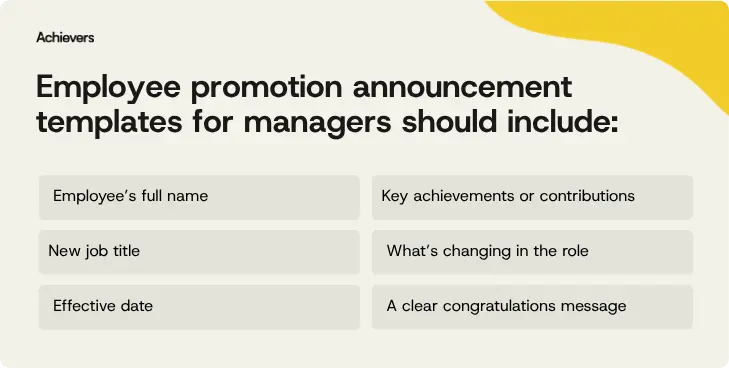
Promotions unequivocally deserve more than a quick, perfunctory update. They are moments that crystallize growth, validate recognition, and illustrate the pathway to success within an organization. Drawing upon best practices and insights from leading HR institutions, the following key elements form the bedrock of any impactful promotion announcement, regardless of the specific communication channel:
- Employee’s Full Name: Clarity and consistency are paramount, especially in company-wide or written announcements. This avoids any ambiguity and ensures the recognition is unmistakably attributed to the correct individual.
- New Job The title must be stated precisely as it will be officially used going forward. Clear titles are essential for helping teams understand reporting lines, delineating responsibilities, and knowing where to direct inquiries or decisions.
- Effective Date: Communicating when the change takes effect is crucial. This sets clear expectations for all stakeholders and enables teams to prepare for any corresponding shifts in responsibilities, workflows, or team structures.
- Key Achievements or Contributions: This is arguably the most vital component. Briefly yet specifically explaining why the promotion occurred is fundamental. Highlighting concrete accomplishments reinforces the principle of fairness, demonstrates meritocracy, and provides tangible examples of what success looks like in practice, thereby inspiring others. Generic praise, without this context, often falls flat.
- What’s Changing in the Role: Explicitly calling out new responsibilities, an expanded scope, or shifted focus areas is critical. This helps the team understand how the promoted employee’s role will evolve and how these changes might impact existing collaboration dynamics, projects, or team interactions.
- A Clear and Genuine Congratulations Message: The announcement must conclude with a sincere note of congratulations. This human element transforms the announcement from a mere administrative update into a heartfelt moment of recognition and celebration, fostering positive sentiment.
When these elements are consistently present, promotion announcements resonate as intentional and motivating, rather than hurried or formulaic. This consistency is particularly important in organizations experiencing rapid growth, where every communication moment plays a role in reinforcing trust, fostering clarity, and highlighting opportunities for development. An example of effective phrasing, as illustrated by a real-world scenario, would be: "I’m excited to share that Jordan Lee has been promoted to Senior Operations Manager, effective June 1. Over the past two years, Jordan has led our warehouse expansion, improved on-time delivery by 18%, and built a strong team culture rooted in accountability and collaboration." Such clear details eliminate ambiguity and reinforce fairness, factors that strongly influence trust and retention, especially in mid-sized and growing organizations navigating complex talent landscapes.
Strategic Communication: Tailoring the Message for Maximum Resonance
The tone of a promotion announcement must always align with the intended audience and the underlying purpose of sharing the news. The same promotion, while conveying consistent core facts, should and often must sound different depending on who is receiving the message and through which channel. This nuanced approach ensures that the announcement achieves its full strategic potential.

- Direct Team: For immediate team members, the tone should be personal, appreciative, and collaborative. Focus on the individual’s direct impact on the team, how their new role will affect daily operations, and express collective excitement for their continued contribution. This fosters team cohesion and minimizes disruption.
- Company-Wide: A broader audience requires a more formal yet celebratory tone. Here, the emphasis shifts to the employee’s alignment with company values, their contribution to broader strategic goals, and how their promotion exemplifies growth opportunities within the organization. This helps reinforce culture and inspire others across departments.
- External or Public (e.g., LinkedIn): For external audiences, the tone should be professional, concise, and focused on employer branding. Highlight the new role, perhaps a key achievement that reflects positively on the company, and convey congratulations for a well-deserved next step. This can serve as a powerful talent attraction tool.
Across all communication formats, it is crucial to avoid generic phrases such as "well-deserved" without providing specific context. On their own, such phrases fail to explain why the promotion occurred or what others can learn from it. The Achievers Workforce Institute’s State of Recognition Report consistently demonstrates that recognition is most effective when it is both specific and timely, directly correlating with stronger feelings of belonging and improved performance. When promotion announcements strike the right tone, they transcend the mere celebration of an individual; they actively reinforce clarity, cultivate trust, and build momentum across the entire workforce.
Maximizing Impact and Avoiding Common Pitfalls
Promotion announcements are fundamentally recognition moments, and like all forms of recognition, the manner of their delivery is as critical as the decision itself. A thoughtfully crafted announcement builds trust, reinforces fairness, and actively motivates others. Conversely, a rushed, vague, or poorly communicated announcement can have the opposite effect, breeding cynicism, confusion, and undermining morale. To ensure that an employee promotion announcement lands effectively and achieves its intended positive outcomes, several common mistakes must be consciously avoided:
- Skipping the "Why": A significant oversight is failing to explain why the promotion happened. When employees don’t understand the rationale, it can lead to speculation, perceived unfairness, and uncertainty about career paths. It deprives others of a clear example of what behaviors and contributions lead to advancement.
- Using Vague Praise Without Examples: Phrases like "great job" or "well-deserved" are insufficient on their own. They lack substance and fail to provide concrete evidence of the employee’s impact. This deprives the recognition of its power and fails to set a clear benchmark for other aspiring employees.
- Announcing Without Context for the Team: Simply stating a new title without explaining new responsibilities or how the change impacts team dynamics can create confusion, disrupt workflows, and leave team members feeling uninformed or disrespected. It can inadvertently create friction rather than celebration.
Instead, managers should actively strive to maximize the impact of their promotion announcements by adhering to the following best practices:
- Highlight Specific Contributions: Always connect the promotion to tangible results, projects, or behaviors. For instance, instead of "Alex was promoted due to strong performance," state, "Alex was promoted after leading three cross-functional launches that improved customer onboarding time by 22%." The difference lies not in length, but in clarity and impact.
- Connect the Promotion to Team or Business Goals: Demonstrate how the individual’s advancement contributes directly to broader organizational objectives. This reinforces the idea that individual success is intertwined with collective success and strategic priorities.
- Reinforce How Growth Happens in Your Organization: Use each promotion as a living example of the career progression pathways available. This helps demystify the advancement process, making it more transparent and achievable for other employees.
These moments are not just symbolic; they are instrumental. Achievers research underscores this, revealing that employees who receive weekly recognition are nine times more likely to report a strong sense of belonging – a fundamental driver of engagement and retention in today’s competitive labor market. When promotion announcements are handled with intentionality and strategic thought, they transcend the celebration of a single individual; they actively strengthen the organizational culture for every single person paying attention.
Tailoring Your Announcement to Audience and Channel
Once the fundamental structure and appropriate tone are established, the next crucial step involves tailoring the promotion announcement to the specific audience receiving it and the channel through which it will be delivered. The objective is not to rewrite the entire message from scratch, but rather to strategically emphasize the details that are most relevant and impactful for each audience, while judiciously removing or de-emphasizing those that are not.
- Leadership Audiences: For senior leadership, the announcement might focus more on the strategic implications of the promotion, such as how the new role supports key business objectives, addresses skill gaps, or contributes to succession planning within a critical department. Performance metrics and strategic value would be prioritized.
- Peers and Immediate Collaborators: For colleagues and direct teammates, the message should highlight how the promoted individual’s new role might affect day-to-day collaboration, project dynamics, or team structure. It should emphasize continued partnership and foster a sense of shared excitement.
- External or Public Audiences: When communicating externally, such as on LinkedIn or in a press release, the focus should be on celebrating the individual’s achievement in a way that enhances the company’s employer brand. This might include a concise summary of their impact and the significance of their new role for the company’s external reputation or market position.
Small, thoughtful adjustments like these ensure that the message remains relevant, respectful of the audience’s perspective, and maximally impactful. The difference between a generic and a tailored announcement is profound. When promotion announcements are crafted with such thoughtfulness, they achieve more than just informing; they build understanding, reinforce fairness, and help every audience member grasp what success truly looks like from their unique vantage point within or outside the organization. Ultimately, effective promotion announcements are not about saying more, but about saying the right things to the right people. By tailoring the message to both audience and channel, promotions become clearer, fairer, and imbued with deeper meaning. This strategic approach transforms a simple organizational update into a powerful moment that reinforces trust, transparency, and vividly illustrates what genuine growth entails within an organization.
Turning Employee Promotion Moments into Organizational Momentum
Promotion announcements are more than just administrative updates; they are critical moments that profoundly shape how employees experience growth, perceive recognition, and understand opportunity within their workplace. When managers are equipped with the appropriate structure and language, these moments transition from potentially rushed or awkward exchanges into clear, motivating, and equitable celebrations.
Organizations like Achievers play a pivotal role in enabling this consistency and impact. By seamlessly embedding recognition into everyday workflows, platforms like Achievers empower managers with straightforward tools to articulate why promotions occur, to celebrate meaningful contributions with precision, and to explicitly connect individual growth to the overarching values and strategic objectives of the organization. The tangible result is a workforce where employees feel genuinely seen, heard, and appreciated, fostering a robust culture where authentic recognition is not just a nice-to-have, but a powerful catalyst driving concrete business results, enhancing engagement, and securing talent in a fiercely competitive market.