
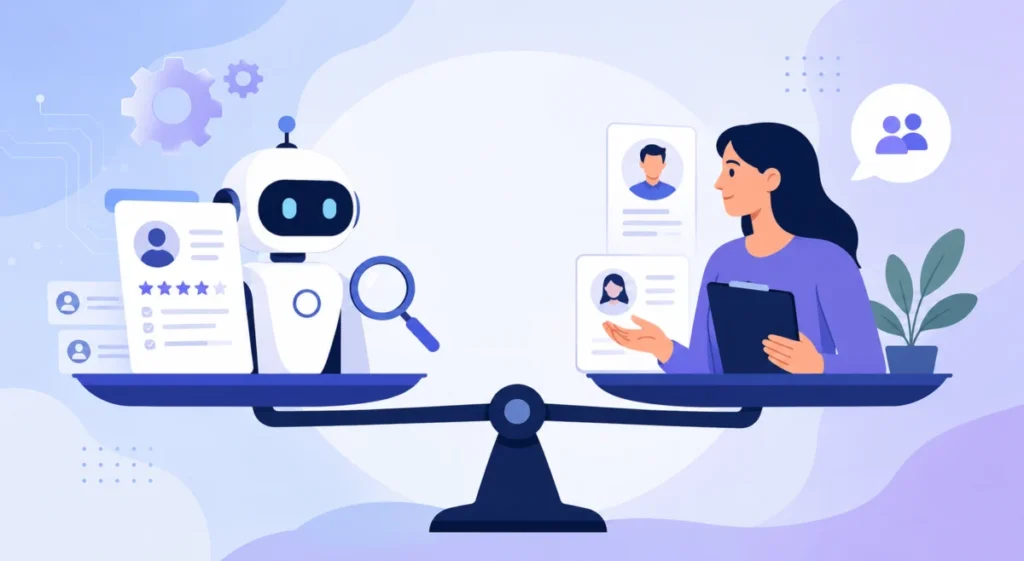
The contemporary landscape of talent acquisition (TA) is fundamentally reshaped by artificial intelligence, transforming what was once a largely manual and intuitive process into a sophisticated, data-driven operation. By 2026, the question for employers and recruiters is no longer if AI should be adopted, but how to achieve an optimal balance between AI capabilities and human insight to elevate hiring quality and strategic outcomes. This shift is not theoretical; empirical data confirms its prevalence, with an estimated 35% to 45% of companies having already integrated AI into their core hiring processes, a figure projected to continue its upward trajectory. As automated recruitment solutions become increasingly sophisticated and accessible, understanding the best practices for AI deployment alongside essential human intervention is paramount for organizational success in attracting and retaining top talent.
The Ascent of AI in Talent Acquisition: A 2026 Perspective
The pervasive nature of AI in talent acquisition is underscored by its undeniable effectiveness and the significant return on investment it offers, particularly for large enterprises managing thousands of candidate profiles monthly. Market experts anticipate the enterprise sector of AI recruitment to grow at a Compound Annual Growth Rate (CAGR) of 6.8% between 2020 and 2032, signaling robust, sustained expansion. This growth is driven by AI’s capacity to process vast amounts of candidate data, expedite workflows, and operate at a scale unattainable by human teams alone.
From Automation to Augmentation: AI’s Evolving Impact
Initially serving quietly in the background as an administrative aid, AI has rapidly evolved into a strategic partner, increasingly functioning as a "gatekeeper to employment," as articulated by Noelle London, CEO and founder of employee data platform Illoominus. This evolution is particularly evident with recent breakthroughs in agentic AI, which introduces fully autonomous, non-human entities into the TA team. Global HR technology studies indicate that an impressive 87% of enterprise organizations have already integrated agentic AI tools into their TA pipelines, showcasing a rapid embrace of these advanced capabilities. These AI agents are capable of performing complex, multi-step tasks independently, from drafting initial job descriptions to managing candidate outreach sequences.
However, the advent of sophisticated AI agents does not diminish the critical need for a human-in-the-loop (HITL) approach. While AI excels at data processing, pattern recognition, and automation, human participation remains indispensable for making nuanced decisions, interpreting complex social cues, and ensuring ethical oversight. The symbiotic relationship between AI and human expertise is the cornerstone of optimizing hiring quality in the current landscape.
Strategic AI Applications Across the Recruitment Lifecycle
AI’s utility spans the entire recruitment lifecycle, offering significant enhancements at each stage. Understanding these applications and identifying where human "magic" can best complement algorithmic efficiency is key.
Elevating Candidate Sourcing with Predictive Analytics
Candidate sourcing remains a persistent challenge for recruiters, with 46% reporting difficulties in finding the best talent amidst constantly shifting industry norms and job market expectations. AI offers a powerful solution, replacing error-prone manual data inputs and engagements with automated analytics. AI candidate sourcing solutions can instantly qualify and shortlist talent based on objective search criteria, ensuring a perfect job fit and accessing refreshed job seeker data. This enables companies to proactively win talent by offering suitable roles at every career stage, even reaching the 70% of candidates classified as passive job seekers. Beyond immediate needs, forward-thinking employers leverage AI for predictive workforce planning, proactively identifying and addressing future skill gaps.
Human Oversight: While AI provides an insightful first-round of talent scouting, it should not be a sole replacement for human decision-making. TA teams must exercise their expertise by evaluating the nuances of talent profiles, including soft skills, cultural compatibility, and testimonials, which AI, despite its advancements, struggles to contextualize fully. A human recruiter can discern potential beyond keywords, identifying candidates whose unique experiences or non-traditional backgrounds might be overlooked by an algorithm.
Streamlining Interview Logistics and Candidate Experience
Inefficient interview scheduling practices significantly detract from the candidate experience, with 42% of candidates reportedly withdrawing from hiring processes purely due to scheduling issues. AI-powered automated scheduling enhances candidate engagement through transparency and accuracy. These solutions offer self-scheduling links, timely reminders, and prompt status updates, giving job seekers flexibility while keeping them informed. In 2026, AI technology routinely exceeds candidate expectations: while applicants anticipate a first response within seven days, AI achieves this within 48 hours. Similarly, AI provides self-scheduling links for interviews within a day, significantly faster than the 2-6 days candidates typically expect.
Human Touchpoint: Despite AI’s efficiency in managing multi-round interviews, a critical human element remains. Studies show that 25% of hires trust employers less if AI is used to evaluate their information, a sentiment that can extend to automated scheduling if perceived as impersonal. Human teams can mitigate these trust issues by vetting automated messages for tone, ensuring they are personalized, respectful, and avoid generic "Do not reply" lines or muddled salutations. A human check ensures empathy and maintains a positive candidate perception throughout the process.
Precision in Resume Screening and Skill Matching
For enterprises handling thousands of applications per vacancy, manual resume reviews are a herculean task. Automated resume screening, powered by AI, efficiently scans CVs for data points matching an employer’s role criteria. Quality solutions analyze a CV’s format and content quality in seconds, scoring profiles to prioritize engagement and flagging issues like keyword stuffing, a common tactic in exaggerated resumes. Advanced solutions, such as X0PA AI’s BRIQ scoring model, utilize Natural Language Processing (NLP) and Large Language Models (LLMs) to thoroughly assess application context against millions of global profiles, ensuring a precise match.
Human Element: Empathy and contextual understanding remain necessary components of talent selection. While AI excels at summarizing the "what," it often lacks the contextual analytics for the "whys." Human TA teams should manually review resumes for "points of note" like career gaps, which AI might flag negatively without understanding underlying reasons (e.g., caregiving, further education, personal sabbatical). This human review helps uncover a candidate’s full potential and ensures a more holistic assessment, preventing valuable talent from being overlooked.
Optimizing Job Descriptions and Employer Branding
Crafting and publishing thousands of job descriptions (JDs) across various platforms presents significant risks of readability issues and subconscious bias, which can deter candidates and tarnish employer branding. Less-than-optimized JDs compromise hiring ROI by failing to engage or actively repelling qualified applicants. An AI JD-vetting solution analyzes and corrects biases, improves readability, and ensures proper formatting, including the presence of key sections like benefits and salary. These platforms also equip TA teams with organized JD libraries for scalable, one-click uploading.
Human Imperative: While AI excels at refining grammar, vocabulary, and syntax to improve readability and eliminate biases (gender, education, ableism, etc.), it cannot reliably capture the unique essence of a company’s workplace culture. Culture is an ongoing, dynamic process influenced by leadership, industry shifts, and economic conditions. This is where human teams must step in to enhance AI-polished JDs with authentic storytelling, promoting the company’s unique Employee Value Proposition (EVP). For example, listing specific inclusion strategies that align with company goals, such as championing intersectionality among underrepresented groups, adds a genuine human touch that resonates deeply with prospective hires.
The Evolving Role of the Recruiter: Adaptation, Not Replacement
The prevailing concern that "AI is taking over recruitment jobs" is largely unfounded. Instead, AI is a transformative tool that redefines the rules of the recruitment game, shifting the focus from administrative tasks to strategic oversight. As long as companies hire people, the vital need for a human touch throughout the TA pipeline will persist. AI primarily reduces human error in managing complex candidate data, freeing up recruiters to engage in higher-value activities.
This transformation has led to significant shifts in the world of work. AI-related job postings in the US rose by 95% in the first half of 2026, indicating a strong demand for professionals who can manage and leverage AI tools. Recruiters are increasingly becoming talent strategists, AI architects, and culture ambassadors, focusing on smaller pools of high-value, in-demand skills. They must develop AI literacy, data interpretation skills, and a strategic understanding of how to integrate technology to enhance human decision-making.
Navigating the Ethical Landscape of AI in Recruitment
The ethical deployment of AI in recruitment is paramount, necessitating proper safeguards and compliance. The rise of Explainable AI (XAI) addresses these concerns by providing transparency into how an AI system or algorithm arrives at a decision, such as prioritizing one candidate over another in an automated Applicant Tracking System (ATS). XAI moves beyond the "black box" approach, supporting ethical and logical decision-making.
Hiring teams can ensure the legal and ethical use of AI recruitment by:
- Prioritizing Algorithmic Fairness: Regularly auditing AI systems for bias, ensuring diverse training data, and implementing bias detection and mitigation strategies.
- Ensuring Data Privacy and Security: Adhering to global data protection regulations (e.g., GDPR, CCPA) and implementing robust cybersecurity measures to protect sensitive candidate information.
- Maintaining Transparency with Candidates: Clearly communicating when AI is used in the hiring process, explaining its purpose, and outlining avenues for human review or appeal.
- Implementing Human Oversight Protocols: Establishing clear guidelines for when and how human recruiters review AI-generated recommendations, ensuring that final hiring decisions rest with humans.
- Staying Abreast of Regulatory Changes: Continuously monitoring evolving legal frameworks and industry standards related to AI ethics and employment law.
Key AI Tools Shaping the 2026 Recruitment Ecosystem
The increasingly saturated software marketplace makes finding the ideal AI tool challenging. Based on applied AI recommendations for 2026, several solutions stand out across different categories:
-
Ashby (Candidate Sourcing): Ashby’s automated HR solution features an intuitive candidate sourcing capability for shortlisting suitable hires. The platform supports advanced search queries, enabling users to quickly discover candidates with specific skillsets across extensive databases. Ashby also facilitates fostering talent communities and employs multichannel outreach sequences to diversify and elevate candidate engagement, crucial for tapping into passive talent pools.
-
X0PA AI (Candidate Screening): This solution boasts an intelligent candidate matching algorithm that can reduce manual candidate reviews by as much as 80%. X0PA AI’s BRIQ scoring model leverages the latest developments in NLP and LLMs to thoroughly assess application context. It compares talent against a vast database of over 250 million global profiles, meticulously matching candidates to JD requirements and identifying the best fits with high precision.
-
TheHireHub.AI (Interview Scheduling): TheHireHub.AI utilizes AI technology to seamlessly coordinate candidate and interviewer availabilities. Its comprehensive suite of smart features includes automated interview reminders, self-scheduling links that empower candidates, and accurate timezone detection, significantly improving the overall interview experience and reducing logistical friction.
-
Ongig (JD Vetting): Ongig is a trusted JD-vetting platform that specializes in eliminating inherent biases and restructuring content to attract top-tier candidates. The company’s Text Analyzer solution integrates smoothly with existing ATS/HRIS, minimizing disruptions during onboarding. With Text Analyzer, hiring teams can improve JD readability, ensure compliance with diversity and inclusion standards, optimize for SEO, and streamline the JD creation and distribution process, ultimately enhancing employer branding and conversion rates.
Conclusion: The Hybrid Future of Talent Acquisition
By 2026, the synergy between AI and human expertise has become the definitive pathway to optimal talent acquisition. AI serves as a powerful accelerator, enabling efficiency, scalability, and data-driven insights that transform administrative burdens into strategic advantages. Yet, the irreplaceable human element—empathy, cultural intuition, ethical judgment, and the capacity for authentic connection—remains the anchor, ensuring that the hiring process is not just efficient but also equitable, engaging, and ultimately, human. The future of recruitment is undoubtedly hybrid, where technology empowers human decision-makers, and human insight guides the ethical and strategic deployment of AI. This dynamic collaboration is set to continually elevate hiring quality, fostering diverse, innovative, and high-performing workforces for years to come.
July 15, 2026 by Laurenzo Overee in AI Recruitment






