
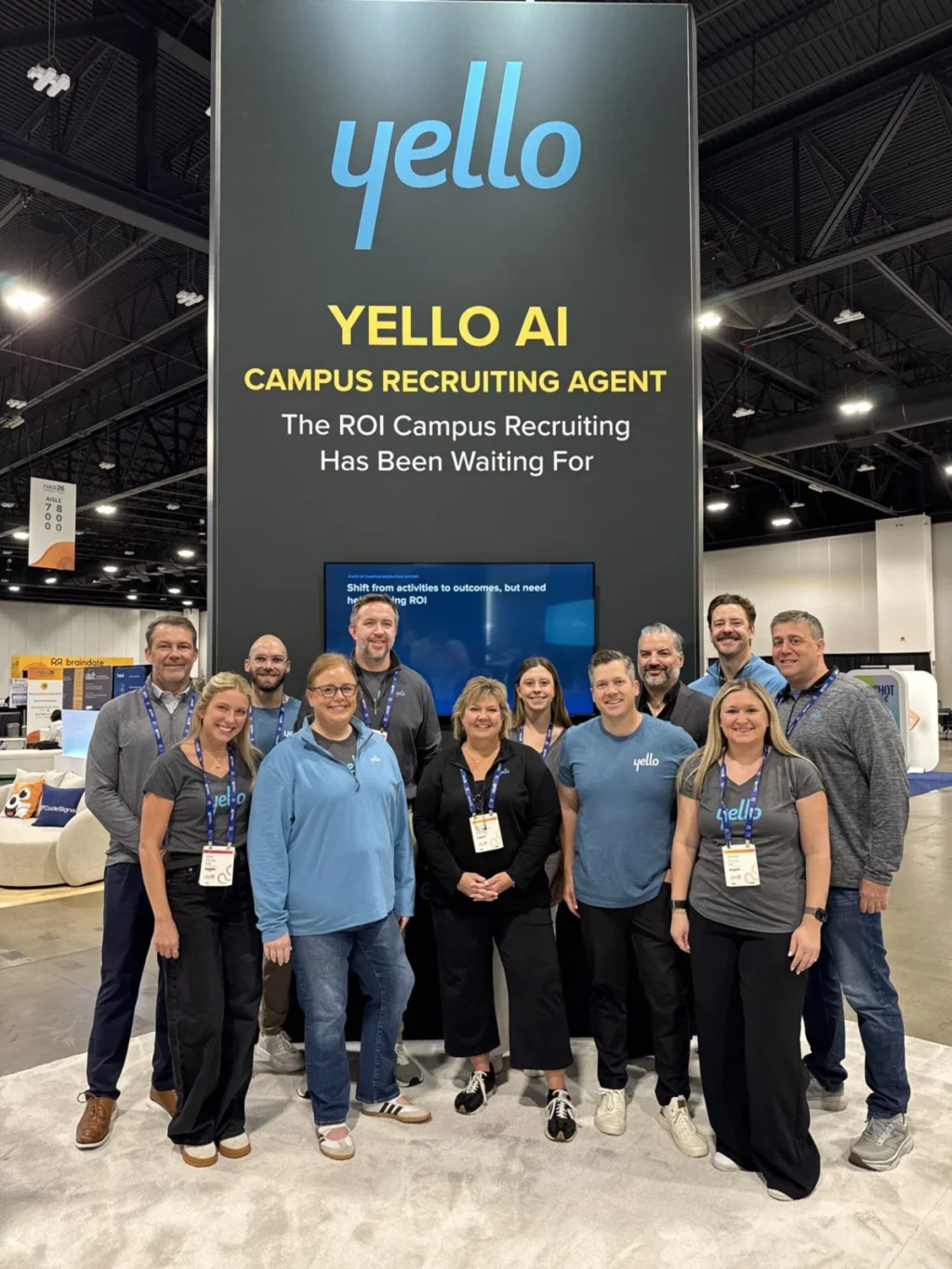
Denver, CO – The National Association of Colleges and Employers (NACE) annual conference, NACE26, held recently in Denver, served as a pivotal forum for discussing the evolving landscape of early talent acquisition. Amidst a robust gathering of industry leaders, educators, and recruiters, Yello, a prominent provider of early talent recruiting software, made significant waves, not only as a platinum sponsor but also through the debut of its AI Campus Recruiting Agent and a strategic partnership announcement with Symplicity. These developments, coupled with key insights gleaned from conference sessions, underscore a paradigm shift towards more strategic, technology-driven, and relationship-centric approaches in campus recruiting.
NACE26: A Confluence of Innovation and Insight for Early Talent
NACE26, an annual gathering orchestrated by the National Association of Colleges and Employers, stands as a cornerstone event for professionals dedicated to connecting college students and recent graduates with employers. The conference, typically spanning several days, provides an invaluable platform for networking, professional development, and the exchange of best practices in career services, university relations, and early talent recruiting. This year’s event in Denver, running from June 3rd to June 6th, brought together thousands of attendees, all focused on optimizing the journey from campus to career. Yello’s prominent role as a platinum sponsor highlighted its commitment to this community and its position at the forefront of innovation in the sector. The company’s booth was a hub of activity, facilitating numerous conversations, while its speaking sessions addressed some of the most pressing challenges facing recruiters today. The timing of Yello’s announcements, coinciding with such a high-profile industry event, ensured maximum impact and immediate engagement from the target audience.
The Shifting Sands of Recruiting: Key Takeaways from Denver
Discussions and presentations throughout NACE26 converged on three critical themes that are fundamentally reshaping early talent acquisition: the transformative yet nuanced role of Artificial Intelligence (AI), a radical re-evaluation of event strategies, and the persistent challenge of offer reneges.
1. AI’s Double-Edged Sword in Campus Recruiting: Automation Over Autonomy
The pervasive influence of Artificial Intelligence was undeniably the most talked-about subject at NACE26. While AI’s potential to revolutionize recruiting is widely acknowledged, the consensus among attendees and panelists was clear: its application must be purpose-built and strategically focused on augmenting human recruiters, rather than replacing them. Yello’s own "State of Campus Recruiting report," released prior to the conference, provided compelling data, revealing that 26% of current AI usage in campus recruiting is concentrated in sourcing candidates, and another 25% in initial candidate communications—predominantly top-of-funnel activities.
However, a significant gap was identified: the area where AI could deliver the most profound impact—data analysis and proving Return on Investment (ROI)—is where its presence is largely absent. This disparity resonated deeply with recruiters in Denver, who expressed a clear preference for AI that handles administrative burdens and repetitive tasks, thereby freeing up valuable time for more meaningful interactions with candidates. This sentiment was directly addressed in Yello’s session, "Can Campus Recruiting Be Autonomous? The Answer Is Complicated." Panelists Tamara Welch from LPL Financial, NACE’s Matthew Brink, and Yello’s Dan Bartfield explored the distinction between achieving fully autonomous recruiting and simply empowering recruiters to focus on higher-value work. The audience firmly favored the latter, emphasizing that effective AI in this domain must be specifically designed for the unique challenges of campus recruiting. By automating manual processes, AI enables recruiters to dedicate more energy to critical aspects like candidate engagement, relationship building, and strategic decision-making.
Furthermore, the ethical considerations surrounding AI in hiring were a recurring point of discussion. Matthew Brink of NACE highlighted a crucial candidate perspective: students are increasingly wary of employers who rely too heavily on AI in their hiring processes, especially those who fail to disclose its use. An impersonal or opaque AI-driven process risks alienating qualified candidates and subtly damaging an employer’s brand reputation. This underscores the need for transparency and a human-centric approach, even as technology integrates more deeply into recruitment workflows. The broader implications suggest that while AI offers immense efficiency gains, its deployment requires careful consideration of its impact on candidate experience and employer brand integrity. Industry analysts project the global HR tech market to reach over $49 billion by 2028, with AI-powered solutions being a primary growth driver, yet ethical AI adoption remains a critical challenge.
2. Rethinking Event Strategy: Purpose Over Presence
The second major takeaway from NACE26 centered on a fundamental shift in how employers approach recruitment events. Application volumes continue to surge, yet recruiters face an increasingly difficult task in identifying truly qualified candidates. This paradox, as articulated by panelists in Yello’s session "Purpose Over Presence: Rethinking Your Event Strategy for Better ROI," is partly attributable to the proliferation of AI-assisted resume tools. Vincent Bond from Synchrony aptly described this phenomenon as "AI fighting AI," where candidates leverage AI to craft polished resumes, which are then screened by employers using their own AI tools, often leading to a homogenization of applications.
In response, leaders like Vincent Bond, Kristin Leek from Boeing, and Christopher Cantu from Marathon Petroleum advocated for a more intentional, outcomes-based event strategy. The traditional model of attending numerous career fairs, engaging a high volume of candidates, and hoping to stumble upon a few good fits is proving inefficient. Instead, employers are now prioritizing earlier and more deliberate investments in relationship building, primarily through targeted in-person events. The purpose of the in-person event has evolved; it’s no longer about sheer presence or high-volume interactions. Rather, the focus has shifted to measuring events by their return on investment (ROI) in terms of quality hires and sustained engagement.
Christopher Cantu’s analogy of career fairs as the "end zone" was particularly insightful: these events are where relationships are finalized and offers are extended, not where they begin. The critical groundwork, he explained, occurs months, sometimes even years, in advance through carefully curated events and consistent touchpoints. This concept of "relationship equity" has emerged as a crucial competitive differentiator in today’s campus recruiting landscape, offering a potent countermeasure against rising application volumes and the challenge of candidate fraud. Data from NACE indicates that while overall job fair attendance has rebounded post-pandemic, the quality of candidate engagement and conversion rates vary significantly, pushing employers towards more strategic, smaller-scale engagements.
3. Tackling the Renegade Offer: Sustaining Engagement Post-Acceptance
The issue of offer reneges—candidates accepting an offer only to withdraw later—remained a persistent and costly challenge for employers, a sentiment widely echoed at NACE26. This phenomenon highlights that an offer acceptance no longer guarantees a closed deal; the period between offer and start date has become an active recruiting phase. Organizations successfully mitigating renege rates are those that prioritize consistent, personalized communication and engagement during this critical window. Panelists shared anecdotal evidence linking their proactive relationship-building efforts at events to lower renege rates, underscoring the long-term value of early and sustained candidate engagement.
In Yello’s virtual session, "Designing the Complete Journey: From Pre-Boarding to Off-Boarding," Ahva Sadeghi introduced the "KEEP framework," a comprehensive approach designed to maintain candidate engagement throughout the entire journey. KEEP, an acronym for Kick Off, Engage, Enable, and Perform, outlines four pillars guiding a candidate from offer acceptance through to their first day on the job. Sadeghi delved into the various reasons candidates renege—ranging from competitive counter-offers to a perceived lack of connection with the employer—and the substantial true cost associated with each renege, encompassing lost productivity, recruitment expenses, and onboarding costs. She also highlighted how Symba customers have achieved remarkable success, reducing their renege rates by over 55% by implementing structured pre-boarding and engagement strategies. Industry reports suggest that the average renege rate can be as high as 15-20% for certain roles, with the cost of replacing a reneged offer estimated to be upwards of 1.5 times the annual salary for entry-level positions.
Yello’s Dual Announcements: Pioneering the Future of Campus Recruiting
NACE26 served as the official platform for Yello to unveil two significant developments poised to redefine efficiency and reach in campus recruiting.
The Yello Campus Recruiting Agent: Intelligent Automation for Quality Engagements
Yello officially launched its groundbreaking AI Campus Recruiting Agent, showcasing its capabilities to a receptive audience. This innovative AI-powered agent is engineered to automate a wide array of manual tasks that typically consume a recruiter’s time, including event building, candidate sourcing, campaign management, and interview scheduling. The fundamental premise of the agent is to liberate recruiting teams from administrative burdens, allowing them to redirect their focus towards meaningful candidate engagement.
Historically, campus recruiting has been characterized by a reactive model: employers attend events, set up booths, and hope the right candidates walk by. The Yello Campus Recruiting Agent fundamentally flips this paradigm. Instead of relying on chance encounters, the agent proactively identifies best-fit candidates and pre-schedules interviews before an event even begins. It undertakes the heavy lifting of building and managing events, intelligently matching and prioritizing candidates based on predefined criteria, orchestrating outreach campaigns, and meticulously scheduling interviews. The transformative benefit for recruiters is profound: they arrive at an event with a pre-filled interview schedule comprising highly qualified candidates who genuinely align with their roles. This shift promises to dramatically enhance the efficiency and effectiveness of campus recruiting efforts, ensuring that every interaction is purposeful and impactful. Early adopters project a potential 30% increase in interview-to-offer conversion rates due to improved candidate quality.
Strategic Partnership with Symplicity: Expanding Reach and Access
Further solidifying its commitment to expanding access and optimizing candidate discovery, Yello announced a new strategic partnership with Symplicity. This collaboration grants Yello customers unparalleled access to Symplicity’s extensive network of over 600,000 early talent candidates. Symplicity is a global leader in student success and engagement technology, connecting millions of students with career opportunities through its university partners.
The integration of Symplicity’s database into the Yello ecosystem means that employers utilizing the Yello Campus Recruiting Agent can now match against a significantly broader pool of active candidates. This includes not only candidates from their own Applicant Tracking Systems (ATS), their existing Yello database, and platforms like WayUp, but also an additional 35+ diverse sources across the web, now seamlessly augmented by Symplicity’s vast early talent network. This partnership is a game-changer for recruiters seeking to broaden their candidate reach, enhance diversity in their talent pools, and ensure they are connecting with the most relevant and engaged early career professionals. The ability to access such a comprehensive and diverse candidate pool through a single, intelligent platform significantly streamlines the sourcing process and amplifies the potential for successful hires. This collaboration is expected to increase candidate pipeline diversity by up to 25% for Yello clients, addressing a critical need for many organizations.
Broader Impact and Future Implications
The insights and innovations presented at NACE26, particularly Yello’s announcements, collectively paint a picture of a future where early talent acquisition is more strategic, data-driven, and intrinsically human-centric. The industry is moving away from volume-based, transactional recruiting towards an approach that prioritizes quality interactions, meaningful relationships, and demonstrable ROI. AI is no longer a futuristic concept but a practical tool for administrative relief, enabling recruiters to focus on the invaluable human element of their work. Event strategies are becoming more refined, emphasizing targeted engagement and long-term relationship building over broad, undifferentiated outreach. And the challenge of reneges is being tackled with proactive, personalized engagement strategies that extend well beyond the initial offer.
Yello’s Campus Recruiting Agent and its partnership with Symplicity are pivotal in this evolution, providing the technological infrastructure necessary to implement these advanced strategies effectively. By automating mundane tasks and expanding access to qualified talent, Yello is empowering recruiters to navigate the complexities of the modern early talent market with greater efficiency and impact. The competitive landscape for early talent remains fierce, with companies vying for top university graduates and interns. The ability to leverage intelligent automation and extensive candidate networks will be a decisive factor for organizations seeking to secure the best emerging talent, ultimately shaping the workforce of tomorrow. The discussions at NACE26 and Yello’s strategic moves indicate a clear path forward: a synergistic blend of technology and human connection will define success in early talent acquisition for years to come.






