
By Liz Lavelle
While your organization’s HR technology stack might appear robust on paper, featuring engagement surveys, performance reviews, recognition programs, development plans, and an HRIS to tie it all together, a critical flaw often lurks beneath the surface. Each of these tools may function adequately in isolation, but the real challenge arises in the chasm between them. A subtle decline in employee engagement might never reach the attention of a manager during a one-on-one meeting. A high performer’s recognition might trail off, with no connection made to the growing retention risk that this oversight quietly cultivates. The signals are present, but they remain isolated, never converging to provide a holistic view. This phenomenon, the "disconnected data problem," is not merely an IT concern; it directly impacts an HR department’s ability to confidently answer executive queries, proactively identify flight risks, and dedicate valuable time to strategic action rather than report compilation. Fortunately, the solution lies not in acquiring more data or discarding existing tools, but in enabling these disparate systems to communicate effectively. This article will explore the hidden costs of fragmented people data and the transformative benefits of its integration.
Understanding Disconnected People Data
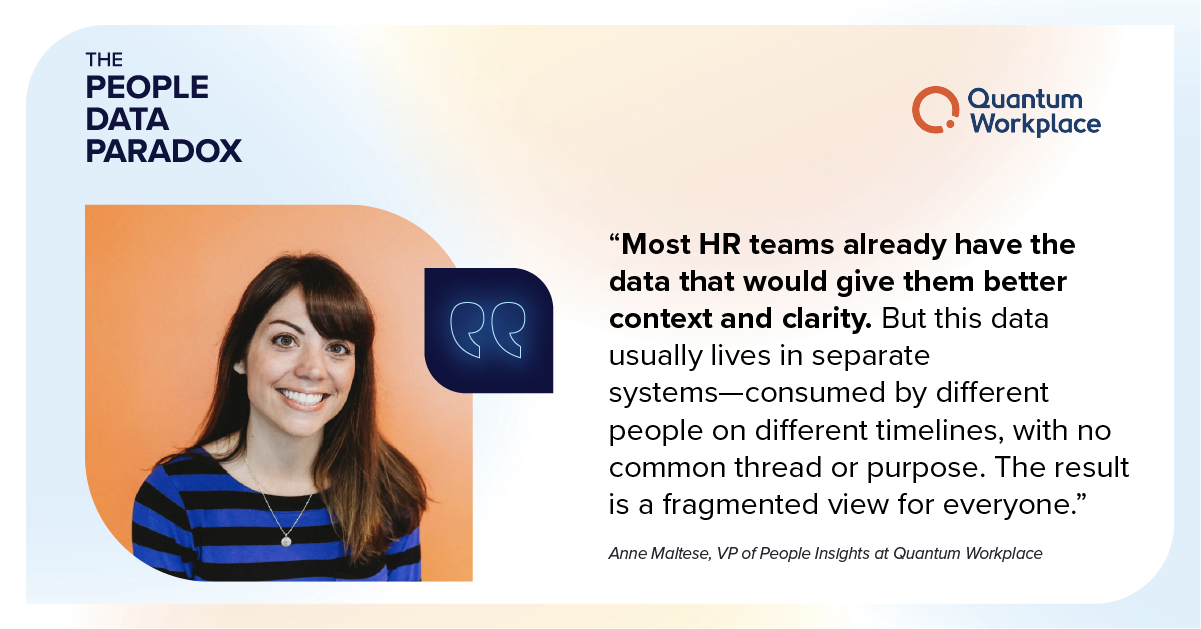
Disconnected people data refers to a situation where vital HR information—spanning engagement surveys, performance reviews, recognition activities, development plans, and HRIS records—resides in separate, incompatible systems. These systems were not designed to interoperate, resulting in each holding only a fraction of the employee narrative. Consequently, instead of a unified, clear perspective on team performance and well-being, organizations are left with a collection of isolated snapshots, necessitating manual compilation and analysis to derive actionable insights. This fragmentation creates a "people data paradox," where an abundance of information exists but lacks the coherence to inform strategic decisions.
The proliferation of specialized HR technology solutions, while offering targeted functionalities, has inadvertently contributed to this data siloing. Research from Quantum Workplace indicates that HR leaders typically utilize between two to four HR solutions from different vendors, yet a mere 39% report that these systems are effectively integrated. This disparity highlights a widespread challenge: data continues to accumulate, but the clarity needed for decisive action lags significantly behind.
The Substantial Cost of Fragmented People Data
The ramifications of disconnected people data extend far beyond administrative inconvenience, translating into significant financial losses for organizations. These losses manifest in reduced productivity, avoidable employee turnover, and missed opportunities in talent development. For a mid-sized company with 2,500 employees, the annual cost associated with underequipped managers and unaddressed retention risks can approach an alarming $4 million. This figure underscores the tangible economic impact of an HR infrastructure that fails to connect critical employee insights.
The arduous process of extracting and synthesizing information from multiple disparate systems to answer a single executive question is a familiar frustration for many HR professionals. While the answers are embedded within the data, accessing them cleanly, quickly, and with the requisite confidence for strategic action remains a persistent hurdle. This gap is not a reflection of individual shortcomings or simple technological glitches; it is a systemic issue stemming from an unintegrated data ecosystem.
The detrimental effects of fragmented data manifest in several key areas:

1. The Cost of Underequipped Managers
Managers serve as the primary conduit for employee engagement and performance. Their effectiveness directly influences the success of their teams. When managers are not adequately supported, their struggles inevitably cascade throughout their departments. The root cause of this managerial struggle often lies not in a lack of inherent talent, but in the absence of essential resources and insights needed for effective leadership. The average manager now shoulders approximately 51% more responsibility than is realistically manageable, and a significant portion, 39%, has never received formal leadership training.
The business implications are profound. Managers ranking in the highest decile of leadership effectiveness generate twice the net revenue of their counterparts. This disparity between top-performing and struggling managers represents not just a developmental gap, but a palpable performance deficit within an organization. Without integrated data, identifying which managers require support, understanding the specific challenges they face, and providing targeted interventions becomes an exercise in guesswork.
2. The Cost of Overlooking High-Potential Talent
High-performing employees are not merely valuable; they are disproportionately productive, contributing between 400% and 800% more than an average employee. Despite this outsized impact, a concerningly low 57% of organizations possess a formal process for identifying these critical individuals. In the absence of connected data, talent identification often relies on visibility and subjective advocacy. Employees who are more vocal, more visible, or have stronger internal networks are more likely to be nominated or noticed, meaning those generating the most significant value may not always make the cut. Each quarter these individuals go unrecognized represents a lost opportunity for the organization to fully leverage their exceptional contributions.
3. The Cost of Missing Retention Risk
By the time a high-potential employee submits their resignation, the decision to leave was often made months prior. Subtle warning signs—a dip in survey sentiment, a cessation of development conversations, or a decline in recognition—were likely present. Individually, these signals may not trigger alarm bells. However, when viewed in aggregate through connected data, they form a clear narrative of impending attrition.
Replacing an employee can incur costs ranging from 50% to 200% of their annual salary. Compounding this, research suggests that one in three departing employees believe their exit was preventable. These preventable departures are a direct consequence of the organization’s inability to connect the dots within its own data, missing the critical signals that could have prompted proactive retention efforts.
The Cumulative Impact of Fragmented Data
To illustrate the financial burden, consider an organization with 2,500 employees and 250 managers. If 50 of these managers are inadequately equipped and this leads to a 10% disengagement among their direct reports, the annual loss in productivity could reach $1.7 million.
Now, factoring in retention risk, if 10 high performers depart due to a lack of recognition or development, the cost of replacing them at double their salary adds another $2 million. This brings the total financial drain directly attributable to disconnected data to nearly $4 million, without even accounting for the broader implications of teams lacking the optimal conditions to thrive, such as misdirected effort, slow skill development, or unrecognized potential.
The Transformative Power of Connected Data
For years, the aspiration of connecting signals across fragmented systems demanded an inordinate investment of time and resources, often beyond the capacity of many HR departments. However, advancements in artificial intelligence are revolutionizing this landscape. AI can now continuously analyze data from engagement surveys, performance reviews, development plans, recognition programs, and HRIS systems, comparing it against benchmarks and uncovering patterns that were previously invisible.
The fundamental shift is not in the volume of data collected, but in the ability to finally interpret the insights that existing data has been trying to convey. When these disparate signals converge, organizations can begin to answer the most pressing questions that concern HR and executive leadership:
- Proactive Risk Identification: Instead of reacting to resignations, identify employees exhibiting patterns of disengagement or declining performance that signal potential attrition.
- Targeted Development: Pinpoint managers who are struggling with team engagement or performance and provide them with the specific resources and training they need.
- Talent Optimization: Uncover high-potential employees who may be overlooked due to visibility issues, ensuring their unique contributions are recognized and nurtured.
- Performance Enhancement: Understand the direct correlation between employee recognition, development opportunities, and overall team productivity.
- Strategic Workforce Planning: Gain a comprehensive understanding of workforce dynamics to inform critical decisions about talent acquisition, retention, and development strategies.
Transitioning from Fragmented Data to Connected Talent Insights
The true value of understanding the full picture lies in its ability to influence subsequent actions. This is where solutions like Quantum Workplace are making a significant impact. Quantum Workplace integrates signals from engagement, performance, development, and recognition into a unified view, enabling leaders to move beyond piecing together fragmented information and gain a clear understanding of what is truly happening within their teams.
AI-powered insights illuminate the hidden patterns that exist between disparate systems. Crucially, each finding is accompanied by a clear, prioritized next step, contextualized by the organization’s unique priorities and benchmarks, and delivered directly to leaders within their workflow. This approach ensures that insights translate into tangible actions.
By connecting people data, HR teams can:
- Empower Managers: Provide managers with real-time insights into their team’s engagement and performance, equipping them to have more impactful conversations and interventions.
- Identify and Develop Top Talent: Proactively identify high-potential employees based on a comprehensive view of their performance, engagement, and development trajectory.
- Reduce Turnover: Intervene early with at-risk employees by recognizing the subtle signals of disengagement and dissatisfaction before they lead to departure.
- Boost Productivity: Foster a more engaged and motivated workforce by understanding the drivers of performance and recognition within teams.
- Drive Strategic Decisions: Equip HR and leadership with the data-driven insights necessary to make informed decisions about talent management, organizational development, and overall business strategy.
In essence, the integration of people data transforms HR from a reactive administrative function into a strategic driver of organizational success. By breaking down data silos, companies can unlock the full potential of their workforce, mitigate costly risks, and build a more resilient, high-performing future.