

The landscape of business-to-business (B2B) marketing has undergone a fundamental shift from proactive broadcasting to sophisticated analytical listening, as organizations increasingly recognize that the most effective demand generation strategies are rooted in external data rather than internal assumptions. Social listening, once relegated to the periphery of customer service and brand reputation management, has emerged as a cornerstone of modern market intelligence. By systematically analyzing online conversations across diverse digital ecosystems, B2B marketers are now able to decode the complex needs of their ideal buyers, identify emerging industry pain points, and refine product positioning with a level of precision previously unattainable through traditional market research methods.
The Strategic Imperative of Market Intelligence
In the current high-stakes B2B environment, obtaining new clients is a rigorous process that rarely occurs by chance. Decision-makers today are more informed and more vocal than ever before, frequently sharing their frustrations, technical questions, and procurement objections across platforms like LinkedIn, Reddit, specialized industry forums, and review sites. This continuous stream of unstructured data represents a goldmine for marketers who can move beyond the surface level of brand mentions to uncover deep-seated buyer motivations.
Recent industry data underscores this shift. According to the Brandwatch 2024 Digital Marketing Trends report, approximately 76% of marketing professionals now believe that social listening tools will be the primary driver of their marketing strategies moving forward. This consensus reflects a broader move toward data-driven growth, where organizations prioritize the "voice of the customer" to validate initiatives before they are launched. By replacing guesswork with linguistic analysis of how buyers actually describe their problems, companies can ensure their messaging resonates with the specific priorities of their target audience.

The Evolution of Social Listening: A Chronology of Insight
The transition from social monitoring to social listening represents a significant evolutionary leap in digital marketing. To understand the current state of the industry, it is necessary to examine the timeline of how these tools have been utilized by global enterprises.
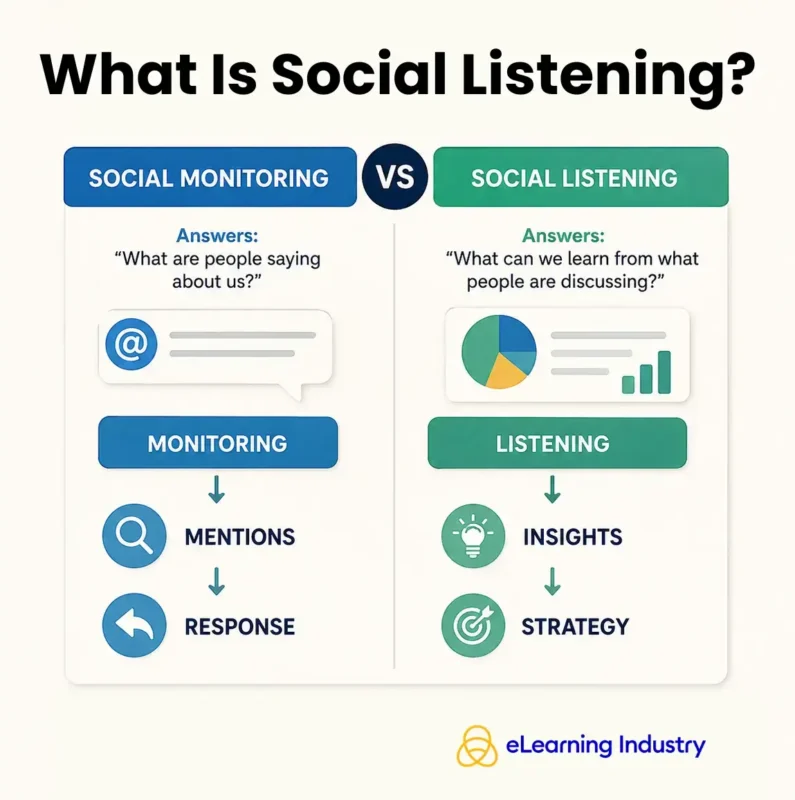
In the early 2010s, the focus was primarily on "social monitoring." Companies focused on reactive engagement—tracking direct @mentions, responding to customer complaints on Twitter (now X), and managing immediate brand crises. The primary question was "What are people saying about us?"
By the mid-2010s, the rise of "Dark Social" and niche professional communities began to shift the focus. Marketers realized that the most valuable conversations were happening in places they didn’t own, such as private Slack groups or Reddit threads. The emphasis shifted toward "social listening," which asks the broader question: "What can we learn from what the industry is discussing as a whole?"
By 2020, the integration of Artificial Intelligence (AI) and Machine Learning (ML) allowed for sentiment analysis and trend forecasting. This era saw social listening move into the realm of product development and competitive intelligence. Today, in the mid-2020s, social listening is being integrated with Search Engine Optimization (SEO) and Generative Engine Optimization (GEO), helping brands prepare for a future where AI-driven search engines synthesize online discussions to provide answers to B2B buyers.
Distinguishing Social Listening from Social Monitoring
While the terms are often used interchangeably, professional marketers distinguish between the two based on scope and intent. Social monitoring is a micro-level activity. It is the process of identifying and responding to individual brand mentions. It is essential for customer success and reputation management but offers limited long-term strategic value.
Social listening, conversely, is a macro-level analytical process. It involves the aggregation of data across thousands of conversations to identify recurring themes, emerging objections, and shifts in market sentiment. While monitoring tells you that a customer is unhappy, listening tells you why an entire segment of the market is moving away from a specific type of software architecture or pricing model. This distinction allows B2B teams to move from being reactive participants to proactive market leaders.
Mapping the B2B Buyer Conversation Ecosystem
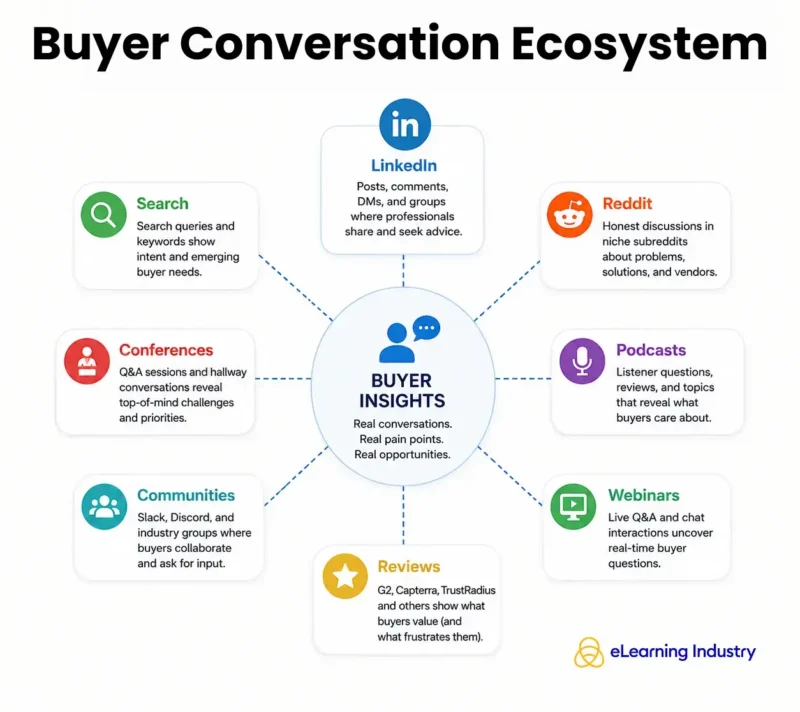
B2B buying decisions are notoriously complex, often involving long research cycles and multiple stakeholders. Gartner research indicates that the average B2B buyer is nearly 70% of the way through the purchasing journey before they ever engage with a sales representative. During this "silent" research phase, they leave a significant digital footprint across various channels:
1. Professional Networks and Public Forums
LinkedIn remains the preeminent space for professional discourse, where decision-makers share white papers and seek peer recommendations. However, Reddit has seen a surge in B2B relevance because of its anonymity, which encourages users to share unfiltered opinions on software implementation failures, hidden costs, and the actual quality of vendor support.
2. Niche Communities and Review Platforms
Private Slack channels, Discord servers, and professional associations offer high-density insights from practitioners. Simultaneously, software review platforms like G2 and Capterra provide structured feedback that highlights exactly where a competitor’s product falls short, offering a roadmap for better product positioning.
3. Multimedia and Interactive Channels
Webinars, podcasts, and YouTube comments are often overlooked sources of social data. The Q&A sessions of a competitor’s webinar can reveal the exact technical hurdles a prospect is trying to clear, while podcast guest interviews can signal a shift in an industry leader’s strategic priorities months before they are reflected in official corporate messaging.
The LISTEN Framework: A Structured Workflow for Insight
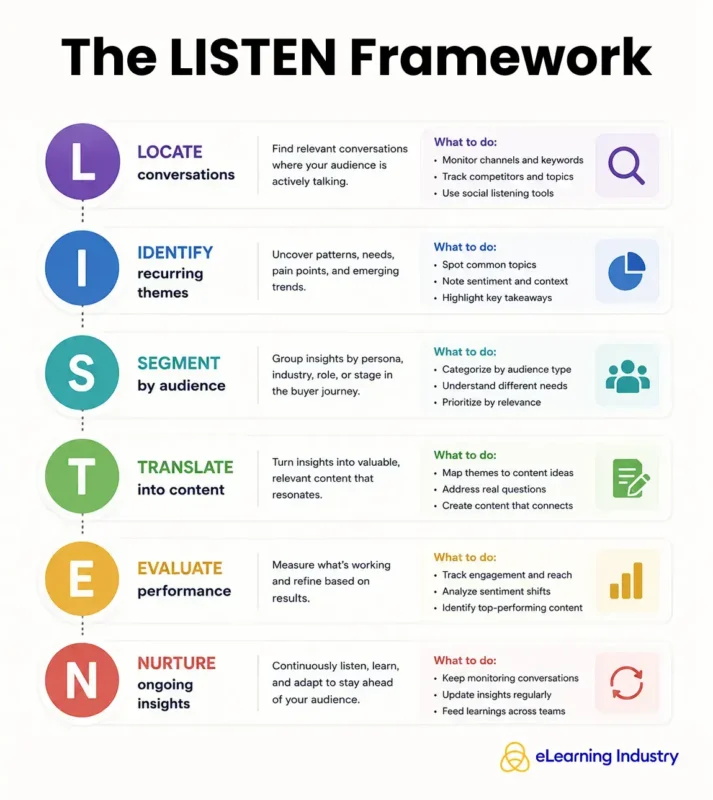
To transform raw data into actionable strategy, leading B2B organizations utilize a structured approach known as the LISTEN framework. This ensures that the process of social listening is repeatable, scalable, and directly tied to business outcomes.
- Locate Conversations: The first step involves identifying the specific digital watering holes where the target audience congregates. This goes beyond the "Big Three" social networks to include technical forums and specialized industry hubs.
- Identify Recurring Themes: Using AI-powered tools, marketers look for patterns. If "integration difficulty" appears in 40% of conversations regarding a specific software category, it becomes a high-priority theme for content creation.
- Segment by Audience: Not all voices carry the same weight. Insights must be segmented by job title (e.g., CTO vs. end-user), industry, and stage in the buyer journey to ensure the right message reaches the right person.
- Translate into Content: This is the execution phase. Insights are converted into articles, case studies, and webinar topics that directly answer the questions identified during the listening phase.
- Evaluate Performance: Marketers must measure whether content informed by social listening performs better than "assumption-based" content. Key metrics include engagement rates, share of voice (SoV), and conversion intent.
- Nurture Ongoing Insights: Market sentiment is not static. The workflow must be continuous to account for economic shifts, new technological breakthroughs, and evolving competitor tactics.
Competitive Intelligence and Market Positioning
One of the most potent applications of social listening is the systematic deconstruction of competitor strategies. By monitoring what customers say about rival firms, a brand can identify "white space" in the market.
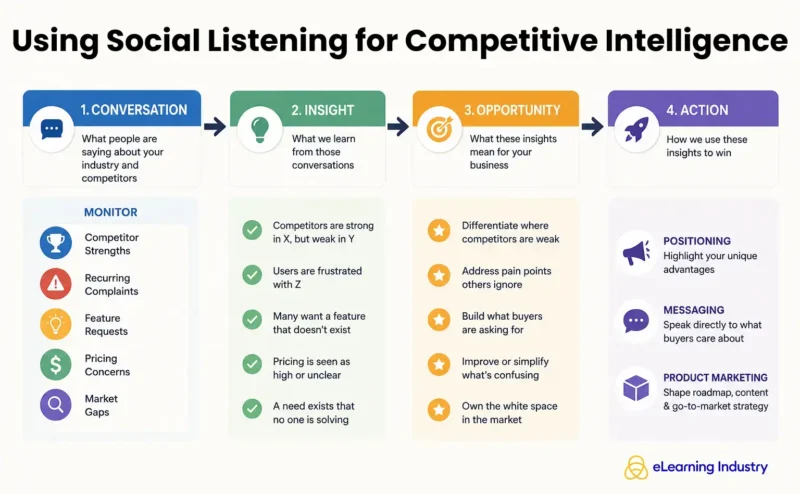
For example, if social listening reveals that users of a dominant competitor are consistently frustrated by a lack of personalized onboarding, a challenger brand can pivot its entire messaging strategy to highlight its "white-glove service" and "customer-first implementation." This form of competitive intelligence is more reliable than traditional SWOT analyses because it is based on the lived experience of the end-user rather than the marketing claims of the competitor.
The Convergence of Social Listening, SEO, and AI
As search behavior evolves, social listening is becoming an essential input for Search Engine Optimization (SEO) and the emerging field of Generative Engine Optimization (GEO). Traditional SEO relies on historical search volume data, which can often be lagging. Social listening, however, provides "real-time" keyword data. When a new industry term or acronym begins to trend in LinkedIn comments, social-savvy marketers can create content around that term weeks before it shows up in standard SEO tools.
Furthermore, with the rise of AI-driven search (such as Perplexity or ChatGPT’s Search), content must be structured to answer complex, conversational queries. By using social listening to identify the exact phrasing buyers use when asking questions, marketers can optimize their content to be the "preferred source" for AI models. This ensures that when a buyer asks an AI, "What are the risks of migrating to a cloud-based LMS?", the brand’s insights—informed by real-world social data—are the ones being synthesized in the response.
Broader Implications and Future Outlook
The future of B2B marketing belongs to the organizations that listen best. As AI tools become more adept at processing vast amounts of unstructured audio and video data, the scope of social listening will expand to include real-time analysis of conference speeches, earnings calls, and industry podcasts.
However, the human element remains critical. While AI can identify a trend, it requires a skilled marketer to understand the cultural and emotional nuance behind the data. The organizations that successfully combine high-tech listening tools with high-touch strategic thinking will be the ones that build the most authentic connections with their buyers.
In summary, social listening is no longer a luxury for B2B brands—it is a survival mechanism. By closing the gap between what companies think their buyers want and what buyers are actually saying, social listening provides a roadmap for sustainable growth, relevant innovation, and superior market positioning in an increasingly crowded digital landscape. Marketers who master this discipline will find themselves not just reacting to the market, but actively shaping the conversations that define their industry’s future.






