The landscape of corporate education is undergoing a fundamental shift as organizations increasingly move away from static, screen-based training modules in favor of more dynamic, accessible formats. At the forefront of this evolution is the eLearning podcast, a specialized audio program designed specifically to facilitate employee development, skill acquisition, and career advancement. Unlike traditional podcasts designed for mass-market entertainment or external brand marketing, eLearning podcasts are precision-engineered educational tools integrated into a company’s broader Learning and Development (L&D) framework. These programs are structured around specific pedagogical goals, leveraging the intimacy and flexibility of audio to meet the demands of a modern, often fragmented workforce.
The Strategic Evolution of Workplace Education
The emergence of podcast-based learning marks a significant milestone in the chronology of corporate training. Historically, employee development relied on intensive, in-person seminars—a model that became increasingly difficult to scale as corporations expanded globally. The subsequent move to digital learning in the early 2000s introduced Learning Management Systems (LMS) and video-based modules, which solved the problem of scale but often struggled with low engagement rates and "Zoom fatigue." By the mid-2010s, the rise of the "gig economy" and remote work necessitated a more mobile-friendly approach.
Today, the adoption of audio-first learning is a response to the "always-on" nature of professional life. According to industry data, the average employee has only 1% of their workweek to dedicate to professional development. In this context, the eLearning podcast serves as a bridge, allowing for "hidden" learning time. Whether an employee is commuting, exercising, or transitioning between meetings, audio content provides a low-friction entry point for continuous education. This flexibility is particularly vital for the growing segment of remote and hybrid workers who require asynchronous learning opportunities that do not demand additional screen time.
Analyzing the Drivers of the Audio Revolution in L&D
The shift toward podcasting is driven by several measurable advantages that traditional media struggle to replicate. One of the most significant factors is the alignment with microlearning principles. Research into cognitive load and the Ebbinghaus Forgetting Curve suggests that information is better retained when delivered in short, spaced intervals rather than marathon sessions. Podcast-based learning excels here, offering 10- to 15-minute episodes that focus on a single concept, skill, or organizational challenge. This "bite-sized" approach supports spaced repetition, allowing learners to revisit complex topics without the commitment required by a full-length video course.
Furthermore, the cost-effectiveness of audio production cannot be overstated. Producing a high-quality instructional video involves significant overhead, including lighting, cameras, professional editing, and often on-camera talent. In contrast, high-fidelity audio can be produced at a fraction of the cost and updated much more rapidly to reflect changing industry standards or internal policy shifts. This agility allows L&D teams to remain current in fast-moving sectors like technology or compliance.
Engagement metrics also favor the audio format. While slide-based courses often feel like a digital chore, podcasts are inherently conversational and personal. By featuring internal subject matter experts, executive leaders, or peer success stories, organizations can foster a sense of community and culture that is often lost in standard digital training. Christopher Pappas, CEO and founder of eLearning Industry, notes that the strategic value of these programs lies in their ability to create opportunities for reflection. "Organizations that treat podcasts as a strategic learning channel rather than a content experiment gain a powerful advantage," Pappas states. "The real value isn’t in producing more episodes but in creating opportunities for employees to learn, reflect, and improve performance."
High-Value Applications Across the Corporate Spectrum
As organizations refine their audio strategies, several key areas have emerged where eLearning podcasts deliver the highest Return on Investment (ROI):

Streamlined Onboarding and Cultural Integration
The first 90 days of an employee’s tenure are critical for retention. However, traditional onboarding often involves an overwhelming amount of documentation. Podcasts allow new hires to absorb company culture, history, and values through storytelling. Hearing the founder’s vision or a veteran employee’s advice provides a level of nuance and emotional connection that a PDF handbook cannot achieve.
Leadership and Executive Development
Leadership training often requires a level of nuance and soft-skill development that is difficult to convey through multiple-choice quizzes. Podcasts featuring interviews with executives or coaching sessions provide managers with practical, "in-the-trenches" insights. This format allows for the exploration of complex topics like conflict resolution, emotional intelligence, and strategic decision-making in a way that feels like a mentorship session.
Agile Compliance and Policy Updates
Compliance training is frequently cited as the least engaging aspect of corporate life. By converting dry policy updates into short, narrative-driven podcast episodes, L&D teams can highlight the "why" behind the rules. Explaining the real-world implications of regulatory changes through audio case studies can significantly improve compliance rates and information retention.
Sales and Product Enablement
For sales teams that are often on the move, podcasts are an ideal medium for staying updated on product features, competitive intelligence, and customer success stories. Short "flash" episodes can be distributed immediately following a product launch, ensuring the global sales force is aligned on messaging without requiring them to stop their field activities.
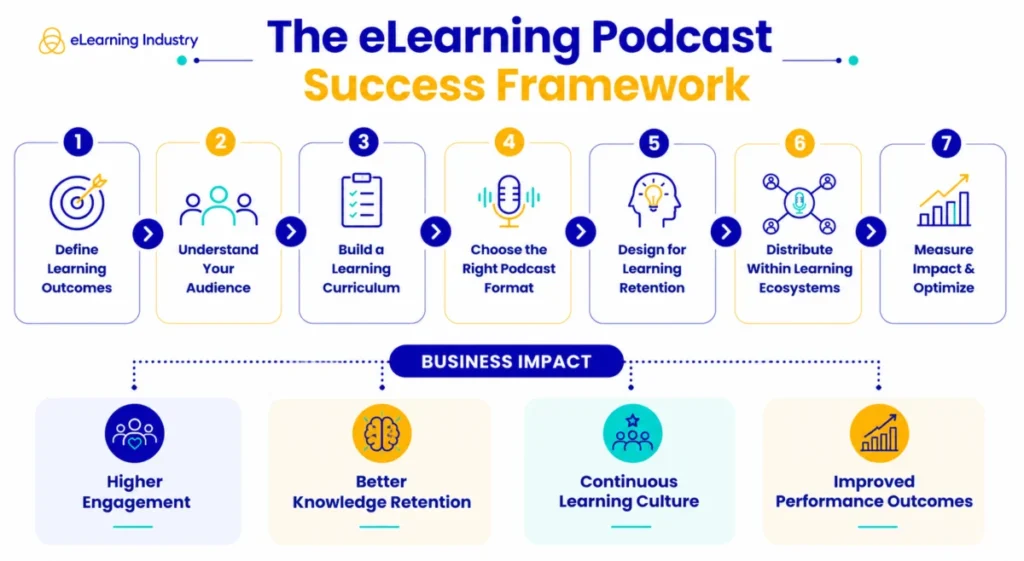
A Framework for Implementation: The Seven-Step Path to Success
Creating a successful eLearning podcast requires a disciplined approach to instructional design. It is not merely about recording a conversation; it is about engineering a learning experience.
- Defining Outcomes: Every series must begin with a clear objective. L&D leaders must identify what specific behavior they aim to change or what knowledge gap they intend to bridge.
- Audience Persona Mapping: Content must be tailored to the specific needs of different cohorts. A frontline worker’s information needs differ vastly from those of a C-suite executive.
- Curriculum Architecture: Rather than a series of disconnected episodes, the content should follow a logical progression, building upon previous lessons to create a comprehensive learning path.
- Format Selection: Organizations must choose the right "vessel" for their message. This might include a solo "Masterclass" format for technical skills, a panel discussion for diverse perspectives, or a narrative storytelling format for cultural initiatives.
- Instructional Scripting: Effective scripts incorporate reflection prompts—questions that ask the listener to consider how they would apply the information in their specific role. This transforms passive listening into active learning.
- Integrated Distribution: To ensure high adoption, podcasts should be integrated into existing ecosystems. This includes hosting episodes within the LMS for tracking purposes and promoting them via internal communication tools like Microsoft Teams or Slack.
- Impact Measurement: Success is measured through a combination of quantitative data (download rates, completion percentages) and qualitative outcomes (improved performance metrics, employee feedback surveys).
Broader Implications and the Future of Corporate Audio
The rise of the eLearning podcast is a symptom of a larger shift toward the "consumerization" of corporate learning. Employees now expect their workplace tools to be as intuitive and accessible as the apps they use in their personal lives. As AI-driven voice synthesis and automated transcription technologies continue to advance, the barrier to entry for high-quality audio production will drop even further.
Furthermore, the global nature of modern business makes audio a versatile tool for localization. While translating and re-shooting video content is prohibitively expensive, audio content can be translated and re-recorded in multiple languages with relative ease, ensuring that global teams receive consistent training.
In conclusion, the eLearning podcast represents a transition from "just-in-case" learning—where employees are forced to sit through broad training—to "just-in-time" learning, where information is available at the exact moment of need. By prioritizing instructional design over mere production value and integrating audio into a holistic blended learning strategy, organizations can build a more resilient, informed, and engaged workforce. The future of corporate L&D is not just digital; it is increasingly audible, mobile, and deeply integrated into the rhythm of the modern workday.