The modern talent acquisition landscape is increasingly characterized by intense competition for skilled professionals, leading to a prevalent and costly challenge for organizations: candidate reneging. This phenomenon, where a candidate accepts an offer but subsequently withdraws before their official start date, has become a significant disruptor to recruitment pipelines and business operations. Historically, many talent programs have lacked a formalized process to identify and mitigate this risk, often discovering a renege only after it has occurred. By the time a promising candidate goes quiet, indicating a potential withdrawal, their decision is frequently already firm, leaving companies scrambling for last-minute backfills. This reactive approach not only incurs substantial financial and operational costs but also underscores a fundamental gap in candidate relationship management during the critical pre-start phase.
The Strategic Imperative of Pre-Start Engagement
The period between a candidate accepting an offer and their first day of employment is a highly vulnerable window. During this time, candidates may be weighing competing offers, experiencing personal circumstances that alter their availability, or simply grappling with uncertainty about their career move. In a candidate-driven market, organizations that fail to maintain consistent, meaningful engagement during this phase risk losing valuable talent they have already invested significantly in acquiring. The traditional approach, often characterized by a flurry of activity during the interview process followed by a lull until onboarding, inadvertently creates an opportunity for disengagement.
The financial implications of candidate reneging are substantial. Industry analyses consistently show that the cost of replacing an employee can range from 30% to 150% of their annual salary, depending on the seniority and specialization of the role. This figure encompasses direct costs such as additional recruitment fees, advertising, and interviewer time, as well as indirect costs like lost productivity, training expenses for a new hire, and the potential impact on team morale and project timelines. Beyond the immediate financial burden, reneges can damage an organization’s employer brand, especially if candidates share negative pre-boarding experiences on professional networking sites or social media platforms.
Recognizing these challenges, leading organizations are now shifting their focus towards proactive engagement strategies, treating early engagement signals as crucial leading indicators of a candidate’s commitment. This paradigm shift moves away from simply waiting for a renege email to arrive and instead involves continuous monitoring and strategic intervention during the pre-start period.
The Engagement Health Scorecard: A Proactive Framework for Talent Retention
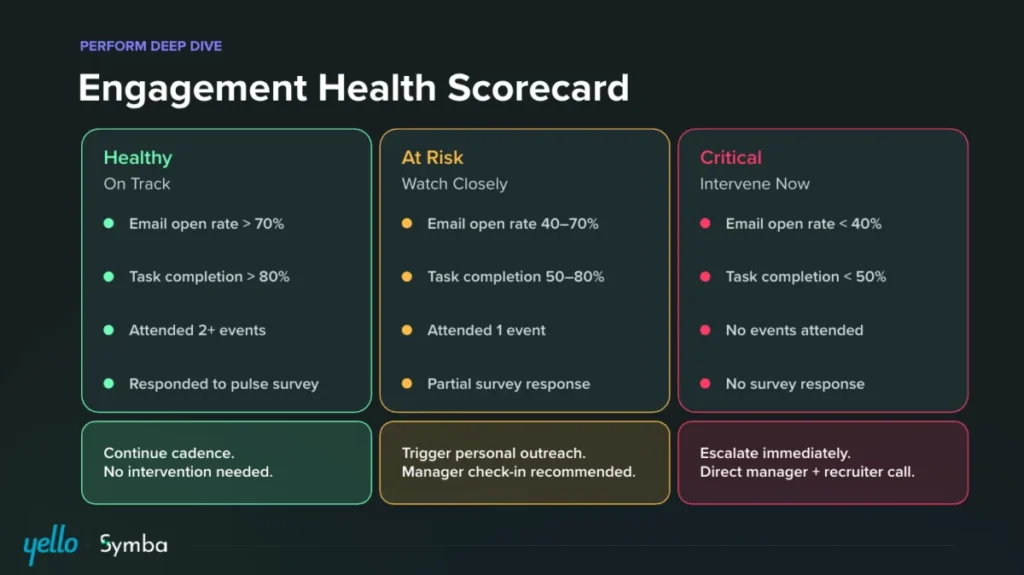
At the forefront of this proactive approach is the implementation of structured tools like the Engagement Health Scorecard. This innovative framework categorizes candidates into distinct groups based on their behavior and interaction levels during the critical pre-start phase, allowing talent acquisition teams to tailor their responses effectively. The core principle is to identify declining engagement early, enabling timely interventions that can often re-establish connection and reaffirm a candidate’s commitment.
The scorecard typically relies on quantifiable metrics derived from a candidate’s interaction with pre-boarding materials, communications, and events. These metrics include email open rates, completion of administrative tasks, attendance at pre-start events or webinars, and responsiveness to surveys or direct inquiries. By aggregating and analyzing these data points, organizations gain a real-time pulse on a candidate’s "health" or level of engagement.
Deconstructing the Engagement Health Tiers and Intervention Protocols
The Engagement Health Scorecard categorizes candidates into three primary tiers: Healthy, At-Risk, and Critical. Each tier is defined by specific behavioral thresholds and corresponds to a recommended set of actions designed to either maintain positive engagement or address declining interest.
1. Healthy Candidates: Maintaining Momentum
- Characteristics: Candidates in the "Healthy" category demonstrate robust engagement with the organization. This typically includes email open rates consistently above 70%, prompt completion of pre-boarding tasks (e.g., background checks, paperwork, benefits enrollment), active attendance at multiple pre-start events (such as virtual meet-and-greets, departmental introductions, or informational webinars), and timely, complete responses to surveys designed to gauge their enthusiasm or address early questions. Their behavior signals sustained interest and excitement about their impending role.
- Recommended Actions: For healthy candidates, the primary strategy is to "continue the cadence and stay the course." This involves maintaining the established communication schedule, providing consistent updates, and offering opportunities for further engagement without overwhelming them. The goal is to nurture their positive sentiment, reinforce their decision, and ensure they feel valued and informed. This might include sharing company news, team updates, or inviting them to optional, informal virtual gatherings to meet future colleagues. As HR experts often advise, consistent positive reinforcement during this phase can solidify a candidate’s commitment and further integrate them into the company culture even before their official start date.
2. At-Risk Candidates: Timely Intervention
- Characteristics: "At-Risk" candidates exhibit a noticeable decline in engagement signals. Their email open rates may fall into a range of 40-70%, indicating a potential decrease in attention to organizational communications. They might show limited attendance at pre-start events, missing some or only participating minimally. Survey responses, if provided, may be incomplete or delayed, suggesting a wavering commitment or a reluctance to fully engage. These subtle shifts are crucial warning signs that require immediate attention.
- Recommended Actions: For candidates in the At-Risk tier, personal outreach within 48 hours is critical. This intervention should be highly personalized and aimed at re-establishing a direct connection. Effective actions include:
- Direct Message from the Program Manager: A personalized message from the program manager or team lead, expressing enthusiasm for their start and offering to answer any questions, can make a significant difference. This human touch can cut through the noise of mass communications.
- Individualized Event Invitation: Instead of generic invites, an invitation to the next event that feels specifically tailored to their interests or role, perhaps with a personal note explaining its relevance, can re-engage them.
- Hiring Manager Check-in: A brief, informal check-in call or message from the hiring manager can be particularly impactful. This direct communication from their future leader can reinforce the value of their role and address any nascent doubts.
- Industry research indicates that personalized communication can significantly increase engagement. A study published by the Society for Human Resource Management (SHRM) highlighted that candidates who feel a personal connection to their future team and manager are substantially less likely to renege. These timely, individualized interventions often turn things around quickly by addressing underlying concerns before they escalate.
3. Critical Candidates: Immediate Escalation
- Characteristics: Candidates categorized as "Critical" show almost no engagement, signaling a high probability of reneging. Their email open rates are typically below 40%, often indicating they are not even reviewing company communications. They exhibit no attendance at pre-start events, no survey responses, and a complete lack of activity for three or more weeks. This profound disengagement is a red flag demanding urgent, high-level intervention.
- Recommended Actions: For critical candidates, immediate escalation is necessary. The goal is to initiate a direct, honest conversation to uncover the root cause of their disengagement. Key actions include:
- Direct Call from the Hiring Manager: A personal phone call from the hiring manager is often the most effective first step. This shows the candidate that their potential absence is noted and valued at a senior level, prompting them to be more candid.
- Personal Touchpoint from the Recruiter: The recruiter, who has built a rapport with the candidate throughout the hiring process, should follow up with a personal call or message, reiterating the company’s excitement and offering support.
- A Real Conversation about What’s Going On: The objective of these interventions is not merely to send messages but to initiate a genuine dialogue. Often, the root cause of disengagement for critical candidates is a competing offer they are seriously considering, a personal circumstance (e.g., family illness, relocation issues), or simple uncertainty about the role or company culture. Catching these issues in time allows the organization an opportunity to address concerns, provide additional information, or even sweeten the offer, potentially preventing a costly renege. Data from talent analytics firms suggests that a significant percentage of reneges are preventable if the underlying issues are identified and addressed proactively.
The Financial and Operational Toll of Unaddressed Reneges
The difference between organizations that successfully retain candidates and those perpetually scrambling to backfill positions is almost always rooted in their approach to data. The former continuously monitors engagement data, not just reacting when a renege email arrives, but proactively identifying and addressing risks. The latter, operating in a reactive mode, faces recurring operational disruptions, project delays, and increased stress on existing teams.
Beyond the direct costs of recruitment, the operational impact can be severe. A critical role left vacant for an extended period can halt project progress, delay product launches, or even impair service delivery. This can lead to missed revenue targets, damage customer relationships, and erode employee morale as existing team members are forced to absorb additional workloads. The cumulative effect of multiple reneges can undermine strategic initiatives and significantly impede an organization’s growth trajectory.
Expert Perspectives on Data-Driven Talent Retention
Leading HR analysts and recruitment strategists widely endorse the shift towards data-driven candidate engagement. "The era of ‘post-offer, pre-start’ black boxes is over," states Dr. Evelyn Reed, a prominent talent acquisition consultant. "In today’s competitive environment, every touchpoint is an opportunity to reinforce commitment or identify a potential flight risk. Organizations that leverage engagement data aren’t just filling roles; they’re strategically building their future workforce."
Another industry expert, Mark Jenkins, CEO of a global HR technology firm, emphasizes, "The cost of not having a robust pre-boarding engagement strategy far outweighs the investment in the tools and processes required. It’s about protecting your talent pipeline and ensuring continuity. Continuous data insights allow for targeted, efficient interventions rather than broad-brush, often ineffective, reactive measures." These sentiments highlight a consensus that proactive, data-informed candidate relationship management is no longer a luxury but a strategic necessity for organizational resilience.
Broader Implications for Talent Acquisition and Employer Branding
The adoption of an Engagement Health Scorecard and similar proactive strategies has broader implications for talent acquisition and employer branding. It signifies a maturation of the recruitment function, transforming it from a transactional process into a strategic, candidate-centric relationship management endeavor. By actively engaging and supporting candidates throughout the pre-start phase, companies not only reduce renege rates but also enhance their employer brand. A positive pre-boarding experience can turn candidates into advocates, regardless of whether they ultimately join the company. Word-of-mouth recommendations, positive online reviews, and a reputation for being supportive and communicative can attract future talent.
Furthermore, this approach fosters a culture of continuous improvement within talent acquisition teams. By analyzing intervention outcomes and tracking candidate behavior, organizations can refine their pre-boarding programs, making them more effective and personalized over time. This iterative process ensures that the candidate experience is consistently optimized, reflecting the company’s values and commitment to its future employees.
Implementation and Continuous Improvement: The KEEP Playbook
For organizations looking to implement or refine their candidate engagement strategies, comprehensive resources are becoming available. The KEEP Playbook, for instance, offers a detailed framework for managing candidate engagement effectively. It includes the full engagement health scorecard with predefined thresholds and recommended actions for each tier, providing a ready-to-use template for talent teams. Beyond the scorecard, it offers a step-by-step intervention playbook, guiding teams through the nuances of personalized outreach and escalation. Crucially, it also incorporates a post-cycle review template, enabling organizations to analyze their program’s effectiveness, identify areas for improvement, and continuously enhance their talent retention capabilities with every recruitment cycle. This holistic approach ensures that talent acquisition is not just about hiring but about successfully integrating new team members into the organizational fabric.
Conclusion: The Future of Candidate Relationship Management
In an increasingly competitive global talent market, the ability to secure and retain top talent post-offer is a critical differentiator for organizational success. The proactive management of candidate engagement during the pre-start period, facilitated by tools like the Engagement Health Scorecard, represents a significant evolution in talent acquisition strategy. By treating engagement signals as leading indicators and implementing timely, personalized interventions, organizations can drastically reduce candidate renege rates, mitigate substantial financial and operational risks, and cultivate a stronger, more resilient talent pipeline. The future of candidate relationship management unequivocally lies in data-driven insights, continuous monitoring, and a unwavering commitment to nurturing candidate relationships from offer acceptance through to successful onboarding.