
The Patient-Centered Outcomes Research Institute fee, commonly referred to as the PCORI fee, represents a critical annual compliance obligation for small business owners and sponsors of self-insured health plans. Established under the Affordable Care Act (ACA), this fee is designed to fund federal research into the clinical effectiveness of various medical treatments, helping healthcare consumers and providers make more informed decisions. While insurance carriers typically handle these payments for fully-insured plans, employers who offer self-insured arrangements—including Health Reimbursement Arrangements (HRAs)—must navigate the filing process independently. As the July 31 deadline approaches for the 2026 reporting cycle, understanding the nuances of IRS Form 720 and the updated fee structures is essential for maintaining regulatory compliance and avoiding significant financial penalties.
The Origins and Purpose of the PCORI Fee
The Patient-Centered Outcomes Research Institute was created as an independent, non-profit organization through the 2010 Affordable Care Act. Its primary mission is to conduct research that compares medical treatments to determine which work best for specific patient populations. By focusing on "patient-centered" outcomes, the institute aims to provide data that transcends traditional clinical trials, offering insights into how different treatments affect the daily lives of patients.
Initially, the PCORI fee was intended to be a temporary measure, with an expiration date set for 2019. However, recognizing the ongoing value of the research produced by the institute, Congress moved to extend the funding mechanism. The Further Consolidated Appropriations Act of 2020 officially pushed the expiration date to September 30, 2029. This extension ensured that the institute would have a stable decade of funding to continue its comparative effectiveness research, even as the broader healthcare landscape underwent significant shifts.
For the federal government, the fee serves as a dedicated revenue stream that bypasses the traditional appropriations process, ensuring that research into healthcare quality remains insulated from certain political fluctuations. For employers, however, it represents an annual administrative task that requires precise accounting of "covered lives" within their benefit ecosystems.

Determining Liability: Who Must File?
Liability for the PCORI fee depends largely on the structure of the health benefits provided to employees. The IRS distinguishes between "specified health insurance policies" and "applicable self-insured health plans."
In the case of fully-insured group health plans, the insurance carrier is the party responsible for calculating and paying the fee. The cost is often baked into the premiums paid by the employer, meaning the business owner has no direct filing requirement with the IRS for these specific plans.
The landscape changes significantly for self-insured employers. If a company sponsors a plan where it assumes the financial risk for providing healthcare benefits, it is classified as the "plan sponsor" and must file Form 720. This requirement extends to several popular modern benefit models, including:
- Individual Coverage HRAs (ICHRA): These allow employers to reimburse employees for individual health insurance premiums.
- Qualified Small Employer HRAs (QSEHRA): Designed for businesses with fewer than 50 full-time employees that do not offer a group medical plan.
- Group Coverage HRAs (GCHRA): Also known as integrated HRAs, these are offered alongside a group health plan.
There are specific nuances regarding GCHRAs. If an employer offers a GCHRA alongside a fully-insured medical plan, the employer is responsible for the PCORI fee for the HRA, while the carrier handles the fee for the medical plan. Conversely, if the GCHRA is integrated with a self-insured medical plan from the same sponsor, the two are treated as a single plan, and only one fee per covered life is required.
Exemptions do exist. Plans that provide "excepted benefits," such as stand-alone dental or vision insurance, are not subject to PCORI fees. Similarly, Health Savings Accounts (HSAs) and most Employee Assistance Programs (EAPs) are exempt, provided they do not provide significant medical care benefits.

Fee Structure and Chronology of Adjustments
The PCORI fee is not a flat tax; it is calculated on a per-plan-participant basis and is adjusted annually by the Department of Health and Human Services (HHS) to account for inflation in National Health Expenditures.
For the current reporting cycle due in July 2026, the fees are determined by the date the plan year ended. For plans that concluded between October 1, 2025, and September 30, 2026, the fee is set at $3.84 per covered life. This marks a notable increase from the $3.47 rate applied to plans ending the previous year.
The following timeline illustrates the steady rise in PCORI fees over recent years, reflecting the rising costs of healthcare and the inflationary adjustments mandated by the ACA:
- Plan years ending Oct 2021 – Sept 2022: $2.79 per covered life
- Plan years ending Oct 2022 – Sept 2023: $3.00 per covered life
- Plan years ending Oct 2023 – Sept 2024: $3.22 per covered life
- Plan years ending Oct 2024 – Sept 2025: $3.47 per covered life
- Plan years ending Oct 2025 – Sept 2026: $3.84 per covered life
For an employer running a standard calendar-year HRA that ended on December 31, 2025, the applicable rate for the July 2026 filing would be $3.84 per participant.
Calculating the "Number of Lives"
One of the most complex aspects of PCORI compliance is accurately determining the number of covered lives. The IRS provides three primary methods for self-insured plan sponsors to calculate this figure:
- The Actual Count Method: The sponsor adds the total number of lives covered on each day of the plan year and divides by the number of days in the plan year. This is the most precise but also the most administratively burdensome method.
- The Snapshot Method: The sponsor counts the number of lives covered on a single day (or multiple days) during each quarter and divides the total by the number of dates used. The dates must be consistent across quarters.
- The Form 5500 Method: This method uses the participant counts reported on the company’s Form 5500 for the corresponding plan year. This is often the simplest method for larger employers who are already required to file Form 5500.
Special rules apply to HRAs. For an ICHRA or QSEHRA, the employer only needs to count the employees participating in the plan; they do not need to count spouses or dependents, even if those family members are being reimbursed for their own individual premiums. However, for other types of self-insured medical plans, COBRA participants and retirees must be included in the total "lives" count.
Filing Mechanics: IRS Form 720
The PCORI fee is reported on IRS Form 720, the Quarterly Federal Excise Tax Return. Although Form 720 is generally a quarterly filing used for various excise taxes—such as those on fuel, communications, and air transportation—PCORI fees are reported only once a year in the second quarter (covering April, May, and June).
The deadline is strictly July 31. If July 31 falls on a Saturday, Sunday, or legal holiday, the return is considered timely if filed on the next business day. For the 2026 cycle, employers must ensure their documentation is processed and payment is initiated by this date to remain in good standing.
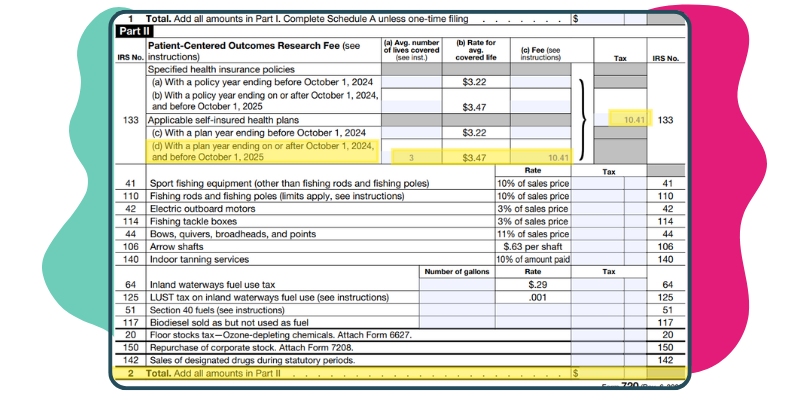
The form itself requires the sponsor to identify the plan type under Part II, specifically line 133. Section (c) is used for plan years ending before October 1 of the prior year, while section (d) is used for plan years ending on or after that date. The final total is then transferred to Part III to determine the balance due. Payment must be accompanied by Form 720-V, a payment voucher, unless the employer chooses to pay electronically via the Electronic Federal Tax Payment System (EFTPS).
Expert Perspectives and the Risks of Non-Compliance
Financial experts emphasize that while the dollar amount per person may seem nominal, the penalties for oversight are not. David Blain, CEO of BlueSky Wealth Advisors, notes that the administrative burden often outweighs the actual cost of the fee itself. "Forgetting or choosing not to pay this fee can lead to penalties and interest charges, which can be significant and add unnecessary costs," Blain observed.

Blain highlights a common pitfall: the miscalculation of covered lives during audits. "We’ve seen scenarios where entities miscalculated their covered lives or missed the fee payment deadline, and both situations led to complications during their annual audits. Acting swiftly to correct the oversight and promptly communicating with the IRS has helped in minimizing the penalties for our clients."
Under Internal Revenue Code § 6651, the penalty for failing to file the return or pay the tax can be 5% of the amount due for each month the return is late, capped at 25%. For a large organization with thousands of covered lives, a 25% penalty on top of interest can result in a substantial unexpected expense.
Broader Implications for the Healthcare Market
The persistence of the PCORI fee into the late 2020s signals a continued federal commitment to data-driven healthcare. By funding the Patient-Centered Outcomes Research Institute, the government is essentially taxing the insurance industry and self-insured employers to pay for the "intelligence" that theoretically makes the entire system more efficient.
Critics of the fee argue that it places an unfair administrative burden on small businesses, particularly those who have moved toward HRAs to escape the complexity of traditional group plans. Proponents, however, point to the hundreds of clinical studies funded by PCORI that have helped reduce ineffective medical spending.
As the healthcare market continues to evolve toward personalized medicine and value-based care, the data generated by PCORI-funded research is expected to become even more integral to insurance plan design. For employers, the annual July 31 filing is more than just a tax obligation; it is a contribution to the national database of medical effectiveness that may, in the long run, help stabilize the very premiums and healthcare costs they struggle to manage today.

In conclusion, self-insured employers must treat the PCORI fee with the same rigor as any other federal tax filing. By utilizing digital tools—such as those provided by HRA administration platforms—and consulting with tax professionals, business owners can ensure they meet the July 31 deadline, accurately calculate their "covered lives," and contribute their mandated share to the nation’s healthcare research infrastructure.