The modern human resources department often boasts a sophisticated technology stack, seemingly covering every critical function: engagement surveys, performance reviews, recognition platforms, development planning tools, and a core HRIS to manage it all. On paper, this technological arsenal appears robust, addressing each essential HR pillar. However, the illusion of a complete system shatters when examining the crucial connections—or lack thereof—between these individual tools. A subtle dip in employee engagement might go unnoticed by a direct manager during a one-on-one meeting. A high performer’s consistent contributions might not be adequately recognized, failing to preemptively address a looming retention risk. The signals are undeniably present, but they remain isolated, never converging to paint a comprehensive picture of the workforce.
This pervasive issue, termed the "disconnected data problem," is far more than a mere IT inconvenience. It directly impacts an HR leader’s ability to confidently answer critical questions posed by the Chief Human Resources Officer (CHRO), to proactively identify potential employee flight risks, and to reclaim valuable time currently spent painstakingly aggregating disparate reports instead of acting on actionable insights. Fortunately, the solution doesn’t lie in acquiring more data or overhauling an entire suite of tools. Instead, the imperative is to enable these existing systems to communicate and share information effectively. Understanding the silent costs of this data fragmentation and the transformative benefits of integration is paramount for any forward-thinking organization.
Understanding Disconnected People Data
At its core, disconnected people data refers to the scenario where vital employee information—gleaned from engagement surveys, performance evaluations, recognition programs, development plans, and HRIS records—resides in siloed systems that were not designed for interoperability. Each system captures a segment of the employee narrative, but no single platform offers a holistic view of team dynamics and individual contributions. Consequently, instead of a clear, unified perspective on workforce well-being and performance, organizations are left with a collection of fragmented snapshots, requiring significant manual effort to stitch together into something actionable.
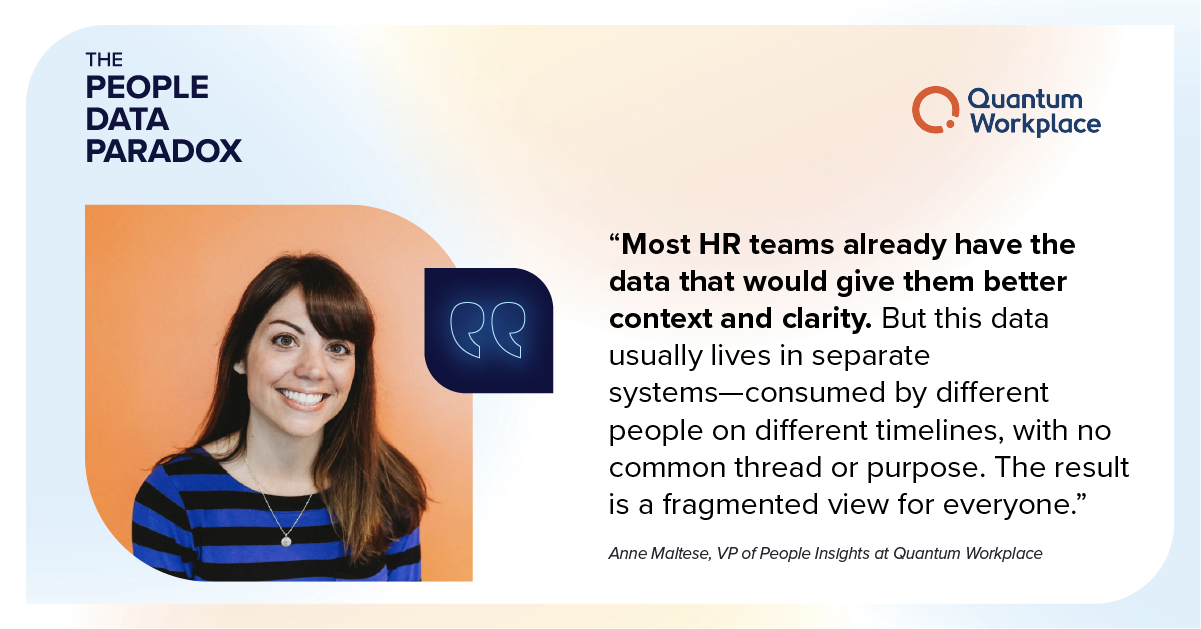
This fragmentation is not a new phenomenon. For years, HR technology has evolved in discrete functional areas, leading to a proliferation of specialized tools. While each may excel in its specific domain, the lack of integration creates a critical chasm. According to research from Quantum Workplace, a significant majority of HR leaders utilize between two and four HR solutions from different vendors, yet a mere 39% report that these systems are meaningfully integrated. This disconnect means that valuable data continues to accumulate, but the clarity and actionable insights that should accompany it remain elusive.
The Significant Economic Impact of Fragmented People Data
The consequences of disconnected people data extend far beyond operational inefficiencies, translating into substantial financial losses. Organizations can incur millions of dollars annually due to diminished productivity, preventable employee turnover, and the missed identification and development of high-potential talent. For a mid-sized company with approximately 2,500 employees, the annual cost associated with underequipped managers and the attrition of top performers alone can approach $4 million.

The familiar frustration of compiling reports from multiple systems to answer a single executive question is a tangible manifestation of this problem. The necessary data exists within the organization’s digital infrastructure, but its inaccessibility and the lack of cohesive analysis prevent swift and confident decision-making. This gap is not a reflection of individual shortcomings within the HR department or a simple technological glitch; it is a systemic issue with profound business implications.
This fragmentation manifests most acutely in several critical areas:
The High Cost of Underequipped Managers
Managers serve as the primary conduit for employee engagement and performance. When managers are supported and effective, their teams tend to flourish. Conversely, their struggles can cascade throughout their direct reports. The root cause of managerial challenges often lies not in a lack of inherent talent, but in the absence of adequate support and resources. The average manager is reportedly burdened with 51% more responsibility than is realistically manageable, and a concerning 39% have never received formal leadership training.
The business impact of this managerial deficit is substantial. Studies indicate that managers in the top decile of leadership effectiveness generate twice the net revenue of their counterparts. This disparity highlights a critical performance gap within organizations, stemming directly from inadequate leadership development and support.
The Opportunity Cost of Overlooking High-Potential Talent
High-performing employees are not merely valuable; they are disproportionately so, capable of producing between 400% and 800% more than an average employee. Despite this outsized impact, a significant number of organizations—57%—lack a formal process for identifying these individuals. In the absence of connected data, the identification of high-potential talent often becomes reliant on visibility and advocacy, favoring those who are nominated or noticed, rather than those who consistently deliver exceptional results. This means that the employees contributing the most significantly may not always be recognized, leading to a continuous loss of potential value for the organization.
The Preventable Cost of Missing Retention Risks
The decision for a high performer to resign is rarely sudden. It is typically the culmination of months of developing dissatisfaction, often signaled by subtle shifts in survey sentiment, a cessation of development conversations, or a decline in recognition. Individually, these signals may not trigger alarms. However, when viewed collectively through connected data, they paint a clear and urgent picture of potential attrition. Replacing an employee can cost anywhere from 50% to 200% of their annual salary. Furthermore, research suggests that as many as one-third of departing employees believe their exit could have been prevented. These critical warning signs are often embedded within existing data, but remain obscured by system silos.
The Cumulative Impact of Fragmented Data
Consider an organization with 2,500 employees and 250 managers. If 50 of those managers are inadequately supported, and this leads to a 10% disengagement rate among their direct reports, the annual cost in lost productivity alone can reach $1.7 million. Adding the scenario where 10 high performers depart due to a lack of recognition, with replacement costs at twice their salary, introduces an additional $2 million in expenses. This brings the total estimated financial drain directly attributable to disconnected data to nearly $4 million, and this figure does not even encompass the broader economic implications of teams operating without optimal conditions for success, such as misdirected effort, slow skill development, or unrealized potential.
The Transformative Power of Connected Data
Historically, the process of connecting signals across fragmented systems was prohibitively time-consuming and resource-intensive for most HR teams. However, advancements in technology, particularly artificial intelligence (AI), are revolutionizing this landscape. AI can now continuously analyze data from engagement, performance, development, and recognition platforms, cross-referencing it with HRIS records and industry benchmarks to identify patterns that were previously invisible.
This paradigm shift is not about accumulating more data, but rather about finally deciphering the crucial messages that existing data has been trying to convey. When these disparate signals are integrated, organizations can begin to address the complex questions that often keep HR and executive leadership awake at night:
- Identifying early indicators of employee disengagement: By correlating engagement survey results with performance metrics and recognition frequency, trends that signal potential disengagement can be identified before they significantly impact productivity.
- Proactively addressing flight risks: A combination of declining engagement scores, reduced development activity, and a lack of recent recognition can serve as an early warning system for potential attrition, allowing for targeted retention interventions.
- Uncovering hidden high-potential talent: By analyzing performance data, development aspirations, and consistent positive feedback, individuals who may not be in traditional leadership tracks can be identified and nurtured for future roles.
- Optimizing manager effectiveness: Connecting performance feedback, training records, and team engagement scores can highlight areas where managers may need additional support or development, thereby improving overall team performance.
- Measuring the true impact of HR initiatives: By linking data from various HR programs to key business outcomes, the ROI of HR investments can be more accurately assessed and demonstrated.
Transitioning Fragmented Data into Unified Talent Insights
The true value of interconnected data lies not just in its visibility, but in its ability to drive meaningful action. Quantum Workplace, a leader in people intelligence, offers a platform designed to bridge the gap between fragmented systems and actionable insights. Their solution consolidates engagement, performance, development, and recognition data into a single, unified view, empowering leaders to move beyond piecing together disparate reports and gain a clear understanding of what is truly happening within their teams.
Leveraging AI-driven insights, the platform uncovers patterns hidden between disparate systems. Each finding is accompanied by clear, prioritized next steps, contextualized by the organization’s unique priorities and benchmarks, and delivered directly to leaders within their workflow. This integrated approach enables HR teams to:
- Gain a 360-degree view of employee experience: Understand how engagement, performance, and development efforts are interconnected and influence each other.
- Identify and address talent risks and opportunities with precision: Move from reactive problem-solving to proactive talent management by spotting trends before they escalate.
- Equip managers with actionable insights: Provide leaders with the data and guidance they need to effectively support and develop their teams.
- Demonstrate the strategic value of HR: Clearly articulate the impact of HR initiatives on business outcomes through data-driven reporting.
- Foster a culture of continuous improvement: Create a feedback loop that drives ongoing development and enhances the employee experience.
In an era where talent is a critical differentiator, the ability to harness the full potential of people data is no longer a luxury but a necessity. By breaking down data silos and fostering inter-system communication, organizations can unlock a deeper understanding of their workforce, mitigate significant financial risks, and build a more engaged, productive, and high-performing future.