The U.S. Equal Employment Opportunity Commission (EEOC) concluded its 2025 fiscal year with a dramatic reduction in litigation activity, filing just 93 merit lawsuits—the lowest volume recorded in a decade. This sharp decline follows a period of unprecedented administrative upheaval, including the summary termination of top officials and a fundamental redirection of the agency’s enforcement priorities under the second Trump administration. While the fiscal year began with the momentum of a Democratic majority and a substantial budget, the subsequent leadership purge and loss of a functional quorum have fundamentally altered the landscape of federal employment law enforcement.
A Comparative Analysis of Litigation Trends
To understand the significance of the 93 filings in FY 2025, one must look at the historical context of the agency’s activity over the last 30 years. During the Obama administration, the EEOC frequently filed upwards of 300 merit lawsuits annually. Even during the first Trump administration and the subsequent COVID-19 pandemic, numbers remained relatively stable, with 94 filings in FY 2020 and 111 in FY 2021.
The agency saw a brief resurgence in FY 2023 under the Biden administration, filing 144 lawsuits—a five-year high attributed to the installation of General Counsel Karla Gilbride and a Democratic majority. However, the momentum shifted in FY 2024 when filings dipped to 96, and the trend has now bottomed out at 93 in FY 2025. This figure represents not only a ten-year low but stands as one of the quietest years for the Commission since the early 1990s. For comparison, in the final month of FY 2023 alone, the EEOC filed 71 lawsuits; in FY 2025, that total barely represents the entire year’s output.
Chronology of a Leadership Overhaul
The trajectory of FY 2025 was dictated by political shifts that began shortly after the 2024 presidential election. The fiscal year, which runs from October 1 to September 30, began under a Biden-appointed leadership structure but was swiftly transformed in January 2025.
In late January, President Trump took the unprecedented step of firing EEOC Commissioners Charlotte Burrows and Jocelyn Samuels, despite both having years remaining on their appointed terms. This move was accompanied by the termination of General Counsel Karla Gilbride. In their place, Andrea Lucas was elevated to Acting Chair. This purge left the Commission without a quorum, as only Acting Chair Lucas and Commissioner Kalpana Kotagal remained.
The lack of a quorum has profound legal implications. Under the agency’s delegation of authority, the General Counsel can initiate "routine" litigation. However, without a full Commission vote, the agency is generally restricted from filing cases involving:
- Systemic discrimination or pattern-and-practice allegations.
- Major expenditures of agency resources.
- Positions that run contrary to established Circuit Court precedent.
- Cases likely to generate significant public controversy.
This "quorum crisis" explains the narrowing scope of the agency’s litigation docket in the latter half of the fiscal year.
Geographic and Monthly Filing Volatility
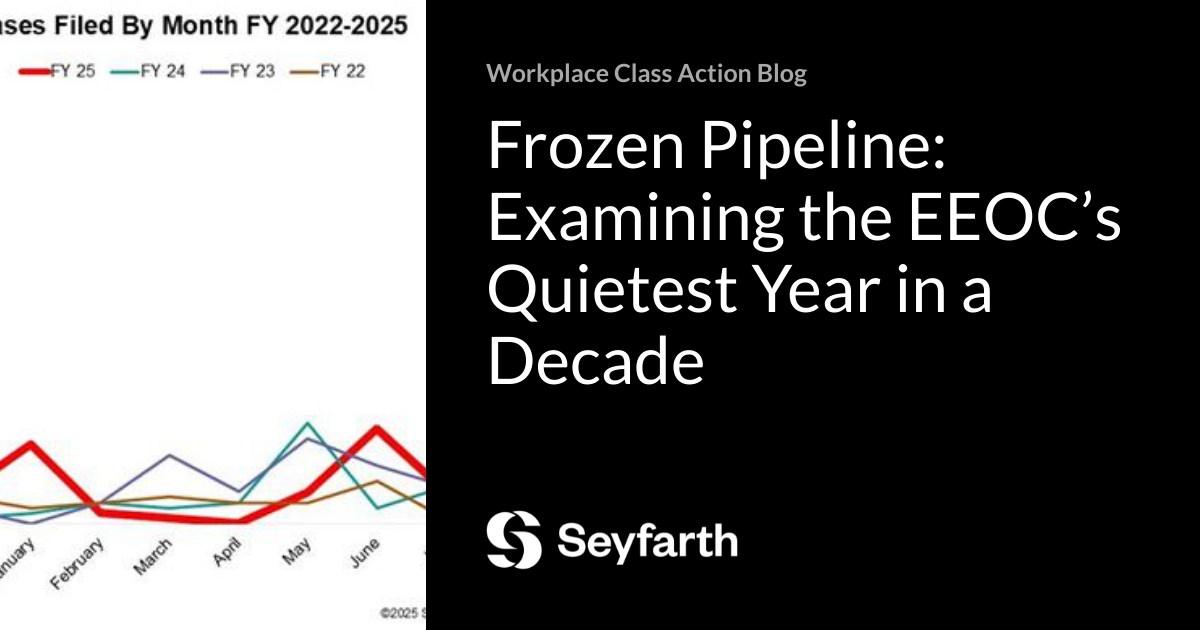
The timing of filings in FY 2025 suggests an agency in transition. The first four months of the fiscal year (October through January) saw a relatively high volume of 24 lawsuits. Legal analysts suggest this "front-loading" was an attempt by the outgoing administration’s personnel to move cases into the court system before the change in leadership.
The traditional "September Surge," where the agency typically files the bulk of its cases to meet annual quotas, was notably muted. In September 2025, the EEOC filed 35 lawsuits, a significant drop from the 56 filed in September 2024 and the 71 filed in September 2023.

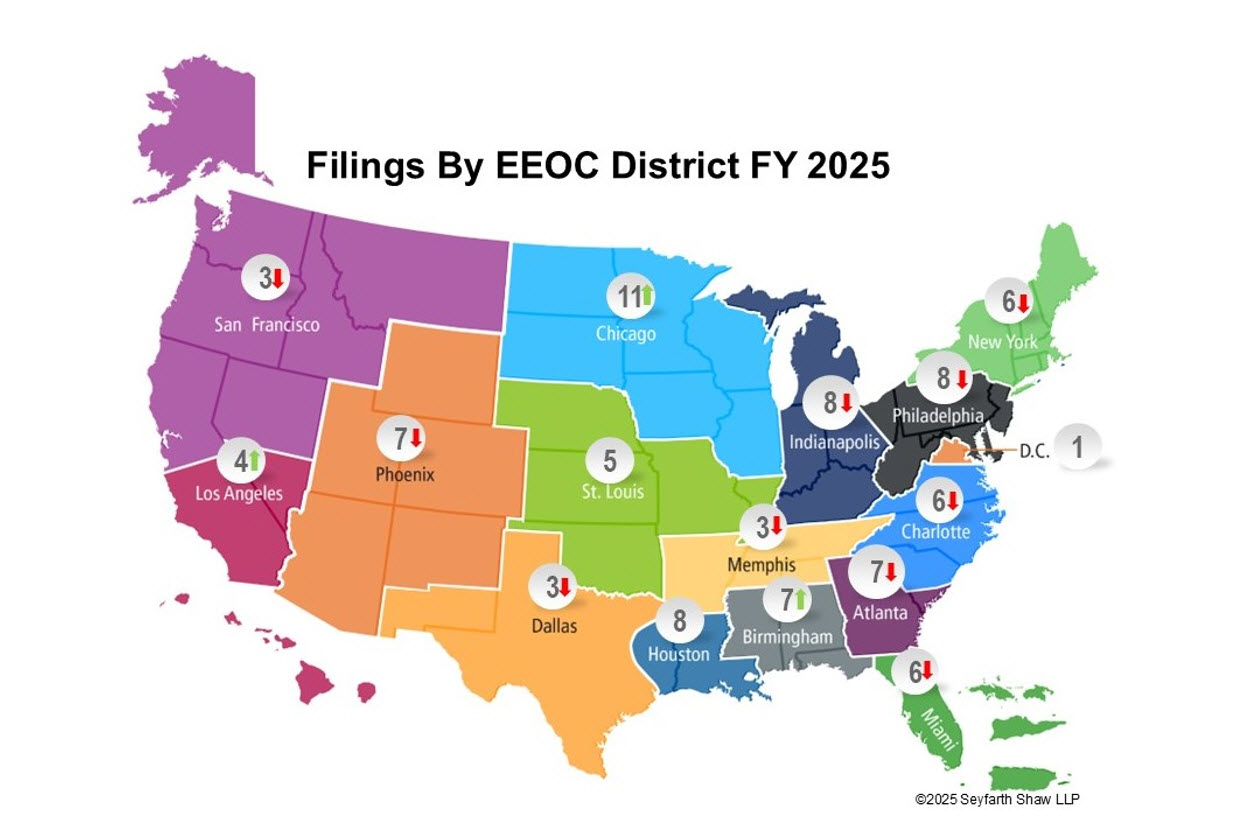
Geographically, the Chicago District Office reclaimed its position as the most aggressive branch, leading the nation with 11 merit filings. Other active hubs included Philadelphia, Indianapolis, and Houston, each recording eight filings. Conversely, the West Coast offices in Los Angeles and San Francisco—once hotbeds of EEOC activity during the Obama era—remained remarkably quiet, filing only four and three lawsuits, respectively. This geographic shift highlights a pivot away from the traditionally liberal coastal circuits toward the more conservative central and southern regions.
Shift in Substantive Legal Priorities
While the quantity of cases dropped, the nature of the claims filed provides a roadmap of the current administration’s "restoration" of what Acting Chair Lucas describes as "biological truth" and "religious freedom."
The Rise of Religious and Pregnancy Protections
One of the most notable trends in FY 2025 was the surge in religious discrimination filings. The Commission filed 11 lawsuits asserting religious discrimination or failure to accommodate, a direct response to the 600% increase in religion-based charges filed during the pandemic. Acting Chair Lucas stated that under her leadership, the EEOC is ensuring workers are "not forced to choose between their paycheck and their faith," signaling a pivot away from what she termed "woke policies."
Simultaneously, the agency maintained a strong focus on sex and pregnancy discrimination, filing 37 cases in this category. This includes enforcement of the newly enacted Pregnant Workers Fairness Act (PWFA), which has become a cornerstone of the agency’s current sex-discrimination mandate.
The Retreat from LGBTQ+ Advocacy
In a stark reversal of Biden-era policies, the EEOC effectively ceased its advocacy for transgender and gender-nonconforming workers. In January 2025, Acting Chair Lucas issued a statement asserting that "biological sex is real" and that the use of pronouns based on biological reality does not constitute harassment. Following an executive order from President Trump, the EEOC moved to dismiss two pending lawsuits involving transgender workers (Starboard Group and Brik Enterprises), although private plaintiffs have intervened to keep those cases alive.

Disability Discrimination Remains a Constant
The Americans with Disabilities Act (ADA) remained the most cited statute in EEOC filings, with 34 lawsuits. However, the focus has shifted toward "invisible" disabilities. The agency increasingly targeted employers for failing to accommodate mental health conditions such as PTSD, anxiety, and depression, as well as sensory impairments like hearing and vision loss.
Decline in Race and National Origin Claims
Perhaps the most surprising data point from FY 2025 is the collapse of race and national origin litigation. The agency filed only three such lawsuits, the lowest number in over a decade. Notably, two of these three cases were based on theories of "reverse discrimination" or "anti-American bias," involving claims where non-Japanese or non-Black workers were allegedly disadvantaged.
Implications for the Private Bar and Employers
The reduction in EEOC-initiated litigation does not necessarily translate to a decrease in overall legal risk for employers. Historically, the private plaintiffs’ bar follows the trail blazed by the EEOC. While the Commission may be filing fewer cases, the theories it continues to pursue—particularly regarding the PWFA and religious accommodations—are being adopted by private class-action attorneys.
Furthermore, the EEOC’s FY 2025 activity reveals a willingness to target smaller regional businesses and local government entities, moving away from the "Big Game Hunting" of Fortune 500 companies that defined previous years. The healthcare industry emerged as a primary target this year, accounting for nearly 20% of all merit filings.
Future Outlook
As the EEOC enters FY 2026, the primary question remains the restoration of a quorum. A Trump-appointed nominee currently awaits Senate confirmation. Once a Republican majority is established, legal experts anticipate the agency may become more active, but with a focus that differs sharply from traditional civil rights enforcement.
For now, the "sluggish" activity levels reflect an agency in the midst of a profound identity shift. Employers are advised to remain vigilant regarding ADA and pregnancy compliance, while preparing for a new era of enforcement that prioritizes religious liberty and "biological" definitions of sex over the broader social justice mandates of the previous decade. The historically low filing numbers of FY 2025 may not be a sign of a permanent retreat, but rather the "calm before the storm" as the Commission retools for a different kind of legal battle.