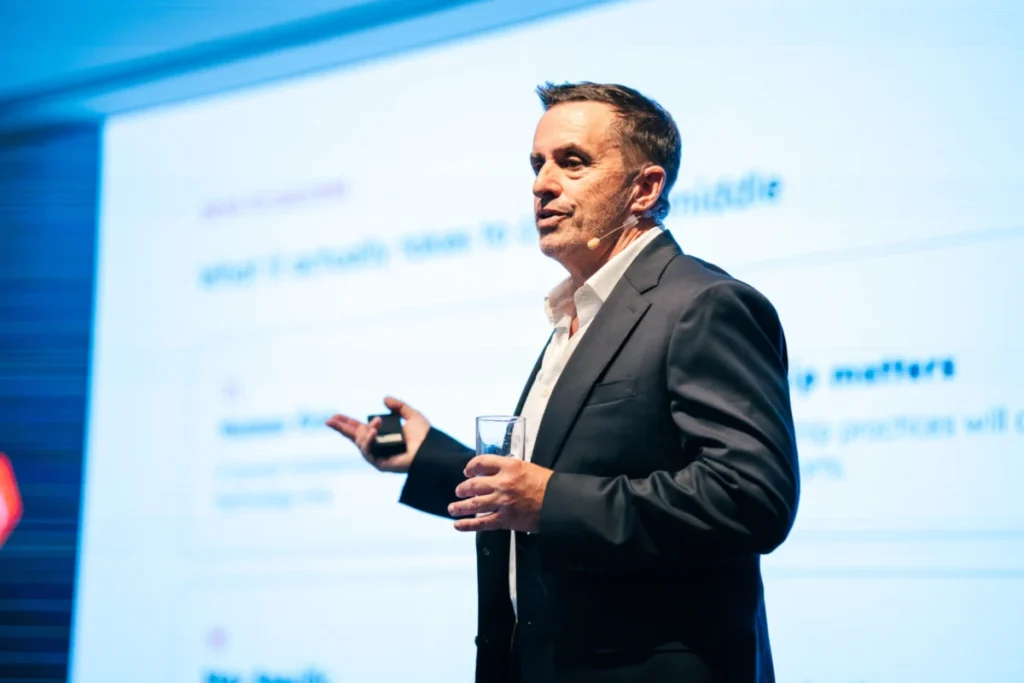
Ben Putterman, HubSpot’s vice president of learning and talent development, candidly shared his perspective on the complex journey of integrating Artificial Intelligence (AI) into an organization, emphasizing that true transformation stems from more than just adoption. Speaking at HubSpot’s Reimagine ’26 event in Singapore, Putterman expressed a healthy skepticism towards organizations that claim to have all the answers regarding AI implementation. "When I go to conferences and any organization tells me they’ve figured everything out, I tend to get a little skeptical," he admitted to the audience. His address focused on the lessons learned and the challenges encountered during HubSpot’s two-year endeavor to become an AI-first organization, highlighting the critical question leaders must eventually answer: "So, what?" This question, he explained, probes the tangible business results achieved amidst significant investment and discourse surrounding AI.
The Reimagine ’26 event, held in the vibrant global hub of Singapore, served as a platform for industry leaders to discuss the future of work, technology, and organizational development. The conference typically brings together a diverse audience of business professionals, tech innovators, and thought leaders to explore emerging trends and best practices. Against this backdrop of forward-thinking discussion, Putterman’s insights offered a grounded and practical perspective on navigating the often-hyped landscape of AI.
The Initial Push: Broad Access and Visible Leadership
HubSpot’s strategic shift towards an AI-first model began in late 2024 with a deliberate strategy of providing broad access to AI tools. This initiative was significantly bolstered by the visible role modeling of CEO Yamini Rangan. Rangan openly shared her personal journey with AI adoption, detailing the specific tools she experimented with, what proved effective, and what fell short. This transparency from the top aimed to foster a culture of exploration and learning.
Crucially, HubSpot encouraged experimentation, explicitly communicating to employees that both successes and failures would be valuable learning opportunities. The initial adoption figures appeared promising. A survey indicated that 84% of employees felt comfortable using AI, and a remarkable 90% were actively engaged in its use. These metrics suggested a widespread embrace of the new technology, a seemingly positive indicator of the organization’s AI strategy.
Hindsight and the Year of Fluency: Refining the Approach
Reflecting on the initial phase, Putterman acknowledged areas where the approach could have been more refined. He admitted that the "floodgates" of tool access, while intended to democratize AI, "created a lack of clarity" regarding which tools were best suited for specific tasks. The invitation to experiment, without sufficient directional guidance, also posed a challenge.
This realization led to 2025 being internally designated as the "year of fluency." This period saw a concerted effort to build deeper AI understanding and capability across the organization. Initiatives included organization-wide learning days, hackathons designed to foster innovative AI applications, and reverse mentoring programs. AI fluency was elevated to a formal requirement in all hiring and promotion decisions, signaling its strategic importance.
However, the very definition of "fluency" required further clarification. HubSpot discovered that the term lacked a consistent meaning across different departments. Fluency for an engineer, for instance, looked vastly different from fluency for a salesperson. To address this, the concept was redefined function by function, ensuring that the learning and application of AI were contextually relevant. By the end of 2025, approximately half of HubSpot’s employees reported using AI to either automate or augment aspects of their work. A particularly surprising outcome was that the organization’s most successful hackathon project did not originate from the engineering department, but from the legal team, underscoring the broad applicability of AI across diverse functions.
The Unseen Work: Unlocking AI’s Potential Through Human Insight
A core tenet of HubSpot’s evolving AI strategy, as articulated by Putterman, revolves around understanding and leveraging the "work the organization cannot see." This refers to the tacit knowledge, expertise, and intuition that reside within individuals – the insights that guide a salesperson’s decision-making or a team’s strategic pivots. "It actually sits inside people’s heads – the expertise and instincts that tell a salesperson when to pivot or which lead is worth pursuing," Putterman explained. He stressed that AI cannot effectively transform work that remains invisible to it.
This realization has led HubSpot to adopt a cyclical approach: See the work, redesign it with AI, measure, and scale. The "See the work" phase is critical and involves leaders actively engaging with employees, interviewing them, and observing their tasks firsthand. This goes beyond examining documented processes to understanding how work is genuinely performed.
Following this deep understanding, the "redesign" phase offers four distinct pathways for incorporating AI:
- Automate: Tasks that are repetitive and data-driven can be fully automated by AI.
- Augment: Employees can be paired with AI agents to enhance their capabilities and efficiency.
- Eliminate: Tasks that are no longer valuable or add significant business impact can be discontinued.
- Human-Centric: Certain tasks that require deep judgment, trust, and relationship-building are deliberately kept human-led, with AI serving as a supportive tool rather than a replacement.
Framework for Success: Narrow Focus and Timely Measurement
The implementation of this framework is guided by two key principles. Firstly, teams are encouraged to focus on "narrow, specific use cases" rather than broad, overarching ambitions. This approach allows for more targeted experimentation and clearer measurement of impact. Secondly, measurement cycles are recommended to run between six to 12 weeks. Putterman cautioned against longer timelines, stating that anyone planning to assess results after a year is "way off track." This emphasis on agile measurement allows for rapid iteration and adjustment of AI strategies.
The Human Element: "Expose the Work, Not the People"
Perhaps the most profound lesson from HubSpot’s experience lies in the human dimension of AI transformation. Putterman highlighted a potential pitfall: the perception that efforts to understand how work is done might be a precursor to job displacement. To counter this, HubSpot adopted the internal mantra: "Expose the work, not the people." The goal is to empower individuals with unique knowledge, making them "heroes" and co-creators of change. "You make heroes out of those people [with knowledge in their heads], and you help them co-create the change," Putterman emphasized. He firmly believes that AI transformation is "as much, if not more, of a human transformation than it is a technology transformation."
In subsequent conversations with HRM Asia, Putterman elaborated on the complex emotional landscape employees navigate. He noted that individuals are not simply resistant or enthusiastic; they often experience both opportunity and apprehension simultaneously as AI reshapes the workplace. This duality is a critical factor for leaders to acknowledge and manage.
AI as a "Great Levelling Tool": Shifting Hierarchies and Leadership
The cultural implications of AI are particularly pronounced in hierarchical, tenure-based organizations. Putterman described AI as becoming "the great levelling tool," blurring traditional distinctions based on experience and title. At HubSpot, junior employees are now mentoring senior leaders, a phenomenon he attributes to AI’s ability to democratize knowledge and application. This form of reverse mentoring, which he previously found ineffective, is now proving successful due to the evolving nature of work and skill acquisition in the AI era. He predicted that some organizations will adapt well to this cultural shift, while others will face significant challenges.
This recalibration extends to leadership assessment. The primary focus for evaluating leaders has shifted to their ability to lead change, navigate ambiguity, foster experimentation, establish clarity of priorities, and maintain a close connection to the actual work being done, rather than operating at a remove.
Rethinking Engagement and Leadership Effectiveness
Putterman also offered a contrarian view on the traditional HR understanding of employee engagement. He posited that "it’s performance that drives engagement," rather than the other way around. True engagement, in his view, arises when employees are growing, learning, and contributing to meaningful work. This perspective challenges the prevailing notion that engagement is solely a precursor to performance. He also noted a drift in leadership evaluation towards a "likeability scale versus actual leadership effectiveness," suggesting a need for a more robust and results-oriented approach to assessing leadership capabilities.
Enduring Principles: Human First, Clarity Always
Despite the rapid pace of technological change, Putterman’s core philosophy remains consistent. With decades of experience at companies like Oracle, Tesla, and LinkedIn, his guiding principle is "human first, managers second." This underscores the fundamental truth that "every organization is just a collection of human beings."
Crucially, Putterman stressed that the most fundamental obligation an organization owes its employees, regardless of technological advancements, is clarity. This clarity must encompass what matters most, priorities, performance expectations, and the trajectory of their careers. In an era of AI-driven transformation, providing this clear direction is not just beneficial; it is essential for fostering trust, mitigating anxiety, and enabling individuals and organizations to thrive. The "So What?" of AI, therefore, is not merely about technological adoption, but about a profound human and organizational evolution.