
The persistent challenge of staffing critical public service roles in education and healthcare is more than an administrative inconvenience; it directly impacts the well-being and development of individuals. A vacant teaching position translates to a student without consistent guidance, and a shortage of nurses in a hospital ward means longer wait times for patients and increased strain on existing staff. For the human resources leaders and recruiters tasked with filling these essential roles, their work is not merely an operational function, but a direct conduit to serving the public. This inherent pressure intensifies during peak hiring seasons, as educational institutions and healthcare systems grapple with demanding timelines and fierce competition from faster-moving, often better-resourced private sector employers. In this landscape, artificial intelligence (AI) interviewing is emerging as a practical and increasingly vital tool, enabling public-serving organizations to accelerate their hiring processes without compromising the quality of candidates.
The Shared Strain: Identifying Common Hiring Bottlenecks
At first glance, a K-12 school district and a large public hospital system might appear to operate in vastly different spheres. However, a closer examination of their hiring cycles and the pressures they face reveals striking similarities. Both sectors are characterized by intense, predictable hiring waves. Schools must onboard educators and support staff before the academic year commences and again mid-year to address turnover. Similarly, health systems and public health departments experience significant staffing needs tied to seasonal demands like flu season, budget allocations, and unpredictable public health emergencies.
In both scenarios, the window for effective hiring is often narrow, and the sheer volume of applicants can overwhelm traditional recruitment processes. This high-volume hiring, particularly the screening phase, frequently becomes the primary bottleneck. The challenge is amplified by the fact that public service organizations often operate with procurement processes, union agreements, and budgetary constraints that can slow down their hiring timelines considerably. This places them at a distinct disadvantage when competing for talent against private clinics or corporate training companies, which typically possess more agile hiring frameworks. The consequences of slow or failed hiring in these sectors are not abstract internal metrics; they manifest directly in the classroom or at the patient’s bedside, underscoring the urgent need for efficient and effective recruitment strategies. This shared reality necessitates a unified approach to understanding and addressing these recruitment challenges.

Education Sector: Navigating Seasonal Demands and Shrinking Talent Pools
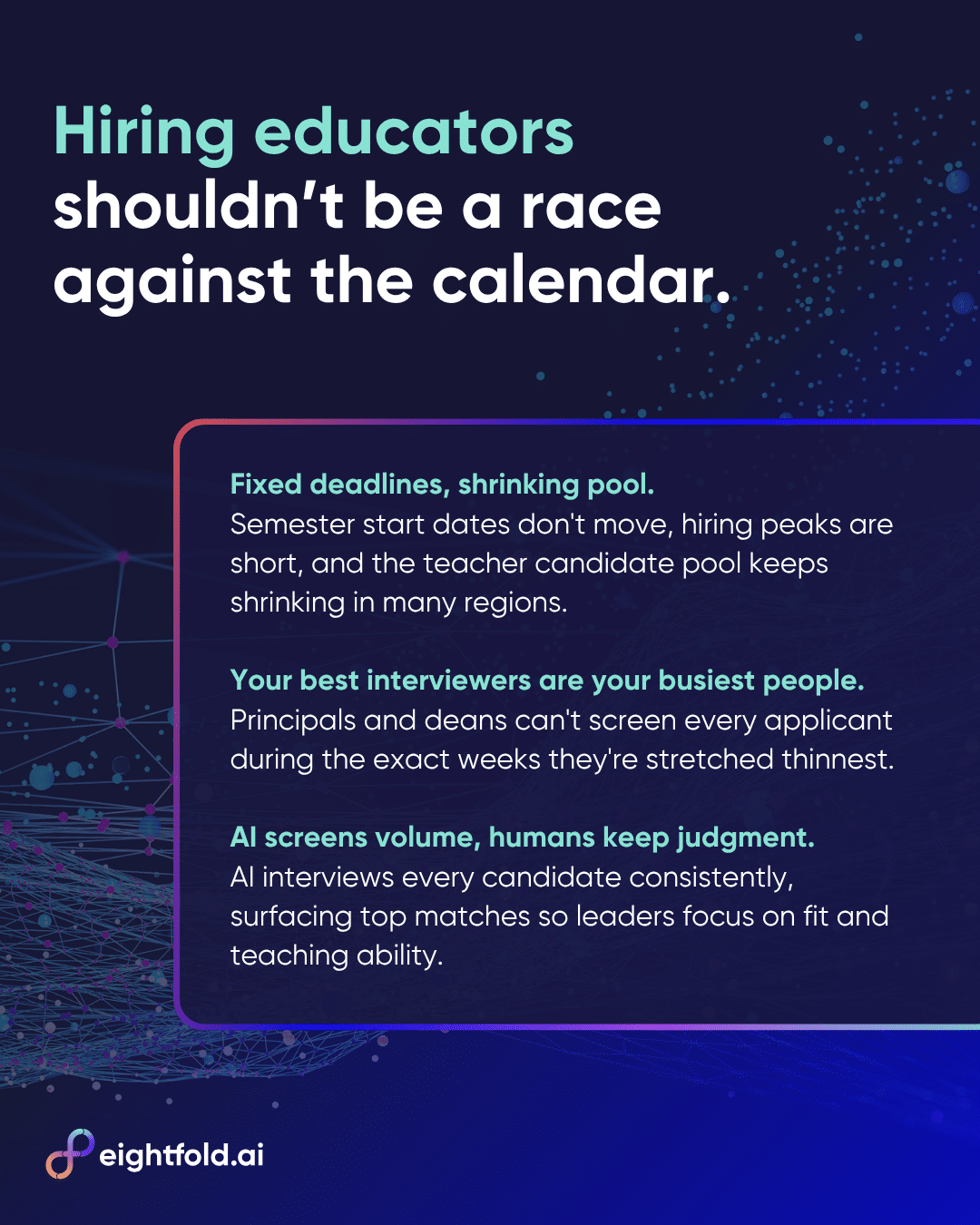
The hiring calendar for public education, encompassing both K-12 and higher education institutions, is dictated by a rigorous seasonal rhythm. Universities and school districts face the non-negotiable deadline of filling positions before the start of each semester or academic year. The flexibility to adjust these critical dates is minimal. Compounding this pressure is the fact that the very individuals responsible for conducting interviews—principals, department chairs, and deans—are often the busiest staff members during these peak hiring periods. The expectation that they personally screen every applicant on top of their existing responsibilities during August or January is both unrealistic and unfair to both the educators and the candidates.
Furthermore, many regions are experiencing a shrinking applicant pool for essential teaching and instructional roles. This scarcity means that qualified candidates must be processed through the hiring pipeline swiftly, lest they accept alternative employment. This is precisely where AI interviewing demonstrates its value. Rather than supplanting the crucial human element in educational hiring—such as assessing a candidate’s ability to connect with students or their cultural fit within a school community—AI interviewing effectively manages the high volume that precedes these qualitative evaluations. It can efficiently screen a large cohort of applicants during the most critical weeks of the hiring surge, posing standardized, role-specific questions to each candidate. This process surfaces only the most promising matches, allowing for human-led interviews where teaching aptitude and cultural alignment can be thoroughly assessed.
This technological intervention significantly alleviates the burden on principals and department heads during their most demanding periods. Crucially, it ensures that candidates receive timely feedback, avoiding the prolonged silence that can lead to frustration and the loss of valuable talent. AI Interviewer can be meticulously configured to identify specific qualifications, certifications, and criteria essential for each role. This includes verifying teaching licenses, assessing subject-matter expertise, or confirming experience with particular student demographics. By performing this targeted screening, the process moves beyond simple keyword-based resume triage to a more meaningful evaluation of candidate suitability.
Eightfold.ai’s internal data highlights the scalability of this approach. A single job posting can attract hundreds of applicants, and AI Interviewer processes these candidates, providing summaries that equip hiring managers with contextual information, thereby preventing the accumulation of backlogs. For instance, in a large urban school district like the Los Angeles Unified School District (LAUSD), which serves over 500,000 students, the annual hiring cycle for thousands of teachers and support staff presents an immense logistical challenge. Implementing AI interviewing could streamline the initial screening of thousands of applications, allowing HR teams to focus on more in-depth assessments and ensuring that critical positions, such as special education teachers or bilingual educators, are filled promptly.

Public Health and Healthcare Systems: Accelerating Response in Critical Times
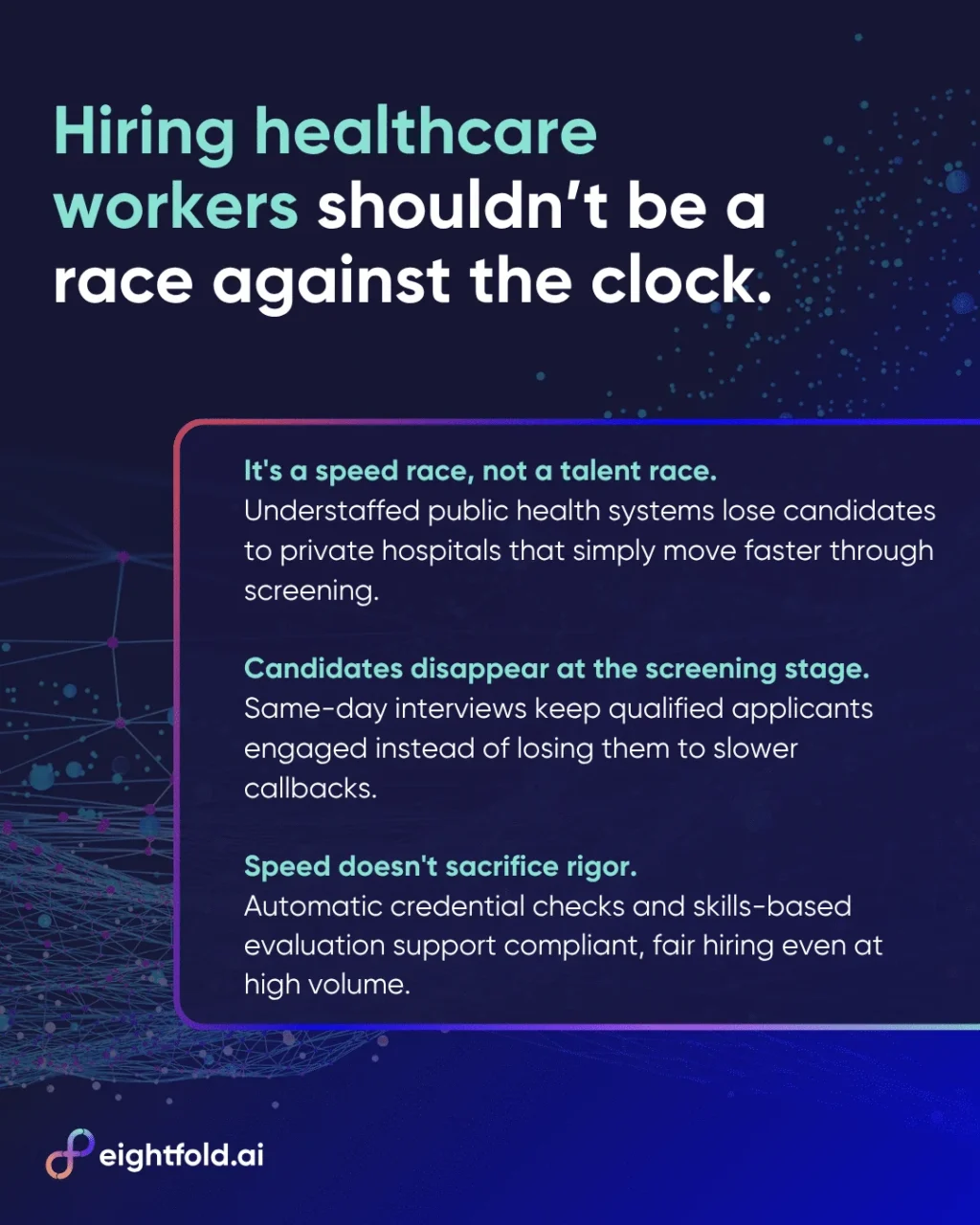
Public hospitals and health departments often operate under more stringent conditions than many private healthcare providers. They contend with chronic understaffing, budget limitations, and an imperative to fill clinical and support roles with extreme urgency, as every vacant shift directly impacts patient care capacity. Compounding this, these organizations frequently lose candidates to private hospitals and health systems that can expedite their hiring pipelines, sometimes extending offers before the public sector has even completed its initial screening.
The screening stage is a common point of attrition for candidates within these systems. A qualified individual applies, only to wait days for a response while simultaneously fielding offers from other institutions. By the time a callback is received, they may have already accepted a position elsewhere. AI interviewing effectively mitigates this delay by engaging candidates immediately upon application. This can result in a candidate completing an interview on the same day they apply, thereby maintaining their interest and keeping them within the recruitment pipeline at the precise moment they are most likely to be exploring other opportunities.
For roles where specific credentials are non-negotiable—such as nursing licenses, specialized certifications, or the necessity of a background check—the AI Interviewer platform can be configured to verify these qualifications directly within the interview process. This proactive approach ensures that critical requirements are not overlooked at a stage where their absence might only surface much later in the hiring process. This is particularly vital in regulated environments. AI Interviewer is designed to evaluate solely a candidate’s verbal responses, deliberately excluding factors like facial expressions, tone of voice, or emotional cues. This methodology is engineered to promote fairness and ensure compliance with stringent regulations, such as New York City’s Local Law 144, Illinois’ Biometric Information Privacy Act, and Maryland’s HB 1202. This objective evaluation approach, coupled with robust fraud-detection safeguards, empowers public health employers to maintain and document a consistent and defensible hiring process.
The scale of impact is particularly relevant to public health, given the high-volume and shift-based nature of much of its staffing. Early adopters of AI Interviewer have reported a dramatic acceleration of hiring cycles, shrinking them from approximately six weeks to less than one week. The time taken to present a candidate for their initial interview has been compressed by as much as 90%. In chronically understaffed systems, this efficiency translates directly into more shifts being covered, rather than left vacant. Consider the COVID-19 pandemic’s impact: during peak surges, public health departments faced unprecedented demands for contact tracers, nurses, and public health advisors. The ability to rapidly screen and onboard qualified individuals, even for temporary roles, could have significantly bolstered response efforts. For example, the Centers for Disease Control and Prevention (CDC) often needs to rapidly deploy personnel for emerging health crises. Streamlining the initial candidate assessment for these critical roles can shave valuable days, or even weeks, off the deployment timeline.
The Broader Implications: Ensuring Quality Without Sacrificing Speed
In both education and public health, a delayed hire is never merely an internal HR metric. It represents a classroom that remains under a substitute teacher for an extended period, or a hospital unit operating short-staffed during the most critical weeks of a pandemic or flu season. The individuals most affected by these delays are not within the HR department; they are the students and patients whom these organizations are fundamentally established to serve.
AI interviewing offers a solution that does not force HR leaders in education and public health to choose between speed and quality. It effectively offloads the high-volume initial screening—a process that traditionally consumes weeks and occupies the time of the organization’s busiest personnel—to a layer that can operate around the clock. This automated process evaluates every applicant against the same standardized criteria, delivering a curated list of genuinely qualified candidates rather than an unorganized pile of applications. The ultimate hiring decisions remain firmly in human hands. However, these decisions are made with better information, at a faster pace, and crucially, without the risk of losing promising candidates to the more agile private sector.
As educational institutions prepare for new academic years and healthcare systems brace for seasonal surges or public health emergencies, exploring the capabilities of AI interviewing for their specific open roles is a prudent step. The ability to configure AI Interviewer to precisely match the credentials, certifications, and criteria essential for any given role ensures that the screening process is not just a formality, but a substantive and effective first step in building a robust and dedicated public service workforce. This technology represents a significant stride towards ensuring that the vital work of educating our youth and caring for our communities is supported by adequate, qualified staffing, even in the face of challenging recruitment landscapes.







