The familiar rhythm of the hiring process, a dance often measured in weeks, is undergoing a seismic shift. For most organizations, the journey from posting a job to a signed offer letter typically spans between 36 and 44 days. This duration, while seemingly standard, can stretch considerably longer for highly specialized technical roles and become an agonizing crawl for high-volume hourly positions, where every vacant shift represents an immediate operational strain. The critical question facing talent acquisition professionals is no longer if this timeline can be shortened, but how drastically it can be reduced without compromising the integrity of the hiring process or the quality of candidates. The answer, increasingly, lies not in accelerating existing steps, but in systematically eliminating the inherent inefficiencies that have become tacitly accepted as the norm.
The current hiring paradigm, characterized by protracted waiting periods and extensive logistical coordination, is ripe for disruption. The emphasis is shifting from simply filling roles to optimizing the entire talent acquisition lifecycle, ensuring that valuable human capital is not lost due to procedural drag. This transformation is driven by the recognition that significant time drains within the hiring funnel have little to do with candidate evaluation and everything to do with administrative bottlenecks.
Deconstructing the Time Sink: Where the Weeks Actually Disappear
While interviews are often perceived as the primary culprit behind lengthy hiring cycles, a closer examination reveals a more nuanced reality. When a requisition is meticulously tracked from its inception to a final offer, the actual time spent in interviews—whether face-to-face, virtual, or panel-based—frequently occupies a smaller slice of the overall timeline than the surrounding administrative overhead. The real time thieves are the periods of inactivity and the complex coordination required to simply bring the right people together at the right time.
A typical 30-to-40-day hiring cycle can be more accurately broken down, revealing the hidden costs:
- Sourcing and Application Review: Initial outreach, candidate discovery, and the meticulous review of incoming applications can consume a significant portion of the early stages. This phase is often hampered by manual processes and the sheer volume of applications, particularly for widely advertised roles.
- Screening and Initial Assessments: Pre-employment questionnaires, basic skills tests, and initial recruiter screenings, while necessary, add layers of process that can introduce delays if not efficiently managed.
- Scheduling and Coordination: This is arguably the most insidious time sink. Orchestrating a single interview loop involves aligning the availability of a candidate with multiple interviewers, often across different time zones and competing professional priorities. The back-and-forth communication, calendar Tetris, and potential for rescheduling can easily add days, if not weeks, to the process.
- Interviews: While visible, the actual interview time itself is often outpaced by the delays in scheduling them. Multiple rounds of interviews, while intended to provide thorough evaluation, can exacerbate the scheduling challenges.
- Debriefs and Decision Making: Internal discussions and consensus-building among hiring teams, while crucial for informed decisions, can also become protracted if not managed with clear objectives and timelines.
- Offer Extension and Acceptance: The final stages, including background checks, reference checks, and the negotiation of offer terms, can also introduce their own set of delays, particularly if there are unforeseen issues or lengthy approval processes.
The friction points lie not solely within the interview itself, but in the logistical hurdles that precede and follow it. These interstitial periods, where nothing is actively happening with the candidate or the hiring team, collectively represent a substantial, yet often overlooked, drain on efficiency.
The "Scheduling and Coordination Tax": An Unacknowledged Burden
The logistical burden of scheduling interviews is a universal pain point for talent acquisition teams. Coordinating a single interview loop can involve navigating the calendars of two, three, or even five interviewers, each with their own demanding schedules and competing priorities. This complexity is amplified when dealing with candidates who are currently employed elsewhere, possessing limited windows for even brief phone calls.
This manual coordination often devolves into a cascade of missed connections, Slack threads, and follow-up emails. Recruiters find themselves chasing down busy interviewers, while candidates may experience extended silences, leading to disengagement. Research into remote hiring practices has highlighted a stark contrast: the transition from a candidate expressing interest to completing an interview can take days when reliant on manual scheduling, whereas automated systems can achieve this in a matter of hours. This delay is not merely an inconvenience; it represents a critical window of opportunity where a highly sought-after candidate remains on the market, potentially engaging with competitors and one expedited offer away from being lost entirely.

When this scheduling gap is multiplied across every interview round within a typical hiring process, it’s easy to see how weeks can evaporate before a single hiring decision is even solidified. This realization often elicits a visceral reaction from hiring managers, as it mirrors the daily frustrations they experience within their own teams.
Revolutionizing the Interview Stage: The AI-Assisted Approach
The most impactful gains in compressing hiring timelines are achieved by directly addressing the scheduling and coordination bottleneck. This is where the advent of AI-assisted interviewing offers a transformative solution. Instead of relying on the precarious alignment of multiple human schedules, AI interviewers empower candidates to complete structured, role-relevant interviews on their own terms. This means candidates can engage with the assessment process during evenings, weekends, or even in the 20-minute gaps between their current job’s meetings, eliminating the need for back-and-forth communication and rescheduling.
This asynchronous approach eradicates the dependency on shared calendars. Candidates do not drop out of the pipeline due to an inability to find a 45-minute overlapping slot within a two-week window. For the hiring team, the time investment shifts dramatically. Instead of dedicating hours to conducting numerous similar first-round interviews, recruiters and hiring managers receive concise, structured summaries and scored evaluations shortly after each AI interview concludes, often within hours rather than days.
A key benefit of AI-driven interviews is the inherent consistency they provide. Questions are standardized across all candidates, ensuring that each individual is evaluated against the same objective criteria and at the same depth. This eliminates the potential for interviewer bias or variations in assessment quality that can arise in traditional, human-led interviews.
The scale of time savings is profound. Organizations that have integrated AI-assisted interviewing for early and mid-stage candidate evaluations have reported a dramatic reduction in their overall time-to-hire, shrinking from an average of six weeks to approximately one week. Specifically, the time-to-interview has seen reductions of up to 99%, as the interview process is no longer dictated by calendar availability. This single technological intervention serves as the primary catalyst for achieving a compressed hiring timeline, transforming it from an aspirational goal into a tangible reality.
The Reimagined Hiring Timeline: Efficiency in Action
When the inherent friction points of traditional hiring are systematically addressed, a radically different requisition-to-offer timeline emerges. This optimized process prioritizes speed and efficiency without sacrificing the critical human elements of decision-making and candidate engagement.
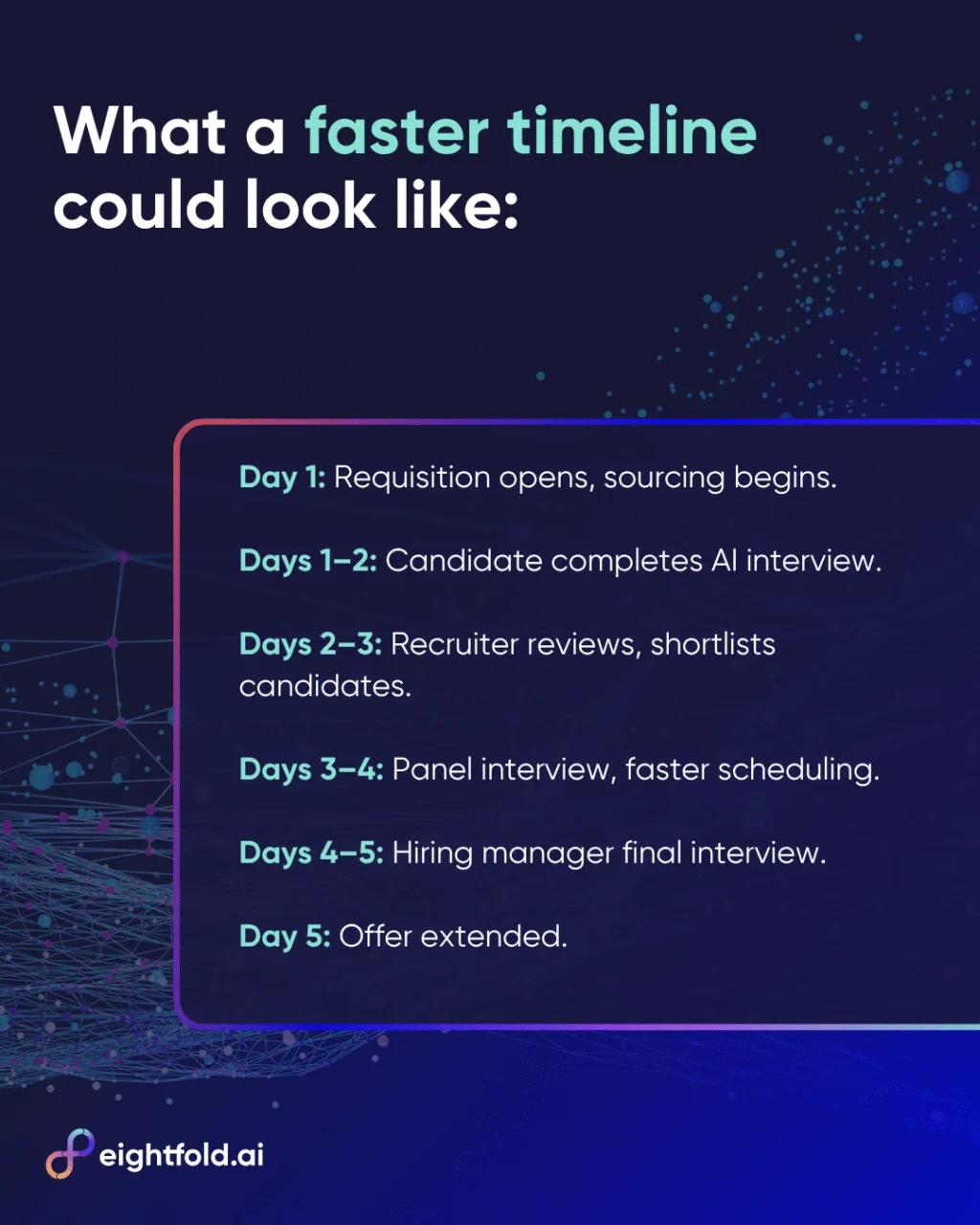
A realistic, streamlined hiring timeline, powered by AI and optimized workflows, might look like this:
- Day 1-2: Requisition Open & Initial Sourcing: The job is posted, and targeted sourcing efforts are immediately launched. AI-powered talent intelligence platforms can accelerate this by identifying and engaging relevant passive candidates.
- Day 2-3: AI-Powered Screening & Initial Assessment: Candidates apply and are immediately directed to an AI-assisted interview. This allows for a structured assessment of foundational skills and role-specific competencies at the candidate’s convenience.
- Day 3-4: AI Interview Review & Shortlisting: Within hours of completion, hiring managers receive detailed reports and scored evaluations from the AI interviews. This allows for rapid identification of top candidates.
- Day 4-5: Final Interviews & Decision: A select group of candidates proceeds to a final, human-led interview. These interviews are more focused, leveraging the insights gained from the AI assessment. Decision-making is streamlined, building on the objective data provided.
- Day 5: Offer Extension: The offer is extended to the chosen candidate, often on the same day the final decision is made.
This five-day model is not about rushing candidates or compromising quality. It is about eliminating the "dead time" where nothing is actively progressing. The crucial human touchpoints—the final interview, the offer conversation, and the moments where genuine connection and nuanced judgment are paramount—remain firmly in human hands. What disappears is the unnecessary waiting and the administrative drag that has historically plagued the hiring process.

The Ripple Effects of Accelerated Hiring
The benefits of drastically shortening the hiring timeline extend far beyond the aesthetics of a more favorable recruiting dashboard. This efficiency translates into tangible, positive outcomes across the entire organization.
For hiring managers, the immediate impact is the ability to fill critical open positions before the workload becomes unsustainable for the existing team. Projects that were stalled due to insufficient headcount can finally commence, driving innovation and productivity.
Candidates, too, experience a vastly improved experience. They are met with a process that respects their time, eliminating the agonizing three-week silences that can follow a promising initial conversation. The uncertainty of being "ghosted" is removed, replaced by a sense of engagement and transparency. This streamlined, consistent, and transparent hiring journey consistently receives higher ratings from candidates, irrespective of the technologies employed in the assessment process.
Moreover, in today’s competitive talent landscape, speed is a critical differentiator. Highly skilled professionals rarely remain on the market for extended periods. If a company’s hiring process takes three weeks to reach a decision while a competitor engages and makes an offer within five days, the outcome is often predetermined before the slower organization even concludes its internal debrief. Accelerating the hiring timeline is therefore not merely an internal efficiency win; it is a direct strategic advantage in securing top talent and preventing valuable candidates from joining competitors.
Conclusion: Waiting Less, Achieving More
The hiring timeline that has become familiar to many organizations is not an immutable law of nature. Instead, it is the cumulative effect of numerous small, rectifiable delays, most of which have no bearing on a candidate’s actual ability to perform the job. The most significant improvements in time-to-hire are not achieved by cutting corners on the evaluation of talent, but by systematically removing the pervasive "scheduling tax" and the coordination drag that encumbers the traditional hiring process.
Ultimately, halving the time it takes to fill a position is not about working faster; it is about waiting less. By embracing technological solutions like AI-assisted interviewing and optimizing existing workflows, organizations can transform their talent acquisition from a protracted ordeal into a swift, efficient, and candidate-centric engine for growth. The future of hiring is not about enduring delays, but about strategically eliminating them.