
The corporate learning landscape in 2026 is undergoing a profound transformation, defined not by the sheer volume of technological innovation, but by a widening "expectation gap" between those who build learning platforms and those who purchase them. While technology vendors have spent the last several years aggressively integrating Artificial Intelligence (AI) and automation into their products, a comprehensive new benchmark report from eLearning Industry reveals that Learning and Development (L&D) buyers are prioritizing practical utility, user experience, and measurable business outcomes over cutting-edge features. This shift marks a maturation of the market, moving away from the initial "AI hype" cycle toward a period of pragmatic implementation where technology must solve real-world organizational problems to justify its investment.
The Evolution of the AI Expectation Gap
To understand the current state of the market, one must look at the trajectory of learning technology over the past four years. In 2022 and 2023, the emergence of generative AI sparked a gold rush among Learning Management System (LMS) and Learning Experience Platform (LXP) vendors. The focus was on rapid feature release: automated content creation, AI-driven chatbots, and predictive analytics. By 2025, however, many organizations found themselves with "feature-rich" platforms that were difficult to integrate into existing workflows or failed to engage the average employee.
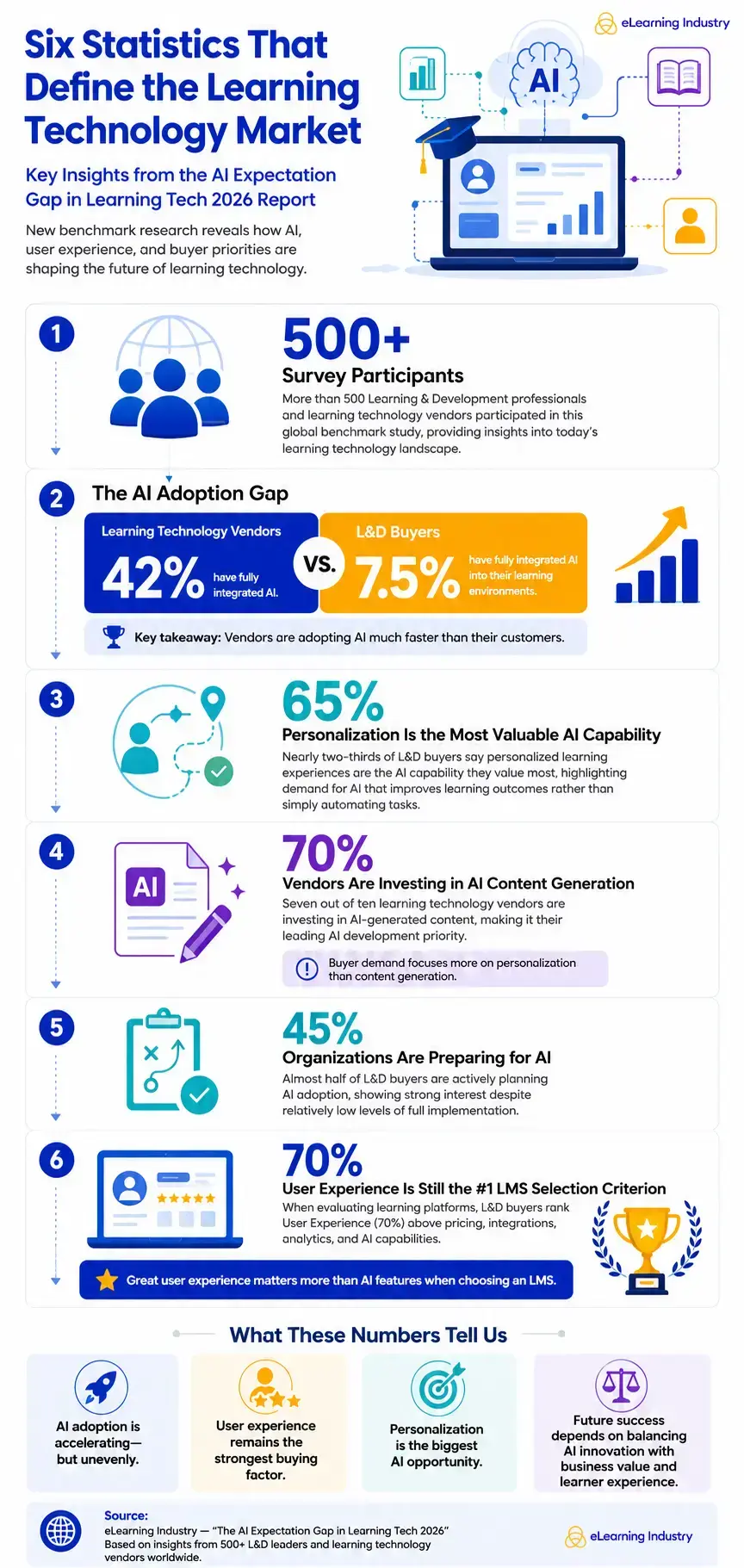
Entering 2026, this disconnect has solidified into what industry analysts call the "AI expectation gap." Data derived from a global survey of over 500 L&D buyers and technology vendors highlights a stark reality: 42% of vendors claim their platforms have achieved full AI integration, yet only 7.5% of buyers report that AI is fully functional within their specific learning environments. This 34.5% discrepancy suggests that while the tools exist in a vacuum, the infrastructure, data readiness, and internal expertise of buying organizations have not kept pace with vendor development.
Core Findings and Statistical Disparities
The benchmark report challenges several long-held assumptions about what drives the $20 billion global learning technology market. Perhaps the most significant finding is the hierarchy of purchasing criteria. While vendors often lead their marketing efforts with AI capabilities, 70% of L&D buyers cite User Experience (UX) as the primary reason for selecting a platform. In contrast, only 30% of buyers rank AI features as a top-tier priority.
This misalignment extends to the implementation phase. Nearly half—45%—of L&D leaders are still in the planning stages of their AI adoption strategy. This suggests a cautious, evaluative approach among corporate buyers who are increasingly wary of "black box" algorithms and unproven automation. For these leaders, the priority is not how advanced the AI is, but how seamlessly it integrates with existing enterprise resource planning (ERP) systems and human resources information systems (HRIS).
The Resilience of the Learning Management System
Despite years of predictions suggesting that the traditional Learning Management System would be replaced by more agile, experience-focused tools, the LMS remains the dominant force in 2026. According to the data, 90% of buyers continue to utilize an LMS as their primary learning hub, compared to 36% using LXPs and 27% using specialized AI learning platforms.

The reason for this persistence is rooted in the fundamental needs of the modern enterprise: compliance, reporting, and centralized administration. However, the LMS of 2026 is not the static repository of a decade ago. It has evolved by absorbing the best features of its competitors. Modern LMS platforms now incorporate AI-powered personalization and social learning features, effectively negating the need for organizations to purchase multiple disparate systems. For vendors, the takeaway is clear: the market favors a "unified" approach where smart features enhance, rather than replace, the foundational administrative capabilities of the LMS.
Seven Defining Trends for the 2026 Market
The report identifies seven critical trends that are currently shaping vendor-buyer dynamics. Understanding these shifts is essential for any technology provider looking to maintain a competitive edge in an increasingly crowded marketplace.
1. User Experience as the Ultimate Differentiator
In an era where software capabilities are increasingly commoditized, UX has become the primary battleground. Buyers are looking for "frictionless" learning—platforms that require minimal training to navigate and that mimic the intuitive interfaces of consumer-grade applications like Netflix or Spotify. The research indicates that even the most advanced AI cannot compensate for a confusing navigation structure or a slow, unresponsive interface.
2. The Normalization of Artificial Intelligence
AI has transitioned from a "wow-factor" feature to a baseline requirement. In 2026, having AI-driven recommendations is no longer a unique selling point; it is the "price of entry" for the market. Buyers now expect these features to be included in standard pricing models rather than offered as expensive add-ons. Consequently, vendors must find new ways to differentiate themselves, such as through superior customer support or industry-specific content libraries.
3. Investment Outpacing Demand
There is a notable "front-running" effect where vendors are building capabilities that the average organization is not yet ready to use. This creates a risk of "feature bloat," where platforms become overly complex and intimidating for the end user. Successful vendors in 2026 are those who provide not just the technology, but also the change management support and "AI literacy" training necessary to help buyers bridge this gap.
4. The Demand for Hyper-Personalization
When buyers do express interest in AI, their focus is narrow: they want personalization. They are less interested in AI that generates generic slide decks and more interested in AI that can map a unique learning path for an individual based on their specific skill gaps, career aspirations, and past performance. This "skills-based" approach to learning is the most significant opportunity for vendors to deliver tangible value.
5. The Emergence of the "Trust Economy"
As AI takes a more central role in employee development and performance evaluation, issues of ethics and transparency have moved to the forefront. Buyers are increasingly asking about data governance, algorithmic bias, and "explainable AI." Vendors who can provide clear documentation on how their AI makes decisions and how it protects learner privacy will have a significant advantage in the procurement process.
6. The Undervalued Role of Human Interaction
A surprising trend in 2026 is the resilient demand for human-led training. While vendors have leaned heavily into automation, 48% of buyers still prioritize virtual classrooms and live, instructor-led training (ILT) tools. There is a perceived "empathy gap" in purely automated systems. The most successful platforms are those that use AI to facilitate—rather than replace—human connection, such as by automating the scheduling of mentorship sessions or providing instructors with real-time data on student engagement.
7. Integration and Ecosystem Compatibility
The "walled garden" approach to software is officially dead. Buyers in 2026 demand that their learning platforms work harmoniously within a broader tech stack. This includes deep integrations with communication tools like Microsoft Teams and Slack, as well as talent management and payroll systems.
Industry Reactions and Expert Analysis
Christopher Pappas, CEO and founder of eLearning Industry, emphasizes that the current market phase is a "reckoning" for technology-first companies. "The next generation of learning platforms won’t be defined by how much AI they include, but by how effectively they help organizations develop people, solve real business challenges, and earn users’ trust," Pappas stated in the report. "Innovation only matters when it delivers meaningful outcomes."
Industry analysts suggest that the "AI expectation gap" is partly a result of a disconnect between vendor marketing departments and their engineering teams, as well as a lack of clear ROI metrics for AI features. Organizations are no longer satisfied with "engagement" as a metric; they want to see how a learning platform reduces onboarding time, improves sales performance, or closes critical technical skill gaps.
Implications for the Future
For vendors, the implications of these 2026 trends are clear: the era of "AI for AI’s sake" is over. To succeed, providers must pivot their strategies toward "Human-Centric AI." This involves:
- Prioritizing UX Design: Investing as much in interface designers as in data scientists.
- Focusing on Integration: Developing robust APIs that allow for easy data flow between systems.
- Educating the Buyer: Moving from a "software vendor" role to a "strategic partner" role by helping L&D leaders build their internal AI roadmaps.
- Demonstrating Ethical Rigor: Being proactive about AI governance to build long-term trust.
The learning platform market of 2026 is more competitive and sophisticated than ever before. While AI remains a powerful tool for transformation, its value is ultimately determined by the end user’s ability to use it effectively. As the "AI expectation gap" eventually closes, the winners will be those who remembered that at the heart of "Learning and Development" is a human being seeking to grow. Innovation, in this new era, is measured not by the complexity of the code, but by the clarity of the result.






