The persistence of the strategy-execution gap remains one of the most significant hurdles in contemporary organizational management, with recent data suggesting that a vast majority of corporate initiatives fail to reach their intended outcomes. While executive leadership teams frequently invest months in developing sophisticated strategic plans, the transition from high-level vision to ground-level reality often falters within the first two quarters of implementation. This breakdown is frequently attributed to "culture problems," yet emerging management frameworks suggest that this diagnosis is oversimplified. Instead of viewing culture as a nebulous set of shared values, experts are increasingly pointing toward "operational culture"—the specific conditions and systems that dictate how daily decisions are made—as the primary driver of strategic success.
Recent research into corporate performance underscores the severity of this issue. According to foundational studies by Robert Kaplan and David Norton, as many as 90 percent of organizations fail to execute their strategies successfully. This failure is rarely due to a lack of talent or flawed strategic thinking; rather, it stems from an inability to translate strategic objectives into coordinated, day-to-day action. When departments move in divergent directions and meetings prioritize updates over decisive action, the organization experiences a "strategic drift" that erodes momentum and wastes resources.
The Evolution of Organizational Culture Theory
To understand the current shift toward operational culture, it is necessary to examine the historical context of organizational theory. For decades, culture was defined by pioneers like Edgar Schein and Peter Schein as a set of shared assumptions, values, and beliefs. This led to an era where corporations focused heavily on crafting mission statements, defining core values, and decorating office walls with behavioral expectations. However, the modern business environment has revealed a fundamental flaw in this approach: employees experience culture through what an organization does, not what it says.
Management analysts argue that culture is not an outcome of success, but an operational capability that must be intentionally designed. It reveals itself in the priorities leaders establish, the behaviors they recognize, and the systems used to evaluate performance. In this context, the role of leadership shifts from merely setting a direction to creating the organizational conditions that enable people to make decisions aligned with the mission. This transition represents a move from "heroic leadership," where progress depends on a few extraordinary individuals, to "organizational capability," where the system itself facilitates high performance.
The Four Pillars of the Operational Culture Framework
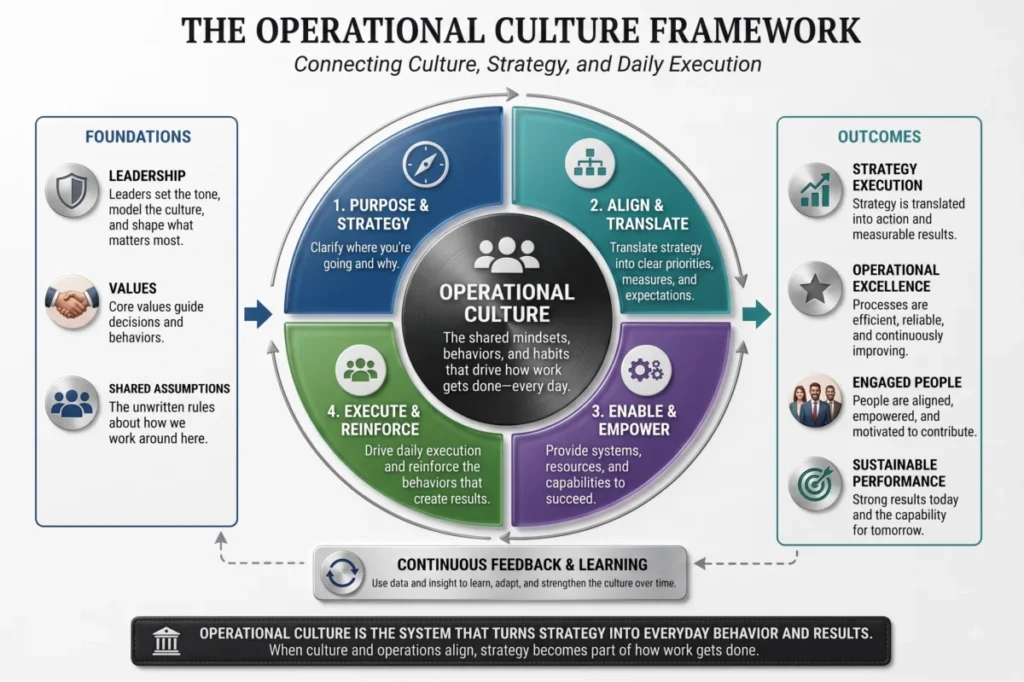
A new framework is emerging to bridge the execution gap, centered on four critical capabilities: clarity, accountability, collective intelligence, and adaptability. These pillars are designed to transform culture from an abstract concept into a functional mechanism for strategy execution.
Clarity as a Strategic Compass
Clarity provides the essential direction required for decentralized decision-making. In many stalled organizations, employees lack a clear understanding of what success looks like or how their specific tasks contribute to the broader mission. When priorities are ambiguous, uncertainty leads to paralysis or conflicting efforts. Clarity reduces this friction, allowing individuals at every level of the hierarchy to make informed choices without constant oversight.
Accountability and Ownership
The framework distinguishes between compliance-based management and true accountability. While compliance relies on monitoring and rules, accountability transforms expectations into ownership. Effective leaders establish clear responsibilities and, crucially, provide the authority necessary for employees to act. This creates an operating rhythm where results are owned collectively, and performance is evaluated as a continuous process rather than an annual event.
Collective Intelligence and Psychological Safety
The best strategic decisions rarely emerge from a vacuum or a single leader. High-performing organizations intentionally leverage expertise across various functions. This requires more than an "open-door policy"; it necessitates formal structures for surfacing dissent and specialized knowledge. The precondition for this is psychological safety—the shared belief that speaking up will not result in negative repercussions. Without this safety, the organization loses the benefit of its collective intelligence, often leading to "groupthink" or the suppression of critical warnings.
Adaptability in the Face of Disruption
Adaptability is defined not just as a reaction to change, but as the ability to learn faster than the environment evolves. Management expert John Kotter has long emphasized the difference between managing a one-time change event and building an organization structured for continuous evolution. Adaptability ensures that as market conditions shift, the organization can refine its approach without losing sight of its core purpose.

Historical Chronology: The Case of Kodak and the Cost of Inaction
The risks of failing to build these operational capabilities are best illustrated by the historical trajectory of the Eastman Kodak Company. The chronology of Kodak’s decline serves as a definitive warning for modern leaders.
In 1975, Kodak engineer Steve Sasson invented the first digital camera. At the time, Kodak was the undisputed leader in the film industry. However, the organization’s operational culture was so deeply rooted in the highly profitable film business that it lacked the capability to act on its own innovation. Throughout the 1980s and 1990s, despite having the technology and the market insights, the internal systems and decision-making structures remained tethered to legacy products.
By the time leadership attempted to pivot in the early 2000s, competitors who had built more adaptable operational cultures had already seized the digital market. Kodak’s eventual bankruptcy in 2012 was not caused by a lack of information or a poor initial strategy; it was caused by a lack of organizational capability to execute a transition that would disrupt its existing profit models. This historical example confirms that adaptability is not about seeing change coming—it is about being built to act on what is seen.
Supporting Data and Contemporary Industry Trends
The shift toward operational culture is further supported by contemporary workplace data. A 2023 report on workforce productivity found that employees who feel their work is "aligned with company strategy" are 3.5 times more likely to be engaged than those who do not. Furthermore, Gartner research indicates that organizations with high "culture-strategy alignment" see a 22 percent increase in employee performance.
The rise of artificial intelligence (AI) has added a new layer of complexity to this dynamic. As AI takes over routine analytical tasks, the human element of strategy—judgment, collaboration, and ethical alignment—becomes more critical. Leaders are now tasked with championing a culture where people can perform at their highest potential alongside automated systems. In this technological landscape, the "operational culture" acts as the glue that ensures AI tools are used to advance the shared mission rather than just increasing the speed of disjointed activities.
Sector-Specific Application: Academic and Corporate Redesign
The principles of operational culture are being applied across various sectors, including higher education and corporate learning. A notable example involved a course-redesign initiative at a large institution where instructional designers (IDs) were tasked with assisting faculty. Initially, the project stalled because the IDs operated in a silo, creating support materials based on their own assumptions of quality.
The "culture problem" in this instance was actually a lack of collective intelligence and clarity. Once the organization clarified the shared goals and established a collaborative structure, the relationship shifted. The IDs stopped being seen as a "compliance checkpoint" and became strategic partners. This change in the operational environment allowed the redesign to proceed faster and with higher quality, proving that sustainable improvement comes from strengthening the conditions of work rather than simply launching new initiatives.
Broader Impact and Future Implications
As organizations look toward the next decade, the ability to execute strategy will likely be the primary differentiator between market leaders and those who merely survive. The organizations that thrive will not necessarily be those with the most ambitious plans or the most expensive technology. Instead, success will belong to those whose leaders view culture as an operational capability that can be designed, measured, and refined.
This requires leaders to move away from asking, "How do we improve our culture?" and toward asking more specific, diagnostic questions:
- Do our people know exactly what success looks like for our current strategy?
- Are decisions being made by the people closest to the work, or are they hampered by unnecessary layers?
- Is there a formal mechanism for surfacing expertise and dissent across departments?
- Do our performance systems reward the behaviors we say we value?
- Are we learning from our setbacks, or simply moving to the next task?
When these questions are answered in the negative, it signals a failure of the operational infrastructure. By addressing these specific gaps, leadership can turn "culture" from a vague excuse for failure into the very mechanism by which strategy becomes reality. The move toward an operational culture framework represents a professionalization of leadership, where the "soft" side of business is treated with the same rigor and systematic approach as financial or technical operations.