In an increasingly complex global business landscape, large organizations face a critical challenge: preventing their unique culture from being diluted and lost amidst the noise of exponential growth and distributed workforces. What once effectively fostered appreciation and motivation in a company of 200 employees often proves inadequate, if not entirely ineffective, for an enterprise spanning 20,000 or more. The sheer scale introduces layers of operational complexity, diverse cultural nuances, and logistical hurdles that demand more than just good intentions; they require sophisticated technological solutions designed to keep pace with people, rather than forcing people to adapt to outdated systems. This shift underscores the paramount importance of enterprise employee recognition software as a foundational element of modern talent management and organizational development.
The data consistently highlights a significant "appreciation gap" within corporate environments. A recent Engagement and Retention Report, for instance, revealed a startling statistic: only 25% of employees globally feel genuinely appreciated for their contributions. This deficiency is not merely a matter of morale; it has profound implications for an organization’s bottom line and long-term viability. Critically, the report found that those employees who do feel appreciated are an astounding 12 times more likely to derive meaning from their work. This connection between recognition and meaning is a powerful catalyst for engagement, productivity, and retention. When recognition becomes a rare occurrence rather than a regular fixture, companies risk disengagement, increased turnover, and a diminished sense of purpose among their workforce. The right enterprise recognition platform transforms appreciation from a sporadic event into an easily accessible, measurable, and profoundly meaningful aspect of daily work life.
The Escalating Challenge of Scale: Why Traditional Recognition Fails
The evolution of the workplace, marked by globalization, hybrid models, and the rise of remote work, has exacerbated the challenges of fostering a cohesive and appreciative culture. For decades, employee recognition often relied on informal praise, annual awards dinners, or a simple "employee of the month" plaque. While these methods may have sufficed for smaller, co-located teams, they crumble under the weight of enterprise scale. A global workforce, often distributed across multiple time zones, cultures, and languages, cannot be effectively motivated by a one-size-fits-all approach. Moreover, the administrative burden of managing disparate recognition programs manually across various departments or regions becomes unsustainable, leading to inconsistencies, inequities, and ultimately, a program that fails to resonate.
HR leaders and industry analysts alike acknowledge that a strategic, technology-driven approach is no longer a luxury but a necessity. As a Gartner report on HR technology trends noted, "The employee experience is now a critical differentiator for attracting and retaining top talent, and seamless recognition plays a central role in shaping that experience." The cost of high employee turnover, which can range from tens of thousands to hundreds of thousands of dollars per employee depending on the role, provides a clear financial incentive for investing in systems that demonstrably improve retention. Companies with robust recognition programs consistently report lower turnover rates, higher employee satisfaction, and improved productivity, demonstrating a clear return on investment.
Core Pillars: Essential Features for a Robust Recognition Platform
To effectively address the appreciation gap and scale culture, enterprise recognition software must possess a foundational set of capabilities that ensure its reliability, reach, and impact.
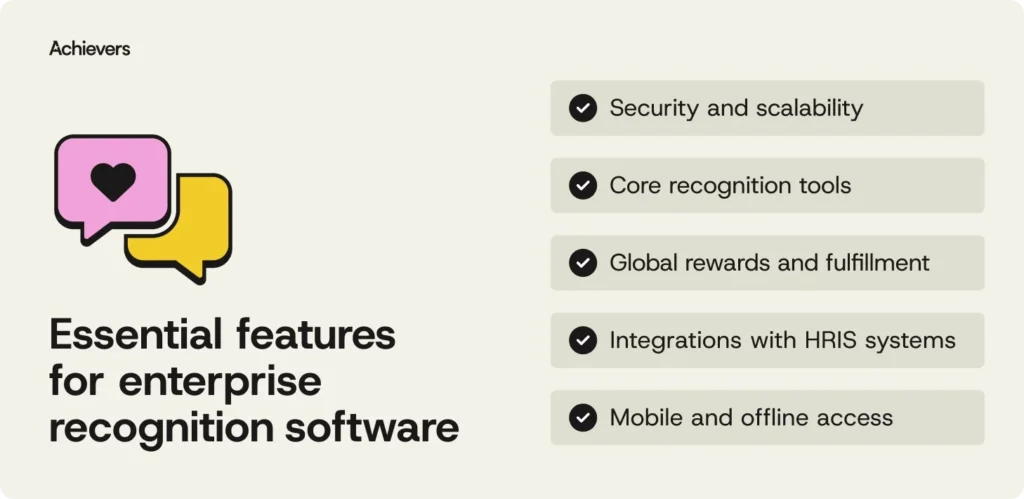
1. Security and Unwavering Scalability:
The bedrock of any successful enterprise software is its ability to protect sensitive data and perform flawlessly under immense pressure. For recognition platforms, this means safeguarding personal information, performance data, and reward redemption details. Trust is inextricably linked to security; employees must feel confident that their data is protected. Simultaneously, the platform must be inherently scalable, capable of seamlessly accommodating tens of thousands, or even hundreds of thousands, of users without degradation in performance. This includes handling high volumes of transactions, diverse user roles, and complex organizational hierarchies. Compliance with global data privacy regulations such as GDPR, CCPA, and others is non-negotiable, ensuring that data is handled legally and ethically across all operating regions. A program’s effectiveness hinges on its reliability and the effortless access it provides to every user, ensuring that recognition is always just a click or tap away.
2. Comprehensive Core Recognition Tools:
Effective recognition is a powerful employee retention strategy. The 2026 State of Recognition Report, which annually surveys 2,500 employees globally, underscored this by revealing that employees recognized weekly are six times more likely to envision a long-term career at their current company. This highlights the importance of making appreciation an ingrained habit, not an added burden. The best enterprise recognition software facilitates a culture where appreciation becomes second nature, offering diverse mechanisms for expressing gratitude. This includes peer-to-peer recognition, enabling colleagues to celebrate each other’s achievements; manager-to-employee recognition, empowering leaders to acknowledge contributions; and top-down recognition from senior leadership, reinforcing company values. Features like social recognition feeds, personalized recognition messages, and the ability to tie recognition to specific company values or strategic objectives amplify the impact, making appreciation public, visible, and aligned with organizational goals.
3. Global Reach: Localized Rewards and Seamless Fulfillment:
For global organizations, the impact of recognition can be severely diminished if rewards are not relevant or easily accessible across different geographies. A truly effective global rewards marketplace must offer a diverse catalog that resonates with employees whether they are in Toronto, Tokyo, or Timbuktu. This necessitates local fulfillment options, culturally appropriate reward choices (e.g., local gift cards, experiences, merchandise, charitable donations), and seamless currency conversion. Managing tax implications for rewards across various jurisdictions is also a complex but essential feature. The platform should simplify this complexity, ensuring that recognition feels equitable and valuable to every employee, regardless of their location, making the act of giving and receiving rewards genuinely enjoyable and impactful worldwide.
4. Seamless Integration with Existing HR Ecosystems:
Modern enterprise recognition thrives when it integrates naturally into the existing HR and communication systems that employees already use daily. This avoids creating yet another siloed application and reduces friction for adoption. Seamless software integrations with Human Resources Information Systems (HRIS) like Workday, SAP, Oracle, and communication platforms such as Slack, Microsoft Teams, or Google Workspace are critical. These integrations ensure that employee data is synchronized, new hires are automatically onboarded into the recognition program, and recognition events can be triggered or shared within familiar communication channels. By embedding recognition into existing workflows, it becomes an intuitive part of the employee experience rather than a separate, often forgotten, task. This interconnectedness boosts participation, enhances data accuracy, and provides a holistic view of employee engagement.
5. Actionable Insights: Analytics and Reporting for Strategic Impact:
Beyond merely tracking recognition events, a robust platform must transform raw data into meaningful, actionable insights. Analytics and reporting capabilities allow organizations to understand what types of recognition are most effective, identify patterns in engagement, pinpoint recognition gaps within specific teams or demographics, and measure the direct influence of recognition on key business outcomes. This includes tracking participation rates, sentiment analysis of recognition messages, identifying top givers and receivers, and correlating recognition activity with performance metrics, retention rates, and even customer satisfaction scores. Such insights empower HR leaders and senior management to refine their recognition strategies, allocate resources more effectively, and demonstrate the tangible ROI of their programs, ensuring continuous improvement and strategic alignment.
6. Universal Accessibility: Mobile and Offline Capabilities:
In an era where a significant portion of the global workforce operates outside traditional office settings—whether on factory floors, in retail stores, or out in the field—recognition must be universally accessible. Mobile and offline access ensures that appreciation can reach everyone, irrespective of their role or location. A dedicated mobile application provides convenience, allowing employees to give and receive recognition on the go, anytime, anywhere. Offline capabilities are crucial for environments with intermittent internet access, ensuring that appreciation can still be logged and processed when connectivity is restored. When access is consistent and inclusive across every device and location, recognition feels effortless, equitable, and genuinely integrated into the daily fabric of the organization, fostering a stronger sense of belonging for all employees.

Elevating Engagement: Advanced Features for Future-Proof Recognition
Beyond the foundational elements, leading enterprise recognition platforms offer advanced capabilities that allow organizations to truly customize and optimize their programs for maximum impact and strategic advantage.
1. Tailored Experiences: Configurability and Customization:
No two enterprise cultures are identical, and a one-size-fits-all recognition program is unlikely to resonate deeply. The most effective enterprise recognition software allows organizations to shape programs around their unique workflows, values, and strategic priorities, rather than forcing them to adapt to a rigid system. This includes extensive configurability for program rules, budget allocations, branded campaigns, multi-level approval paths, and eligibility criteria. The flexibility to create custom recognition moments, integrate company branding, and align recognition with specific performance objectives ensures that the program feels authentic, on-brand, and capable of evolving with the organization’s culture over time.
2. Fiscal Responsibility: Intelligent Budget Management and Cost Visibility:
While the cultural benefits of recognition are invaluable, a successful program must also make sound financial sense. Advanced platforms provide comprehensive budget management and cost visibility tools. This includes real-time tracking of spend against allocated budgets, forecasting future expenses, and providing detailed reports on the financial impact of the program. Transparent pricing models and flexible controls allow organizations to manage budgets effectively, prove the ROI of recognition initiatives, and demonstrate how these programs drive both cultural enrichment and measurable business goals. This financial accountability is crucial for securing ongoing leadership buy-in and investment.
3. The Augmented Manager: AI and Automation in Action:
Managers are often at the nexus of team leadership and administrative tasks, leading to increasing rates of manager burnout. AI and automation can significantly alleviate this burden and enhance the effectiveness of recognition. AI-driven prompts can remind leaders to recognize employees at opportune moments, such as after project milestones, significant achievements, or periods of high effort. Automation can handle routine recognition tasks like work anniversary celebrations, birthday acknowledgments, and campaign-specific reminders, freeing managers to focus on more strategic interactions. The result is more authentic connections, more consistent recognition, and more effective leadership, contributing to a more engaged and supported workforce.
4. Proactive People Management: Behavioral Insights and Predictive Analytics:
Leveraging sophisticated data analytics, advanced platforms can offer behavioral insights that go beyond surface-level metrics. These insights can uncover critical trends, such as early signs of "job hugging"—where employees remain in roles they’ve outgrown due not to commitment but to comfort. By analyzing recognition patterns, engagement levels, and other behavioral data points, leaders can identify at-risk talent, understand underlying motivations, and proactively intervene. This allows for re-engagement strategies through targeted recognition, personalized growth opportunities, and meaningful feedback, preventing disengagement and costly turnover.
5. Partnership for Success: Comprehensive Support and Onboarding:
The success of an enterprise software implementation hinges on robust support and a collaborative partnership. Organizations should seek platforms that offer comprehensive support from initial setup through continuous strategy scaling. This includes dedicated onboarding teams, live global assistance available 24/7, and an extensive library of accessible resources. A strong customer success team acts as a strategic partner, helping organizations keep their recognition programs fresh, aligned with evolving business objectives, and continuously driving value as the enterprise grows and adapts. This ongoing partnership ensures long-term adoption and sustained impact.
Industry Perspectives and the Achievers Approach
The consensus among HR technology analysts and business leaders is clear: effective employee recognition is a strategic imperative for enterprise organizations. It directly impacts employee experience, talent retention, and ultimately, organizational performance. Platforms like Achievers exemplify the capabilities required to meet these complex demands. Achievers positions itself as a solution designed to make enterprise recognition easy to scale, simple to manage, and impossible to overlook. It offers a comprehensive suite of features, from robust security and global rewards to AI-driven insights and seamless integrations, all geared towards helping global workforces stay connected, engaged, and inspired at scale. Achievers highlights its ability to integrate deeply into existing HR systems, provide localized reward options globally, and offer advanced analytics that translate recognition data into actionable business intelligence. This approach underscores the idea that behind every thriving culture is a meticulously designed system that ensures appreciation is consistent, impactful, and built to last.
The Broader Impact: Cultivating a Thriving Organizational Culture
The implications of implementing a strategic enterprise employee recognition program extend far beyond individual employee morale. It fundamentally shapes the organizational culture, fostering an environment where psychological safety, belonging, and trust flourish. When appreciation is a consistent and visible aspect of the workplace, it enhances collaboration, encourages innovation, and reinforces desired behaviors aligned with company values. This, in turn, contributes to a stronger employer brand, making the organization more attractive to prospective talent and reinforcing its reputation as a great place to work. From improved productivity and customer satisfaction to reduced absenteeism and enhanced overall business agility, the ripple effects of a well-executed recognition strategy are profound and far-reaching. It empowers employees to find meaning in their work, knowing their contributions are seen, valued, and celebrated.
Conclusion: Strategic Selection for Sustainable Appreciation
Great cultures are not accidental occurrences; they are meticulously constructed through consistent, meaningful moments of appreciation. The journey towards a truly engaged and high-performing enterprise workforce is paved with genuine recognition that resonates with every individual. When evaluating and comparing recognition platforms, organizations must look beyond superficial features and prioritize solutions that are engineered to scale with their people, not just their headcount. The ideal enterprise employee recognition software integrates seamlessly into the daily workflow, offers global reach with local relevance, provides actionable insights, and leverages advanced technologies like AI to make appreciation intuitive and impactful. Ultimately, the goal is to select a platform that transforms recognition into the most rewarding and impactful part of the workday, fostering a sustainable culture of appreciation that drives both human flourishing and business success.