
The United States labor market is projected to face significant worker shortages over the next decade, a stark contrast to widespread concerns about Artificial Intelligence (AI) leading to mass job displacement. New employment projections released by the Bureau of Labor Statistics (BLS) for the period 2025-2035 indicate a future where labor demand will outstrip supply, even as AI technologies drive substantial productivity gains. This forecast challenges conventional narratives and points towards a fundamental reshaping of the workforce, necessitating a strategic shift for businesses and human resources professionals alike.
Declining Workforce Growth and Escalating Productivity Demands
The BLS report projects a modest 3.5% growth in the U.S. labor force over the ten-year period from 2025 to 2035. This represents a significant deceleration compared to the 10.9% growth observed in the preceding decade. Concurrently, the Gross Domestic Product (GDP) is anticipated to expand by a substantial 22% during the same timeframe. This widening gap between economic output and labor force expansion implies an annual labor productivity increase of nearly 2%. Such a demand for heightened productivity is expected to compel businesses across all sectors to accelerate their adoption and integration of AI technologies.
The confluence of slower workforce growth and ambitious economic targets creates a fertile ground for labor shortages. As AI automates routine tasks and enhances efficiency, the focus will increasingly shift to roles that require uniquely human skills, adaptability, and continuous learning. This transition underscores the need for organizations to foster what experts term "Dynamic Organizations," characterized by agility, resilience, and a proactive approach to workforce development. For Human Resources professionals, this evolving landscape presents both challenges and unprecedented opportunities, with the HR job market itself experiencing a surge in demand, according to independent analysis.
Key Findings from the 2035 Employment Projections
The BLS report, a cornerstone for understanding future labor market trends, highlights several critical findings that will shape the American employment landscape.
Workforce Growth Slowdown: A Multifaceted Challenge
The projected 3.5% growth in the U.S. workforce between 2025 and 2035 is nearly a third slower than the growth experienced in the prior decade. This demographic shift is a primary driver of anticipated labor shortages, even as AI automates a portion of existing jobs.

Analysis of the current job market reveals that approximately 61% of U.S. jobs, when measured by population, necessitate physical or human-centered engagement. Healthcare emerges as the largest segment within this category. While AI currently possesses the potential to fully automate around 13% of all jobs, its impact is not characterized as outright job elimination but rather as a catalyst for "Superworker" opportunities. This concept, explored in depth in forthcoming publications, posits that AI will augment human capabilities, allowing individuals to perform at higher levels.
Adding to the workforce constraints are the nation’s immigration policies, which have been characterized as restrictive. Reports from The Economist have indicated that such policies could further exacerbate existing workforce shortages by limiting the influx of new workers. The underlying reasons for this slowdown in labor growth are a complex interplay of factors, including evolving immigration policies, declining birth rates, and an aging population.
An Aging Workforce: Shifting Demographics and Extended Careers
The demographic profile of the U.S. workforce is undergoing a significant transformation, with individuals aged 65 and over representing one of the fastest-growing segments. Currently, 7% of the workforce falls into this age bracket. Projections indicate this figure will rise to 8.5% within the next decade, a growth rate of 21% – seven times the overall workforce growth rate.
Studies by the AARP have revealed a notable trend of "unretiring," with nearly 10% of workers over 65 returning to the workforce. This phenomenon suggests an elongation of career spans, as older individuals seek continued engagement and financial security. For HR leaders, this trend underscores the imperative to implement robust generational diversity programs. It is widely documented that employers often exhibit age bias, impacting pay and hiring practices for older workers. Surveys indicate that a quarter of individuals over 50 feel "left behind" in their careers, highlighting a critical area for organizational improvement and policy reform.
Healthcare and Home Health Leading Sectoral Growth
The healthcare sector is poised to dominate U.S. labor market growth, driven by an aging population and increasing demand for medical services. The demand for home health and personal care aides is projected to grow by 18%, necessitating an additional 5.5 million individuals in these roles.
Registered nurses, a critical component of the healthcare system, are also expected to see significant demand, with their wages projected to experience the highest percentage growth among all segments. The number of nurse practitioner positions is anticipated to expand by 41%, with average wages projected to increase from $132,000 to $181,000. Overall, the healthcare industry is expected to account for 37% of all job growth, with its share of total U.S. employment expanding from 13.3% to 14%.
AI’s Impact on Administrative Roles and the Rise of Human-Centric Jobs
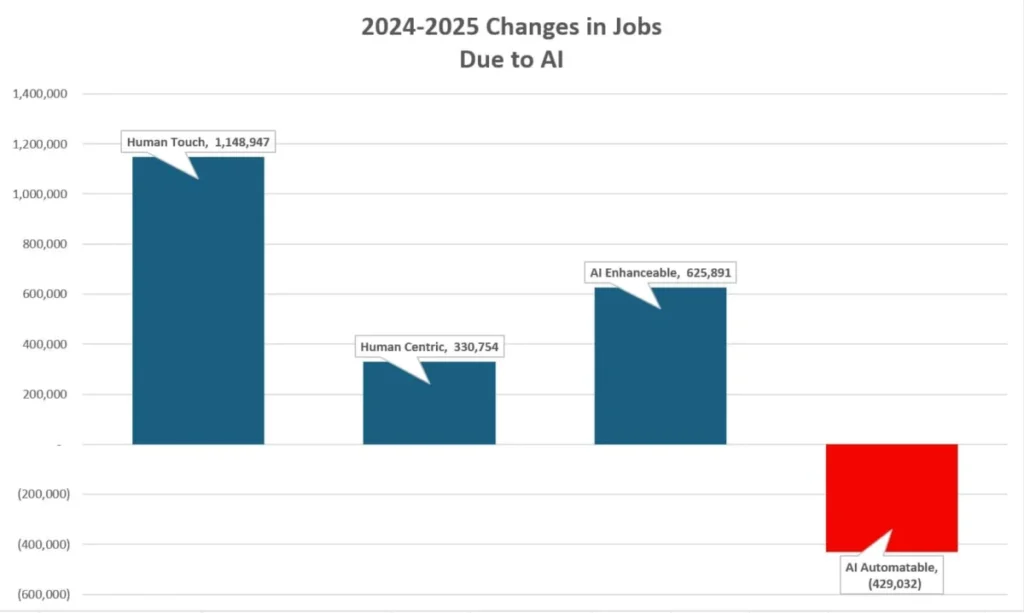
The BLS taxonomy, comprising 830 job titles, has been analyzed to categorize roles into four groups: human-touch, human-centric, AI-enabled, and AI-automated. The findings indicate that job titles experiencing the most rapid decline are predominantly administrative, including cashiers, clerks, bookkeepers, secretaries, receiving clerks, retail managers, and tellers. These roles currently constitute approximately 13% of the workforce.
The BLS anticipates an acceleration of this trend, with similar impacts expected for human-touch roles as robotic technology matures. Certain IT positions, such as computer support specialists, programmers (excluding software developers), testers, and data entry personnel, are also experiencing a decline in both numbers and wages, reflecting their administrative nature.
Conversely, jobs demanding high levels of human interaction and empathy are witnessing a surge in demand. These human-centric roles, which constitute 61% of the workforce, encompass laborers, electricians, plumbers, as well as professionals in home health, counseling, and psychology. Emerging fields such as energy and power production, aerospace, health sciences, and bio-engineering are also projected to be fast-growing industries, creating new employment opportunities.
Stability in Management, Sales, and Teaching Sectors
Contrary to some predictions, management roles are expected to grow, not diminish. The BLS forecasts indicate a continued demand for managers, who will be essential in overseeing and supporting the evolving workforce, particularly the "Superworkers" empowered by AI. This observation is echoed by independent research suggesting the need for "Supermanagers" to navigate the complexities of AI-augmented teams.
While retail sales positions are projected to see a slight decline of 3-5%, high-value sales roles are expected to expand. Teaching positions are also anticipated to remain stable, despite declining birth rates. This stability is attributed to the escalating need for new skills acquisition and the development of innovative learning methodologies.
Wage Premiums for "Superworker" Roles
The analysis of wage trends reveals a significant premium being placed on jobs that are "AI-enabled." Rather than experiencing wage stagnation or decline, these roles are seeing increased value. For instance, a software engineer leveraging AI is no longer merely a programmer but a product leader and problem solver, commanding higher compensation. Similarly, an HR business partner equipped with AI tools transitions from data lookup to a role as a strategic consultant and advisor. These "Superworker" job families are experiencing wage growth at twice the rate of inflation.
The "Superworker" Effect: Augmentation Over Automation
The overarching narrative emerging from these projections is the "Superworker" effect. Rather than AI leading to mass unemployment, it is poised to "superpower" existing jobs, transforming routine tasks into opportunities for enhanced human contribution. The definition of "routine" itself is evolving, impacting roles like cashiers, clerks, customer service representatives, administrative assistants, and bookkeepers.
Individuals in these roles are not expected to become unemployed but rather to engage in reinvented work, focusing on the core aspects of their responsibilities rather than the time-consuming tasks that previously defined their work. The analysis categorizes the 830 BLS job titles into four key areas:
- Human Touch: Roles requiring direct physical interaction or manual engagement.
- Human-Centric: Roles demanding empathy, listening, teaching, or support.
- AI-Enhanceable: Roles where AI can significantly augment performance.
- AI-Replaceable: Roles where a significant portion can be automated by AI.
Currently, 61% of jobs fall under the human-touch or human-centric categories. Approximately 26% are heavily AI-ready, and 13% are considered "AI-replaceable." Even within human-touch and human-centric roles, AI can offer significant support through improved scheduling, training, and data analysis, thereby transforming these into Superworker roles over time.
The BLS does project some job displacement, but as a percentage of the over 160 million working Americans, this is considered relatively small. In the past year, for example, job destruction accounted for approximately one-third of a percent of the workforce. While automation may evoke apprehension, the total loss of jobs is a gradual process.

Looking ahead, the categories will continue to evolve. Robots are expected to impact human-touch jobs more significantly, and AI will increasingly influence human-centric roles.
Implications for the Future of Work
The BLS projections offer a clear vision for the next decade: the U.S. will likely experience worker shortages, particularly in human-touch and human-centric fields, which will become increasingly important and "Superpowered." Professionals in knowledge-intensive roles can anticipate continued growth.
Sectors such as healthcare, manufacturing, logistics, retail, entertainment, hospitality, and transportation will need to prioritize hiring, training, and employee enablement. Routine jobs will diminish, replaced by roles demanding greater cognitive and emotional intelligence. The overall U.S. economy may face challenges in maintaining its growth trajectory due to these persistent labor shortages.
For CEOs and CHROs, the implementation of AI necessitates a strategic focus on productivity. The coming decade will demand an unprecedented emphasis on managing people for growth, skill development, retention, and engagement. The ability of organizations to adapt and cultivate a skilled, motivated workforce will be paramount to navigating the evolving economic landscape and ensuring continued prosperity.
Further detailed analysis of these projections, including specific occupational forecasts and their implications for individual career paths, is available through resources such as the BLS’s own research and specialized AI-powered platforms designed for HR and management decision-making. The underlying message is one of transformation, where human ingenuity, augmented by technology, will define the future of work.







