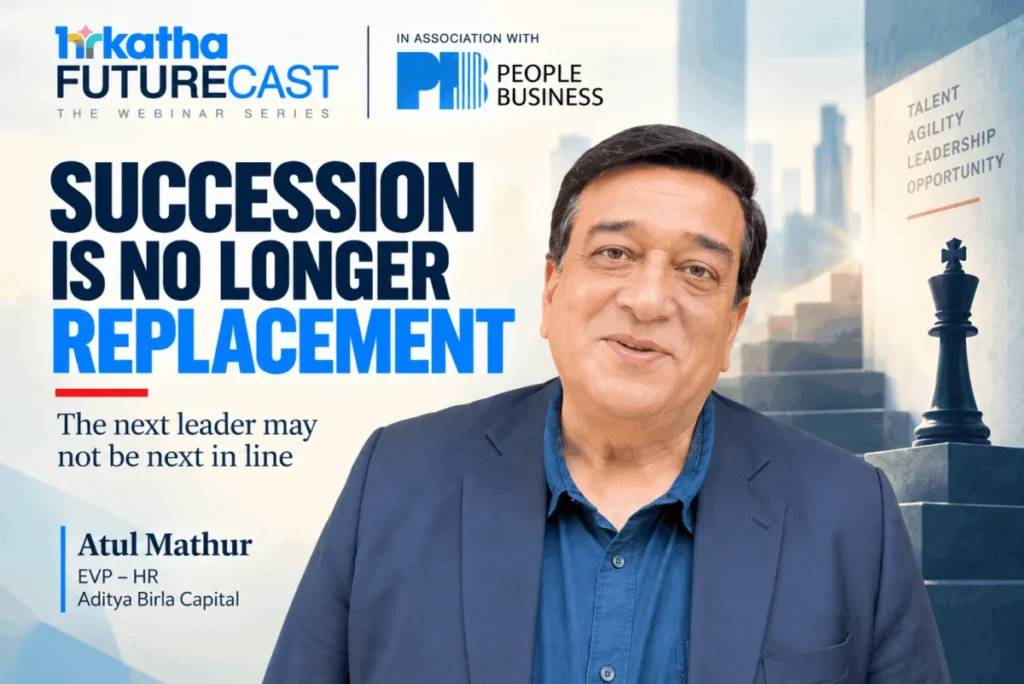
The conventional wisdom that an organisation’s most obvious successor is necessarily its best fit for future leadership is increasingly being challenged, particularly within the dynamic Banking, Financial Services, and Insurance (BFSI) sector. As regulatory frameworks evolve, technological advancements accelerate, and business models undergo fundamental shifts, the traditional linear approach to succession planning is proving insufficient. Atul Mathur, Executive Vice President of HR at Aditya Birla Capital, articulates a compelling argument that effective succession planning must transcend merely identifying the next person in line, instead prioritising candidates who demonstrate exceptional learning agility and a broad spectrum of experience, capable of navigating a future markedly different from the present. This critical insight emerged from the HRKatha Futurecast: The Future of Succession in BFSI, an influential event held in association with People Business, where Mathur underscored that the ultimate purpose of succession planning is to prepare an organisation not just for a change in leadership, but for the fundamental changes that lie ahead.
The Evolving BFSI Landscape: A Catalyst for New Leadership Paradigms
The BFSI sector stands at the vanguard of economic transformation, simultaneously grappling with unprecedented disruption and presenting immense opportunities. Over the past decade, financial institutions have witnessed a paradigm shift driven by several converging forces. The advent of digital banking, mobile payment systems, artificial intelligence (AI), machine learning (ML), and blockchain technology has reshaped customer expectations and operational efficiencies. Concurrently, regulatory bodies worldwide have intensified their scrutiny, demanding greater transparency, robust risk management, and enhanced consumer protection in the wake of global financial crises and emerging data privacy concerns like GDPR and CCPA. Furthermore, new business models, spearheaded by agile fintech startups and challenger banks, have eroded traditional market shares, compelling established players to innovate or risk obsolescence.
In this environment, leadership roles are no longer about merely maintaining stability but about driving proactive transformation. A leader in today’s BFSI sector must possess a deep understanding of digital ecosystems, a nuanced grasp of global economic trends, and the foresight to anticipate future disruptions. This complex matrix of challenges and opportunities necessitates a departure from succession models that merely reward longevity or a narrow functional expertise. The HRKatha Futurecast, a platform known for its forward-thinking discussions on human resources, chose "The Future of Succession in BFSI" as a focal point precisely because of these profound industry shifts. The event, supported by People Business, a consultancy specialising in talent and organisational development, aimed to bring together industry leaders and HR strategists to collectively redefine leadership preparedness for this critical sector.
The Imperative of Learning Agility
At the core of Mathur’s argument is the concept of "learning agility" – the capacity and willingness to learn from experience, adapt to new situations, and apply new skills and knowledge effectively in novel conditions. This goes beyond mere intellectual curiosity; it signifies a leader’s ability to unlearn outdated practices, assimilate new information rapidly, and pivot strategies in response to unforeseen challenges. In the BFSI sector, where technological cycles are shortening and market dynamics are in constant flux, a leader’s ability to quickly grasp complex concepts like quantum computing’s potential impact on cryptography, the ethical implications of AI in credit scoring, or the intricacies of environmental, social, and governance (ESG) investing, is paramount.
According to a 2022 report by Deloitte, approximately 75% of organisations globally reported a significant gap in leadership capabilities required to navigate future business challenges. A substantial portion of this gap was attributed to a lack of adaptability and strategic foresight among senior management. Traditional leadership development often focuses on mastering specific domains; however, the speed of change now renders such static mastery insufficient. Leaders must be perpetual students, comfortable with ambiguity, and adept at cross-functional problem-solving. A survey by the Corporate Executive Board (CEB) found that high-potential employees with high learning agility were significantly more likely to succeed in new roles and drive innovation compared to their less agile counterparts, reinforcing the tangible benefits of prioritising this trait in succession planning.
Beyond the Traditional Hierarchy: Embracing Breadth of Experience
Equally critical is the emphasis on "breadth of experience." Historically, succession planning often favoured individuals who had meticulously climbed a single functional ladder – a head of retail banking becoming the CEO, or a chief financial officer moving to the top role. While deep functional expertise remains valuable, Mathur argues that the multifaceted nature of modern BFSI operations demands leaders with a more diverse background. This could involve stints in different geographies, exposure to various business units (e.g., retail, corporate, wealth management, technology), or even experience outside the financial sector. Such varied experiences cultivate a holistic perspective, enabling leaders to understand the interconnectedness of different business functions, appreciate diverse cultural nuances, and foster a more integrated strategic vision.
For instance, a leader with experience in both product development and customer service is better equipped to drive customer-centric innovation. Someone who has worked in risk management and digital transformation can better balance technological adoption with regulatory compliance. A 2023 study by PwC highlighted that only 18% of global organisations felt their current leadership development programmes adequately prepared leaders for cross-functional roles. The report further indicated that companies actively fostering diverse career paths for high-potential individuals experienced a 15% higher success rate in strategic initiatives compared to those with more rigid progression models. This suggests a strategic imperative to design career paths that intentionally expose future leaders to a variety of challenges and responsibilities, moving away from the siloed departmental progression that has long defined corporate ascension.
Data-Driven Insights into Leadership Gaps and the Future Workforce
The urgency of this shift is underscored by a wealth of data indicating a looming leadership crisis if traditional approaches persist. A 2021 Korn Ferry study revealed that 85% of organisations globally struggle to find the right talent for critical leadership positions. This challenge is particularly acute in BFSI, where the demand for digitally-savvy leaders far outstrips supply. The global financial services industry alone is projected to invest trillions in digital transformation over the next five years, yet the human capital required to lead these initiatives remains scarce.
Moreover, the demographic shift presents another layer of complexity. As older generations retire, a significant brain drain of institutional knowledge is occurring. Younger generations entering the workforce, while often digitally native, may lack the deep industry specific knowledge and crisis management experience accumulated over decades. Effective succession planning must therefore also incorporate robust knowledge transfer mechanisms and mentorship programs that bridge this generational gap, while simultaneously nurturing the adaptive skills vital for future challenges.
The "great resignation" phenomenon, while impacting all sectors, has put additional pressure on leadership pipelines. High-performing individuals are increasingly seeking organisations that offer clear growth trajectories, opportunities for continuous learning, and a sense of purpose. Companies that fail to demonstrate a forward-looking approach to leadership development risk losing their best talent to competitors who are more proactive in cultivating agile, broadly experienced leaders. This makes the discussions at platforms like HRKatha Futurecast not just academic exercises but vital strategic imperatives for organisational survival and growth.
Industry Reactions and Expert Consensus
The insights shared by Atul Mathur resonate widely within the HR and leadership development communities. Representatives from People Business, the associate partner for the HRKatha Futurecast, often emphasise the critical need for organisations to move beyond rudimentary succession matrices. A spokesperson from People Business, in a statement following the event, highlighted, "Our work with numerous BFSI clients consistently shows that leadership effectiveness is directly correlated with an organisation’s ability to foresee and prepare for future challenges. Mathur’s emphasis on learning agility and breadth of experience is not just theoretical; it’s a practical blueprint for building resilient leadership teams that can navigate volatility, uncertainty, complexity, and ambiguity."
Leading HR consultancies and industry analysts echo this sentiment. A recent report by McKinsey & Company on future-proofing leadership pipelines suggested that "companies that proactively invest in developing agile leaders with diverse skill sets are 30% more likely to outperform their peers in terms of innovation and market share." Similar findings from Gartner indicate that "organisations with highly agile leadership teams are twice as likely to report strong business performance compared to those with traditional leadership structures." These observations collectively underscore a growing consensus that the future of leadership development lies in fostering adaptability, experiential diversity, and a continuous learning mindset.
Furthermore, several senior executives across the BFSI sector have implicitly or explicitly begun to adopt these principles. Major banks and insurance companies are revamping their leadership training programs, incorporating elements such as reverse mentoring (where junior employees mentor senior leaders on digital trends), cross-functional secondments, and leadership roles in innovation labs or fintech partnerships. This practical implementation reflects an understanding that the leadership qualities of tomorrow are vastly different from those that defined success in the past.
Strategic Implications for the Future of Work in BFSI
The implications of this redefined approach to succession planning are far-reaching, affecting not just the HR function but the entire strategic direction of BFSI organisations.
For Organisations: The primary implication is the need for a radical overhaul of talent management systems. This involves developing sophisticated assessment tools that can accurately gauge learning agility and identify potential across diverse experiences. It necessitates creating structured pathways for cross-functional and cross-geographical exposure, often involving temporary assignments or project leadership roles. Furthermore, organisations must cultivate a culture that values continuous learning, encourages experimentation, and accepts calculated risks – prerequisites for agile leadership. Investment in digital learning platforms, leadership coaching, and mentoring programs will become even more crucial.
For the HR Function: HR’s role transforms from an administrative and reactive function to a strategic and proactive one. HR leaders must become architects of talent ecosystems, working closely with business leaders to anticipate future skill requirements and design development interventions. This involves leveraging data analytics to identify high-potential individuals, track their development, and provide personalised growth opportunities. The HR department will be instrumental in fostering a culture of psychological safety, where leaders feel empowered to take on new challenges and learn from failures without fear of punitive consequences.
For Individuals: Aspiring leaders within BFSI must recognise that their career progression will increasingly depend on their willingness to step outside their comfort zones. This means actively seeking out diverse experiences, embracing opportunities to lead unfamiliar projects, and committing to continuous personal and professional development. Cultivating a growth mindset, proactively seeking feedback, and demonstrating an eagerness to learn new technologies and business models will be paramount. The onus is on individuals to not just follow a prescribed path but to actively shape their own learning journey.
Broader Economic Impact: The BFSI sector is the backbone of the global economy. Effective leadership within this sector is crucial for financial stability, economic growth, and the successful navigation of global challenges such as climate change, pandemics, and geopolitical shifts. By ensuring that leadership pipelines are filled with agile, broadly experienced individuals, financial institutions can better manage systemic risks, drive responsible innovation, and contribute to a more stable and prosperous global economy. The shift in succession planning, therefore, is not merely an internal HR matter but a critical component of global economic resilience.
In conclusion, the insights from HRKatha Futurecast, particularly Atul Mathur’s emphasis on learning agility and breadth of experience, mark a pivotal moment in the discourse on leadership succession within the BFSI sector. It signals a definitive move away from rigid, linear progression towards a more dynamic, adaptive, and future-oriented approach. As the industry continues to evolve at an unprecedented pace, organisations that embrace these principles in their leadership development will be better positioned not only to survive but to thrive, ensuring they are prepared for whatever comes next.