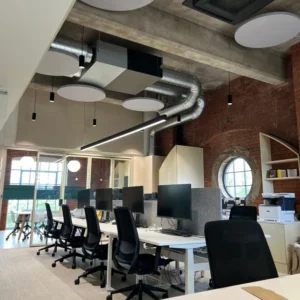
Hybrid work, once a revolutionary concept, has firmly cemented its place as a foundational expectation for today’s workforce. The initial discourse surrounding its implementation has matured into a widespread understanding that flexibility is no longer a perk, but a necessity. However, beneath this accepted paradigm lies a less understood, yet significantly costly, challenge: the financial and operational ramifications of scheduling variabilities and the opaque nature of how office spaces are actually utilized. While many corporate leaders possess a firm grasp on the tangible assets of their real estate – square footage, cost per square foot, energy expenditures, and occupancy rates – a critical blind spot persists regarding the dynamic and often unpredictable ways in which these spaces are inhabited.
A comprehensive survey conducted by Wakefield Research, polling 400 workplace decision-makers, revealed a striking deficit in actionable intelligence. A substantial 62% of these leaders admitted to lacking a clear understanding of office space utilization without resorting to either directly surveying employees or deploying technology solutions that raise privacy concerns. The former approach often yields responses skewed towards perceived desirability rather than genuine usage patterns, while the latter can erode trust and foster an environment of performative behavior, ultimately undermining the very insights they aim to uncover. This predicament highlights a fundamental challenge: the majority of data organizations collect about their workplaces fails to offer meaningful insight into the nuanced reality of human interaction within these environments.
The Silent Drain: Quantifying the Cost of Ignorance
The consequences of this data deficit are far-reaching and financially impactful. Faced with a lack of concrete information, a significant 36% of decision-makers admit to relying on intuition or "gut instinct" when making critical choices about office investments, including amenity upgrades, redesign projects, and lease renewals. This reliance on assumption-based planning directly correlates with the concern expressed by 76% of respondents who fear their current office layouts are not optimized for maximum productivity.
From a facilities management and employee comfort perspective, the absence of genuine usage insights leads to tangible waste. A staggering 24% of office space is regularly subjected to heating and cooling, despite being underutilized or entirely unoccupied. These ongoing energy expenditures, coupled with the ripple effects of reduced productivity and potential impacts on employee retention, contribute to escalating operational costs. This situation is particularly acute at a time when organizations are actively investing in office renovations, a trend further amplified by rising fit-out costs.
Data from JLL’s "Future of Work" reports underscore this investment surge, indicating that 59% of organizations are increasing their expenditure on office fit-outs. The firm’s "Global Office Fit-Out Costs Guide" further details a global increase in renovation expenses ranging from 2% to 6%, with North America experiencing the highest costs, falling between $230 and $375 per square foot. The disconnect between these substantial investments and a lack of understanding regarding actual office usage can result in costly learning experiences, as companies reconfigure layouts and introduce amenities based on assumptions rather than validated needs. This disparity, the gap between understanding how an office is truly used and what the workforce genuinely prefers and requires, is often termed the "spatial intelligence gap."
Bridging the Gap: Towards Informed Workplace Strategies
Addressing this spatial intelligence gap necessitates a shift towards data-driven decision-making. While various technological solutions exist, a common strategy involves aggregating data from disparate sources such as occupancy counters, badge swipe systems, and room reservation platforms. Integrating these datasets into a unified dashboard can offer a more holistic view and help validate or challenge existing assumptions about office usage.

However, even these integrated approaches can inadvertently create a blind spot. They often provide a macro-level view of building entry and exit times, but fall short of capturing the nuanced, day-to-day ebb and flow of human activity within the office. Workforce behavior is not static; it fluctuates with seasonal changes, vacation periods, and less obvious environmental factors. For instance, the position of the sun can create glare, increase ambient temperature, strain cooling systems, and disrupt employees working on computers. Such disruptions can prompt individuals to relocate within the building or even depart for the day, creating localized pockets of underutilization and impacting overall productivity.
While these seemingly minor adjustments might appear insignificant in isolation, their cumulative operational costs can be substantial. The Wakefield survey highlights this point directly, with 62% of respondents believing that better utilization insights could yield measurable savings in building energy costs. Similarly, 60% of decision-makers identified cleaning costs as another area where enhanced data could lead to significant efficiencies. Moving beyond simply tracking who is in the building and for how long, organizations can achieve greater effectiveness by gaining accurate, anonymized insights into real human behavior.
The Rise of Thermal Sensors: Anonymous Insights for Smarter Spaces
To unlock this critical layer of insight, particularly in scenarios where traditional surveillance is inappropriate or infeasible, thermal sensing technology has emerged as a powerful solution. Unlike cameras, thermal sensors operate by detecting heat signatures, not by capturing visual images. This inherent characteristic ensures privacy, as the technology focuses on the presence and movement of individuals without identifying them.
When thermal data is mapped onto an office layout, it creates a visual representation of human behavior patterns. This granular understanding can empower decision-makers to identify trends and make informed adjustments. For example, one employer utilized this data to discover a deficit in conference rooms and private work areas, leading to a strategic reconfiguration of the office that ultimately boosted productivity. In another instance, a company achieved annual savings of approximately $1,400 per restroom through more intelligent resource planning informed by usage data. By providing accurate, granular, and anonymized insights into human activity, thermal data enables the creation of smarter office layouts and schedules that genuinely align with workforce needs and the unique culture of an organization.
From Data to Decisions: Leveraging AI for Workplace Optimization
The challenge of capturing office usage data is only the first step; transforming this raw information into actionable narratives requires sophisticated analysis. Millions of data points can be generated, necessitating efficient methods for interpretation. This is where artificial intelligence (AI), supported by high-quality data, becomes indispensable.
AI can analyze trends, identify peak usage times and days, and provide written and visual recommendations for layout adjustments or desk assignments. Furthermore, it can assist in exploring various scheduling models based on consistent patterns, such as spikes in support desk calls, and assess their impact on employees, maintenance, and facilities management.
Anecdotal evidence suggests a renewed vibrancy in many office environments, with parking lots full, desks occupied, and consistent foot traffic observed. Commercial Real Estate (CRE) executives, property managers, and tenants are actively investing in their workplaces. To maximize the return on these significant investments, which represent one of an organization’s largest capital expenses, a deep understanding of occupancy, usage, and anonymized human behavior is paramount. Experimentation and innovative approaches to space optimization must be firmly grounded in real, reliable data to ensure that these investments translate into tangible improvements in efficiency, productivity, and employee experience. The journey from understanding hybrid work as a concept to optimizing its practical execution is ongoing, and data-driven insights are the compass guiding this critical evolution.