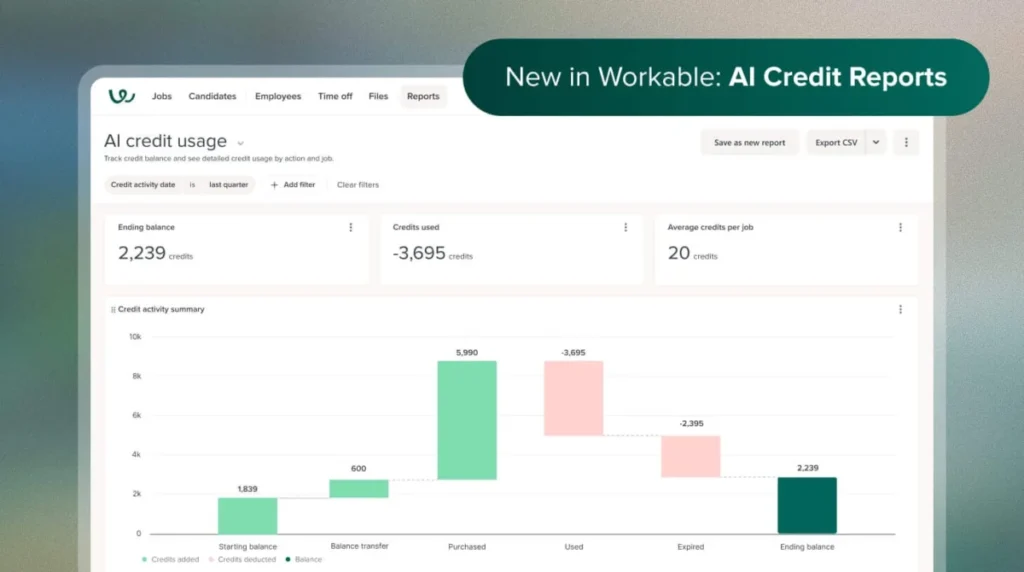
Workable, a leading global provider of recruiting software, has announced the immediate availability of its new AI Credits Report, a significant enhancement designed to provide account administrators with unprecedented transparency and control over their artificial intelligence resource consumption. This new feature, seamlessly integrated into Workable’s existing suite of recruiting reports, allows users to meticulously track AI credit usage from purchase to expiration, offering detailed insights into how these credits are allocated across various jobs and activities within their accounts. The launch addresses a growing demand within the talent acquisition sector for clearer visibility into the operational costs associated with increasingly sophisticated AI-powered recruitment tools, empowering organizations to optimize their spending and maximize the return on investment from their AI technologies.
The introduction of this dedicated reporting mechanism marks a pivotal moment in the evolution of HR technology, reflecting a broader industry trend towards greater accountability and strategic management of digital resources. As AI tools become integral to sourcing, screening, and engaging candidates, understanding their cost implications and efficiency becomes paramount for HR departments navigating complex budgetary landscapes. The AI Credits Report is designed to demystify AI consumption, offering a clear, actionable overview that was previously unavailable, and requiring no additional setup for existing Workable customers on any plan.
The Evolving Landscape of AI in Recruitment
The past decade has witnessed a dramatic acceleration in the adoption of artificial intelligence within human resources, particularly in the realm of talent acquisition. From automating initial candidate screenings and resume parsing to powering intelligent job recommendations and even facilitating conversational AI for candidate engagement, AI has transformed how companies identify, attract, and hire talent. This technological shift has brought numerous benefits, including increased efficiency, reduced time-to-hire, improved candidate experience, and the potential to mitigate unconscious bias in the early stages of recruitment. According to a 2023 report by Grand View Research, the global HR management system market size was valued at USD 24.06 billion in 2022 and is projected to grow at a compound annual growth rate (CAGR) of 12.8% from 2023 to 2030, with AI being a primary driver of this expansion. However, the proliferation of AI tools also introduces new complexities, particularly concerning their operational costs and the effective management of digital resources.
Many AI-powered platforms operate on a credit-based system, where specific actions (like using an AI assistant to write a job description, generate interview questions, or analyze candidate profiles) consume a predefined number of credits. While this model offers flexibility, it can also lead to opaque spending patterns, making it challenging for account administrators to track usage, forecast future needs, and justify expenditures. Without granular insights, organizations risk overspending, underutilizing valuable AI assets, or failing to identify inefficiencies in their recruitment processes. This lack of transparency has been a growing concern for HR and finance leaders seeking to optimize their technology stacks and ensure every investment yields tangible value.
Addressing a Critical Need: The Genesis of the AI Credits Report
Recognizing this emerging challenge, Workable strategically developed the AI Credits Report to provide a robust solution. The impetus for this feature stemmed from direct feedback from Workable’s extensive client base, who expressed a clear need for greater visibility into their AI tool consumption. The development timeline for such a comprehensive reporting tool likely involved several phases, beginning with user research and requirements gathering, followed by design, engineering, and rigorous testing, culminating in its official release.
This move aligns with Workable’s commitment to empowering HR professionals with intuitive, powerful tools that simplify complex tasks. The company, known for its user-friendly interface and comprehensive suite of recruitment functionalities, understood that integrating AI capabilities required an equally robust framework for managing those capabilities. By offering an integrated solution, Workable aims to remove the guesswork from AI budgeting, allowing companies to make data-driven decisions about their talent acquisition strategies. This proactive approach to cost transparency reflects a broader industry movement where SaaS providers are increasingly expected to offer detailed usage analytics, moving beyond basic billing statements to provide actionable insights.
Key Features and Functionality: Unpacking the New Report
The Workable AI Credits Report offers a multifaceted view of AI credit activity, designed to cater to the specific needs of account administrators. Its integration within the existing "Recruiting reports" section ensures a familiar user experience, minimizing the learning curve for current users.
-
Comprehensive Credit Lifecycle Tracking:
The report provides an end-to-end view of AI credits, tracking their entire lifecycle within an account. This includes detailed records of all credits purchased, when they were acquired, and their associated costs. Furthermore, it meticulously logs credit consumption, detailing exactly when and how credits are used, right up to their expiration. This holistic overview allows administrators to understand not just their current balance, but also the historical flow of credits, enabling better forecasting and preventing unused credits from expiring without being fully leveraged. For instance, an admin can quickly identify if a large batch of credits purchased last quarter is nearing expiration, prompting them to encourage their team to utilize AI features more effectively. This level of detail is crucial for financial planning and ensuring maximum value from AI investments. -
Granular Usage Attribution:
A standout feature is the ability to pinpoint precisely what activities and actions are consuming AI credits. The report breaks down usage by specific AI-powered features, such as AI-generated job descriptions, AI-powered candidate outreach, automated screening questions, or interview script generation. This granular attribution helps administrators understand which AI functionalities are most heavily utilized by their teams. For example, if a significant portion of credits is being spent on AI-generated job descriptions, it indicates a high adoption of this particular feature, but also prompts a question about its efficiency and necessity. Conversely, if a feature designed to enhance candidate engagement is barely using credits, it might signal a need for more training or a re-evaluation of its effectiveness. This insight is invaluable for optimizing workflow and training initiatives. -
Job-Specific Cost Analysis:
Perhaps one of the most impactful features for talent acquisition teams is the ability to drill down to the job level. The report shows how many AI credits are being consumed for each specific job opening. This allows HR and recruiting managers to analyze the AI cost associated with filling particular roles. For instance, if hiring for a highly specialized tech role incurs significantly more AI credit usage compared to a general administrative position, it provides data points for cost-benefit analysis. This feature supports strategic decision-making, helping organizations understand the true "cost-per-hire" for AI-assisted roles and potentially identify areas where AI is either highly effective or where its use might be less efficient. This level of detail empowers recruiters to justify AI usage for specific challenging roles and helps leadership allocate resources more effectively across different hiring initiatives. -
Customizable Reporting and Insights:
Understanding that different organizations have unique reporting needs, Workable has built in robust filtering capabilities. Account administrators can customize their views by filtering data based on specific timeframes, individual jobs, types of AI actions, or even by user. This flexibility allows for targeted analysis, whether it’s reviewing monthly AI expenditure, assessing AI credit usage for a particular department’s hiring efforts, or identifying power users of AI features. The ability to export this filtered data further enhances its utility, allowing for integration into broader financial reports or for deeper analysis using external business intelligence tools. This level of customization ensures that the report is not just a static data dump, but a dynamic tool for ongoing performance monitoring and strategic planning.
Strategic Implications for Account Administrators
For account administrators, the new AI Credits Report transcends mere financial tracking; it becomes a strategic tool that empowers them to play a more proactive role in managing their organization’s talent acquisition technology stack.
- Enhanced Budget Control and Forecasting: By providing clear visibility into AI credit consumption, administrators can accurately monitor spending against budgets, identify potential overruns or underspending, and make informed adjustments. This precision allows for more accurate forecasting of future AI credit needs, preventing last-minute purchases or unnecessary stockpiling.
- Optimized Resource Allocation: Understanding which jobs and activities consume the most AI credits enables administrators to strategically allocate resources. They can identify high-value AI applications and perhaps re-evaluate or refine the use of AI in less impactful areas, ensuring that every credit spent contributes meaningfully to recruitment goals.
- Demonstrating ROI and Value: With detailed usage data, administrators can better articulate the return on investment (ROI) of their AI tools. They can present concrete evidence of how AI is being used to streamline processes, accelerate hiring, or improve candidate quality, justifying the ongoing investment in these technologies to executive leadership.
- Process Improvement and Efficiency Gains: The granular data can highlight inefficiencies in AI usage. For example, if multiple recruiters are performing similar AI actions for the same job, it might indicate a need for better coordination or a review of best practices to consolidate efforts and reduce redundant credit consumption. This data-driven approach fosters continuous improvement in recruitment workflows.
- Vendor Management and Accountability: Transparent reporting enhances accountability not just internally, but also with the vendor. Administrators can have more informed conversations with Workable regarding their AI usage patterns, potential for bulk purchasing, or exploring features that align more closely with their actual consumption profiles.
Industry Context and Supporting Data
The demand for such transparency tools is not unique to Workable or the HR tech sector. Across the broader SaaS industry, businesses are increasingly seeking greater visibility into their subscription and usage-based costs. A 2023 survey by Flexera indicated that 70% of enterprises struggle with optimizing SaaS spend, with shadow IT and lack of visibility being primary culprits. As companies embrace more complex, AI-driven solutions, the need for detailed cost attribution becomes even more critical.
The global AI in HR market, valued at USD 1.3 billion in 2022, is projected to reach USD 5.7 billion by 2030, growing at a CAGR of 20.2%, according to a report by Research and Markets. This exponential growth underscores the increasing investment in AI technologies within HR departments. However, this investment comes with an imperative for careful management. Many HR leaders express concerns about the practical implementation and cost-effectiveness of AI. A recent Deloitte study highlighted that while 70% of HR executives believe AI will significantly impact HR, only 10% feel their organizations are fully prepared to integrate it effectively, with cost management and ethical implications being key challenges. Workable’s new report directly addresses the former, providing a crucial tool for preparation and effective integration.
Reactions and Expert Commentary
While Workable has yet to release specific official statements beyond the product announcement, the implications of such a feature are clear. A Workable spokesperson might emphasize the company’s dedication to user empowerment and operational excellence. "Our goal at Workable has always been to simplify recruitment and empower HR professionals with the best tools," a hypothetical Workable executive might state. "The AI Credits Report is a direct response to our customers’ needs, providing them with the clarity and control necessary to truly leverage AI effectively, ensuring every investment translates into measurable value for their talent acquisition strategies."
Industry analysts are likely to view this as a positive and necessary development. "In an era where AI adoption is skyrocketing, transparency in usage and cost is no longer a luxury, but a fundamental requirement," says a hypothetical HR tech analyst from a leading firm. "Workable’s new report sets a benchmark for how SaaS providers should empower their users, enabling them to make smarter, data-driven decisions about their AI investments. This move not only benefits their customers but also solidifies Workable’s position as a leader committed to practical, user-centric innovation."
From the perspective of an HR practitioner, the benefits are tangible. "Managing our AI credit usage has always felt like a guessing game," shares a hypothetical Head of Talent Acquisition at a mid-sized tech company. "This new report from Workable is a game-changer. I can finally see exactly where our AI budget is going, identify which roles benefit most from AI, and optimize our strategy accordingly. It gives me the confidence to invest further in AI knowing I have full visibility and control."
Broader Impact on Talent Acquisition and Business Strategy
The Workable AI Credits Report extends its impact beyond mere financial accounting, influencing broader talent acquisition and business strategies. By providing a clear picture of AI utilization, organizations can:
- Refine AI Adoption Strategies: Data from the report can inform decisions about which AI features to emphasize, which to potentially scale back, and where additional training might be needed to maximize the benefits of underutilized tools.
- Improve Collaboration between HR and Finance: The transparent data facilitates more productive conversations between HR departments and finance teams, enabling a shared understanding of AI expenditures and their strategic value. This fosters greater alignment on technology investments.
- Benchmark Performance: Companies can use the report to benchmark their AI usage efficiency across different teams, departments, or even against industry standards (if comparable data becomes available). This encourages continuous improvement and the sharing of best practices.
- Support Ethical AI Deployment: While primarily a cost management tool, understanding where AI is used can indirectly support ethical AI initiatives by highlighting areas for review. If certain AI features are disproportionately used in specific hiring scenarios, it might prompt questions about potential biases or fairness, prompting further investigation.
- Future-Proofing Recruitment Operations: As AI continues to evolve and integrate deeper into recruitment workflows, having robust reporting mechanisms in place ensures that organizations can adapt, manage, and scale their AI usage responsibly and effectively. It prepares them for a future where AI is not just a tool, but a strategic partner in talent acquisition.
Looking Ahead: The Future of AI in HR and Transparency
The release of Workable’s AI Credits Report signifies a crucial step in the maturation of AI within the HR technology landscape. As artificial intelligence becomes increasingly sophisticated and pervasive, the demand for transparency, accountability, and robust management tools will only intensify. Companies like Workable that prioritize these aspects are poised to lead the market, offering solutions that not only enhance efficiency but also empower users with the data needed to make intelligent, strategic decisions. This commitment to clarity will undoubtedly shape the future development of HR tech, pushing the industry towards more integrated, insightful, and user-centric platforms.
For those eager to explore the capabilities of this new feature, Workable encourages users to connect with their account managers or request a demo from a product specialist. This hands-on experience will allow administrators to fully grasp the depth of insights available and immediately begin optimizing their AI credit consumption for more efficient and cost-effective recruitment operations.