Most compliance checklists treat the burgeoning array of AI hiring laws with a simplistic uniformity, assigning each a single bullet point with an identical tone and implied urgency. This approach is not only inaccurate but has been demonstrably so for months, if not longer. The reality is far more complex: these are distinct legal obligations, each with its own timeline, definition of compliance, and enforcement mechanisms. One such law was stymied by a federal court before its intended implementation date, while another saw its most stringent provisions postponed for over a year, a delay that subsequently became codified into law. Treating all "AI hiring laws" as a monolithic category is a recipe for outdated compliance, particularly for employers operating across state lines. Failing to grasp these nuances—getting a date wrong, misunderstanding a definition—can lead to the grave misrepresentation of a control’s existence or applicability to candidates or regulators. This article aims to dissect the current state of AI hiring legislation across key jurisdictions, highlighting their divergent paths and underscoring the imperative for a more granular approach to compliance.
The Shifting Sands of AI Regulation: A Jurisdictional Deep Dive
The rapid development and deployment of artificial intelligence in hiring processes have outpaced traditional regulatory frameworks, necessitating new legislation. However, the legislative response has been fragmented, with different jurisdictions adopting unique approaches to addressing potential biases and ensuring fairness. Understanding these differences is crucial for any organization aiming to remain compliant.
New York City Local Law 144: A Pioneering Framework in Force
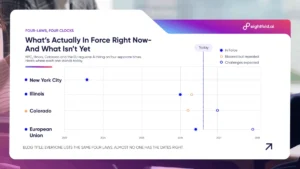
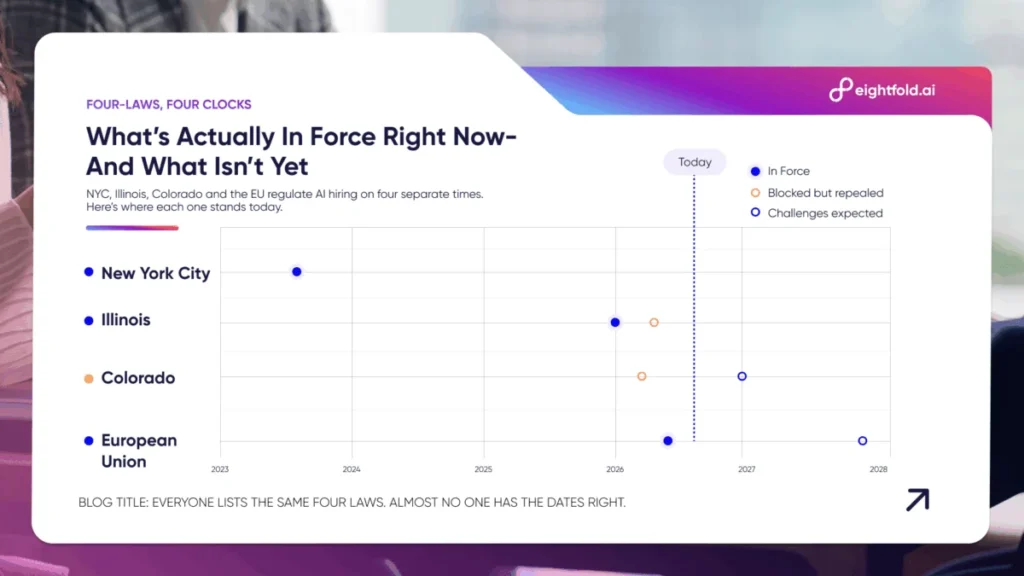
New York City’s Local Law 144, enacted to address concerns about algorithmic bias in automated employment decision tools (AEDTs), stands as one of the earliest comprehensive pieces of legislation in this domain. It officially came into force on July 5, 2023, making it the only one of the four major frameworks discussed here with a significant track record of implementation.
Key Provisions and Compliance Requirements:
Under Local Law 144, any automated tool utilized to evaluate candidates for roles based in New York City must undergo an independent bias audit annually. The results of this audit, including selection rates and impact ratios categorized by protected characteristics, must be published in a readily accessible location for candidates. This transparency extends to a requirement for employers to provide candidates with advance notice—at least ten business days prior to the tool’s use—that an AEDT will be employed. This notice must also include clear instructions on how candidates can request an alternative selection process.
The law mandates that employers make available a summary of the AEDT’s most recent bias audit, detailing the date of the audit and the data sources used. This information is vital for candidates seeking to understand how AI might influence their application. Enforcement of Local Law 144 falls under the purview of the New York City Department of Consumer and Worker Protection (DCWP). A critical aspect of compliance is the continuous availability of a current audit; operating an AEDT without one, regardless of its performance, constitutes a compliance gap.
Vendor Perspective: Vendors offering AI solutions for hiring in NYC are increasingly providing detailed disclosures, such as Eightfold.ai’s NYC disclosure, to assist employers in meeting these stringent requirements.
Illinois HB 3773: Integrating AI into Existing Anti-Discrimination Frameworks
Illinois’s approach, embodied in House Bill 3773, took effect on January 1, 2026. Unlike NYC’s creation of a new audit regime, Illinois chose to integrate AI-assisted employment decisions directly into its existing Human Rights Act. This means that concerns about AI-driven discrimination are addressed through the same legal channels as human-led discriminatory practices, a framework that the state has enforced for decades.
Nuances in Implementation:
Employers in Illinois are required to notify candidates when AI plays a role in hiring, promotion, discipline, or discharge decisions. Furthermore, they must be capable of explaining the function of these tools in plain language. The crucial distinction here is that a discriminatory outcome, whether facilitated by AI or a human, is not treated as a novel "AI violation" but rather prosecuted under the established Human Rights Act. The notion that an algorithm, rather than a human, made a decision has never been a viable defense against discrimination claims.
A notable wrinkle in Illinois’s implementation emerged in June 2026, when the Illinois Department of Human Rights withdrew its proposed implementing rules. This withdrawal was intended to allow for continued coordination with other state agencies, but it left the revised timeline for finalized regulations uncertain. Despite this, the statute’s core duties regarding notice and non-discrimination remain fully applicable. Employers, however, currently lack finalized regulatory detail on the precise language and timing that will satisfy these notice requirements.
Colorado Senate Bill 26-189: A Reimagined Regulatory Approach
Colorado’s legislative journey with AI regulation has been particularly dynamic. The original Colorado AI Act (Senate Bill 24-205) was poised to be one of the nation’s most demanding frameworks, mandating impact assessments, an explicit duty to prevent algorithmic discrimination, and ongoing risk-management programs. However, this initial legislation never took effect as written. In April 2026, a federal court blocked its enforcement following a constitutional challenge.
The Legislative Pivot and Current Status:
Facing pressure from industry stakeholders and the legal challenge, Colorado’s legislature repealed SB 24-205 and enacted Senate Bill 26-189 in May 2026. This new legislation, slated to become effective on January 1, 2027, presents a considerably lighter regulatory burden.
The revised framework requires advance notice to individuals before the use of "covered automated decision-making technology." Following an adverse decision, individuals are entitled to a plain-language explanation within 30 days. The bill also grants a right to request data correction and a right to request human reconsideration, though the latter is qualified by the phrase "to the extent commercially reasonable," underscoring that it is not an unconditional guarantee. Importantly, legal challenges to this revised version are reportedly anticipated, meaning the January 2027 effective date should be treated as a target rather than a settled certainty.
Comparative Table of Colorado’s AI Frameworks:
| Framework | Core Duty | Status |
|---|---|---|
| Original SB 24-205 | Impact assessments, discrimination-prevention duty, ongoing risk management | Blocked by federal court; repealed |
| SB 26-189 | Advance notice, 30-day adverse-decision explanation, data correction, conditional human reconsideration | Effective January 1, 2027; further challenges possible |
The European Union AI Act: A Comprehensive Risk-Based Approach
The European Union’s AI Act represents a landmark effort to establish a unified regulatory framework for artificial intelligence across member states. While the full scope of the Act is extensive, specific obligations related to AI in recruitment and employee evaluation have a confirmed effective date.
High-Risk Obligations and Transparency:
The high-risk hiring obligations under the EU AI Act are set to take effect on December 2, 2027. This follows a procedural step where the Digital Omnibus deferral entered into force in July 2026 as Regulation (EU) 2026/1744, pushing the implementation of Annex III high-risk provisions from August 2026 to the new December 2027 date. These provisions explicitly name recruitment and employee evaluation tools as high-risk, necessitating mandatory risk management, comprehensive technical documentation, robust human oversight, and formal conformity assessments.

Interestingly, one component of the Act—Article 50’s transparency duty—was not subject to this delay. This means that as of now, any candidate interacting with an AI interviewer in the EU should already be informed that they are engaging with an artificial intelligence system during that conversation.
Penalties for Non-Compliance:
The penalties for non-compliance with high-risk AI provisions are significant. They can reach up to €15 million or 3% of global annual turnover, positioning these penalties within the middle tier of enforcement, below the €35 million or 7% ceiling reserved for prohibited AI practices.
The Federal Baseline: Enduring Anti-Discrimination Laws
It is crucial to underscore that none of these emerging AI-specific laws supersede existing federal anti-discrimination statutes. For employers meeting certain employee thresholds, Title VII of the Civil Rights Act of 1964 prohibits employment discrimination based on race, color, religion, sex, and national origin. Similarly, the Americans with Disabilities Act (ADA) and the Age Discrimination in Employment Act (ADEA) provide protections against discrimination. These federal laws apply irrespective of whether an AI tool or a human made the employment decision.
The Equal Employment Opportunity Commission (EEOC) provides guidance that complements these statutes, rather than being incorporated within them. The EEOC’s technical assistance on the ADA (2022) and guidance on Title VII (2023) address algorithmic risks, but neither constitutes enacted AI-specific legislation. Importantly, an employer’s liability under these federal laws is not diminished or shifted by a vendor’s audit results; the ultimate responsibility rests with the employer.
AI Hiring Compliance: Four Levers, One Employer Mandate
A comparative analysis of these four distinct regulatory frameworks reveals fundamental structural differences, not mere cosmetic variations.
- New York City (Local Law 144): Employs an "audit-and-publish" model. Employers must demonstrate the validity of their hiring numbers through annual public audits. Failure to do so results in non-compliance, regardless of intent.
- Illinois (HB 3773): Leverages an existing civil-rights framework. AI-assisted decisions are evaluated and adjudicated under the same principles as human decisions within the state’s Human Rights Act.
- Colorado (SB 26-189): Adopts a "notice-and-recourse" approach. Employers are required to provide advance notice, offer post-decision explanations, and allow for human review, albeit with commercial reasonableness caveats.
- European Union (AI Act): Functions akin to a product-safety regulation. It mandates classification, documentation, assessment, and pre-market approval for high-risk AI systems, a process more aligned with how medical devices are regulated than marketing claims.
While the underlying concern—preventing bias and ensuring fairness in AI-driven hiring—is consistent across these jurisdictions, the methods for holding employers accountable are entirely disparate. A vendor proficient in addressing only one of these compliance models is ill-equipped to serve clients operating in multiple jurisdictions.
Constructing an Effective AI Hiring Compliance Checklist
Developing a truly effective compliance strategy requires moving beyond a simple checklist and embracing a dynamic, multi-faceted approach. This involves:
- Jurisdictional Mapping: Accurately identifying all relevant federal, state, and local laws applicable to the employer’s hiring practices, considering candidate location, role location, and employer footprint.
- Tool Inventory and Assessment: Maintaining a comprehensive inventory of all AI-powered tools used in the hiring process, understanding their specific functions, and assessing their compliance status against applicable regulations.
- Vendor Due Diligence: Rigorously vetting AI vendors to ensure their tools and practices align with compliance requirements, and clearly defining responsibilities through contractual agreements.
- Internal Policies and Procedures: Developing and implementing clear internal policies and procedures for the use of AI in hiring, including guidelines for candidate notification, data handling, and human oversight.
- Regular Auditing and Monitoring: Establishing a schedule for regular internal and external audits of AI tools to detect and mitigate potential biases and ensure ongoing compliance.
- Training and Awareness: Providing comprehensive training to HR personnel, recruiters, and hiring managers on the ethical and legal implications of AI in hiring.
- Legal Counsel Engagement: Continuously consulting with legal counsel specializing in employment law and technology regulation to stay abreast of evolving legislation and best practices.
Unanswered Questions and the Imperative for Continuous Review
Despite the growing body of legislation, several critical questions remain unanswered, and the dynamic nature of these laws necessitates constant vigilance.
Defining "In Force" and Audit Validity: Four jurisdictions, four distinct interpretations of "in force," and this is before considering other states that may introduce their own AI hiring laws. Crucially, none of these laws explicitly define what constitutes a valid bias audit. Questions such as the required sample size for statistically significant results or the differentiation between genuine bias and coincidental data fluctuations remain largely unaddressed by the legislation itself. These are not merely legal questions but complex statistical and analytical challenges that few auditors elucidate clearly.
The Role of Legal Counsel: The effective dates of these laws are subject to change, as evidenced by the shifts in Colorado and the EU. Three of the four frameworks discussed here experienced significant changes within a relatively short tracking period. Therefore, it is imperative to consult the current statutory text and seek advice from qualified legal counsel before making any compliance decisions based on informational resources, including this article.
Frequently Asked Questions on AI Hiring Compliance
Q1: Does a later EU deadline delay a live NYC or Illinois obligation?
A1: No. Each jurisdiction’s timeline operates independently. Employers must adhere to all applicable deadlines currently in force within each respective jurisdiction, regardless of pending legislation elsewhere.
Q2: Is an employer responsible for a vendor’s AI tool?
A2: Yes. While vendor documentation and contracts may allocate specific tasks, they do not absolve the employer of its inherent employment law responsibilities. A human decision-maker must remain involved at material stages of the hiring process.
Q3: Is a Local Law 144 alternative process the same as an ADA accommodation?
A3: No. These are distinct requests managed through separate processes. One does not substitute for the other; both must be addressed independently if applicable.
Q4: What do staffing firms need to know about the EU AI Act?
A4: Under the EU AI Act, a firm that develops or significantly modifies an AI tool is considered a "provider" with documentation duties. A firm that merely uses the tool for recruitment acts as a "deployer," following the provider’s instructions. Both roles carry distinct compliance obligations that should be contractually defined with legal counsel.
Q5: How does location impact AI hiring law coverage?
A5: Employers must consider the candidate’s location, the role’s location, and their own operational footprint. For instance, NYC’s Local Law 144 coverage can be triggered by the job’s location, even if interviews occur remotely. Remote work scenarios are fact-specific and require consultation with legal counsel.
Q6: What if an NYC audit is older than 12 months?
A6: The tool cannot be used for covered NYC hiring activities until a current, independent bias audit is completed and the required summary report is published.
Q7: How often should this compliance landscape be reviewed?
A7: At a minimum, this landscape should be reviewed quarterly. Additionally, any review or update should occur before launching a new AI tool or expanding operations into new role locations. The timelines for these four major AI hiring laws are evolving more rapidly than traditional annual policy review cycles.
The proliferation of AI in hiring presents both opportunities and significant compliance challenges. A nuanced understanding of the distinct legal frameworks, coupled with a proactive and adaptable compliance strategy, is essential for organizations navigating this rapidly evolving terrain.