The conversation around artificial intelligence and hiring bias often gets stuck on a simplistic binary: a candidate was either passed or not. This superficial understanding misses the crucial nuance of what constitutes a genuine audit and how to interpret its findings. The true value of an AI bias audit lies not in a final verdict but in the rigorous methodology employed to examine a specific system, a defined candidate pool, a fixed timeframe, and a clearly articulated metric. These audits, far from being a recent invention, are built upon legal frameworks established decades ago, most notably the Uniform Guidelines on Employee Selection Procedures from 1978, which introduced the foundational concept of the "four-fifths rule" as a cornerstone for scoring such evaluations.
Bias Isn’t Monolithic: Tailoring Tests to Specific Disparities
A fundamental misunderstanding of AI hiring bias is the tendency to treat all disparities as identical problems. Effective audits recognize that different types of bias require distinct investigative approaches. The complexity arises because bias can manifest in various forms, each demanding a specific testing methodology to be accurately identified.
One significant form is historical or representation bias. This occurs when historical inequities in certain career paths mean that specific demographic groups are underrepresented in the training data used by AI systems. For instance, if a particular industry has historically seen fewer women in leadership roles, an AI trained on that data might inadvertently perpetuate this underrepresentation. Detecting this requires comparing subgroup representation within the applicant pool against their eventual outcomes in the hiring process. A disparity here might indicate that the AI is not adequately accounting for qualified candidates from historically underrepresented backgrounds.
Another critical category is proxy-variable bias. This insidious form of bias occurs when seemingly neutral data points, such as ZIP codes, educational institutions, or gaps in employment history, inadvertently correlate with protected characteristics like race, gender, or age. For example, certain ZIP codes might be predominantly populated by a specific ethnic group, and if an AI heavily weights this factor, it could indirectly discriminate. Identifying proxy-variable bias necessitates not only analyzing the direct impact of these variables but also employing counterfactual analysis. This involves creating hypothetical candidate profiles where only the proxy variable is changed, while all other qualifications remain identical, to observe if the AI’s evaluation shifts.
Aggregation bias emerges when overall positive results mask significant disparities at the subgroup level. An AI might appear fair on average, but a closer look could reveal that certain protected groups are consistently experiencing lower success rates at specific stages of the hiring process. To combat this, audits must report disaggregated results, breaking down outcomes by demographic subgroups rather than relying solely on blended, aggregate figures. This granular analysis is essential for uncovering hidden inequalities.
Finally, interaction or automation bias arises from human over-reliance on AI outputs. Even if an AI system is designed to be fair, human recruiters might unquestioningly accept its recommendations, potentially amplifying any subtle biases present. Audits need to scrutinize user interactions with the AI, examining override rates – how often humans deviate from the AI’s suggestions – and subsequent advancement patterns. High override rates, particularly when they disproportionately affect certain groups, can signal an issue with either the AI’s recommendations or the human interpretation of them.
The critical takeaway is that a test designed to detect one type of bias will not reliably identify another. This inherent limitation underscores why a single, headline-grabbing number from an audit is often insufficient to tell the complete story of an AI system’s fairness.
The Four-Fifths Rule: The Mathematical Backbone of Bias Detection
The "four-fifths rule," a cornerstone of employment law since the late 1970s, provides a quantitative framework for identifying potential adverse impact. It is a straightforward arithmetic calculation. The rule dictates that a selection rate for any group that is less than 80% of the selection rate for the group with the highest rate is considered evidence of potential adverse impact.
In practical terms, this means comparing the proportion of candidates from each demographic group who advance to the next stage of the hiring process (referred to as the "selection rate") against the group that has the highest advancement rate. For example, if 50% of male applicants are advanced to interviews, and only 30% of female applicants reach that stage, the women’s selection rate is 60% of the men’s rate (30% / 50% = 0.60 or 60%). This 60% falls below the 80% threshold, triggering a requirement for closer examination to understand the reasons behind this disparity.
It is crucial to understand that the four-fifths rule does not inherently explain why a disparity exists. It is a statistical flag, indicating that a significant gap warrants further investigation. It signals that a disadvantage experienced by a particular group is substantial enough that it cannot be dismissed without a thorough review. Companies like Eightfold are actively implementing this rule within their AI matching models, providing detailed audit results that include the underlying methodology and data, rather than relying on isolated statistics.
Counterfactual Pairs: Isolating Algorithmic Influence
While the four-fifths rule is effective at identifying the existence of disparities, it doesn’t definitively prove whether the AI system caused the gap or if it simply reflects the demographic makeup of the applicant pool at a given time. To address this, a secondary, distinct testing method is required: the use of counterfactual pairs.
This technique involves taking a single candidate’s resume and creating an identical duplicate, with the sole alteration being a signal that maps to a protected characteristic. This could be changing a name commonly associated with a particular gender or ethnicity, while ensuring every qualification and experience remains precisely the same. Both the original and the modified resume are then run through the AI system. If the AI’s evaluation or recommendation changes despite no change in the candidate’s actual qualifications, it provides isolated evidence of the algorithm’s direct influence on the outcome, independent of the applicant pool’s composition.
A robust audit will not perform this counterfactual analysis as a one-off check. Instead, it will conduct these comparisons repeatedly across various roles, seniority levels, and demographic signals. The aggregate results of these numerous tests, rather than a single anecdote, offer a more comprehensive picture of the AI’s behavior. This method moves beyond metaphorical interpretations of "opening the black box" and provides a concrete, repeatable procedure with quantifiable results. Audits that neglect this crucial step only answer half of the fairness question, providing a superficial glimpse rather than a deep understanding.
The Critical Role of Sample Size in Meaningful Audits

The statistical significance of any bias audit is heavily dependent on sample size. Small numbers can distort results, not due to malicious intent, but due to the inherent volatility of limited data. If, for example, only six candidates from a specific demographic group applied for a role, the outcome for a single individual could drastically alter that group’s overall advancement rate, creating a seemingly significant fluctuation that is statistically meaningless due to the thinness of the data.
A rigorous audit will establish minimum sample thresholds. If a particular demographic group falls below this threshold, the audit will decline to publish a specific rate for that group. While this might appear evasive to those unfamiliar with statistical principles, it is, in fact, a more honest approach. Presenting a confident statistic based on insufficient data is not more truthful; it is misleadingly precise. Publishing numbers only when the sample size can reliably support the claim, and transparently stating when it cannot, represents a more disciplined and ethically sound practice, even if it is less easily quotable.
Independent Audits: Ensuring True Objectivity
The term "independently audited" is often used loosely, making it essential to define its true meaning. Genuine independence in auditing AI systems hinges on three critical conditions being met simultaneously:
- No Contingent Fees: The auditor must not be compensated based on the outcome of the audit. Their fees should be fixed, irrespective of whether the results are favorable or unfavorable. This prevents any incentive to skew findings.
- Independent Methodology Design: The auditor should be responsible for designing its own testing methodology, rather than operating from a predetermined script provided by the vendor whose system is being audited. This ensures that the tests are comprehensive and unbiased.
- Auditor Certification: The auditing firm itself should be certified by an independent body that scrutinizes auditors, not just their reports. This adds a layer of accountability and ensures that the auditors possess the necessary expertise and ethical standards. This third condition is often the easiest to overlook and the hardest for external observers to verify without the vendor disclosing the specific credentialing of their auditor.
Furthermore, it is crucial to recognize that different AI tools require distinct audits. For instance, an AI system designed to rank resumes for initial screening performs a fundamentally different function than an AI chatbot used for live interviews. Testing one and applying those results to the other would be a significant shortcut that a genuine audit process avoids. The decision-making processes and potential biases of these tools differ, and the findings from one cannot be extrapolated to the other.
Seven Steps to Transform Claims into Reproducible Evidence
For a claim of fairness regarding an AI hiring system to be considered credible, it must be substantiated by evidence that is traceable and reproducible. This involves a structured approach:
- Defining the System: Clearly identify the specific AI system or component being audited, including its version and intended use.
- Establishing the Candidate Population: Define the specific group of candidates whose data will be used for the audit, ensuring it reflects the relevant applicant pool.
- Setting the Time Window: Specify the period during which the data was collected and the audit was conducted.
- Selecting Key Metrics: Clearly define the metrics that will be used to evaluate fairness, such as selection rates, pass/fail rates, or score distributions.
- Choosing Appropriate Tests: Select testing methodologies (like the four-fifths rule and counterfactual analysis) that are relevant to the types of bias being investigated.
- Documenting the Process: Maintain detailed records of the data used, the tests performed, and the parameters of the analysis.
- Reporting Findings Transparently: Present the results in a clear and understandable manner, including the methodology, data, and any limitations.
A system designed to be fair on paper, through its intended functionality, is not a substitute for empirically testing its actual outcomes. Similarly, a table of results without a visible methodology behind it is merely an assertion of fairness, not evidence of it.
Purpose-Built Models vs. General LLMs: A Comparative Analysis
The distinction between purpose-built AI models for hiring and general-purpose Large Language Models (LLMs) is critical when evaluating bias. General LLMs, while adept at generating fluent text, are primarily trained to sound human-like rather than on verified hiring outcomes. This can lead to systemic underperformance in fairness metrics.
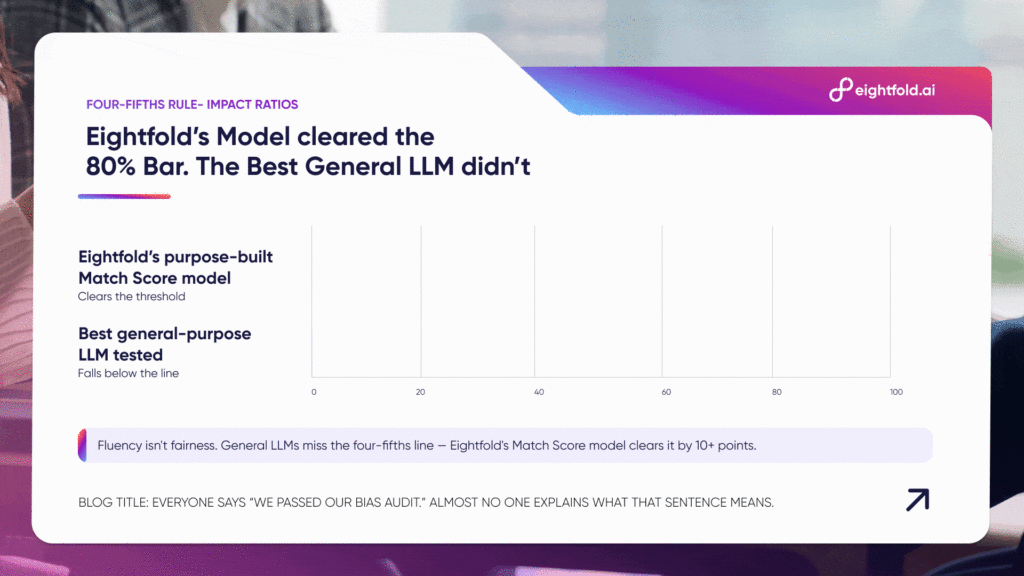
Internal research conducted by Eightfold, for instance, compared a general-purpose LLM against their purpose-built matching model. The best-performing general LLM achieved an intersectional impact ratio of 0.773, whereas Eightfold’s purpose-built model achieved a ratio of 0.906. This indicates that general models, lacking specific training on equitable hiring data, are more prone to structural biases that manifest consistently, rather than as occasional errors. It is imperative to differentiate between internal research findings and formal, third-party published bias audits when interpreting such figures.
A Passing Result: A Snapshot, Not a Permanent Certification
The outcome of an AI bias audit is not a one-time certification of fairness. AI models are dynamic systems. A model trained on data from last year, when applied to a candidate pool that has evolved since then, effectively becomes a different system in practice, even if the underlying code remains unchanged. This dynamic nature is why regulatory frameworks, such as New York City’s Local Law 144, mandate annual audits. A system’s fairness is time-sensitive. An audit without a scheduled re-test date is akin to a photograph – accurate for the moment it was captured but offering no insight into subsequent changes.
Accountability in the Wake of Audit Publication
Publishing audit results does not absolve individuals or organizations of responsibility; rather, it clarifies roles and accountability. A credible governance model explicitly defines these responsibilities:
- Independent Auditor: Owns the testing process and documented findings. They cannot have their fees contingent on favorable results.
- Talent and Product Leaders: Own the workflow context and the specific version of the AI system tested. They cannot influence or approve their own results.
- Legal and Compliance Teams: Own the review of disclosures and management of regulatory exposure. They cannot alter the underlying findings of the audit.
- Executives: Own the funding for remediation efforts and overall oversight. They, like auditors, cannot condition fees on favorable outcomes.
Ultimately, humans remain accountable for all significant hiring decisions. A favorable audit result serves as supporting evidence for human judgment, not a replacement for it.
The Unanswered Questions: Navigating Vendor Evaluations
Understanding the rigorous methodology of AI bias audits equips organizations to critically evaluate published reports. However, this knowledge does not automatically provide a roadmap for dealing with vendors who have not published audits or who offer evasive answers during the procurement process. Identifying questions that distinguish genuine responses from deflections, and recognizing red flags before signing a contract, requires a separate, specialized checklist specifically designed for vendor evaluation. This process of scrutinizing vendors and their claims is a critical next step in ensuring the responsible deployment of AI in hiring.