The traditional mandate for a Chief Learning Officer (CLO) has historically been defined by the successful rollout of structured curricula and the tracking of completion metrics. However, as artificial intelligence (AI) continues to permeate the corporate landscape, this linear model of "cascading" information from the top down is proving insufficient. A common scenario now facing global organizations involves a standardized rollout of AI "copilots" across various business units. On paper, the initiative appears successful: dashboards show high certification rates for managers and widespread access to the software. Yet, empirical evidence from 18-month post-implementation reviews often reveals a stark divide. While a minority of teams successfully integrate the technology to sharpen their workflows, the majority treat the tool as a mandatory but ignored digital artifact.
This disparity highlights a critical flaw in modern organizational learning: the focus on adoption over circulation. When knowledge remains siloed within high-performing teams, or when struggling employees hide their difficulties for fear of appearing obsolete, the organization fails to achieve the "speed of learning" necessary to match the "speed of technological evolution." To remain competitive, enterprises must transition from a rigid, unidirectional cascade of information to a multidirectional circulatory system built on psychological safety and human-centered design.
The Current State of Global AI Investment and the Human Gap
The urgency for this transition is underscored by massive shifts in capital allocation. According to recent data from Boston Consulting Group (BCG), organizations are on track to roughly double their AI investments as a share of total revenue. Furthermore, approximately 72 percent of CEOs have moved beyond delegation, now personally directing AI strategy within their firms. This shift indicates that AI capability is no longer viewed as a peripheral IT concern but as a core pillar of corporate survival.
Despite this financial commitment, the human element remains a significant bottleneck. Deloitte’s Global Human Capital Trends report indicates that while 70 percent of business leaders identify organizational nimbleness and speed as their primary competitive strategies through 2029, 59 percent of organizations still utilize a purely technology-focused approach to AI implementation. The data suggests this is a strategic error; organizations that fail to infuse technology rollouts with human-centered design are 1.6 times more likely to fall short of their expected returns on investment (ROI) compared to those that prioritize the human experience.
The gap is even more pronounced at the middle-management level. Research from Udemy’s 2026 Global Learning and Skills Trends Report reveals a disconnect between employee expectations and managerial readiness. While 88 percent of employees believe effective leadership is the linchpin of successful AI initiatives, only 48 percent believe their direct managers are actually "AI-ready." This "readiness gap" creates a culture of silence where managers, feeling the pressure to lead a transition they do not fully understand, are the least likely to admit their own confusion, thereby stifling the flow of information.
From Cascade to Circulation: A Structural Reimagining
The traditional architecture of corporate learning is built on the "cascade" model. In this system, knowledge is curated at the executive or L&D level and pushed downward through the hierarchy. Feedback, if it exists, is usually gathered via post-training surveys that arrive too late to influence the implementation process. This is what theorists describe as "single-loop learning"—a system that corrects errors based on existing rules but never questions the rules themselves.
In contrast, a "circulatory" model utilizes "double-loop learning." In this framework, the frontline employee is not merely a recipient of information but a primary source of it. Knowledge moves in all directions: upward from the teams discovering "hacks" or workarounds, and horizontally across peer groups. In a circulatory system, the organization treats the frontline as a sensing mechanism.
The shift from cascade to circulation requires a systems mindset that prioritizes relatedness and multidirectional feedback loops. For these loops to function, employees must believe two things: first, that their input will result in tangible change, and second, that admitting to a struggle or a "rogue" workflow will not lead to professional repercussions. Without these pillars of trust, the most sophisticated learning dashboard will only capture performative compliance rather than genuine skill acquisition.
The Role of Psychological Safety and Humanizing Leadership
Circulation is fueled by trust rather than tooling. When AI rollouts are treated strictly as technical deployments, they often trigger a "threat response" in the workforce. Employees may fear that admitting they do not understand a tool will make them appear dispensable. Conversely, those who find more efficient ways of working may keep their methods secret, fearing that their "workarounds" will be viewed as a violation of company policy.
A humanizing mindset in leadership addresses these fears by attending to people, purpose, and presence. This involves leaders modeling "not-knowing" in real-time. For instance, when a senior executive publicly admits to struggling with prompt engineering or fumbling a new AI-driven analytics tool, it sets a cultural norm that experimentation and failure are part of the learning process.

One effective method for fostering this environment is "rapid-cycle inquiry." This involves short, structured bursts of authentic listening—such as flash focus groups or brief workflow walk-throughs—that feed directly into decision-making. By asking questions like, "What are we assuming about this tool that we haven’t tested?" leaders can surface insights that would otherwise remain hidden. In one documented case, this simple question allowed a regional team to share a custom-built workaround that was eventually adopted across the entire organization, saving thousands of man-hours.
Equity in the Circulatory Model
A critical risk in the transition to a circular learning model is the potential for power re-concentration. If an organization does not intentionally design for equity, the only knowledge that "circulates" is that of the most visible and credentialed employees—those who already have a seat at the table.
Employees further from institutional decision-making, such as contract staff, night-shift workers, or those in remote regional offices, often possess unique insights into the practical application of AI tools. However, without a deliberate channel to harness this knowledge, their innovations fade away. A humanizing learning system must extend beyond traditional power structures, ensuring that psychological safety is built into the system at every level, regardless of an individual’s identity or rank.
AI as a Listening Partner and the Shift to Judgment-Based Curricula
Paradoxically, the same AI technology that creates the need for new learning models can also facilitate them. "Agentic AI"—systems capable of independent action and pattern recognition—can serve as a critical organ in an organization’s circulatory system. These tools can identify unconnected teams that are independently developing similar use cases for AI, flagging these trends for L&D leaders to investigate.
However, for AI to function as a "listening partner," it must be introduced with transparency. If employees feel that AI is being used to monitor their "behindness" or performance gaps, the tool becomes a surveillance mechanism, and the candor required for a circulatory system disappears.
As AI takes over the "how-to" of technical tasks—drafting financial models, writing code, or generating communications plans—the focus of human learning must shift. The new curriculum is not procedural; it is based on judgment. L&D must now teach employees when to trust an AI output, how to interrogate it for bias, and how to apply human ethics to machine-generated results. These "power skills"—reflexivity, critical thinking, and the ability to navigate ambiguity—are becoming the load-bearing pillars of the modern workforce.
Strategic Implementation: The Next Two Quarters
For organizations looking to move from a cascade to a circulatory model, the transition does not require a complete platform migration, but rather a series of deliberate design choices.
Phase 1: The Inquiry Ritual (Months 1–3)
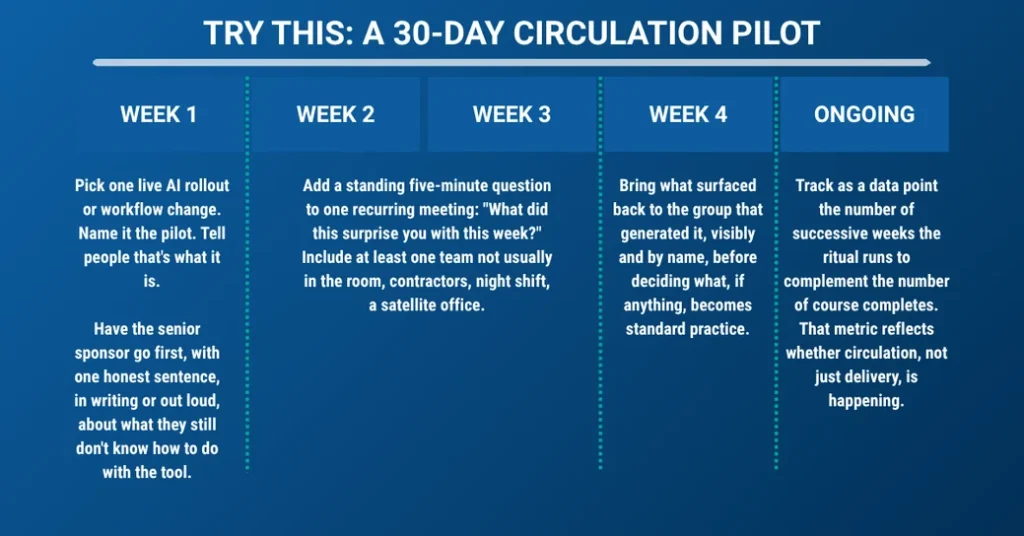
Leaders should select a near-term initiative and build a standing five-minute inquiry slot into every meeting. In these sessions, managers and frontline teams discuss their actual usage of AI tools. A senior leader must lead by example, naming their own uncertainties or failures with the technology before asking others to contribute. This "inquiry mindset" must be tracked as a core competency rather than a side project.
Phase 2: Widening the Sensing Mechanism (Months 3–6)
Organizations should purposefully expand their listening mechanisms to include voices typically excluded from strategy sessions. This includes frontline workers and contract staff. Simultaneously, a "trait-mapping" exercise should be conducted. Rather than screening employees against static job descriptions, leaders should map specific human strengths—such as future-focus, interpersonal sensitivity, and idea generation—against active projects. This allows teams to be reconfigured dynamically around the work, rather than the org chart.
Conclusion: The CLO as Learning Architect
In a period defined by rapid technological volatility, the role of the Chief Learning Officer has been fundamentally redefined. The CLO is no longer a mere owner of curriculum; they are an architect of organizational systems. The goal is to build a system that produces connection, resilience, and continuous learning as a natural byproduct of its operation.
Success in the AI era is not measured by how many employees have clicked through a training module, but by how quickly a new insight on the frontline can reach the executive suite and be redeployed across the enterprise. Organizations that master the art of circulation—where people feel safe to share what they know and what they do not—will possess the ultimate competitive advantage in an increasingly automated world. Building this habit of continual inspection and trust is not a one-time initiative; it is the new foundation of corporate infrastructure.