The Evolution of Situational Awareness: From Cockpits to Corporate Offices
The formal study of situational awareness traces its origins to the early 20th century, specifically within military aviation. During World War I, Oswald Boelcke, a German flying ace, recognized that pilots who were "aware" of their surroundings before an engagement were significantly more likely to survive. However, it was not until the 1980s that Dr. Mica Endsley, a former Chief Scientist of the United States Air Force, codified the theoretical framework that governs most modern training programs today.
Endsley’s model defines SA as "the perception of the elements in the environment within a volume of time and space, the comprehension of their meaning, and the projection of their status in the near future." This three-tier model—Perception, Comprehension, and Projection—serves as the backbone for contemporary workplace training.
In the late 1990s and early 2000s, high-reliability organizations (HROs), such as nuclear power plants and surgical teams, began adopting these principles to mitigate "human error," which remains the leading cause of industrial accidents. Today, the scope has widened further. With the rise of cybersecurity threats, workplace violence concerns, and the need for agile decision-making in retail and logistics, SA training is now viewed as a "universal soft skill" with hard-bottom-line impacts.
The Three Pillars of Cognitive Awareness
Effective organizational training programs are built upon the three distinct levels of cognitive processing identified in human factors engineering. Understanding these levels is essential for any leadership team looking to reduce risk and improve operational efficiency.
Level 1: Perception (Recognizing the Data)
The first stage involves the sensory perception of status, attributes, and dynamics of relevant elements in the environment. In a manufacturing setting, this might be the subtle change in the vibration of a conveyor belt. In a corporate office, it could be identifying a sophisticated phishing attempt or noticing a colleague’s uncharacteristic agitation. Training at this level focuses on "attentional control"—teaching employees what to look for and, equally importantly, what to ignore to avoid information overload.
Level 2: Comprehension (Synthesizing Information)
Comprehension goes beyond mere observation. It requires the employee to integrate various pieces of Level 1 data to understand how they impact current goals. A logistics manager might perceive a weather delay in one region and a labor shortage in another; comprehension allows them to realize that these two independent factors will result in a total supply chain bottleneck within 48 hours.
Level 3: Projection (Predicting Future States)
The highest level of situational awareness is the ability to forecast what will happen next. This proactive mindset allows for "pre-emptive intervention." When an employee can project that a current trend will lead to a safety violation or a missed deadline, they can take corrective action before the crisis manifests. This stage is where the highest return on investment (ROI) is found, as it prevents the "cascading failure" typical of major industrial disasters.
Quantifying the Impact: Data and ROI of Awareness Training
The drive toward situational awareness training is supported by a growing body of empirical evidence. According to data from the Occupational Safety and Health Administration (OSHA), human error contributes to nearly 80% of all workplace accidents. Organizations that implement comprehensive SA programs often report a significant decrease in "Lost Time Injuries" (LTI).
In a five-year longitudinal study of manufacturing firms, researchers found that teams trained in SA principles demonstrated a 25% improvement in hazard recognition compared to those who only received standard compliance training. Furthermore, the financial implications are staggering. The National Safety Council (NSC) estimates that the total cost of work injuries in the United States exceeded $160 billion in recent years. By reducing incident rates through better awareness, companies can see a direct reduction in insurance premiums and legal liabilities.
Beyond safety, the operational benefits are measurable. In the retail sector, situational awareness training has been linked to a 15% reduction in "shrinkage" (loss due to theft or administrative error) and improved customer satisfaction scores, as employees become more adept at anticipating customer needs and de-escalating conflicts.
Methodology: How Modern Organizations Build Awareness
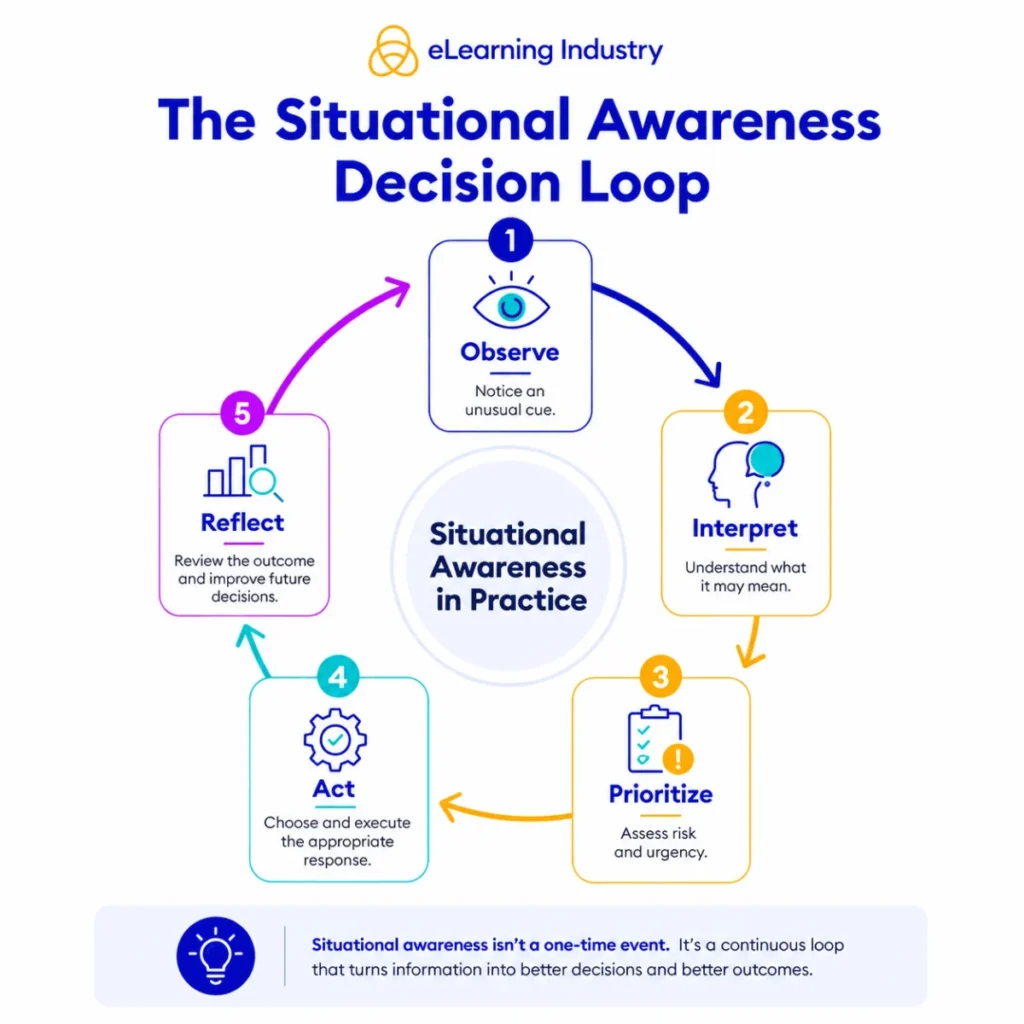
The transition from "telling people to pay attention" to "training people how to process information" requires a structured pedagogical approach. Modern training modules typically follow a five-step cycle: Observe, Interpret, Decide, Act, and Reflect.
1. Advanced Observation Techniques
Training often begins with "environmental scanning" exercises. Employees are taught to use their senses systematically. In high-risk environments, this may involve "The 5-4-3-2-1 Technique" or "Left-to-Right Scanning" to ensure no sector of the workspace is ignored. The goal is to move from passive seeing to active looking.
2. Contextual Interpretation
Organizations use "Tabletop Exercises" (TTX) and case studies to help employees interpret data. By analyzing past failures within their specific industry, workers learn the "precursors" to accidents. For instance, a nurse might review a case where subtle changes in a patient’s respiratory rate were ignored, leading to a code blue.
3. Rapid Decision-Making Frameworks
Under pressure, the human brain often defaults to "tunnel vision." SA training introduces frameworks like the OODA Loop (Observe, Orient, Decide, Act) to help employees maintain a broad perspective even during high-stress events. Training emphasizes "recognition-primed decision making," where employees learn to match current patterns against a mental library of "scripts" developed through simulation.
4. Safe Execution and Drills
The "Act" phase is reinforced through high-fidelity simulations. Many organizations are now utilizing Virtual Reality (VR) to place employees in dangerous or complex scenarios—such as a chemical spill or an active shooter event—without physical risk. This builds "muscle memory" and reduces the "startle response" that often paralyzes untrained individuals.
5. The Role of After-Action Reviews (AAR)
The final stage, reflection, is perhaps the most critical for long-term growth. The AAR process, popularized by the U.S. Army, involves a structured debrief where teams discuss: What was supposed to happen? What actually happened? Why was there a difference? What will we do differently next time? This creates a "learning loop" that continuously sharpens the organization’s collective awareness.
Industry-Specific Applications and Official Responses
The adoption of SA training has drawn praise from regulatory bodies and industry leaders.
- Healthcare: The Joint Commission, which accredits U.S. healthcare organizations, has frequently highlighted "communication and situational awareness" as a primary solution to preventing sentinel events. Hospitals are now implementing "Safety Huddles" at the start of every shift to ensure all staff members have a shared mental model of the day’s risks.
- Aviation and Aerospace: The Federal Aviation Administration (FAA) continues to mandate Crew Resource Management (CRM) training, which is rooted in SA. This has contributed to the current era being the safest in the history of commercial flight.
- Public Safety and Education: In response to the rise in school-related emergencies, many districts have adopted the ALICE (Alert, Lockdown, Inform, Counter, Evacuate) protocol. This shift from a passive "hide and hope" strategy to an active, awareness-based response has been cited by law enforcement as a key factor in saving lives.
Broader Implications: Resilience in an Uncertain Future
As we look toward the next decade, the importance of situational awareness will only intensify. The integration of Artificial Intelligence (AI) and the Internet of Things (IoT) into the workplace is creating a "hybrid" environment where humans must be aware of both physical and digital signals.
Analysts suggest that situational awareness will become a cornerstone of "Organizational Resilience." In a world where supply chains are fragile and geopolitical shifts can disrupt business overnight, the most successful companies will be those whose employees—from the front-line worker to the C-suite executive—are trained to spot the "weak signals" of change.
Ultimately, situational awareness training is an investment in human capital. It empowers individuals to take ownership of their environment, fostering a culture of proactive responsibility rather than reactive compliance. By building these cognitive skills, organizations are not just preventing accidents; they are building the adaptable, intelligent teams required to thrive in the complex landscape of the 21st century.