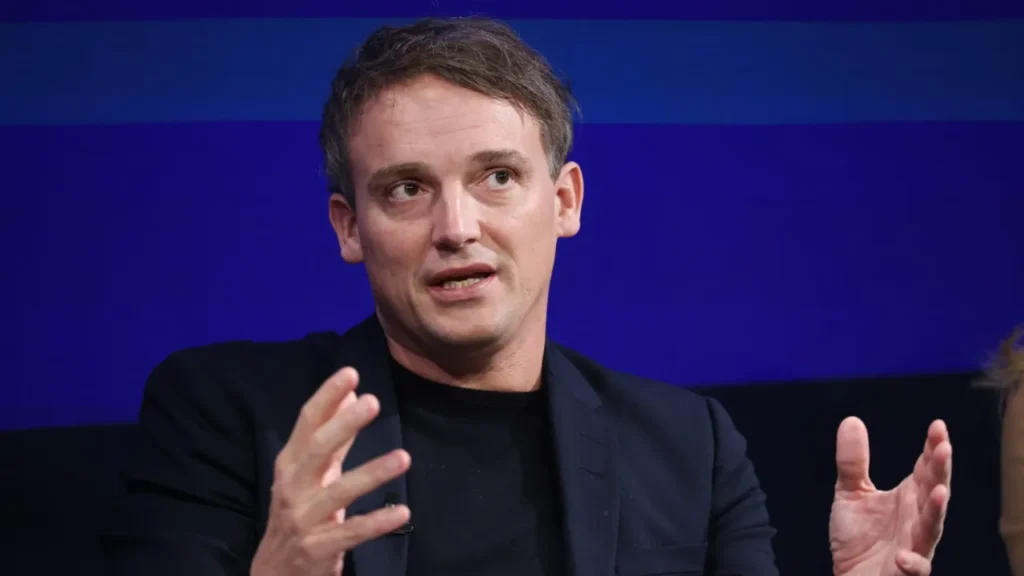
The journey from Henry Mill’s 1714 patent for a “machine transcribing letters” to the sophisticated AI-powered interfaces of today represents a profound evolution in human-computer interaction. Mill’s pioneering, albeit unproduced, invention laid the groundwork for the mechanical typewriter and, subsequently, the electronic keyboard that has dominated professional and personal communication for centuries. However, 312 years after Mill’s initial patent, Christian Klein, CEO of the global software giant SAP, is heralding a significant shift, declaring, “The end of the keyboard is near.” This bold prediction, rooted in the rapid advancements of artificial intelligence, particularly in natural language processing and voice recognition, signals a potential paradigm shift in how businesses operate and interact with their digital systems.
Klein’s assertion is not a speculative musing but a strategic observation from the forefront of enterprise technology. He elaborates on the burgeoning capabilities of AI, stating, “When you encounter voice recognition from many of these large language models, [it] is super strong. Now we have to do some work to translate voice into business language and business data.” This critical step—bridging the gap between conversational AI and actionable business intelligence—is where SAP and other technology leaders are focusing their efforts. The implication is that the act of manually inputting data, a staple of office work since the inception of computing, may soon become obsolete within enterprise systems.
The potential impact of AI on traditional data input methods, such as typing, is a topic that resonates far beyond the simple demise of the QWERTY layout. SAP’s projection that keyboard-based data entry will cease within their systems in the next two to three years is a significant indicator of this technological tide. This prediction has profound implications for efficiency, accessibility, and the very nature of work across a multitude of industries. As Klein puts it, “We are now giving our coworker tool more and more skills.”
The Voice-Enabled Enterprise: A New Era of Interaction
The vision Klein paints is one where employees can interact with complex business systems using natural language commands. “The future will be, for sure, that you are not typing any data information into an SAP system,” Klein explains. “You can instead ask certain analytical questions with your voice. You can trigger operational task workflows. You can also make entries in the system with your voice—performance feedback, pipeline entries, et cetera. The technological capabilities are there, it really is now about the execution.” This shift moves beyond mere dictation tools to a more integrated, intelligent interaction model.
The current phase of AI development, characterized by "applied AI," is moving rapidly from theoretical possibilities to tangible applications. Companies are investing heavily in AI solutions that generate significant revenue by providing services that were unimaginable even a decade ago. SAP, a company whose name stands for “Systemanalyse Programmentwicklung” (System Analysis Program Development), headquartered in Walldorf, Germany, and founded in 1972, is at the vanguard of this transformation. The firm, a major provider of cloud services to a global clientele ranging from the largest corporations to millions of small and medium-sized enterprises, is leveraging its deep understanding of business processes to integrate AI seamlessly.
Christian Klein, at 44, is the youngest CEO of a major company listed on Germany’s DAX index, bringing a forward-thinking perspective to enterprise technology. He identifies two primary categories of businesses in their AI adoption journey: those that are fundamentally transforming their operations through AI, and those that, despite significant investment, are seeing limited value. The latter often treat AI as a superficial efficiency hack for isolated functions, failing to achieve the widespread, systemic impact that true integration can provide. Klein emphasizes that a holistic approach is paramount, stating, “AI is superpowerful, but it needs to be applied in the right way.”
AI Integration: From Silos to Systemic Transformation
SAP’s experience with large enterprises underscores the importance of this integrated approach. Klein cites an example of a major consumer goods company that was struggling with traditional planning processes. The company’s efforts to align customer demand forecasting with financial planning and inventory control were laborious, often spanning months.

“They said, ‘Okay, this agent really is predicting the demand much more intelligently than all the human beings I had in planning,’” Klein recounts. “‘But it still always takes months until I adjust the inventory—and the inventory is dependent on procurement and the manufacturing side.’ So we are now building, with agents, an end-to-end planning scenario which helps them optimize inventory by 20%. This is real money.” This demonstrates how AI, when applied across multiple business functions, can unlock significant value and drive tangible financial gains, moving beyond individual departmental improvements to enterprise-wide optimization.
The successful integration of AI requires not only technological implementation but also a significant focus on workforce readiness. Klein advocates for comprehensive employee training, not just in the technical aspects of AI, but in how to leverage these new tools effectively. Imagine an employee tasked with analyzing vast amounts of financial data. Instead of manually sifting through millions of PowerPoint presentations, they can now instruct an AI model: “Hey, go into my PowerPoint presentations. Give an AI model a million financial analysis PowerPoints. We then need to make sure, with our AI, that the business data is understood and that we can do the analysis right away. The employee can then say, ‘Tell me, from the millions of documents we created in the financial department, what would be the right measures to tackle some of the challenges we see in the financial performance of the company?’”
The output of such an interaction, Klein envisions, would be a beautifully packaged report complete with graphs, commentaries, and recommended actions. This empowers employees to become strategic advisors, driving innovation and demonstrating new ways of steering the company. The employee’s response to a manager’s astonishment would be, “No, there is no training” – referring to traditional methods, implying the AI itself is the transformative agent, augmented by necessary foundational AI literacy.
Navigating Geopolitical Currents in the Age of Applied AI
The discussion of AI’s impact on the workplace is taking place against a backdrop of increasing geopolitical complexity. Klein’s remarks at the World Economic Forum in Davos highlighted the growing influence of geopolitical factors on global trade and business operations. The rise of protectionist sentiments, epitomized by phrases like "my country first," is creating a more fragmented global landscape.

“There are two superpowers in the world, and they’re using the power to have more influence. I don’t expect that this will change anytime soon,” Klein observed, referencing the shifting dynamics of global power. This geopolitical tension introduces new challenges for multinational corporations, particularly those engaged in international trade. Companies are increasingly seeking solutions that can adapt to varying national sovereignty requirements.
“Companies are saying, ‘Hey, Christian, it’s great your software helps [in] over 100 countries. But how do we do this in a world which is becoming more fragmented?’ There are lots of new sovereignty requirements,” Klein elaborated. “In this case, you need the cloud server to be located in the country. In another country, you need to protect the data in a different way. In another country, you need to cut it from the global network. That can be pretty expensive.”
This necessitates a flexible and resilient technological infrastructure. SAP’s strategy involves leveraging diverse cloud infrastructure, including hyperscalers in regions like the U.S., local providers within specific countries, and ensuring the ability to migrate platforms rapidly in response to geopolitical events such as sanctions or export controls. The concept of "kill switches" and geo-location autonomy are becoming critical considerations for business continuity and risk management.
Klein expressed concern that Europe, while a leader in regulation, may be lagging in fostering economic power and unity. He argued, “Europe is a superpower in regulation, but not in unity, because there is no banking union, there is no trade union, there is no digital union, and in a world like this, you need economic power. With economic power, you can influence certain things. You are listened to.” He urged European leaders to prioritize innovation and leverage existing strengths to build economic resilience.

The Broader Implications of Technological and Geopolitical Shifts
The trajectory from Henry Mill’s 18th-century mechanical concept to the AI-driven voice interfaces of the 21st century is a testament to human ingenuity and the relentless pursuit of efficiency. As the world grapples with a new geopolitical reality, characterized by fragmentation and a rise in nationalistic policies, businesses must demonstrate agility and foresight. The decisions made today regarding technological adoption and strategic positioning will shape their ability to navigate this complex landscape.
The evolution of computing interfaces, from the keyboard to voice-driven AI, mirrors the broader shifts in global economics and politics. The world that Henry Mill knew, prior to the formation of the United States, is vastly different from the interconnected yet increasingly fractured global stage of today. Understanding these macro trends is crucial for leaders to make informed decisions about their enterprise architecture, their operational strategies, and their role in the global economy.
The story of the keyboard’s potential end, as articulated by Christian Klein, is not just about a change in input devices. It’s a narrative about the profound impact of artificial intelligence on how we work, interact, and conduct business. It’s also a reflection of the broader geopolitical forces that are reshaping the global business environment. The ability to adapt, to innovate, and to integrate new technologies and strategies effectively will be the defining characteristic of successful enterprises in the coming years. The journey from Mill’s patent to the AI-powered enterprise is far from over, and its next chapter promises to be transformative.