The discourse surrounding Artificial Intelligence (AI) in hiring often crystallizes around a binary outcome: a candidate was either passed or not. However, this simplistic conclusion overlooks the intricate methodologies required to truly assess and mitigate bias within AI-driven recruitment systems. Audits, far from being mere pass/fail examinations, are rigorous processes designed to scrutinize specific systems, defined candidate populations, fixed timeframes, and meticulously chosen metrics. A favorable result, therefore, offers a conclusion about the tested parameters, not a sweeping generalization applicable to every role or future deployment. The foundational principles for such assessments have roots predating widespread AI adoption, with the 1978 Uniform Guidelines on Employee Selection Procedures introducing the "four-fifths rule," a cornerstone still informing how these audits are scored today.
Bias Isn’t Monolithic: Tailoring Tests to Specific Disparities
A critical insight into AI hiring bias is that not all disparities are created equal, and a comprehensive audit recognizes this complexity, refusing to treat them as interchangeable. Effective auditing requires differentiating between various forms of bias, as each necessitates a distinct investigative approach.
-
Historical or Representation Bias: This occurs when certain career paths or demographic groups are underrepresented in the training data used for AI models. Consequently, the AI may inadvertently learn to devalue candidates from these backgrounds, even if their qualifications are strong. The appropriate test for this type of bias involves comparing subgroup representation within the applicant pool against their ultimate outcomes in the hiring process. This helps identify if certain groups are consistently overlooked or filtered out at disproportionately higher rates.
-
Proxy Variable Bias: This form of bias arises when seemingly neutral data points inadvertently correlate with protected characteristics. For instance, ZIP codes, alma maters, or even gaps in employment history can act as proxies for race, gender, or socioeconomic status. An AI might penalize a candidate based on these proxies without explicitly considering the protected trait. Detecting proxy variable bias requires a multi-pronged approach, including dedicated proxy analysis and the use of counterfactual pairs to isolate the impact of these indirect indicators.
-
Aggregation Bias: This bias emerges when an overall positive or neutral outcome masks significant disparities at the subgroup level. An AI system might perform well on average across all candidates, but a deeper analysis could reveal that specific minority groups are experiencing substantially worse outcomes. The solution here lies in reporting disaggregated results, breaking down performance by demographic subgroups rather than relying on blended averages that can obscure critical inequities.
-
Interaction or Automation Bias: This bias is less about the AI’s internal workings and more about human interaction with it. It occurs when users over-rely on the AI’s output without critical evaluation, effectively automating potential biases embedded within the system. Auditing for this involves reviewing override rates – instances where human recruiters deviate from the AI’s recommendations – and examining advancement patterns to understand if AI suggestions are disproportionately influencing hiring decisions for certain groups.
Crucially, a test designed to detect one form of bias may not effectively identify another. This underscores why a single, headline performance metric rarely provides a complete picture of an AI’s fairness.
The Four-Fifths Rule: A Quantitative Benchmark for Adverse Impact
The four-fifths rule, a principle rooted in employment law, provides a clear arithmetic method for flagging potential adverse impact. The process involves calculating the "selection rate" – the proportion of candidates from a particular group who advance to the next stage of the hiring process. This rate is then compared to the selection rate of the group with the highest advancement rate. If any subgroup’s selection rate falls below 80% of the top-performing group’s rate, the disparity is flagged for further investigation.
For example, if 50% of male applicants proceed to the interview stage and only 30% of female applicants do, women’s selection rate is 60% of men’s (30/50 = 0.6). This 60% is well below the 80% threshold, triggering a closer examination. It is vital to understand that the four-fifths rule does not inherently explain why the gap exists; it merely quantifies the magnitude of the disparity, indicating that a gap of this size warrants scrutiny and cannot be dismissed without further inquiry. Companies like Eightfold.ai, for instance, conduct audits of their Matching Model that rigorously apply this comparative analysis across protected categories, making their full methodologies and underlying data accessible, thereby offering transparency beyond superficial figures.
Counterfactual Pairs: Isolating Algorithmic Influence
While the four-fifths rule identifies the existence of a disparity, it doesn’t definitively prove whether the AI algorithm is the cause or if the observed gap is a reflection of the applicant pool’s composition at a given time. To disentangle these factors, a second, distinct test employing "counterfactual pairs" is essential. This method involves taking a single candidate’s profile, creating an identical duplicate, and then altering only a single signal that is mapped to a protected characteristic – such as a name commonly associated with a specific gender or ethnicity – while keeping all other qualifications precisely the same. Both versions are then processed by the AI. If the evaluation or recommendation changes despite no alteration in the candidate’s actual skills or experience, it indicates the algorithm’s independent influence on the outcome, separate from the broader applicant pool demographics.
A comprehensive audit doesn’t perform this counterfactual analysis as an isolated check. Instead, it is conducted repeatedly across various roles, seniority levels, and demographic signals, with the aggregated results reported. This approach offers a more robust understanding of the algorithm’s behavior, moving beyond anecdotal evidence to a specific, repeatable procedure with quantifiable results. Audits that omit this crucial step effectively answer only half the question, leaving the algorithmic contribution to bias unexamined.

The Critical Role of Sample Size in Statistical Validity
The validity of any bias audit hinges significantly on sample size. Small numbers can structurally distort results, not due to intentional manipulation, but due to statistical volatility. For instance, if only six candidates from a particular demographic group apply for a role, the outcome for just one of those candidates can dramatically alter the group’s overall advancement rate by a substantial margin, creating a seemingly significant figure that lacks statistical meaning due to the insufficient data points.
A rigorous audit establishes minimum sample thresholds. Below these thresholds, it will decline to publish a selection rate for that specific group. While this might appear evasive to those unfamiliar with the statistical underpinnings, it is a practice rooted in honesty and precision. Publishing a statistically weak number based on minimal data is less truthful than withholding it. A confident-looking statistic derived from only six data points is not more accurate; it is less honest, cloaked in false precision. The more disciplined approach involves reporting numbers only when the sample size can reliably support the claim and clearly stating when it cannot.
Independent Audits: Substance Over Superficiality
The term "independently audited" is frequently used, sometimes loosely, making a precise definition crucial. True independence in an audit requires adherence to three core conditions:
- Financial Independence: The auditor must not be compensated based on the favorability of the audit’s outcome. This prevents conflicts of interest where an auditor might be incentivized to produce positive results.
- Methodological Autonomy: The auditor should design its own testing methodology, rather than adhering to a predetermined script provided by the vendor whose system is being audited. This ensures an objective and thorough examination.
- Auditor Certification: The auditing firm itself should be certified by an independent body that reviews auditors and their processes, not merely their final reports. This third condition is often overlooked but is vital for verifying the auditor’s competence and adherence to professional standards. Without knowing who performed the audit and their credentials, the claim of independence can be difficult to substantiate.
Furthermore, it is critical to recognize that different AI tools perform distinct functions. For example, a model designed to rank resumes operates differently from a system conducting live interviews. Testing one and then claiming the results are applicable to the other represents a significant shortcut that a genuine audit process would avoid. Each functionally distinct tool necessitates its own tailored audit.
From Claims to Evidence: The Seven Pillars of Reproducible Audits
Transforming a fairness claim into verifiable evidence requires a traceable record for every conclusion drawn. This involves a systematic approach, often encompassing seven key steps:
- Defining the Scope: Clearly articulating the specific AI system, the candidate population, the timeframe, and the precise metrics being evaluated.
- Establishing the Baseline: Documenting the existing state of hiring outcomes without the AI system, providing a point of comparison.
- Developing the Testing Methodology: Outlining the precise statistical tests, bias detection techniques (like the four-fifths rule and counterfactual analysis), and data analysis procedures.
- Executing the Tests: Applying the defined methodology to the collected data.
- Analyzing the Results: Interpreting the outcomes of the tests, identifying any statistically significant disparities.
- Reporting Findings: Presenting the results in a clear, comprehensive report, including raw data, methodologies, and any identified limitations.
- Remediation and Recalibration: Based on the findings, implementing adjustments to the AI system or hiring processes to address identified biases.
A descriptive account of how a system is designed to function is not a substitute for empirical testing of actual outcomes. Similarly, a results table lacking a transparent methodology is merely an assertion of fairness, not evidence supporting it.
Purpose-Built Models Versus General LLMs: Distinct Performance Profiles
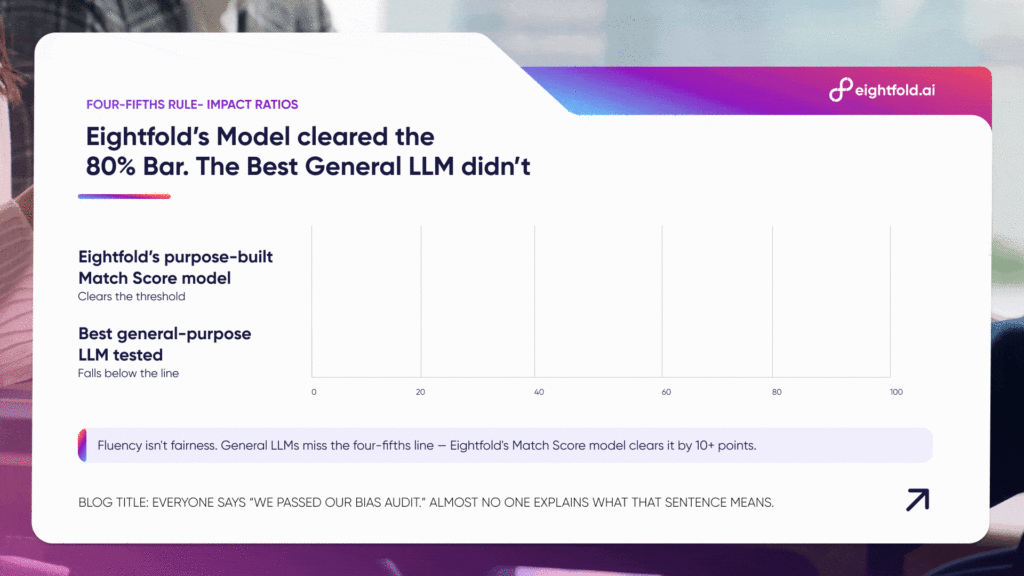
When evaluating AI bias, it’s crucial to differentiate between purpose-built hiring models and general-purpose Large Language Models (LLMs). These are not interchangeable in their performance regarding fairness. Internal research by Eightfold.ai, for instance, has shown a notable difference: their purpose-built matching model achieved an intersectional impact ratio of 0.906, while the best-performing general-purpose LLM tested reached only 0.773. This suggests that LLMs, often trained for fluency and broad language comprehension rather than specific hiring outcomes, tend to exhibit structural under-scoring biases, not just occasional ones. It is important to distinguish between internal research findings and independently published third-party audits when citing such figures.
A Passing Result: A Snapshot in Time, Not a Permanent Certification
The outcome of an AI bias audit is a snapshot, not a permanent certification of fairness. An AI model trained on historical data from one year may operate differently in practice when applied to a candidate pool that has evolved significantly since. Even if the underlying code remains unchanged, the real-world performance can shift. This dynamic is why regulatory frameworks, such as New York City’s Local Law 144, mandate annual re-audits rather than a one-time assessment at launch. An audit report lacking a defined re-test date offers a picture of the system at a specific moment, but provides no assurance of its ongoing fairness.
Accountability in the Audit Ecosystem: Defining Roles and Responsibilities
Publishing audit results does not equate to an equal distribution of responsibility. A robust governance model clearly delineates accountability among various stakeholders:
- Independent Auditor: Owns the testing process and the documented findings. They are prohibited from accepting fees contingent on favorable outcomes.
- Talent and Product Leaders: Are responsible for providing the context of the workflow and the specific version of the AI system being tested. They cannot influence or approve the audit results themselves.
- Legal and Compliance Teams: Oversee disclosure reviews and manage regulatory exposure. They are barred from altering the underlying findings of the audit.
- Executives: Fund remediation efforts and provide oversight. Like auditors, they cannot condition fees on favorable audit outcomes.
Ultimately, human decision-makers remain accountable for all material hiring choices, irrespective of AI system performance. A favorable audit result serves as evidence supporting sound judgment, not a replacement for it.
Unanswered Questions: Navigating Vendor Evaluations and Red Flags
Understanding the rigorous methodology of AI bias audits empowers organizations to critically evaluate published reports. However, it doesn’t inherently equip them to handle vendors who have not published such audits. Identifying which questions can differentiate genuine answers from evasive responses, and recognizing red flags before signing a contract, requires a separate, practical checklist for vendor evaluation. This process, distinct from the technical audit methodology itself, is crucial for ensuring responsible AI adoption. The evolving landscape of AI in hiring demands a continuous commitment to transparency, rigorous testing, and clear accountability to foster equitable and effective recruitment practices.