In an increasingly competitive global talent market, organizations are facing a critical challenge: the rising prevalence of offer reneges, where a candidate accepts a job offer only to withdraw before their official start date. This phenomenon, which can incur significant financial and operational costs, is often discovered too late, leaving recruitment teams scrambling to backfill critical roles. However, a transformative shift is underway in talent acquisition, spearheaded by the adoption of proactive engagement strategies, most notably the "Engagement Health Scorecard." This innovative framework empowers companies to identify and intervene with at-risk candidates long before a renege becomes a reality, transforming the recruitment landscape from a reactive scramble to a strategic, data-driven retention effort.
The Pervasive Challenge of Offer Renege in Modern Recruitment
The term "offer renege" describes the withdrawal of a candidate from an accepted job offer. While not a new phenomenon, its frequency has seen a marked increase in recent years, fueled by a dynamic labor market, heightened candidate leverage, and the proliferation of competing opportunities. Industry data suggests that renege rates can fluctuate significantly by sector and seniority, with some estimates placing the average at 15-20% across industries, and considerably higher in highly competitive fields such as technology, healthcare, and specialized engineering, where rates can climb to 30% or more. This issue extends beyond mere inconvenience, carrying substantial implications for businesses.
The direct costs associated with a renege are staggering. These include the expenses incurred during the initial recruitment cycle—advertising, sourcing, screening, interviewing, and background checks—which are rendered moot. Beyond these direct outlays, organizations face the cost of restarting the recruitment process, often requiring additional time and resources to find a suitable replacement. Furthermore, a renege can delay critical project timelines, increase the workload on existing team members, and negatively impact team morale. The lost productivity from an unfilled role, coupled with the extended time-to-fill, can translate into hundreds of thousands of dollars for senior or specialized positions. Indirectly, a poor candidate experience leading to a renege can also damage an employer’s brand reputation, potentially deterring future top talent. The root causes of reneges are multifaceted, ranging from candidates receiving a more attractive competing offer, unforeseen personal circumstances, a perceived lack of engagement from the hiring company during the pre-start period, or simply a growing sense of uncertainty about the role or organization. Traditionally, organizations have been ill-equipped to address these issues proactively, often only becoming aware of a candidate’s wavering commitment once they have gone quiet or, worse, formally rescinded their acceptance.
The Evolution of Candidate Engagement: From Reactive to Proactive
For too long, the period between offer acceptance and the first day of employment has been a critical, yet often neglected, vulnerability in the talent acquisition process. Many programs have operated without a defined process for candidate engagement during this crucial phase, treating it largely as an administrative handover rather than a strategic opportunity. Consequently, teams would discover a renege only after it had already occurred, by which point the candidate had often already made up their mind and disengaged. This reactive posture leads to a perpetual cycle of backfilling, which is both inefficient and demoralizing for recruitment teams.
The paradigm shift now advocating for treating engagement signals as leading indicators represents a fundamental reorientation of this approach. It recognizes that candidate behavior during the pre-start period is a rich source of data, offering early warnings of potential disengagement. By actively monitoring and interpreting these signals, organizations can transition from merely reacting to problems to proactively identifying and mitigating risks. This strategic pivot transforms the pre-start phase into an active engagement period, designed to nurture the candidate’s commitment, address their concerns, and reinforce their decision to join the company. The focus shifts from merely processing paperwork to building a relationship and ensuring a smooth transition into the organization, significantly enhancing the overall candidate experience and protecting the investment made in securing top talent.
The Engagement Health Scorecard: A Detailed Framework for Retention
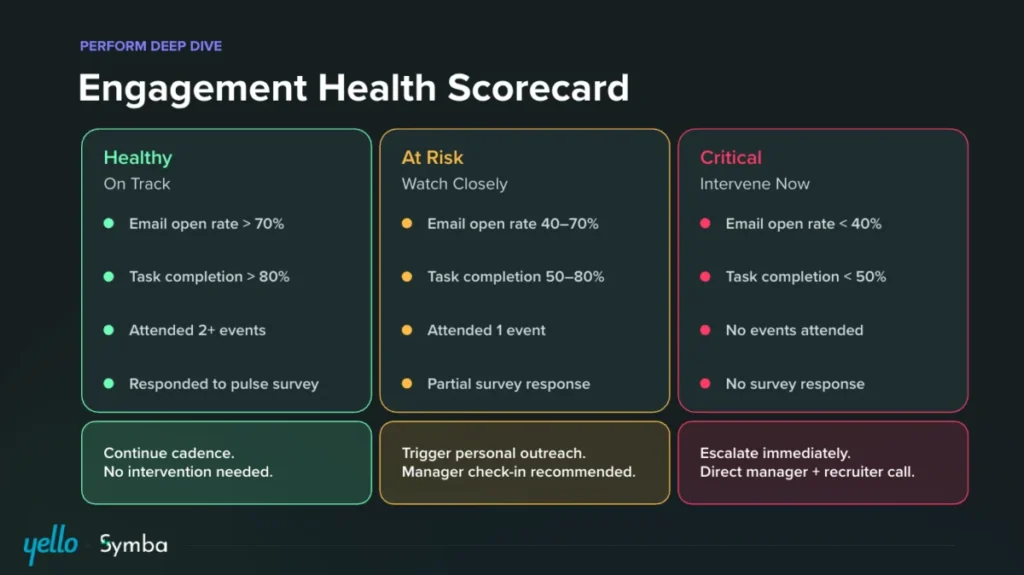
The Engagement Health Scorecard stands as a robust methodological framework designed to systematically categorize candidates based on their behavior during the critical pre-start period. This proactive system moves beyond intuition, providing clear, data-driven indicators that inform targeted interventions. By assigning candidates to one of three distinct groups—Healthy, At-Risk, or Critical—based on defined thresholds of engagement, organizations can tailor their outreach and support efforts precisely, maximizing the chances of retaining their talent.
Healthy Candidates: Nurturing Continued Commitment
Behavioral Profile: Candidates classified as "Healthy" exhibit strong and consistent engagement signals. This typically includes an email open rate above 70%, indicating active consumption of company communications. They diligently complete pre-onboarding tasks, such as filling out HR forms, submitting necessary documentation, and accessing orientation materials. Furthermore, healthy candidates actively participate in company-sponsored pre-start events, such as virtual meet-and-greets, informational webinars, or community-building sessions, attending multiple occurrences. Their responsiveness extends to surveys, providing timely and complete feedback when prompted. This pattern of behavior signals strong interest, enthusiasm, and a clear intent to join the organization.
Recommended Action: For healthy candidates, the prescribed action is to "continue the cadence and stay the course." This means maintaining the established schedule of personalized communications, providing valuable content, and ensuring they have access to all necessary resources without overwhelming them. The goal is to reinforce their positive decision, sustain their excitement, and ensure they feel continuously valued and informed. This might involve sharing company news, team updates, or further details about their role and the culture, ensuring a steady stream of positive reinforcement that solidifies their commitment.
At-Risk Candidates: Timely Intervention for Re-engagement
Behavioral Profile: "At-Risk" candidates display clear signs of declining engagement, signaling potential uncertainty or disinterest. Their email open rates fall into a concerning range, typically between 40% and 70%, indicating that they are not consistently absorbing vital information. Participation in pre-start events becomes limited or sporadic, suggesting a wavering commitment to connecting with their future team or understanding the company culture. Moreover, their responses to surveys might be incomplete, delayed, or entirely absent, reflecting a disengagement from feedback mechanisms. These indicators, while not yet critical, serve as a strong warning that the candidate’s commitment may be faltering and requires immediate attention.
Recommended Action: The urgency for At-Risk candidates is paramount, necessitating "personal outreach within 48 hours." This intervention must be tailored and empathetic, moving beyond automated messages. A direct, personalized message from the program manager, for instance, can provide a human touch and open a channel for honest communication. Invitations to upcoming events should be individualized, highlighting specific benefits or relevance to the candidate, rather than appearing as a mass distribution. Crucially, a check-in from the hiring manager can often be the most effective strategy. This direct engagement allows for a genuine conversation, enabling the hiring manager to address any nascent concerns, clarify uncertainties, or simply reiterate the value of the candidate’s contribution to the team. Such timely, personal outreach can often "turn things around quickly," converting a potentially lost candidate into a re-engaged and committed future employee.
Critical Candidates: Immediate Escalation and Direct Dialogue
Behavioral Profile: "Critical" candidates demonstrate almost no engagement whatsoever, indicating a high probability of an impending renege. Their email open rates plummet below 40%, signaling a profound lack of interest in company communications. There is no record of event attendance, suggesting a complete detachment from pre-start activities and team-building efforts. Survey responses are non-existent, and there may be a prolonged period of inactivity—three or more weeks—across all engagement channels. This pervasive disengagement points to a candidate who has likely already made a decision to withdraw or is on the verge of doing so, necessitating a rapid and decisive response.
Recommended Action: For critical candidates, the situation demands "immediate escalation." The intervention must be direct, senior-level, and focused on understanding the core issue. A direct call from the hiring manager is essential, providing an opportunity for a candid, face-to-face (or voice-to-voice) conversation about "what’s going on." This should be complemented by a personal touchpoint from the recruiter, who can offer support and act as a liaison. The objective is not to persuade but to genuinely understand the candidate’s perspective. Often, the root cause of such disengagement is a competing offer that has materialized, a significant personal circumstance that has arisen, or simply a deep-seated uncertainty about the role, the company, or their career path. Catching these issues in time, even at this late stage, can still allow the organization to address concerns, negotiate terms, or provide necessary support, potentially averting a complete loss. The emphasis is on a "real conversation" that prioritizes understanding and problem-solving.
Timeline and Implementation: A Phased Approach to Proactive Retention
Implementing an Engagement Health Scorecard is a strategic initiative that typically unfolds in a phased manner, ensuring a systematic and effective integration into existing talent acquisition workflows. The timeline for the pre-start period itself can vary significantly, ranging from as little as two weeks for immediate hires to several months for roles requiring extensive background checks or security clearances, or for graduate recruitment programs.
Phase 1: Data Collection and Baseline Establishment. The initial step involves identifying all relevant engagement metrics—email open rates, task completion, event attendance, survey response rates, and communication frequency. Organizations must then establish the technological infrastructure to track these data points consistently across all candidates in the pre-start phase. This often requires integration with existing Applicant Tracking Systems (ATS), Customer Relationship Management (CRM) tools, or specialized candidate experience platforms. A baseline of current renege rates and engagement patterns is also established to measure future improvements.
Phase 2: Scorecard Development and Threshold Definition. With data flowing, the next phase is to define the specific thresholds for "Healthy," "At-Risk," and "Critical" categories. These thresholds should be customized to the organization’s unique context, considering industry norms, the typical length of their pre-start period, and historical candidate behavior. For instance, a 40% email open rate might be critical for a tech company with highly engaged candidates but merely at-risk for another industry. This phase also involves designing the automated alerts and reporting mechanisms that will flag candidates moving into the "At-Risk" or "Critical" categories.
Phase 3: Training and Rollout. Successful implementation hinges on comprehensive training for all stakeholders: recruiters, hiring managers, and program managers. They must understand the scorecard’s methodology, their respective roles in monitoring and intervention, and the importance of timely, personalized outreach. Role-playing scenarios can be particularly effective in preparing teams for difficult conversations with critical candidates. The scorecard is then rolled out, initially perhaps as a pilot program before full-scale deployment.
Phase 4: Continuous Monitoring and Iteration. The Engagement Health Scorecard is not a static tool. It requires continuous monitoring of its effectiveness, regular review of engagement data, and iterative adjustments to thresholds and intervention strategies. Feedback from recruiters and hiring managers on the ground is invaluable for refining the system, ensuring it remains relevant and impactful in a constantly evolving talent landscape. This iterative process ensures the scorecard adapts to new market dynamics and candidate behaviors.
Supporting Data and Industry Insights: The Tangible Benefits
The efficacy of proactive engagement strategies is underscored by compelling data and industry observations. The financial impact of a renege, as previously noted, is substantial. Research from various HR analytics firms consistently estimates that the cost of replacing a single employee can range from 1.5 to 3 times their annual salary, encompassing recruitment, onboarding, and productivity loss. For a mid-level professional earning $70,000, a renege could cost an organization between $105,000 and $210,000. By averting even a handful of reneges, the investment in an engagement health scorecard quickly demonstrates a significant return on investment (ROI).
Companies that have successfully implemented such data-driven engagement systems report notable improvements. Leading organizations have observed a reduction in renege rates by as much as 15-25% within the first year of adopting a comprehensive engagement strategy. Beyond mere prevention, engaged candidates are also found to have a smoother onboarding experience, achieving full productivity faster and exhibiting higher long-term retention rates post-hire. This translates directly into enhanced operational efficiency and reduced turnover costs across the employee lifecycle. The "Great Resignation" and subsequent shifts in the global labor market have amplified candidate power, making robust pre-start engagement not just beneficial but essential for competitive advantage. The proactive monitoring facilitated by an engagement health scorecard transforms recruitment from a reactive cost center into a strategic function that safeguards talent investment and builds a more stable workforce.
Statements and Reactions from Key Stakeholders
The adoption of sophisticated candidate engagement frameworks like the Engagement Health Scorecard has garnered positive reactions across the organizational spectrum, reflecting a growing consensus on its strategic importance.
Maria Rodriguez, VP of Talent Acquisition at InnovateTech Solutions, commented: "For years, we were stuck in a reactive loop, always scrambling to backfill roles after a renege hit. The Engagement Health Scorecard has been a game-changer. We now have visibility into candidate sentiment before issues escalate, allowing our teams to intervene strategically. It’s transformed our approach from panic to proactive partnership, significantly strengthening our talent pipeline and reducing wasted resources."
David Chen, a Senior Hiring Manager at Global Dynamics Inc., emphasized the impact on his team: "As a hiring manager, my biggest fear was losing a top candidate right before they started. The scorecard empowers me with actionable insights. A quick, personal call to an ‘At-Risk’ candidate, often just to address a small concern or reiterate our excitement, has saved us weeks of rework and ensured we get the talent we desperately need. It makes me feel more connected to the process and to my future team members."
Sarah Kim, Program Manager for New Talent Initiatives at Apex Corporation, highlighted the shift in candidate experience: "Our focus has fundamentally shifted from merely processing onboarding documents to creating a truly engaging and supportive pre-start experience. It’s about making candidates feel valued, connected, and truly part of the team even before day one. The scorecard provides the framework for this, ensuring no candidate falls through the cracks and everyone feels ready and excited to start."
Dr. Eleanor Vance, a prominent HR Technology Analyst, offered a broader perspective: "This approach isn’t merely about preventing reneges; it’s about fundamentally elevating the employer brand and optimizing the entire talent acquisition lifecycle. In today’s hyper-competitive talent market, candidate experience is the new currency. Companies leveraging data-driven engagement scorecards are not just retaining hires; they are building a reputation as employers who genuinely care and invest in their people from the very first interaction. This provides a clear competitive advantage in attracting and retaining the best talent."
Broader Impact and Implications for the Future of Recruitment
The widespread adoption of the Engagement Health Scorecard and similar proactive strategies carries profound implications for the future of recruitment and organizational success.
Enhanced Employer Brand and Candidate Experience: By demonstrating a proactive commitment to candidate well-being and engagement, companies significantly bolster their employer brand. A positive pre-start experience transforms candidates into advocates, leading to valuable referrals and a stronger reputation in the talent market. This shift cultivates an environment where candidates feel genuinely valued and supported, rather than just another hire.
Improved Onboarding Success and Long-Term Retention: Candidates who feel engaged and connected during the pre-start period are more likely to have a smoother, more successful onboarding experience. This early positive momentum translates into higher job satisfaction, faster assimilation into the company culture, quicker achievement of productivity milestones, and ultimately, greater long-term retention. The investment in pre-start engagement pays dividends far beyond just preventing a renege.
Data-Driven Recruitment as a Strategic Imperative: The Engagement Health Scorecard champions a shift towards truly data-driven recruitment. By leveraging analytics to predict and address candidate disengagement, recruitment moves from an intuitive art to a precise science. This analytical approach informs not only individual candidate interventions but also broader recruitment strategies, identifying systemic issues and optimizing the entire hiring funnel.
Competitive Advantage in the War for Talent: In an era defined by talent scarcity and high mobility, organizations that master proactive candidate engagement gain a distinct competitive edge. They are better positioned to secure top talent, reduce recruitment costs, and maintain workforce stability, allowing them to focus resources on growth and innovation rather than constant backfilling.
Fostering a Culture of Care and Proactive Problem-Solving: Implementing such a system instills a culture of care and proactive problem-solving within HR and hiring teams. It encourages collaboration between recruiters, hiring managers, and program managers, fostering a shared responsibility for candidate success and well-being. This collaborative spirit enhances overall organizational effectiveness.
Future Trends: AI and Predictive Analytics: The principles underlying the Engagement Health Scorecard are ripe for further evolution with advancements in AI and machine learning. Future iterations will likely see increasingly sophisticated algorithms analyzing vast datasets of candidate behavior to predict renege risks with even greater accuracy, automate personalized communication streams, and recommend highly specific interventions. This will further refine the ability to anticipate and mitigate risks before they fully materialize. Resources such as "The KEEP Playbook," which includes the full engagement health scorecard with detailed thresholds, recommended actions for each tier, a step-by-step intervention playbook, and a post-cycle review template, provide invaluable guidance for organizations looking to institutionalize these practices and continuously improve their talent retention strategies with every program cycle.
In conclusion, the era of reactive recruitment is drawing to a close. Proactive, data-driven candidate engagement, epitomized by the Engagement Health Scorecard, is no longer merely a best practice but an essential strategic imperative. By continuously monitoring engagement signals and implementing timely, personalized interventions, organizations can move beyond the costly scramble to backfill, securing their talent pipeline, enhancing their employer brand, and building a more resilient and engaged workforce ready to drive future success.