The Challenge of Contextual Scaling
The fundamental difficulty in scaling personalization lies in the preservation of context. In a controlled demo environment, a system operates with clean data, a defined learner group, and a linear progression path. In a production environment, these conditions are rarely met. As a platform grows, learner profiles diversify, content arrives from multiple third-party providers, and data flows from systems—such as Human Resource Information Systems (HRIS) or Customer Relationship Management (CRM) tools—that were never originally designed for pedagogical integration.
L&D professionals often equate "scale" with the volume of users or seats. Yet, in the realm of personalization, scale introduces a secondary type of complexity: variation. When the number of resources grows from dozens to thousands, the metadata required to distinguish between them must become significantly more sophisticated. Simultaneously, as the learner base expands, the system must account for a wider array of roles, prior knowledge levels, and shifting career goals.
The Cognitive Science of Adaptivity
A critical component of successful personalization at scale is the recognition that identical learner signals do not always warrant identical recommendations. This phenomenon is supported by the "Expertise Reversal Effect," a cornerstone of instructional design. A 2025 meta-analysis published in Learning and Instruction, which reviewed 60 experimental studies involving nearly 6,000 participants, confirmed that instructional interventions must change as learner expertise grows.
The study found that learners with low prior knowledge benefit significantly from high levels of instructional guidance and "scaffolding." Conversely, as a learner gains expertise, that same level of guidance can actually hinder progress, a situation where "more" instruction becomes a cognitive burden. For a scalable system, this means a score of 80% on a module carries different weight depending on the learner’s history. A senior engineer scoring 80% on a foundational testing module may need to be fast-tracked to advanced architecture, while a junior developer with the same score may need additional reinforcement to solidify their understanding.
To address this, modern systems are moving away from raw percentage scores toward Item Response Theory (IRT). IRT provides a more nuanced signal by estimating a learner’s ability based on the difficulty and discrimination of specific questions rather than just the number of correct answers. This allows the personalization engine to understand not just that a learner passed, but the depth of their mastery.
Architectural Foundations: Content and Learner Representation
For a personalization engine to function at scale, it must possess a deep "understanding" of both the content it serves and the individuals it assists. This requires a robust data architecture centered on two pillars: semantic content representation and dynamic learner profiling.
1. Semantic Content Representation
Traditional keyword-based tagging is insufficient for large-scale catalogs. Instead, organizations are increasingly utilizing vector embeddings—mathematical representations of content that allow systems to identify "semantic similarity." This ensures that a module titled "Conflict Resolution" can be logically linked to a resource on "Difficult Conversations," even if they share no common keywords. Metadata must capture not just the topic, but the skill level, learning objective, prerequisite requirements, and resource type (e.g., video, simulation, or text).
2. Dynamic Learner Profiling
Learner profiles must be more than static snapshots of job titles. A scalable system requires "behavioral evidence" gathered from recent activity, assessment results, and explicit goal-setting. This helps solve the "Cold Start" problem—the challenge of making recommendations for a new user with no history or for a new piece of content with no engagement data. By using content-based signals (matching a new user’s role to existing skill tags) and collaborative filtering (identifying what similar users found helpful), the system can provide immediate value while it waits for more data to accumulate.
Data Interoperability and Industry Standards
The technical execution of personalization relies heavily on the "freshness" and flow of data across systems. According to Scheer IMC’s State of Learning Technologies 2026 report, which surveyed 420 L&D decision-makers from large organizations, 53% of leaders identified the integration of AI and new technologies as their primary hurdle.

To combat this, the industry is gravitating toward standardized protocols to reduce the need for expensive, custom-built API connections. Key standards include:
- OneRoster: Facilitates the secure exchange of roster and class information.
- LTI (Learning Tools Interoperability): Allows for the seamless integration of externally hosted learning tools into a central platform.
- Edu-API: A modern standard designed to enable real-time data exchange across the educational ecosystem.
The timing of this data exchange is critical. While a weekly update may suffice for compliance training, an adaptive practice system requires real-time or near-real-time data to adjust its recommendations during a single learning session.
The Monitoring Crisis: Data and Concept Drift
Once a personalized system is deployed at scale, it enters a phase of constant evolution. Personalization is not a "set it and forget it" technology; it requires ongoing monitoring to ensure recommendations remain relevant. Two primary risks emerge in production:
- Data Drift: This occurs when the nature of the incoming data changes—for example, if a company shifts from hiring generalists to hiring specialists, the types of learner signals the system receives will change.
- Concept Drift: This happens when the relationship between the input data and the "correct" recommendation changes. An AI module that was a "highly recommended" resource in 2023 may become obsolete or even misleading by 2025 due to technological shifts.
Success in this area requires the tracking of specific metrics beyond simple completion rates. Precision (how often the learner accepts a recommendation), downstream performance (how recommendations correlate with skill gains), and instructor overrides (how often a human expert feels the need to correct the AI) are vital indicators of system health.
Defining Success: Accuracy vs. Utility
A significant point of contention in the development of these systems is the definition of a "good" recommendation. A 2025 study by researchers Sohum M. Bhatt, Katrien Verbert, and Wim Van Den Noortgate highlighted that "accuracy"—the mathematical alignment of a resource to a profile—is often less important to educators than "practical utility."
In an enterprise setting, an organization must decide what it is optimizing for. If the goal is engagement, the system will recommend content that is popular or easy to consume. If the goal is "time to proficiency," the system may recommend more challenging, high-friction content that leads to faster skill acquisition. Other optimization goals include:
- Retention: Maximizing the likelihood that a learner stays on the platform.
- Coverage: Ensuring that all critical skills within a framework are addressed.
- Efficiency: Finding the shortest path to a certification or credential.
The Path to Implementation: Strategic Questions
The shift toward scalable personalization represents a fundamental change in how L&D operates, moving the department from "content curators" to "data architects." Before committing to a large-scale rollout, industry experts suggest that organizations must answer five foundational questions:
- Content Readiness: Is the catalog structured with consistent metadata and taxonomies?
- Learner Context: Does the system have access to enough information (roles, goals, prior knowledge) to make a non-generic decision?
- Data Integration: Are the connections between the LMS, HRIS, and assessment tools reliable and timely?
- Evaluation Framework: What specific metric (engagement, mastery, speed) is the system being optimized for?
- Ownership: Who is responsible for monitoring the system for drift and adjusting the logic when recommendations fail?
Implications for the Future of Talent Development
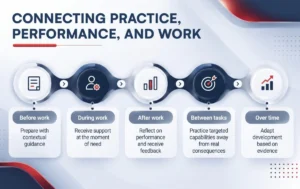
The move toward personalized learning at scale is not merely a technical upgrade; it is a response to the "skills gap" crisis facing modern industries. As the lifespan of technical skills continues to shrink, the ability to rapidly and accurately upskill a workforce becomes a competitive necessity.
The architecture of these systems—relying on AI-driven recommendation engines, semantic search, and real-time data standards—points toward a future where "learning" is no longer a discrete event but a continuous, background process integrated into the workflow. However, the success of this vision depends entirely on the strength of the underlying data layer. As systems grow, the "intelligence" of the personalization is only as effective as the architecture that keeps learner signals connected, current, and contextually relevant. For organizations building these systems today, the focus must shift from the "logic of the recommendation" to the "integrity of the ecosystem."