In an era where consumer choices are more abundant than ever, the quality of customer interaction has transitioned from a back-office support function to a primary competitive differentiator. Modern customer relation training is no longer a peripheral onboarding task but a core strategic investment designed to foster brand loyalty, mitigate churn, and drive long-term revenue. As businesses navigate an increasingly digital and fragmented marketplace, the methods by which they train their frontline and support staff must evolve to meet the heightened expectations of a sophisticated global audience. This guide examines the essential components of a modern customer relations program, the shifting technological landscape of eLearning, and the data-driven methodologies used to measure success.
The Evolution of Customer Relations: A Historical Context
To understand the current state of customer relation training, one must look at the chronology of how businesses have historically interacted with their clients. In the mid-20th century, customer service was largely localized and face-to-face. Training focused on etiquette and basic product knowledge. By the 1980s and 1990s, the rise of the centralized call center shifted the focus toward efficiency and script adherence. However, this era often prioritized "average handle time" over the quality of the resolution, leading to a decline in customer satisfaction.
The digital revolution of the 2000s introduced email and live chat, demanding a new set of written communication skills. Today, we are in the era of "Omnichannel Engagement," where a single customer journey may span social media, WhatsApp, phone calls, and in-person visits. Consequently, modern training programs must address this complexity, moving away from rigid scripts and toward a framework of emotional intelligence and adaptive problem-solving.
Core Pillars of Contemporary Customer Relation Training
A robust training curriculum must balance technical proficiency with interpersonal finesse. Industry experts identify five core pillars that form the foundation of high-performing customer relations teams.
1. Active Listening and Cognitive Empathy
Active listening involves more than simply hearing words; it requires the representative to process the customer’s underlying intent and emotional state. Training exercises now utilize "looping" techniques, where the representative summarizes the customer’s concerns back to them before offering a solution. This validates the customer’s experience and reduces the likelihood of miscommunication. Empathy, often categorized as a "soft skill," is now being quantified. According to data from the 2023 State of Customer Service Report, 71% of consumers claim that empathy from a service agent is the most important factor in a positive experience.
2. Emotional Intelligence (EQ) and Stress Management
Customer relations roles are inherently high-pressure. Representatives often encounter frustrated or aggressive individuals. Training in emotional intelligence helps staff recognize their own physiological triggers, allowing them to remain calm and professional. Techniques such as "tactical breathing" and "cognitive reframing" are increasingly included in corporate training modules to prevent employee burnout and maintain service standards during peak hours.
3. De-escalation and Conflict Resolution
When a relationship sours, the representative’s ability to de-escalate the situation determines whether the company loses a customer for life or creates a "brand advocate" through the service recovery paradox. Effective training teaches staff how to acknowledge errors without becoming defensive, how to offer alternatives when a direct solution isn’t available, and how to set boundaries with abusive callers while remaining respectful.
4. Holistic Product and Ecosystem Knowledge
A friendly demeanor cannot compensate for technical incompetence. Modern training must ensure that representatives understand not just the product they are selling, but the entire ecosystem in which it operates. This includes understanding the supply chain, common third-party integrations, and the specific pain points of different user personas.
5. Multi-Channel Communication Standards
The tone used in a 280-character tweet is fundamentally different from the tone required in a formal billing dispute email. Training programs now include specific modules on "digital body language," teaching reps how to convey warmth and professionalism through text-based mediums where vocal cues and facial expressions are absent.
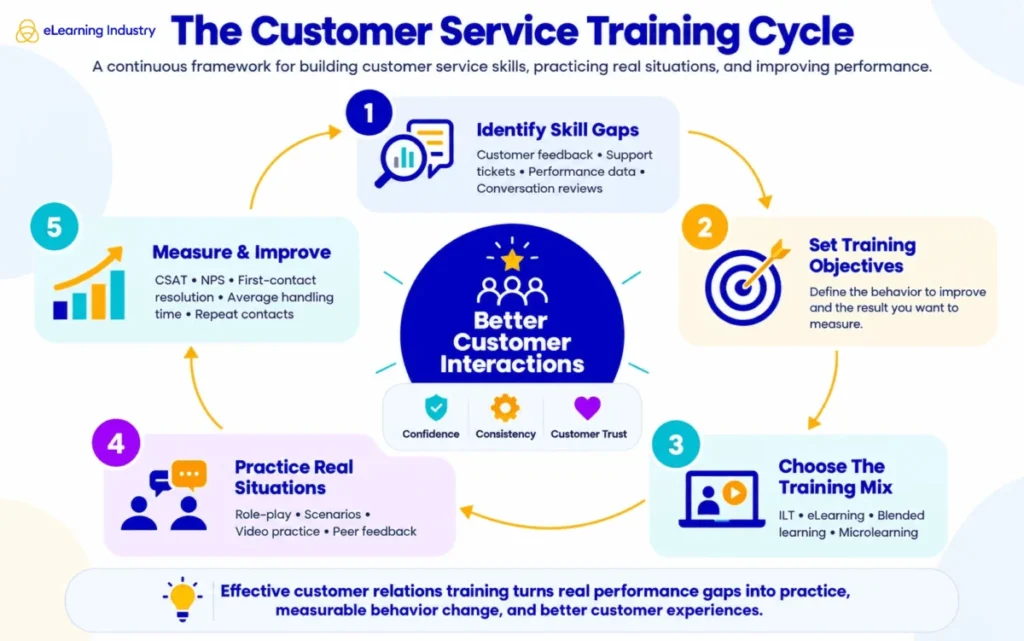
Strategic Program Design: A Five-Step Framework
Developing an effective training program requires a disciplined, data-driven approach. Organizations that fail to align their training with actual performance gaps often see a poor return on investment.
Step 1: Diagnostic Gap Analysis
Before developing content, L&D (Learning and Development) leaders must analyze existing data. This includes reviewing Net Promoter Score (NPS) surveys, analyzing "sentiment" in chat transcripts using AI tools, and interviewing frontline managers. If data shows that customers are satisfied with the friendliness of staff but frustrated by the time it takes to resolve issues, the training should pivot from empathy toward technical troubleshooting and process optimization.

Step 2: Defining Measurable Objectives
Vague goals like "better service" are impossible to track. Successful programs set SMART (Specific, Measurable, Achievable, Relevant, and Time-bound) goals. For example, a company might aim to "increase First Contact Resolution (FCR) by 15% within six months of training completion."
Step 3: Selecting the Delivery Model
The debate between Instructor-Led Training (ILT) and eLearning has largely been settled by the rise of "Blended Learning." While eLearning offers scalability and consistency, ILT provides the nuance required for role-playing and peer feedback. A blended approach typically uses eLearning for knowledge transfer (product specs, company policy) and live workshops for skill application (de-escalation tactics).
Step 4: Iterative Practice and Simulation
Knowledge retention drops significantly without immediate application—a phenomenon known as the Ebbinghaus Forgetting Curve. Training must include high-fidelity simulations where reps can practice in a sandbox environment. This allows them to fail safely before interacting with high-value clients.
Step 5: Continuous Feedback Loops
Training is not a "one-and-done" event. Post-training performance must be monitored through regular quality assurance (QA) audits. If a representative’s scores dip three months after training, "just-in-time" microlearning modules can be deployed to refresh their knowledge.
The Digital Transformation: Leveraging eLearning and AI
The shift toward remote and hybrid work has accelerated the adoption of sophisticated eLearning tools. Modern platforms are moving beyond static PowerPoint slides and toward immersive, interactive experiences.
- Scenario-Based Branching: These modules present a "Choose Your Own Adventure" style of learning. A rep’s choice in a simulated conversation leads to different outcomes, teaching them the direct consequences of their communication style.
- Video-Based Modeling: Instead of reading about tone, reps watch "Good vs. Bad" video examples. Seeing a peer successfully navigate a difficult conversation provides a powerful social proof that encourages behavioral change.
- Microlearning and Gamification: By breaking training into 5-minute "bursts," companies can integrate learning into the daily workflow without disrupting operations. Gamified elements, such as leaderboards and digital badges, tap into intrinsic motivation and increase engagement rates.
Supporting Data: The Economic Impact of Training
The financial justification for robust customer relation training is supported by substantial industry data. A study by the Harvard Business Review found that increasing customer retention rates by just 5% can increase profits by 25% to 95%. Furthermore, Zendesk’s 2023 Trends Report revealed that 60% of consumers will switch to a competitor after just one bad experience.
From a labor perspective, training also reduces turnover. The cost of replacing a single customer service representative can range from $10,000 to $20,000 when accounting for recruiting, onboarding, and lost productivity. Companies with comprehensive training programs report significantly higher employee engagement scores, which directly correlates with lower attrition rates.
Stakeholder Perspectives and Industry Reactions
In recent industry forums, Chief Customer Officers (CCOs) have emphasized that the role of the service agent is becoming more complex as AI takes over simple tasks. "As basic inquiries are automated by chatbots, the ‘human’ interactions that remain are the most difficult and emotionally charged," says Marcus Thorne, a veteran L&D consultant. "This means our training must focus more on high-level reasoning and emotional labor than ever before."
HR directors also note that customer relation training is increasingly being used as a leadership development tool. The skills required to manage an angry customer—patience, clarity, and problem-solving—are the same skills required to manage a team. Consequently, many organizations are opening these training programs to non-customer-facing departments to improve internal collaboration.
Broader Implications and Future Outlook
Looking ahead, the integration of Artificial Intelligence will continue to reshape customer relation training. Generative AI is now being used to create hyper-realistic training simulations that can mimic thousands of different customer personalities. This allows for personalized learning paths where a rep who struggles with "technical clarity" receives different exercises than a rep who struggles with "patience."
However, the core of customer relations remains fundamentally human. As the marketplace becomes more automated, the value of a genuine, empathetic, and knowledgeable human interaction increases. Organizations that view training as a strategic pillar rather than an administrative hurdle will be the ones that survive the volatile shifts in consumer sentiment.
In conclusion, customer relation training is an multifaceted discipline that requires a blend of psychological insight, technical mastery, and pedagogical innovation. By focusing on core skills, utilizing data-driven design, and embracing the flexibility of eLearning, businesses can build resilient teams capable of turning every customer interaction into a building block for long-term success. The investment in people, ultimately, remains the most reliable way to secure a brand’s future in an uncertain world.