The Strategic Shift Toward Learner Variability
For decades, corporate training programs were designed for the "average learner," a statistical myth that assumes most employees possess similar background knowledge, cognitive processing styles, and physical abilities. This approach often results in "educational friction," where experienced employees are forced through redundant material while others face insurmountable barriers due to language differences, sensory impairments, or technological gaps.
UDL offers a proactive solution. By acknowledging that learner variability is the rule rather than the exception, L&D teams can design experiences that allow for multiple pathways to success. This is particularly relevant in the context of the modern "skills gap." According to industry reports, nearly 87% of organizations globally are aware they have a skills gap or will have one within a few years. UDL provides a mechanism to bridge this gap by ensuring that reskilling and upskilling initiatives are accessible to every segment of the workforce, regardless of their starting point.
The Evolution of UDL: A Chronology of Inclusion
The concept of Universal Design did not originate in the classroom, but in architecture. To understand its current application in corporate L&D, it is essential to trace its historical development:
- 1970s: Architect Ronald Mace coins the term "Universal Design," advocating for the design of products and environments to be usable by all people, to the greatest extent possible, without the need for adaptation. This led to the "curb-cut effect," where features designed for people with disabilities (like sidewalk ramps) ended up benefiting everyone (people with strollers, delivery workers, etc.).
- 1984: The Center for Applied Special Technology (CAST) is founded by Anne Meyer, David Rose, and others. They begin exploring how computer technology can provide flexible alternatives to print-based curricula.
- 1990s-2000s: CAST shifts focus from "fixing" the learner to "fixing" the curriculum. They develop the first UDL framework, drawing on neuroscience research regarding how the brain learns.
- 2008: The first official UDL Guidelines are released, providing a formal structure for educators to apply the three core principles.
- 2014-2018: Guidelines are updated to version 2.0 and 2.2, reflecting advancements in digital learning and a growing emphasis on "expert learners."
- July 30, 2024: CAST releases UDL Guidelines 3.0. This major update reflects a modern understanding of equity, identity, and belonging, moving the framework beyond cognitive accessibility to address systemic barriers and learner agency.
Dissecting the Three Core Principles of UDL
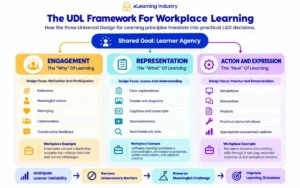
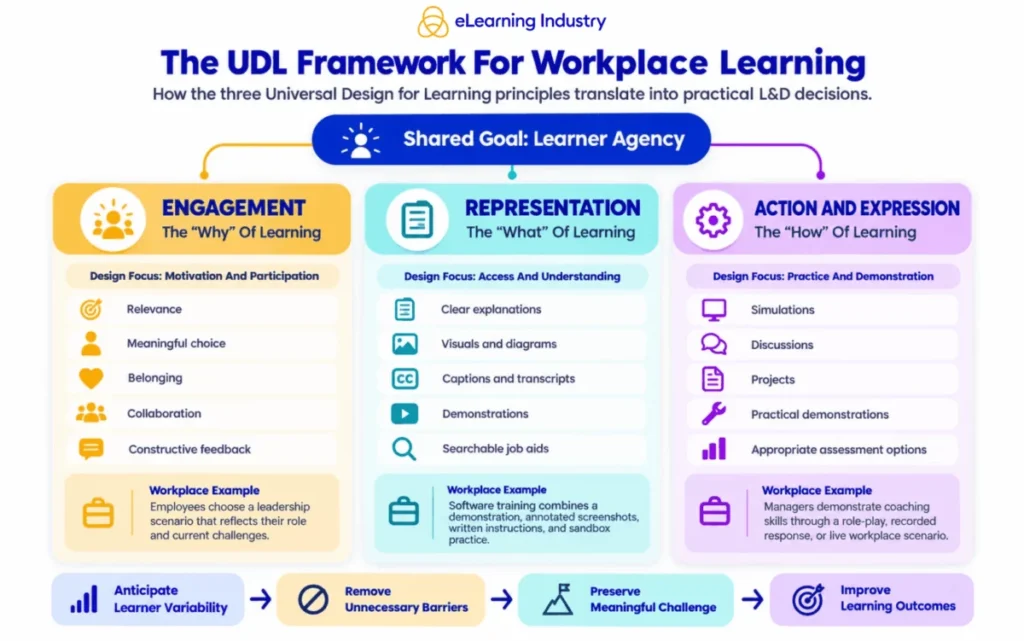
The UDL framework is built upon three primary principles, each corresponding to a specific neural network involved in learning: the affective, the recognition, and the strategic networks.
1. Multiple Means of Engagement (The "Why" of Learning)
This principle targets the affective network, which is responsible for monitoring the internal and external environment to set priorities and motivate action. In a corporate setting, engagement is often the difference between a successful training program and a wasted investment. UDL encourages designers to provide options that recruit interest, sustain effort, and support self-regulation. For example, instead of a mandatory linear course, an organization might offer a "choose your own adventure" scenario where managers select leadership challenges relevant to their specific department’s current needs.
2. Multiple Means of Representation (The "What" of Learning)
This principle addresses the recognition network, which identifies and interprets patterns of sensory information. To accommodate different learners, information must be presented in various formats. This includes providing alternatives for auditory and visual information, such as closed captions for videos, alt-text for images, and transcripts for podcasts. Furthermore, it involves clarifying vocabulary and symbols to ensure that language barriers do not impede the acquisition of core concepts.
3. Multiple Means of Action and Expression (The "How" of Learning)
The final principle focuses on the strategic network, which plans, executes, and monitors mental and motor actions. Learners differ in how they can navigate a learning environment and express what they know. UDL advocates for providing multiple ways for employees to demonstrate competency. While one employee might excel at a written assessment, another might more effectively demonstrate their skills through a recorded video demonstration or a live role-play exercise.
The Impact of CAST UDL Guidelines 3.0
The release of the 3.0 Guidelines in mid-2024 represents a pivotal moment for the framework. The update emphasizes that learning does not happen in a vacuum; it is influenced by a person’s identity, culture, and sense of belonging. The new guidelines specifically call for designers to:
- Address Bias: Scrutinize language and symbols for cultural bias or exclusionary metaphors.
- Foster Interdependence: Encourage collaborative learning models that value the contributions of all team members.
- Enhance Emotional Capacity: Help learners build the resilience and self-awareness needed to navigate complex professional environments.
- Promote Agency: Ensure that learners have the autonomy to make meaningful choices about their learning paths.
Industry experts suggest that these updates are a direct response to the growing demand for Diversity, Equity, and Inclusion (DEI) initiatives within the global corporate sector. By integrating these social and emotional factors, UDL 3.0 provides a more holistic approach to workforce development.

Practical Applications in Corporate L&D
The transition from theory to practice is where UDL demonstrates its value. Organizations that have adopted UDL principles report higher completion rates and better knowledge retention.
Case Study: Employee Onboarding
In a traditional onboarding setup, new hires are often overwhelmed with a "firehose" of information delivered via lengthy PDF manuals or static slide decks. A UDL-aligned onboarding program might instead offer a modular dashboard. New hires can choose to watch short "how-to" videos, read process maps, or engage in "sandbox" environments where they can practice using internal software without fear of making mistakes. This variety ensures that whether a new hire is a visual learner or a "learn-by-doing" practitioner, they can reach the same level of proficiency.
Case Study: Compliance Training
Compliance training is frequently cited as the least engaging form of corporate learning. By applying UDL, L&D teams can move away from "check-the-box" quizzes. Instead, they can use realistic, branched scenarios where employees must make ethical decisions. Providing immediate, corrective feedback and allowing employees to reference digital job aids during the training mimics real-world conditions, making the learning more relevant and retrievable.
Data-Driven Justification for UDL Implementation
The economic argument for UDL is compelling. According to the World Health Organization (WHO), over 1 billion people live with some form of disability. In the United States alone, the Department of Labor notes that the unemployment rate for persons with a disability is significantly higher than for those without. UDL allows companies to tap into this underutilized talent pool by removing the barriers that often exist in the hiring and training phases.
Furthermore, a study by Gallup indicates that disengaged employees cost the global economy approximately $8.8 trillion in lost productivity. By utilizing the "Multiple Means of Engagement" principle, UDL directly addresses the root causes of disengagement—lack of relevance and lack of autonomy—potentially saving organizations millions in turnover and productivity costs.
The Role of Technology and AI in Scaling UDL
Advancements in educational technology (EdTech) and Artificial Intelligence (AI) are making it easier than ever to implement UDL at scale. Learning Management Systems (LMS) now frequently include features such as:
- Auto-Captioning and Translation: Instantly making content accessible to global audiences.
- Screen Reader Compatibility: Ensuring that visually impaired employees can navigate digital content seamlessly.
- Adaptive Learning Paths: Using AI to suggest content formats based on a learner’s previous interactions and preferences.
However, technology is merely a facilitator. Analysts warn that AI-generated content can inadvertently replicate the biases of its training data. Therefore, the "human in the loop" remains essential. Instructional designers must use UDL as a lens through which to evaluate and curate AI-generated materials, ensuring they meet the high standards of representation and inclusivity required by the 3.0 Guidelines.
Implications for the Future of Work
As the "future of work" becomes the present reality, the flexibility inherent in UDL is no longer optional. The rise of remote and hybrid work models means that learning happens in varied environments—from quiet home offices to noisy transit hubs. Content that is designed with "multiple means of representation" (e.g., audio versions for those on the move, high-contrast text for those in bright environments) ensures that learning is continuous and context-aware.
In conclusion, Universal Design for Learning is more than an accessibility checklist; it is a comprehensive strategy for organizational excellence. By dismantling the barriers created by rigid, one-size-fits-all instruction, companies can foster a culture of continuous growth, innovation, and inclusion. The release of the CAST UDL Guidelines 3.0 serves as a timely reminder that as the workforce evolves, so too must the frameworks we use to empower it. Organizations that embrace these principles today are positioning themselves to be the resilient, talent-rich leaders of tomorrow.