The Strategic Importance of Goal Setting in the Modern Workplace
Career development goals are defined as specific, actionable targets set by employees to acquire new competencies, assume greater responsibilities, and progress within their professional hierarchy. These objectives range from short-term technical certifications to long-term transitions into executive leadership. According to recent data from LinkedIn’s 2024 Workplace Learning Report, 94% of employees state they would remain at a company longer if it invested in their career development. This statistic highlights a critical shift in workforce priorities, where the opportunity for growth is often valued as highly as financial compensation.
For organizations, the formalization of these goals provides a roadmap for L&D departments. Without clear input from the workforce regarding their desired trajectories, L&D initiatives often become disconnected from the actual needs of the staff, leading to wasted resources and low engagement. When individual goals are synchronized with corporate strategy, the result is a more agile, highly skilled workforce capable of navigating the complexities of an AI-driven and rapidly changing market.
The Evolution of Professional Development: A Brief Chronology
The concept of career development has evolved significantly over the past five decades. In the mid-20th century, career progression was largely linear and managed by the employer, characterized by the "corporate ladder." By the 1990s, the "protean career" emerged, where individuals began taking more responsibility for their own professional paths, driven by their own values rather than organizational loyalty.
In the current post-pandemic era, the timeline of career development has accelerated. The rise of remote and hybrid work has forced a democratization of learning, where digital platforms allow for "just-in-time" skill acquisition. Today, the focus has shifted from "climbing the ladder" to "building a lattice," where lateral moves and the acquisition of diverse "human skills" are seen as vital for long-term career resilience.
Categorizing Career Development Goals
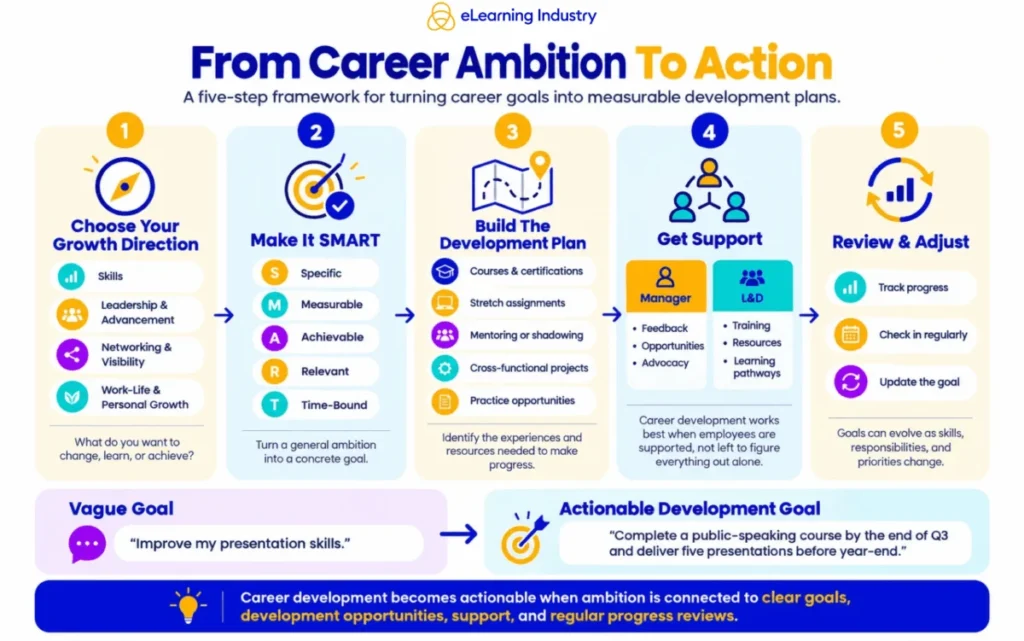
To create a comprehensive development plan, professionals and managers generally categorize goals into four distinct pillars. Each pillar addresses a different facet of professional maturity and organizational contribution.
1. Skill-Building and Competency Goals
These are the most common types of goals, focusing on the acquisition of "hard" technical skills or "soft" interpersonal skills. Examples include mastering a new data analytics software, obtaining a Project Management Professional (PMP) certification, or improving public speaking abilities. Data from the World Economic Forum suggests that by 2025, 50% of all employees will need reskilling due to the adoption of new technology. Consequently, skill-building goals are often the most immediate priority for both employees and L&D teams.
2. Leadership and Advancement Goals
These objectives are centered on vertical movement and the assumption of authority. For an entry-level employee, this might involve a goal to lead a small project team within 12 months. For mid-level managers, it could involve preparing for a C-suite or director-level role. These goals are often contingent on organizational health and budget cycles, making them more complex to navigate than pure skill acquisition.
3. Networking and Social Capital Goals
In a globalized workforce, "who you know" remains as critical as "what you know." Networking goals involve increasing one’s visibility within and outside the organization. This could include attending a specific number of industry conferences, joining cross-functional task forces, or securing a mentor within the senior leadership team. Professionals who set networking goals are significantly more likely to be considered for internal promotions, as their contributions are recognized by a broader range of stakeholders.
4. Holistic Growth and Work-Life Integration
Modern career development increasingly recognizes the importance of personal well-being. Goals in this category might include establishing firm boundaries to prevent burnout, transitioning to a four-day workweek, or seeking roles that offer greater creative autonomy. As "quiet quitting" and "burnout" became prevalent terms in the early 2020s, many organizations have begun to integrate these personal growth metrics into their formal development reviews to ensure long-term employee health.

The SMART Framework: Transforming Intent into Action
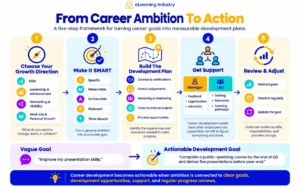
The primary reason career goals fail is a lack of specificity. To combat this, the SMART framework has become the industry standard for goal setting. This methodology ensures that every objective is grounded in reality and measurable against a timeline.
- Specific: Goals must be clear and unambiguous. Instead of "I want to be a better leader," a specific goal is "I want to manage a team of five people in the marketing department."
- Measurable: There must be a way to track progress. This could be a certification, a specific percentage increase in sales, or the completion of a training module.
- Achievable: While "stretch goals" are encouraged, an objective must be realistic given the employee’s current role and the company’s resources.
- Relevant: The goal must align with the broader objectives of the organization. A goal to learn a skill that the company is phasing out is not relevant.
- Time-bound: Every goal needs a deadline. This creates a sense of urgency and prevents the goal from being perpetually postponed.
For example, a vague goal like "learn more about AI" becomes a SMART goal when phrased as: "Complete the ‘AI for Business’ certification from an accredited online provider by the end of Q3 and present three implementation ideas to the executive team by December 1st."
The Role of Management and L&D Integration
The success of career development programs rests heavily on the relationship between managers and their direct reports. Experts suggest that the traditional annual performance review is insufficient for modern career growth. Instead, a "continuous feedback loop" is recommended.
Managers are encouraged to act as "career coaches" rather than just task overseers. This involves regular check-ins where the primary focus is not on current tasks, but on the employee’s progress toward their SMART goals. By providing access to internal resources, such as tuition reimbursement, shadow programs, or internal "gigs," managers can facilitate growth that benefits the company’s bottom line while fulfilling the employee’s personal ambitions.
From an L&D perspective, employee goals provide the data necessary to build future-proof training curricula. If a significant portion of the workforce sets goals related to data literacy, the L&D team can justify the investment in a comprehensive data science training platform. This data-driven approach to corporate education ensures that the organization remains competitive in a skills-first economy.
Industry Analysis: The Economic Impact of Development Goals
The broader implications of structured career development extend beyond individual satisfaction. At a macro level, companies that prioritize internal mobility and clear development paths experience significantly lower turnover costs. The Society for Human Resource Management (SHRM) estimates that the cost of replacing an employee can range from 50% to 200% of their annual salary. By investing in career development goals, organizations essentially "buy" loyalty and "build" the talent they need, rather than competing for expensive external hires in a tight labor market.
Furthermore, as Artificial Intelligence continues to automate routine tasks, the "human" element of career development—strategic thinking, emotional intelligence, and complex problem-solving—becomes the primary value driver. Career goals that focus on these high-level cognitive skills are effectively future-proofing the workforce against technological disruption.
Conclusion and Future Outlook
Career development goals have transitioned from a "nice-to-have" HR initiative to a fundamental pillar of corporate strategy. By utilizing the SMART framework and categorizing goals into skill-building, leadership, networking, and personal growth, employees can take control of their professional destinies. Simultaneously, organizations that support these goals through robust L&D programs and proactive management will find themselves better equipped to retain top talent and navigate the uncertainties of the future.
As the workplace continues to evolve, the integration of AI-driven personalized learning paths and a greater emphasis on holistic employee well-being are expected to become the next frontiers in career development. For now, the focus remains on the clarity of intent and the discipline of execution—turning professional wishes into measurable realities.