The rapid integration of artificial intelligence across the global corporate landscape has created a significant disconnect between technological availability and organizational transformation. While enterprises have deployed AI tools at a speed unprecedented in the history of workplace technology, very few have successfully restructured their core operations to reap the promised benefits. This phenomenon, increasingly described by industry analysts as the AI adoption paradox, suggests that the primary barrier to success is not technical in nature, but adaptive. For Chief Learning Officers (CLOs) and executive leadership, the priority is shifting from the mechanics of implementation toward the complex human challenge of helping workforces evolve alongside these emerging systems.
The State of Artificial Intelligence: 2023–2025
The trajectory of AI adoption has moved with a velocity that has outpaced previous digital transformations, such as the shift to cloud computing or the mobile revolution. According to data from McKinsey & Company, by late 2024 and heading into 2025, nearly nine out of 10 organizations reported using AI regularly in at least one business function. This widespread adoption was fueled by the accessibility of generative AI models, which lowered the barrier to entry for non-technical staff.
However, high adoption rates have not translated into immediate financial performance. MIT’s Project NANDA, which analyzed more than 300 enterprise deployments, revealed a startling efficiency gap: roughly 95 percent of generative AI pilots failed to produce a measurable impact on profit-and-loss (P&L) statements. This disparity highlights a "pilot-to-production" bottleneck where organizations successfully test tools in isolation but fail to integrate them into the broader value chain. Researchers at MIT suggest that this is primarily a learning gap. While tools were distributed, the workforce did not fundamentally change how they approached their daily tasks, leading to what many call "digital layering"—placing new technology on top of old, inefficient processes.
Chronology of the AI Integration Crisis
The current organizational struggle can be traced through a clear timeline of the last three years:
- The Prototyping Surge (Late 2022 – Mid 2023): Following the public release of advanced large language models, organizations rushed to secure licenses and launch internal "sandboxes." The focus was almost entirely on technical feasibility.
- The Pilot Proliferation (Late 2023 – Mid 2024): Companies launched hundreds of small-scale experiments. During this phase, the focus shifted to "prompt engineering" and basic literacy, yet these initiatives remained siloed within IT or specific innovation hubs.
- The Performance Plateau (Late 2024 – Present): Leadership began demanding ROI. As the MIT NANDA report suggests, this is the period where the "learning gap" became visible. Organizations realized that without a shift in leadership mindset and employee behavior, AI remains an expensive utility rather than a transformative engine.
The Framework of Adaptive Leadership
To understand why AI implementation often stalls, researchers at Harvard University point to the distinction between technical challenges and adaptive challenges. Technical challenges are those that can be solved by applying existing knowledge and the expertise of specialists. In the context of AI, this includes software installation, data cleaning, and API integration.
In contrast, adaptive challenges require people to change their values, beliefs, and habits. AI presents a classic adaptive challenge because it alters professional identity, redistributes expertise, and blurs the lines of accountability. When a junior analyst can use AI to perform a task that previously took a senior manager a decade to master, the traditional hierarchy of "expertise" is disrupted. Organizations that treat AI merely as a technical upgrade fail to address these underlying social and professional shifts, leading to internal resistance and stagnant productivity.
The Flux 5: Mindsets for a Responsive Learning Ecosystem
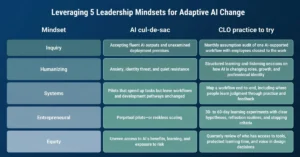
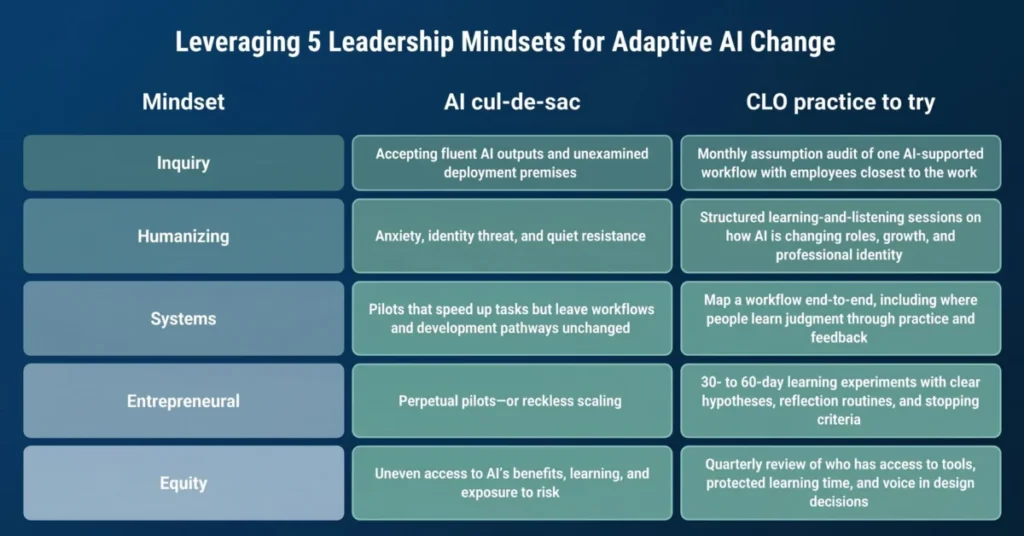
To navigate this transition, a new leadership framework known as "The Flux 5" has emerged. This model identifies five essential mindsets—Inquiry, Humanizing, Systems, Entrepreneurial, and Equity—that allow leaders to move beyond simple adoption and toward a truly adaptive workforce.
1. The Inquiry Mindset: Beyond Prompt Fluency
The inquiry mindset involves an intentional stance of questioning norms and surfacing invisible organizational logic. In an AI-saturated environment, the risk of "automated errors" or hallucinations is high. An inquiry mindset moves the focus from "how do I get the AI to do this?" to "why are we doing this in the first place?"
For CLOs, this means transitioning from training programs that focus on "prompting" to those that focus on "disciplined discernment." Employees must be encouraged to interrogate AI outputs and the premises behind them. Key practices include "AI assumption audits," where teams regularly deconstruct AI-supported decisions to identify hidden biases or logical flaws.
2. The Humanizing Mindset: Addressing AI Anxiety
Psychological safety is a prerequisite for learning. As AI begins to handle tasks related to reasoning, writing, and analysis, employees naturally experience anxiety regarding job security and professional relevance. If leaders frame AI solely as a "productivity lever," the workforce is likely to respond with "knowledge blocking" or silent resistance.
Building on the work of organizational behavior professor Gianpiero Petriglieri, experts suggest that organizations must provide an "institutional holding environment." This involves creating spaces where employees can openly discuss their concerns without fear of retribution. A humanizing mindset protects the developmental pipeline, ensuring that while AI handles foundational tasks, junior employees still have pathways to develop the human judgment that the technology cannot replicate.

3. The Systems Mindset: Mapping the Ecosystem
A common pitfall in AI adoption is "local optimization"—improving a single task while creating a bottleneck elsewhere in the system. A systems mindset requires leaders to look at the entire workflow. If AI makes a specific report 50 percent faster to produce, but the subsequent decision-making process remains slow, the net gain to the organization is zero.
A systems approach involves mapping workflows end-to-end before automation occurs. This allows leaders to identify "leverage points" where small structural changes can lead to major shifts in output. It also requires tracking outcome measures tied to the whole workflow—such as customer experience or cycle time—rather than just tracking how many people are using a specific AI tool.
4. The Entrepreneurial Mindset: Disciplined Experimentation
The rapid pace of AI development means that traditional three-year strategic plans are often obsolete before they are finished. An entrepreneurial mindset favors "bounded experiments"—short, 30-to-60-day cycles with clear hypotheses and success measures.
This approach prevents organizations from falling into "perpetual pilot purgatory," where projects never scale, or from committing to massive enterprise-wide contracts for tools that may be outdated within six months. The goal is to generate "reusable knowledge" from every experiment, regardless of whether the specific tool is ultimately adopted.
5. The Equity Mindset: Distributing Gains and Risks
AI has the potential to widen existing organizational gaps. Access to the best tools and the time to experiment often follows existing hierarchies, leaving those in lower-level or administrative roles—who are often most at risk of automation—with the least support. Furthermore, models trained on historical data can perpetuate biases in hiring and performance evaluations.
An equity mindset ensures that AI fluency is democratized across all levels of the organization. This is not just a matter of social responsibility; it is a matter of organizational resilience. A broader base of AI-literate employees provides a larger surface area for innovation and problem-solving.
Broader Impact and Implications for the Future of Work
The shift toward adaptive AI leadership has profound implications for the role of the Chief Learning Officer. Traditionally, the CLO was responsible for delivering content and tracking completion rates. In the AI era, the CLO becomes a central architect of organizational culture and systemic change.
Industry analysts suggest that the "shelf life" of technical AI skills is shrinking. A specific prompting technique used today may be irrelevant by next year as models become more intuitive. Therefore, the most valuable asset an organization can build is "learning capacity"—the ability of its people to continuously adjust, unlearn, and relearn.
Furthermore, the integration of AI is forcing a re-evaluation of human value in the workplace. As "doing" becomes automated, "thinking," "relating," and "judging" become the primary drivers of value. Organizations that successfully navigate this shift will be those that treat AI not as a replacement for human intelligence, but as a catalyst for a more sophisticated, human-centered way of working.
Conclusion: AI as a Continuous Learning Process
Artificial intelligence is not a final destination; it is an iterative learning process. The technical hurdles of 2023 have given way to the adaptive challenges of 2025. Success in this environment requires more than just a robust IT budget; it requires a leadership team capable of fostering inquiry, protecting human dignity, thinking in systems, experimenting with discipline, and ensuring equity.
The question facing modern boards and executives is no longer whether they will adopt AI, but whether they can build an organization capable of learning alongside it. As AI continues to accelerate the pace of change, the ability to adapt becomes the only sustainable competitive advantage. Organizations that bridge the gap between technical implementation and adaptive leadership will be the ones to finally move the needle on the AI adoption paradox, turning technological potential into measurable organizational value.