The landscape of talent acquisition is undergoing a profound transformation, driven by an escalating demand for pay transparency. What began as a progressive movement for equity has rapidly evolved into a widespread legal mandate and a non-negotiable expectation for job seekers. Employers are now tasked with clearly stating the minimum and maximum pay for a role, often alongside other vital compensation components like bonuses, commissions, or equity. This critical information, ideally placed near the top of a job posting or within a dedicated "Compensation" section, serves as an immediate filter for candidates and a cornerstone of modern HR compliance. The era of vague promises like "competitive salary" or "salary based on experience (DOE)" is unequivocally over, replaced by a demand for specific figures and a clear understanding of the total compensation package.
The Genesis of Pay Transparency: A Chronology of Legislation
The push for pay transparency is rooted in a broader societal drive for pay equity and fairness, aiming to dismantle systemic wage discrimination, particularly along gender and racial lines. For decades, compensation discussions were shrouded in secrecy, often leading to significant disparities and hindering individuals’ ability to negotiate effectively. The lack of open information made it challenging for employees to determine if they were being paid fairly compared to colleagues in similar roles, contributing to persistent wage gaps.
The movement gained significant momentum in the mid-2010s, with a growing chorus of advocacy groups and employees demanding greater insight into compensation practices. Early legislative efforts focused on prohibiting employers from asking about past salary history, a measure designed to prevent the perpetuation of historical pay discrimination. However, these initial steps were just the precursor to more comprehensive disclosure requirements.
Colorado’s Equal Pay for Equal Work Act, enacted in 2021, is widely regarded as a trailblazer in the U.S., mandating salary range disclosure in all job postings, including those for remote roles where the employee might be based in Colorado. This pivotal legislation set a precedent, demonstrating that such laws were not only feasible but also beneficial for both employees and the broader labor market. Following Colorado’s lead, a rapid succession of states and municipalities began to adopt similar measures. New York City, for instance, implemented its law in November 2022, requiring employers to disclose a good faith salary range for all advertised jobs. California and Washington State followed suit in January 2023, expanding the scope of their existing pay equity laws to include proactive salary range disclosure.
By July 2026, a significant milestone will be reached, with 17 U.S. states plus Washington, D.C., having enacted pay range disclosure laws. This patchwork of regulations, though varying in specifics, collectively signals a decisive shift towards greater transparency across the American labor market. Simultaneously, the European Union introduced its groundbreaking EU Pay Transparency Directive in 2023, which adds comprehensive requirements for employers operating within Europe. This directive mandates not only salary range disclosure in job advertisements but also provides employees with the right to request information on average pay levels, further solidifying a global commitment to compensation clarity. These laws are not merely administrative hurdles; they are designed to empower job seekers, foster trust, and ultimately, close stubborn pay gaps by providing the necessary information for informed decision-making and fair negotiation.
Beyond Compliance: The Strategic Advantages for Employers
While legal mandates are a primary driver, forward-thinking organizations recognize that pay transparency offers significant strategic advantages that extend far beyond mere compliance. In today’s competitive talent market, it has become a powerful tool for attracting and retaining top talent, enhancing employer branding, and streamlining the recruitment process.
- Attracting and Engaging Top Talent: Numerous studies and anecdotal evidence consistently demonstrate that candidates overwhelmingly prefer job postings that include salary ranges. Research by LinkedIn and Glassdoor, for instance, has shown that job postings with salary information receive significantly more applications and higher engagement rates. In an environment where skilled professionals have choices, employers who are upfront about compensation immediately stand out as trustworthy and respectful of candidates’ time. This transparency reduces uncertainty and allows job seekers to quickly determine if a role aligns with their financial expectations, leading to a more qualified applicant pool and a faster time-to-hire.
- Enhanced Employer Branding and Trust: Companies that embrace pay transparency are increasingly perceived as fair, progressive, and ethical. This commitment to openness contributes positively to their employer brand, making them more attractive to a diverse range of candidates, particularly younger generations who prioritize authenticity and social responsibility. Transparency builds trust, not only with external candidates but also with existing employees, fostering a culture of openness and reducing internal resentment that can arise from perceived pay inequities.
- Improved Candidate Experience and Self-Selection: Providing salary ranges upfront allows candidates to self-select, preventing wasted time and effort for both parties. Job seekers are less likely to apply for roles that are clearly outside their desired compensation range, and recruiters spend less time interviewing candidates who ultimately decline offers due to salary misalignment. This efficiency leads to a more positive overall candidate experience, even for those who don’t get the job, as they appreciate the clarity and respect shown for their time.
- Streamlined Negotiation Process: When salary expectations are set from the outset, the negotiation phase often becomes less contentious and more efficient. Candidates come to the table with a clear understanding of what’s on offer, and discussions can focus on fitting within the established range based on experience, skills, and qualifications, rather than on fundamental disagreements over compensation philosophy.
- Driving Internal Pay Equity: Perhaps one of the most significant long-term benefits of external pay transparency is its ripple effect on internal compensation structures. The requirement to publicly disclose salary ranges often forces organizations to conduct a thorough review of their internal pay scales, identify and address existing inequities, and standardize their compensation philosophy. This internal audit is crucial for fostering a fair and equitable workplace, reducing the risk of discrimination claims, and improving employee morale and retention.
Crafting Compliant and Effective Salary Disclosures
To meet both legal requirements and candidate expectations, employers must move beyond superficial disclosures and provide comprehensive, clearly articulated compensation information. A truly effective job posting will offer a holistic view of what a candidate can expect to earn.
The core of any disclosure is the base salary range, stated clearly with a minimum and maximum figure in the same unit (e.g., "$75,000 – $90,000 per year" or "$30 – $40 per hour"). This range should reflect a "good faith" estimate of what the employer genuinely expects to pay for the role. Beyond the base, it’s crucial to include other potential earnings that contribute to the total compensation package. This can encompass:
- Bonuses: Disclose any performance-based, sign-on, or annual bonuses, even if they are discretionary.
- Commissions: For sales or revenue-generating roles, clearly state the commission structure or potential on-target earnings (OTE), distinguishing between base pay and variable pay.
- Equity: For startups or growth-stage companies, outline stock options, restricted stock units (RSUs), or other forms of equity, explaining their potential value or the percentage offered.
- Shift Differentials or Special Pay: As seen in the Kaiser Permanente example, hourly roles might include extra pay for evening, night, or weekend shifts.
- Relocation or Sign-on Assistance: If offered, these should be explicitly mentioned, particularly if substantial.
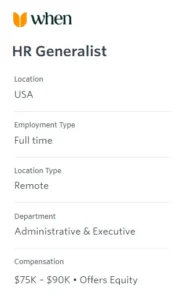
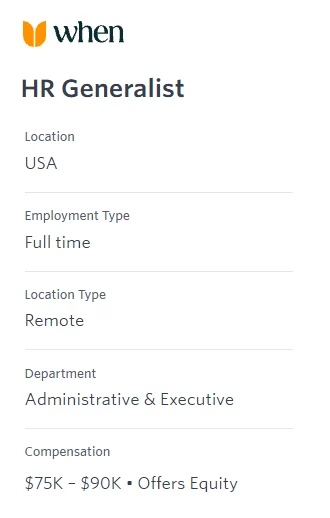
Placement Best Practices: The visibility of this information is paramount. On a company’s own careers page, the salary range should be in a prominent location, such as a dedicated "Compensation" section, a sidebar next to other key job details (like location and job type, as seen with When’s HR Generalist role), or within the main header block of the posting (like Kaiser Permanente’s hourly role). For roles with on-target earnings, like Traversal’s example, it’s best to break down the OTE into its base and variable components for maximum clarity.
Eliminating Ambiguity: The days of vague compensation phrases are over. These terms are not only frustrating for candidates but also often fail to meet legal disclosure requirements.
- "Competitive salary": This phrase conveys no actionable information. Replace it with a specific numerical range (e.g., "$75,000 – $90,000 per year").
- "Salary based on experience" or "DOE": While experience does influence where a candidate falls within a range, these phrases alone are insufficient. State the full range first, then clarify that "final offer will be based on experience, skills, and qualifications."
- "Commensurate with experience": This is a more formal but equally unhelpful variation of "DOE." Again, provide the range and then explain the factors.
- "Up to $90,000": This phrase hides the floor of the compensation, leading candidates to assume the lowest possible pay. Always provide both the minimum and maximum (e.g., "$75,000 – $90,000").
- "$75,000+": This is open-ended and lacks a defined ceiling. A true range offers clarity at both ends.
- "Negotiable": While most offers are somewhat negotiable, this term, when used in place of a range, suggests a lack of transparency. Provide the range, and if needed, add a clarifying statement such as "final offer based on skills and experience."
- "Market rate": Whose market? Which rate? This is too vague. State the specific range and, if applicable, mention factors like location or level that influence it.
- "Earn $200K+": This often mixes guaranteed and variable pay. For roles with variable components, explicitly break it down: "OTE $200,000 – $275,000 (comprising a base salary of $[low]–$[high] plus variable pay at target)."
- "Competitive benefits package": While benefits are important, they are not direct pay. Keep this phrase for the benefits section, but ensure the pay range is listed separately and clearly.
- "Pay varies by location": This gives no specific information for any location. Instead, provide location-specific ranges: "Pay by location: [Region A] $[low]–$[high]; [Region B] $[low]–$[high]."
For employers operating in jurisdictions with pay range laws, using vague phrases like "up to," "competitive," or "DOE" will almost certainly not meet the legal requirements and could lead to compliance issues.
Navigating the Complexities of Multi-State and Remote Hiring
One of the most significant challenges arising from the proliferation of pay transparency laws is the complexity of hiring for remote roles or across multiple states. The "remote role trap" is particularly common: a job posting that is open to candidates in a state or city with a pay transparency law is typically subject to that law, regardless of where the employer’s physical office is located. This means an employer in Texas, for example, must comply with Colorado’s pay transparency law if they are advertising a remote role that a Colorado resident could apply for.
Jurisdictional nuances vary significantly by law. Some laws apply if the position "can be performed" in the jurisdiction, while others apply if the employer has a certain number of employees within that jurisdiction or if the company is "doing business" there. This patchwork of regulations necessitates careful consideration and often legal guidance.
Employers typically handle this complexity in one of three ways:
- Posting a Single, Broad Range: Some employers opt for a single, wide salary range that encompasses the highest possible pay for the role across all locations, or a national average. While simple, this approach has drawbacks. It might lead to overpaying in lower cost-of-living areas or still appear less precise to candidates in specific high cost-of-living regions. It can also create internal equity challenges if employees in different regions are paid vastly different amounts but fall within the same wide advertised range.
- Providing Location-Specific Ranges: This is generally considered the best practice for accuracy and compliance. Employers list different salary ranges for various geographic regions or states. For example: "Salary: $70,000 – $90,000 (New York), $60,000 – $80,000 (Atlanta), $55,000 – $75,000 (Remote – National)." This approach requires more administrative effort to research and maintain multiple pay bands but ensures maximum clarity and compliance.
- Limiting Hiring to Non-Covered States: To avoid the complexities of compliance, some employers choose to explicitly exclude candidates from states or cities with pay transparency laws. While this simplifies compliance, it significantly restricts the talent pool and can be seen as a negative signal to job seekers who value transparency.
Given the evolving nature and varying specifics of these laws, employers are strongly advised to consult their legal teams to ensure full compliance before posting any job advertisements, especially for remote or multi-state roles. Regularly rechecking pay bands and legal requirements is crucial, as the regulatory landscape is constantly shifting.
The Role of Job Boards and Technology
Job boards and HR technology platforms play a pivotal role in the dissemination and enforcement of pay transparency. Major platforms like Indeed and LinkedIn have adapted their interfaces and algorithms to accommodate salary range disclosure.
- Platform Integration: Most job boards now feature dedicated fields for salary information. It is critical for employers to use these structured fields rather than embedding salary information solely within the job description text. This ensures that the platform’s algorithms can accurately read, display, and categorize the compensation data. For instance, Indeed’s guidance explicitly recommends using their salary fields.
- Algorithmic Impact: Job postings without clear salary information are increasingly penalized by job board algorithms. Indeed, for example, may add an estimated pay range to postings lacking this information, or significantly reduce their visibility, leading to fewer applicants. LinkedIn similarly prioritizes jobs with transparent pay. Employers who fail to provide salary ranges risk their postings being pushed lower in search results or even not displayed at all in states with strict disclosure laws.
- ATS and HR Tech Adaptation: Applicant Tracking Systems (ATS) and other HR software solutions are also evolving. Many now include features to help employers manage and display salary ranges, ensuring compliance across various posting channels. Some even offer integrations with compensation data providers to help define appropriate ranges.
- Automated Verification Tools: Tools like Ongig’s Text Analyzer offer pre-publication checks, helping employers catch missing or unclear pay information before a job description goes live. These tools can identify vague phrases, ensure proper formatting, and flag potential compliance issues, saving time and mitigating legal risks.
Internal Implications and HR Takeaways
The mandate for external pay transparency inevitably creates significant internal implications for HR departments. It forces a holistic re-evaluation of an organization’s compensation philosophy and practices.
- Internal Pay Equity Review: The necessity of publishing external ranges often acts as a catalyst for a deeper, more rigorous internal pay equity audit. HR teams must scrutinize existing compensation structures to ensure that employees in similar roles, with similar experience and performance, are paid equitably. Discrepancies that were once hidden can become glaringly obvious when external ranges are published, leading to internal unrest if not proactively addressed.
- Refining Compensation Philosophy: Companies are compelled to clearly articulate and justify their compensation philosophy. What factors determine pay? How is performance rewarded? How do market rates influence internal bands? Having clear answers to these questions is essential for maintaining trust and defending pay decisions.
- Manager Training and Communication: Front-line managers are often the first point of contact for employee questions about pay. They need comprehensive training on the company’s compensation philosophy, how pay ranges are determined, and how to discuss individual compensation transparently and effectively with their teams. Equipping managers with this knowledge is crucial for fostering an open and trusting environment.
- Data-Driven Compensation Decisions: Relying on robust market data and internal benchmarking becomes paramount. HR teams must invest in reliable compensation data sources and regularly update their pay bands to remain competitive and compliant.
- Proactive Compliance and Future-Proofing: Beyond simply reacting to existing laws, HR leaders should adopt a proactive stance, anticipating that pay transparency will become the norm across all jurisdictions. Building a culture of compensation transparency and establishing robust internal processes will position organizations favorably for future regulatory changes and talent market expectations.
In conclusion, pay transparency is no longer a niche concept but a fundamental shift in how organizations approach compensation and talent acquisition. Driven by evolving legal frameworks and heightened candidate expectations, it mandates a clear, comprehensive, and upfront disclosure of salary ranges and total compensation. While presenting initial challenges, particularly in navigating complex multi-state regulations, embracing this new era offers significant benefits. By attracting top talent, enhancing employer branding, and fostering internal equity, pay transparency ultimately strengthens an organization’s foundation for sustained success in a competitive and increasingly open labor market. Employers who prioritize clarity and fairness in their compensation practices will not only meet compliance requirements but also build more resilient, trusted, and high-performing workforces.