For decades, the landscape of campus recruiting has been characterized by a familiar, yet increasingly inefficient, ritual: employers sending large teams to university career fairs, hoping the right candidates will serendipitously approach their booth. This "show up and hope" methodology, while deeply ingrained, has long resulted in substantial wasted resources, an inability to accurately measure return on investment (ROI), and recruiters bogged down in administrative tasks rather than strategic talent engagement. However, a significant paradigm shift is now underway, driven by purpose-built Artificial Intelligence (AI) solutions designed to flip this traditional model on its head, enabling companies to identify, engage, and schedule interviews with best-fit candidates before events even begin.
The Persistent Challenge of Campus Recruiting: A Historical Perspective
Campus recruiting, at its core, has always been about identifying and attracting early talent for internships, co-ops, and entry-level roles. From the informal interactions of the mid-20th century to the formalized career fairs that became ubiquitous in the late 20th and early 21st centuries, the fundamental approach remained largely consistent: a physical presence on campus, often at high-volume events. Recruiters and hiring managers would spend entire days at booths, engaging with a diverse stream of students, collecting resumes, and making snap judgments based on brief interactions.
While this model fostered direct engagement, it was inherently reactive and resource-intensive. Companies invested heavily in booth fees, travel, accommodation, marketing materials, and branded merchandise ("swag"), often without a clear understanding of who they would meet or whether those individuals would align with their specific talent needs. Industry analyses consistently highlight the operational inefficiencies: reports from organizations tracking talent acquisition trends suggest that up to 70% of candidate interactions at traditional career fairs may not lead to viable hires, consuming valuable recruiter time and company budget with limited strategic return. This lack of precision has been a perennial pain point for early talent teams, especially as the competitive landscape for top university graduates intensifies.
The Hidden Costs of Inefficiency: Unpacking the "Show Up and Hope" Burden
The inefficiencies embedded in the traditional campus recruiting model manifest in several critical areas, collectively imposing a significant burden on organizations:
- Recruiter Burnout and Misallocation of Time: When candidate identification is a post-event activity, recruiters are forced to engage with a high volume of unvetted individuals. This translates into an immense administrative backlog: sorting through hundreds, if not thousands, of resumes, manually entering data into Applicant Tracking Systems (ATS), crafting individualized follow-up emails, and coordinating complex interview schedules. This busywork, far removed from the strategic aspects of talent acquisition, often leads to recruiter fatigue and diverts their focus from building meaningful relationships with promising candidates. Surveys within the HR tech sector frequently reveal that recruiters spend upward of 40% of their time on administrative tasks, a figure exacerbated in high-volume environments like campus recruiting.
- Financial Drain of Unoptimized Events: The financial outlay for campus events is substantial. Booth fees at major university career fairs can range from hundreds to several thousands of dollars. Add to this the costs of flights, hotels, ground transportation, and meals for recruiting teams, plus the expense of producing and shipping marketing collateral and swag. Without pre-event intelligence on candidate fit, these investments become speculative gambles. Organizations might send large teams to multiple events, only to find that the candidate pool at many of these events does not align with their hiring profiles, leading to significant expenditure with negligible ROI.
- Suboptimal Candidate Engagement: The nature of traditional career fair interactions is often superficial. With long lines and limited time, recruiters typically spend the initial minutes of each conversation attempting to ascertain a student’s major, experience, and career interests, trying to fit them into available roles. This leaves little room for deep engagement or showcasing the company culture effectively. Consequently, many interactions never progress beyond surface-level information exchange, failing to captivate or truly assess the potential of prospective hires.
- Lack of Measurable ROI and Strategic Budgeting: A persistent challenge for campus recruiting teams has been the inability to definitively connect event expenditure with actual hires. When candidate data is fragmented across spreadsheets, email inboxes, and anecdotal notes, it becomes nearly impossible to conduct robust post-event analysis. This data opacity makes it difficult to justify budget allocations, identify which events are truly productive, and strategically refine future recruiting efforts. According to Yello’s "State of Campus Recruiting Report," a mere 6% of campus teams feel "very confident" in their ability to measure the ROI of their recruiting initiatives, underscoring a widespread systemic issue.
- Competitive Disadvantage and Missed Opportunities: The post-event administrative scramble inherently creates delays. While a company is still sorting resumes and scheduling initial calls, faster-moving competitors—who might have more streamlined processes or a more targeted approach—are already booking interviews and extending offers. This time lag often means that by the time a company reaches out to its top choices, those candidates may have already committed to another employer, resulting in the loss of prime talent. Furthermore, the "show up and hope" model often means missing out on exceptional candidates who might not attend a specific fair, are studying less obvious majors, or are on campuses not traditionally targeted, simply because recruiters lack the bandwidth to look beyond their immediate event attendees.
The Evolving Landscape: Why Traditional AI Solutions Fell Short
The widespread adoption of AI in various business functions, including general recruitment, might lead one to question why campus recruiting has seemingly lagged in its transformation. The answer lies in the distinct nature of early talent acquisition compared to experienced hire recruitment. Most general AI recruiting tools were developed with the latter in mind: a steady flow of applicants for a single requisition, followed by a few structured interview rounds. This model differs significantly from the rhythm of campus recruiting, which is characterized by high-volume, event-driven processes, targeting multiple roles, often with less defined candidate profiles.
Many existing AI tools function primarily as "copilots" bolted onto existing ATS platforms. They might help screen resumes after collection or accelerate the writing of follow-up emails. While these capabilities offer marginal efficiency gains, they don’t fundamentally alter the "show up and hope" model; they merely make it slightly less inefficient. The core problem of pre-event candidate identification and proactive engagement remains unaddressed.
Generalist tools often fall short in four key areas crucial for campus recruiting:
- Lack of Context for Early Talent: Experienced hiring relies heavily on professional work history and specific skill sets. Early talent, however, is evaluated on academic performance, extracurricular activities, project work, and potential. General AI often struggles to contextualize this nuanced data effectively.
- Inability to Manage Event Logistics at Scale: Campus recruiting is inherently event-centric. General tools are not designed to manage the complexities of multiple events, varying university schedules, diverse target demographics, and the logistical coordination of large recruiting teams.
- Non-Integrated Data Ecosystems: Candidate data in campus recruiting is often disparate, residing in university career portals, event registration systems, personal notes, and various databases. General tools typically lack the capability to seamlessly aggregate and unify this diverse data for comprehensive analysis.
- Slow Iteration for Campus-Specific Needs: The rapid cycles and specific demands of campus recruiting (e.g., seasonal hiring peaks, managing relationships with university career services) require agile tools that can quickly adapt. General AI platforms, designed for broader applications, often lack this specialized flexibility.
A Paradigm Shift: Introducing Purpose-Built AI for Campus Recruiting
Recognizing this critical gap, specialized solutions like Yello’s AI Campus Recruiting Agent have emerged to specifically address the unique challenges of early talent acquisition. These purpose-built platforms are designed to fundamentally "flip the model," transforming campus recruiting from a reactive, hopeful endeavor into a proactive, strategic operation. Instead of arriving at a career fair with no prior knowledge of attendees, companies can now walk in with a clear roster of best-fit candidates, many of whom already have interviews scheduled.
Consider the stark contrast between two scenarios at a typical fall career fair, where a company aims to fill a handful of early career roles:
- The Old Way: Show Up and Hope: A company books a booth and dispatches a full team for the day. Lacking pre-event intelligence, the team engages with whoever approaches, often finding that the longest lines are for booths with the most appealing swag, not necessarily the most relevant opportunities. By day’s end, recruiters possess a haphazard collection of resumes, a few memorable names, and the daunting prospect of a week-long administrative marathon to sort, screen, and follow up. By the time interviews are finally scheduled, many top-tier candidates have already accepted offers elsewhere, leaving the company to settle for less-than-ideal matches.
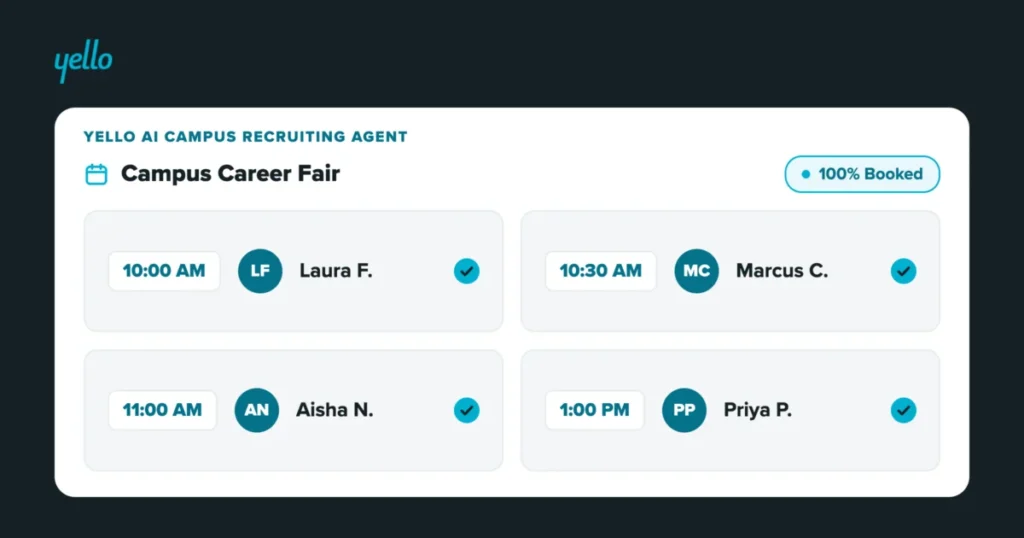
- The New Way: Flipped by Yello’s AI Campus Recruiting Agent: Weeks before the fair, the company leverages AI to identify which students at that specific school align with their open roles, including high-potential individuals who might not have even considered applying traditionally. Their top picks receive personalized invitations to book dedicated interview slots or informational chats at the fair. Recruiters arrive with a pre-populated interview schedule, allowing them to deploy a smaller, more focused team. Their day is spent engaging deeply with pre-qualified, best-fit candidates, while still retaining the capacity to meet new students who express interest at the booth. This strategic approach significantly improves the quality of interactions, accelerates the hiring timeline, and optimizes resource allocation. Moreover, by understanding which events yield the best-fit candidates, organizations can make data-driven decisions to drop unproductive events, further enhancing efficiency and ROI.
The Mechanics of AI-Driven Talent Acquisition: Yello’s Agent in Action
Yello’s AI Campus Recruiting Agent exemplifies how specialized AI can automate the administrative heavy lifting across the entire event workflow, freeing recruiters to focus on the invaluable human aspects of their role. The process unfolds in several interconnected steps:
-
Intelligent Event Setup: The agent streamlines the initial logistical phase by automatically pulling in event information from various external sources (e.g., university career services portals, event management platforms). This eliminates the tedious manual entry of dates, times, locations, and other crucial details, saving valuable recruiter time and reducing the potential for human error. This foundational automation ensures that the event framework is established quickly and accurately.
-
Proactive Candidate Identification and Sourcing: This is where the AI truly transforms the sourcing process. Recruiters load the job descriptions for the roles they aim to fill at the event. The AI agent then performs a comprehensive search, pulling candidate profiles from an extensive array of sources. This includes the company’s internal ATS, its proprietary Yello database, leading early talent platforms like WayUp, and over 45 other diverse sources across the web, collectively encompassing a talent pool of over a billion candidates. This multi-source aggregation ensures a broad and deep search, identifying not only active applicants but also passive candidates who might be an excellent fit but haven’t directly engaged yet.
-
Precision Matching and Prioritization: Once a vast pool of potential candidates is assembled, the AI agent applies sophisticated algorithms to match profiles against the specific requirements outlined in each job description. It identifies key filters such as major, GPA, relevant coursework, project experience, internships, and desired skills. Candidates are then intuitively grouped for recruiter review based on their match quality: "best fit," "good fit," or "partial fit." The agent highlights aligned skills and experiences, providing clear rationale for each match. Crucially, recruiters retain full control, able to chat with the agent to adjust criteria, refine the list, and ensure the selections align precisely with their evolving needs and strategic priorities. This interactive refinement process combines AI’s processing power with human expertise.
-
Automated Engagement and Scheduling: With a prioritized list of best-fit candidates, the AI agent takes over the outreach process. It sends personalized email campaigns using approved templates, inviting candidates to various engagement opportunities—be it an informational session, a casual coffee chat, or a formal interview slot at the upcoming fair. Candidates are then empowered to self-schedule their preferred times in advance, directly into the recruiter’s calendar. This means that recruiting teams arrive at the event with a full interview schedule of pre-qualified, highly interested candidates, eliminating the uncertainty and scramble of traditional walk-in models.
Recruiter Empowerment, Not Replacement
It is paramount to emphasize that this AI-driven approach does not replace the recruiter; rather, it augments their capabilities by eliminating low-value busywork. Recruiters remain firmly in control, reviewing every candidate list, refining match criteria, and approving all outreach communications before they are sent. The essential human elements of recruiting—the engaging conversations at the booth, the in-depth interviews, the art of building rapport, and ultimately, convincing top talent to choose one company over a competitor—remain the exclusive domain of the recruiting team. The AI agent simply clears the administrative clutter, allowing recruiters to dedicate their expertise to these critical, high-impact interactions.
Broader Implications and Future Outlook
The adoption of purpose-built AI in campus recruiting portends a transformative future for early talent acquisition, with several profound implications:
- Quantifiable ROI and Strategic Budgeting: The ability to link specific events to pre-qualified candidates and actual hires fundamentally changes the budgeting conversation. Recruiting leaders can now present concrete data on the effectiveness of each event, allowing for smarter, data-driven investment decisions. This leads to a less spend per hire and a more strategic allocation of resources, ultimately bolstering the business case for campus recruiting efforts. Industry analysts project that companies leveraging such AI solutions could see a reduction of 15-20% in per-hire costs for early talent within the first two years of adoption.
- Enhanced Candidate Experience: From the candidate’s perspective, this new model offers a more respectful and efficient experience. Personalized outreach, targeted opportunities, and pre-scheduled interactions eliminate the frustration of waiting in long lines or feeling like just another face in the crowd. This streamlined process reflects positively on the employer brand, attracting and retaining top talent.
- Competitive Edge in the Talent War: In a fiercely competitive talent market, speed and precision are paramount. By identifying and engaging with top candidates before competitors, companies gain a significant head start, increasing their offer acceptance rates and securing highly sought-after talent.
- Democratization of Opportunity: AI’s ability to source from vast databases and apply objective matching criteria can help companies look beyond traditional target schools or majors. This opens doors to more diverse talent pools, ensuring a broader and more inclusive pipeline, and potentially reaching excellent candidates who might have been overlooked by conventional methods.
- The Evolving Role of the Recruiter: The shift liberates recruiters from mundane administrative tasks, allowing them to evolve into strategic talent advisors and relationship builders. Their focus can pivot towards deeper engagement, candidate advocacy, and crafting compelling employer value propositions, making their role more impactful and personally rewarding. Experts in HR technology suggest this shift is overdue, empowering recruiters to leverage their interpersonal skills and strategic insights more effectively.
- Challenges and Considerations: While the benefits are clear, organizations must also consider data privacy, ensuring ethical AI use, and maintaining continuous human oversight. The goal is to augment human intelligence, not replace it, ensuring fairness and accountability in the recruitment process. University career services departments are generally welcoming of such technological advancements, as they promise to improve the match quality between their students and potential employers, leading to higher student satisfaction and employment outcomes.
The antiquated "show up and hope" model in campus recruiting is rapidly becoming a relic of the past. Purpose-built AI solutions like Yello’s Campus Recruiting Agent are ushering in an era of unprecedented efficiency, precision, and strategic advantage. By transforming the event workflow from reactive chaos to proactive engagement, these technologies are not just optimizing a process; they are fundamentally redefining how companies connect with, assess, and secure the next generation of talent. The math on campus recruiting is changing, promising less spend per hire, better candidates in the room, a significant head start on competitors, and, crucially, ROI that can finally be measured and celebrated. To understand this transformative power fully, organizations are encouraged to explore how the Campus Recruiting Agent can revolutionize their next event, from initial setup to filling their interview schedule with best-fit candidates.