The Historical Evolution of Professional Development
The trajectory of professional training has moved through several distinct eras. In the early 20th century, training was largely observational—apprenticeships and on-the-job shadowing dominated the industrial sector. By the mid-20th century, the "classroom model" became the corporate standard, mimicking academic environments to deliver compliance and technical knowledge.
The 1990s introduced Computer-Based Training (CBT), which offered scalability but lacked the human element, often leading to low completion rates. The most significant turning point occurred in 2020, when the global pandemic forced a massive migration to Virtual Instructor-Led Training (VILT). Today, the industry has entered a "Blended Era," where the efficiency of digital tools is married to the efficacy of human instruction. Current market data suggests that the global corporate training market, valued at over $370 billion, is increasingly pivoting toward these hybrid models to satisfy a workforce that values both flexibility and social connection.
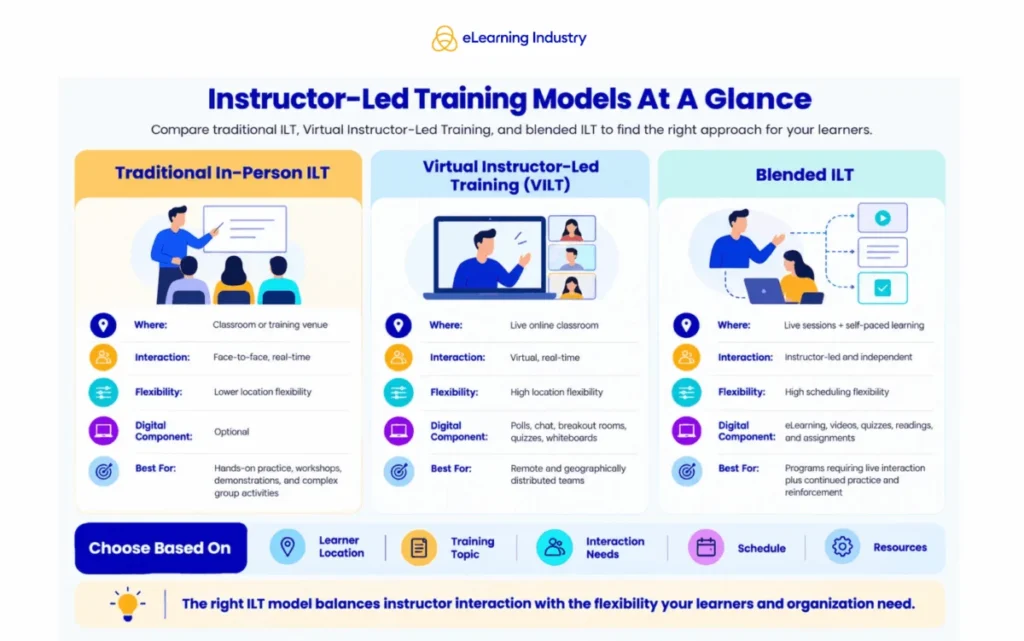
Defining the Primary ILT Models
To understand the current state of corporate L&D (Learning and Development), one must distinguish between the three primary delivery vehicles of instructor-led sessions.
Traditional In-Person ILT
This remains the gold standard for high-stakes, tactile, or interpersonal skill development. In this model, the physical presence of the instructor allows for the reading of non-verbal cues—micro-expressions and body language—that are often lost in digital formats. It is particularly effective for leadership development, where "soft skills" and role-playing require a high degree of psychological safety and immediate physical intervention.
Virtual Instructor-Led Training (VILT)
VILT leverages video conferencing and collaborative software to replicate the classroom experience online. Unlike self-paced eLearning, VILT is synchronous. It allows a subject matter expert (SME) in London to train a cohort of engineers in Singapore and San Francisco simultaneously. The primary advantage here is the removal of geographical barriers while maintaining the "live" nature of the instruction.
Blended ILT (The Hybrid Approach)
The blended model is increasingly viewed by HR leaders as the most sustainable strategy. It utilizes a "flipped classroom" philosophy: learners consume foundational knowledge (definitions, history, basic facts) through asynchronous digital modules before attending a live session with an instructor. This ensures that the expensive "live time" is dedicated to high-level analysis, problem-solving, and Q&A rather than rote lecturing.
Supporting Data: The Case for Human Instruction
Recent industry reports from organizations like LinkedIn Learning and the Association for Talent Development (ATD) highlight a growing preference for instructor-led formats. According to 2023-2024 benchmarks, employees are 25% more likely to retain information when it is delivered in a social, interactive environment compared to isolated digital reading. Furthermore, "social learning"—the process of learning from others—accounts for roughly 20% of the knowledge employees gain at work, according to the 70-20-10 model.
Data also indicates a direct correlation between ILT and employee engagement. Organizations utilizing robust VILT programs report a 15% higher employee satisfaction rate regarding professional development opportunities. This is largely attributed to the "real-time interaction" factor, which reduces the sense of isolation often felt in remote work environments.

Strategic Benefits of Modern ILT
The decision to invest in ILT over cheaper, static alternatives is driven by several critical business advantages:
- Immediate Feedback Loops: In a live setting, an instructor can immediately correct a misunderstanding before it becomes an ingrained habit. This is vital in sectors like healthcare or aviation, where technical accuracy is non-negotiable.
- Adaptive Pedagogy: A skilled instructor can "pivot" mid-session. If a group of learners is struggling with a specific concept, the instructor can spend an extra thirty minutes on that topic, skipping over sections the group has already mastered.
- Complex Topic Simplification: Abstract concepts, such as ethical decision-making or complex software architecture, often require the "Socratic method"—a dialogue of questions and answers that only a live instructor can provide.
- Cost-Effective Scaling via VILT: While traditional ILT involves significant travel and venue costs, VILT offers a middle ground. It provides the human touch of a trainer without the $2,000-per-head price tag associated with flying a team to a central hub.
Addressing the Challenges of Digital Fatigue
Despite its benefits, ILT is not without its hurdles. The most prominent challenge in the current climate is "Screen Fatigue." As employees spend the majority of their day in virtual meetings, adding a three-hour VILT session can lead to cognitive overload and diminished returns.
Furthermore, the "Knowledge Gap" among facilitators is a growing concern. A subject matter expert who excels in a physical classroom may struggle to manage the technical aspects of a virtual room—such as managing breakout sessions, monitoring a chat feed, and troubleshooting audio issues simultaneously. This has led to the emergence of the "Virtual Producer" role, a technical assistant who supports the instructor, allowing them to focus entirely on the pedagogy.
Engineering the Effective Virtual Experience
Designing a VILT session requires a different architectural approach than traditional classroom planning. The "Rule of Ten" is often cited by instructional designers: every ten minutes, there must be a change in the "state" of the learner. This is achieved through:
- Interactive Polls: Used to gauge sentiment or test knowledge in real-time, keeping the learner’s hand on the mouse and their mind on the content.
- Breakout Rooms: Small groups (3-5 people) are moved into private digital spaces to solve a specific problem. This forces active participation from those who might otherwise remain silent in a large group.
- Whiteboarding: Tools like Miro or integrated platform whiteboards allow for collaborative brainstorming, making the learning visual and participatory.
Official Responses and Industry Implications
Leading L&D officers from Fortune 500 companies have recently signaled a move toward "high-touch" training as a retention tool. In various industry forums, HR executives have noted that in an era of Generative AI, where basic information is available at the click of a button, the role of the instructor is shifting from "Information Provider" to "Insight Facilitator."
The implication for the workforce is clear: technical skills are becoming commodities, but the ability to apply those skills within a specific corporate culture—a nuance taught best by internal instructors—is becoming the new competitive advantage. Analysts suggest that companies that abandon instructor-led models entirely in favor of automated "AI-only" training may see a decline in cultural cohesion and long-term skill mastery.
Selecting an ILT Provider: A Fact-Based Framework
For organizations looking to outsource their training, the selection process has become increasingly rigorous. Decision-makers are no longer just looking at content; they are evaluating:
- Platform Compatibility: Does the provider’s software integrate with the existing Learning Management System (LMS) for seamless tracking and reporting?
- Facilitator Pedigree: What is the real-world experience of the trainers? Modern learners reject "academic" trainers in favor of "practitioner" trainers who have faced the same workplace challenges.
- Post-Session Support: The "Forgetting Curve" suggests that humans lose 70% of new information within 24 hours if it is not reinforced. Top-tier ILT providers now offer "nudges," micro-learning follow-ups, and recorded "highlight reels" to combat this.
Conclusion: The Enduring Value of the Human Element
The evolution of Instructor-Led Training demonstrates that while technology can change the delivery of education, it cannot replace the psychology of education. The direct interaction, the ability to ask "why," and the shared experience of a live cohort remain the most effective ways to drive meaningful behavioral change in a corporate environment. As VILT and Blended models continue to mature, the focus will likely shift toward even greater personalization, leveraging data to ensure that every instructor-led minute provides maximum value to both the employee and the enterprise. Organizations that master this balance will be best positioned to navigate the rapid skill shifts of the 21st-century economy.